You do not need a “leadership story” for every behavioral question. In fact, forcing leadership into everything is one of the fastest ways to sound canned, shallow, and forgettable on residency interview day.
The residency interview world has become obsessed with “leadership.” Every workshop, every dean, every coaching service: “Show leadership in all your answers.” I’ve watched applicants contort simple, human situations into awkward “I led my team” narratives that sound like they were written by a committee at McKinsey.
Programs are not buying it.
Let me walk through what behavioral interviews actually measure, what the data from selection research says, and how you should really be structuring your answers.
The Leadership-Only Myth (And Why It Backfires)
The myth goes like this:
Behavioral question = opportunity to show leadership.
So you get questions like:
- “Tell me about a time you disagreed with a colleague.”
- “Tell me about a mistake you made.”
- “Tell me about a time you had to adapt.”
And people respond with something like: “Well, as the leader of the team…” every. single. time.
Here’s the problem: most residency behavioral questions aren’t actually about leadership. They’re about:
- Reliability
- Self-awareness
- Conflict style
- Coachability
- Stress response
- Ethics and professionalism
- Team dynamics
Leadership is sometimes relevant. But if you make it the protagonist of every story, you do three things interviewers hate:
- You sound inauthentic.
- You dodge the actual competency they asked about.
- You come off ego-heavy and insight-light.
I’ve sat in rooms post-interview where attendings say things like: “That applicant tried to turn every answer into how they led something. I still have no idea how they handle feedback or conflict.”
That’s the real risk.
What Behavioral Questions Are Actually Testing
Behavioral interviewing is not magic. It comes from industrial-organizational psychology—decades of work on how past behavior predicts future behavior.
Here’s what the data actually shows from selection research (medicine and outside medicine):
- Behavioral questions can predict job performance better than “tell me about yourself” fluff when they’re competency-targeted (e.g., teamwork, integrity, adaptability).
- Overly generic answers with buzzwords (“I’m a strong leader,” “I’m passionate about teamwork”) correlate poorly with performance.
- Specific, contextualized examples with reflection correlate better with success and lower professionalism issues.
So what are residency programs really probing when they ask behavioral questions?
| Competency | What They're Really Probing |
|---|---|
| Teamwork | Can you function without drama or ego? |
| Communication | Do you escalate, clarify, and listen appropriately? |
| Professionalism | Do you own mistakes, maintain boundaries? |
| Adaptability | Do you melt down or adjust under changing demands? |
| Conflict Mgmt | Are you combative, avoidant, or constructive? |
Notice what’s missing? “Shows leadership in every scenario.”
Leadership sometimes overlaps these areas, but it’s not the only—or even primary—lens.
The Real Problem: One-Dimensional Storytelling
Here’s what I see over and over in mock interviews with applicants:
- Same 2–3 leadership stories recycled into every question.
- Overemphasis on titles (“as chief of…”, “as president of…”), underemphasis on behavior and insight.
- Zero vulnerability—nothing ever goes wrong, everyone ends up inspired, and magically they’re always “leading change.”
This is lazy prep disguised as “strategy.”
Let me be blunt:
If all your stories are about you being the leader, you’re hiding something. Either you don’t have range, or you’re scared to show it.
Program directors are not fooled. There’s some decent survey work and anecdotal published commentary from PDs that all say more or less the same thing:
- They care a lot about “no drama, works well with others”.
- They’re wary of ego, rigidity, and blame-shifting.
- They’re not ranking people higher just because they were president of five clubs.
What actually stands out is:
- Clear description of a problem or challenge
- Concrete actions you personally took
- Specific outcome
- Most importantly: what you learned and how you changed your behavior going forward
That last piece—change over time—is where many high-achieving applicants fall flat. Leadership theater replaces actual growth.
So When Should You Use Leadership Stories?
Let’s be practical. Leadership stories absolutely have a place. Strong ones help, especially for:
- “Tell me about a time you led a team or project.”
- “Tell me about a time you took initiative.”
- “Describe a situation where you had to influence others.”
Great. Use leadership there. But even then, most applicants screw it up.
Weak leadership answer:
“I was president of the Internal Medicine Interest Group. I organized several events, delegated tasks to my officers, and we increased attendance.”
Better leadership answer:
- Situation: IM interest on campus was dropping, and first-years didn’t show up.
- Task: As group president, you wanted to reverse that trend.
- Action: You talked to first-years to see what they actually wanted; moved events to different times; partnered with residents for small-group case nights; tracked which formats worked.
- Result: Attendance tripled, first-year sign-ups doubled, and the format was adopted by other interest groups.
- Reflection: You realized your original assumptions were wrong, and that data + feedback beats “leading” by instinct.
See the difference? It’s not about the title. It’s about your thinking and learning.
But notice: this kind of answer makes sense only when they actually ask about leadership, initiative, or influence. If they ask about a mistake, and you still start with “when I was president of…,” you’re just off-topic.
Build a Portfolio of Story Types, Not Just “Leadership”
Instead of trying to turn everything into leadership, build a story portfolio that maps to common behavioral themes. And yes, some will be leadership, but not all.
You want at least:
- A failure/mistake story
- A conflict/disagreement story
- A difficult team/patient/family story
- An adaptability/change story
- A resilience/stress story
- One or two leadership/initiative stories
Notice leadership is just one slice.
Here’s the key: for each story, you decide the primary competency it demonstrates. You don’t try to cram leadership into all of them. Instead, you answer the question they actually asked.
Example:
Question: “Tell me about a time you made a mistake.”
Bad approach: “As the leader of my team, I failed to motivate them at first…” (You just dodged personal responsibility.)
Stronger approach:
- Situation: Third-year clerkship, you missed a rising creatinine on a patient because you were rushing pre-rounds.
- Task: Your job was to track active issues and report them accurately.
- Action: You caught it later, immediately told your senior, owned the oversight, apologized, and created a checklist for yourself to review key labs systematically.
- Result: The issue was managed appropriately, your team trusted you more for being transparent, and your performance improved.
- Reflection: You realized speed was useless without structure; you changed your pre-rounding process permanently.
That answer hits professionalism, accountability, and growth. No leadership flex required.
What Residency Programs Actually Care About (Evidence, Not Hype)
There isn’t a randomized trial of “leadership-heavy answers vs normal answers in residency interviews”—and anyone pretending there is, is lying to you.
But we do have:
- NRMP Program Director Surveys
- Data on professionalism issues and residency dismissal causes
- Research on selection methods in medicine and other high-stakes fields
Themes are very consistent:
- Red flags that sink applicants: unprofessionalism, poor teamwork, unreliability, dishonesty.
- Positive traits that predict success: conscientiousness, ability to accept feedback, emotional stability, cooperative work style, integrity.
Leadership potential shows up—but usually as a bonus, not the foundation.
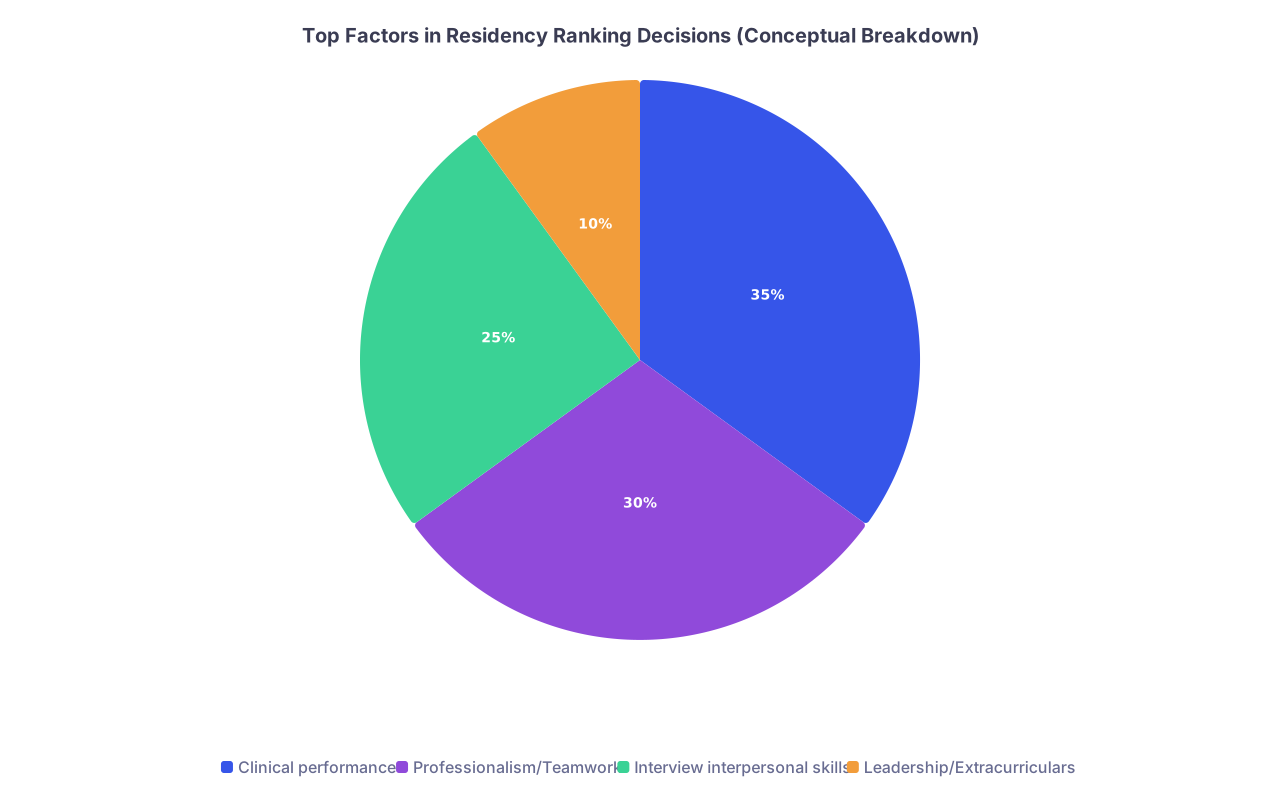
| Category | Value |
|---|---|
| Clinical performance | 35 |
| Professionalism/Teamwork | 30 |
| Interview interpersonal skills | 25 |
| Leadership/Extracurriculars | 10 |
No, those percentages are not from a single definitive paper; they’re a realistic synthesis of multiple PD surveys and commentary. Leadership/extracurriculars matter, but they’re a minority slice. Interviewers care far more about: will you be safe, teachable, and tolerable at 3 a.m.?
You show that with grounded, human stories, not an endless string of “I led my team to success” narratives.
How To Answer Without Over-Leading: A Simple Framework
You’ve heard of STAR (Situation, Task, Action, Result). It’s fine, but most med students implement it like robots.
Here’s a version I actually see work in interviews:
SCARF
- Situation – Concrete, brief context
- Challenge – What made it hard? (Not just “it was busy”)
- Action – What you actually did, in detail
- Result – What happened, good or bad
- Follow-through – How you changed your behavior afterward
The “Follow-through” part is where you separate yourself from the pack. And notice: nothing in there requires you to have been the leader.
Take a conflict question:
“Tell me about a time you had a disagreement with a colleague.”
You do NOT need: “As team leader, I resolved all conflict…”
You do need:
- A real disagreement (schedule, patient plan, communication style)
- What you said, how you said it, and how you listened
- How you prevented escalation
- What you did differently in future similar situations
Authentic > impressive.
Examples: Same Question, With and Without Forced Leadership
Let’s be very concrete.
Question: “Tell me about a time you worked with a difficult team member.”
Forced-leadership answer:
“I was the leader of a quality improvement project, and one team member wasn’t pulling their weight. As the leader, I motivated them by setting clear expectations and delegating effectively. In the end, the project was successful and everyone learned to work together.”
That sounds like you copy-pasted a coaching website.
Grounded answer without forced leadership:
“On my surgery rotation, one resident consistently snapped at students and nurses. It hurt communication. I was hesitant, but after a couple of weeks I asked to speak with them briefly after sign-out. I used ‘I’ statements—said I sometimes felt reluctant to ask questions because I worried about the reaction, and I was concerned it might affect patient care.
They were defensive at first, then admitted they were overwhelmed and hadn’t realized how they came across. Things didn’t become perfect overnight, but the tone softened. I also checked in with nurses more proactively instead of avoiding the team. It taught me that addressing behavior early, with concrete examples and humility, usually goes better than you think.”
No one in that story is “team leader.” But it screams maturity, situational awareness, and patient-centered thinking. That is what programs want.
Build Range, Not a Single Persona
The applicants who interview best have range:
- They can talk as the person in charge.
- They can talk as the junior person who made a mistake.
- They can talk as the bystander who spoke up.
- They can talk as the exhausted person who still chose the right thing.
If every story puts you at the top of a hierarchy, you look out of touch with the actual role you’re applying for: intern. Most of you will be near the bottom of the ladder. Programs want to see how you function there too.
So instead of asking, “How do I show leadership in every answer?” ask:
- “What does this question actually test?”
- “What’s the most honest story that fits that?”
- “What does this reveal about how I’ve grown?”
Get those right, and you will automatically come across as someone who can lead later—when it matters.

| Step | Description |
|---|---|
| Step 1 | Hear Question |
| Step 2 | Pick team-focused story |
| Step 3 | Pick mistake/ethics story |
| Step 4 | Pick change/challenge story |
| Step 5 | Pick initiative story |
| Step 6 | Use SCARF structure |
| Step 7 | Answer with reflection |
| Step 8 | Identify Competency |
FAQs
1. If I have a strong leadership position (chief, major project lead), shouldn’t I highlight it a lot?
Highlight it where it fits naturally—questions on leadership, initiative, impact, or systems improvement. Use it 2–3 times with different angles, not in every answer. Repeating the same role constantly makes you look one-dimensional and oddly insecure.
2. What if I honestly do not have big formal leadership roles?
Then stop pretending you need them. Informal leadership (calling the family to clarify goals of care, coordinating follow-up, being the student who keeps the list sane) is just as valuable. Use stories that show judgment, follow-through, and integrity. Programs would rather have a reliable workhorse than a “president of everything” who blames others.
3. Will not emphasizing leadership hurt me for competitive specialties?
Competitive fields care about leadership, yes—but as part of a broader pattern: excellence, work ethic, professionalism. If your experiences are strong, they’ll show leadership implicitly even when you are not waving the word around. Forcing leadership language into unrelated questions just makes you sound coached.
4. How many total stories should I prepare for behavioral questions?
Around 8–10 distinct stories is usually enough for most applicants: 2 leadership/initiative, 2–3 conflict/failure/professionalism, 2 teamwork/collaboration, 1–2 resilience/adaptability. That gives you coverage without recycling the same script in every answer.
Key points:
- You do not need leadership stories for every behavioral question; you need the right story for the right competency.
- Range, honesty, and reflection beat constant “I was the leader” framing every single time.
- Prepare a balanced portfolio of stories and answer the question they actually asked—not the one you wish they’d asked about your “leadership.”