
The way most applicants answer “Tell me about yourself” quietly kills their chances before the interview has even started.
I’m going to tell you what program directors and faculty actually hear in their heads when you start talking. Not what they say out loud. What they’re writing down. What they’re texting the chief about after you walk out of the room.
Because this question is not small talk. It’s the calibration question. It sets your “ceiling” for the rest of the interview. Get it wrong and every answer after that is graded on a curve—downward.
Let’s pull back the curtain.
What This Question Really Tests (That No One Explains To You)
When you hear “Tell me about yourself,” you think: biography, background, context.
When we ask it, we’re testing four very different things:
- Can you filter?
- Do you understand the role you’re applying for?
- Are you someone I’ll regret putting on call at 2 a.m.?
- Do you have a coherent professional identity, or are you just a pile of bullet points?
Here’s the behind-the-scenes translation.
When you answer, attendings are silently scoring you on:
- Judgment: Do you know what’s relevant for a residency interview and what’s filler?
- Structure: Can you organize information clearly without rambling?
- Self-awareness: Do you see yourself the way others see you clinically, or are you in fantasy-land?
- Fit: Do you sound like someone who will actually work in this environment, not just chase prestige?
No one tells you that. They tell you “have a 60–90 second answer and be confident.” That advice is half-baked. I’ve watched strong candidates sink themselves with “practiced” answers that told me exactly the wrong things.
Let me walk you through the most common styles we see, and what we’re actually hearing.
The Six Common Answers – And The Silent Translation
1. The Chronological Life Story
“Sure. So I was born in Chicago, my parents are both engineers, and growing up I always liked science. In high school I played soccer and volunteered at the hospital, and that’s really what drew me to medicine. Then in college at Northwestern I majored in biology and…”
On the surface? Harmless. In the room? Here’s what we’re hearing:
- You cannot prioritize information.
- You default to autobiography when a simple professional summary is needed.
- You did not prepare thoughtfully; you recycled your med school interview script.
A PD I know in IM actually wrote this once on an eval sheet: “Still in high school mentally.” The student had a 260+ Step 2. Didn’t get ranked.
If your answer sounds like a LinkedIn “About” section crossed with your AMCAS personal statement, you’ve already told us you’re not thinking like a resident. Residents don’t start sign-out with, “So I grew up in Ohio…”
We want: present-focused, residency-relevant, concise. Your childhood is only relevant if it directly ties to how you function now in a concrete way. Which it usually doesn’t.
2. The CV Recitation
“So I went to undergrad at UCLA where I majored in neuroscience, then I did a year of research at the NIH working on epilepsy. Then I started medical school at X, where I’ve been involved in the student-run free clinic, I’m in the global health track, I’ve done a couple of research projects including one on heart failure outcomes that was accepted to ACC…”
Translation in faculty brain:
- “This person doesn’t understand we’ve already read their CV.”
- “They think accomplishments are a personality.”
- “There is no narrative here. Just flexing.”
The unspoken question we’re always asking: “Who will you be on the wards with me?” Nothing in a CV dump answers that.
One PD in surgery put it bluntly in a meeting: “If I need to interrogate ERAS to find your humanity, you’re already behind.”
We want: how your path shaped you as a colleague, learner, and resident—not a second reading of ERAS.
3. The Personality Monologue
“I’d say I’m an easygoing person. I really value teamwork, and my friends would describe me as the glue in the group. Outside of medicine, I love hiking, I play guitar, and I’m really into coffee—like I roast my own beans…”
You think you’re being “well-rounded.” Here’s what we hear:
- Vague traits with zero evidence. Everyone says they’re a team player.
- Social fluff with no clinical anchor.
- You’re trying to be liked instead of respected.
Is some personal color good? Yes. But here’s the ugly truth: most PDs have been burned more by “charming” residents than by quiet grinders. So if all we get is “fun, chill, outdoorsy” vibes, we’re worried: do you actually work?
A PD once wrote beside an eval: “Seems fun. Not sure they realize this is a job.”
You need to connect personality to professional behavior. Otherwise you sound like a dating profile.
4. The Trauma Dump
“My journey to medicine has been a bit unconventional. My father had a stroke when I was in college, and I spent a lot of time in ICUs and rehab facilities, which really opened my eyes. Then during COVID my family was hit pretty hard financially and I…”
Let me be very clear. Your hardships matter. But interviews are not therapy, and some applicants cross that line hard.
What we hear when this goes wrong:
- Emotional boundaries might be loose.
- You may need support we cannot realistically provide during a brutal intern year.
- We’re now walking on eggshells in the interview, which makes us less likely to probe your weaknesses honestly.
One associate PD said after such an answer: “I’m worried we’d be adopting a crisis, not a resident.”
Brutal? Yes. But real.
You can mention adversity. Briefly. Framed. Tied to qualities that show resilience, not raw, active wound.
5. The “Identity Cloud”
“So I’m interested in a lot of things—global health, medical education, maybe critical care down the line. I’ve always loved systems-level thinking and quality improvement, but I’m also very patient-centered. I’m kind of still figuring out what exact niche I want, but I’m very open.”
Translation:
- No clear professional identity yet.
- Might be directionless, easily pulled by every shiny opportunity.
- Will sign up for everything, complete nothing.
Programs hate residents who are “very interested” in twelve things but can’t close the loop on notes, QI projects, or research. This answer sounds like that.
A smart PD phrase I heard in a ranking meeting: “Are they a vector or just Brownian motion?” In other words: do you move in a direction, or just buzz around?
You don’t need a 10-year plan. But you do need a coherent present: “Right now, here’s who I am and where I’m pointed.”
6. The Over-Rehearsed Performance
These are the answers you practiced in a mirror, rewrote 17 times, and memorized.
“I’d describe myself as someone at the intersection of clinical excellence, humanism, and innovation. Growing up in a multicultural household taught me the value of diverse perspectives…”
You hit all the buzzwords. You keep perfect eye contact. You sound…fake.
We hear:
- You care more about image than authenticity.
- We’ll have to work hard to get honest answers from you.
- Under pressure, you’ll default to performance instead of truth.
Most faculty have a visceral allergy to “polished but slippery” people. They’ve seen what that looks like in PGY2 when things go wrong: lots of excuses, no ownership.
An honest, slightly rough answer beats a glossy TED Talk 100 times out of 100.
What They Want To Hear In That First 60–90 Seconds
Program directors rarely say this outright, but there are four questions they’re really trying to answer with “Tell me about yourself”:
- Who are you as a resident-in-formation, not as an undergrad, not as a child?
- Where do you fit in the ecosystem of this specialty and maybe our program?
- How do you think and talk about your work?
- Are you grounded in reality or selling a story?
So what does a good answer actually sound like?
It usually has this skeleton (flexible, not a script):
- Present: Who you are right now as a senior med student / preliminary year, in a way that’s anchored in clinical identity.
- Path: Two or three key experiences that shaped how you function as a trainee, not every stamp in your passport.
- Direction: The kind of resident you want to be and a general sense of where you’re heading.
- Person: A touch of human detail that hints at how you’ll be to live/work with.
Notice what’s missing: childhood, full CV scan, vague adjectives.
Let me show you what PDs actually respond to.
Hearing It Through a PD’s Ears: Good vs Mediocre

Here’s a mediocre answer I’ve heard versions of hundreds of times (internal medicine applicant):
“Sure. So I grew up in Texas, then went to UT Austin for college where I studied biology and Spanish. I’ve always liked science and working with people, so medicine was a natural fit. In medical school I’ve really enjoyed my internal medicine rotation and sub-I, and I’ve been involved in research on heart failure readmissions that I presented at a regional conference. Outside of medicine, I like running, watching basketball, and trying new restaurants with friends.”
What we hear:
- Safe, generic.
- Nothing risky, but nothing that sticks.
- Could describe 300 people in the applicant pool.
Now, here’s a stronger version of the same person:
“I’m a fourth-year at UT Southwestern, and over the last couple of years I’ve really grown into the role of the ‘medicine person’ on the team—the one who enjoys puzzling through complex patients and making sure nothing falls through the cracks.
I started med school thinking I might do EM, but during my third-year IM rotation I found I loved the longer-term relationships and the intellectual depth of caring for patients with multiple chronic illnesses. Since then I’ve done a sub-I on the wards and a month in the CCU, where I realized I’m particularly interested in cardiology and the care transitions side of things—how we set patients up to succeed once they leave the hospital. That led to a small QI project on improving follow-up for heart failure discharges, which we implemented on one of our teams and cut our no-show rate in half over a couple of months.
As a resident, I see myself as the person who’s steady on call, teaches the students, and quietly makes the team better. Outside the hospital, I run a lot—half-marathons mostly—which keeps me sane during busy stretches, and I’m usually the one organizing post-call breakfast for my classmates.”
What a PD hears in that:
- Identity: “medicine person,” “steady on call,” “teaches the students.” That’s gold.
- Evidence-based: specific sub-I, CCU month, concrete QI outcome.
- Orientation toward systems and follow-up = reliable, detail-oriented.
- The running and organizing breakfast? Signals coping skills and social glue, not just “I like Netflix.”
No theatrics. Just a clean, professional self-portrait.
The Hidden Scoring Rubric: What We Jot Down While You Talk
You think people are just nodding politely. Look at interview sheets from actual programs and you’ll see quick judgments being formed in that first question.
Here’s how that usually looks behind closed doors.
| Dimension | Red Flag Example | Green Flag Example |
|---|---|---|
| Focus | Childhood, high school sports, family biography | Current clinical identity and recent experiences |
| Structure | Rambles, no clear beginning or end | Clear start, middle, end within 60–90 seconds |
| Self-awareness | Overinflated, all “strengths,” no nuance | Grounded, specific, realistic picture |
| Professionalism | Inappropriate personal detail, oversharing | Brief, framed mention of adversity (if relevant) |
| Fit / Likeability | Generic, impossible to remember after 10 minutes | Distinct, specific traits tied to residency role |
After you leave, someone says, “What did you think?” Nobody repeats your exact words. They say things like:
- “She seems grounded. I’d trust her on nights.”
- “Nice guy but still in undergrad mode.”
- “High achiever, but something felt…plastic.”
- “Quiet, but there’s a real adult in there.”
Your answer gives us those labels. Fast.
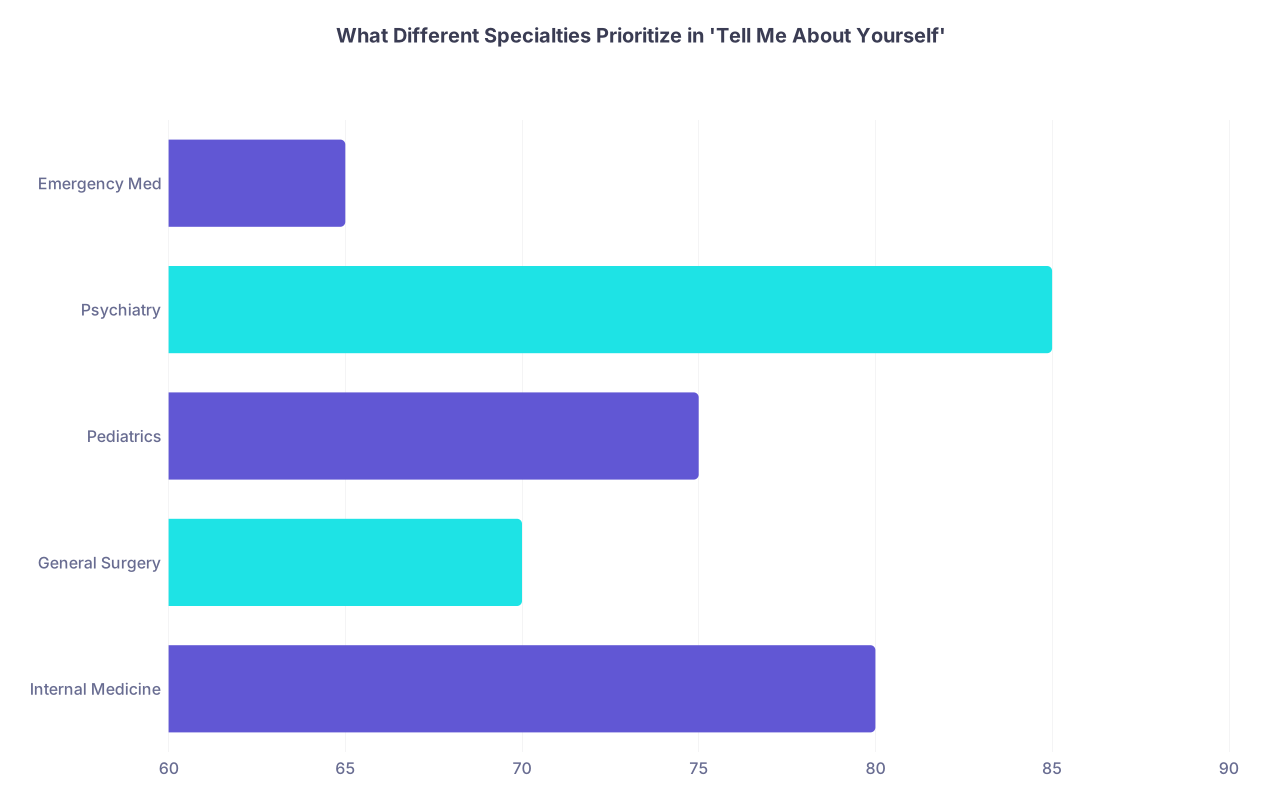
The Specialty Twist: How Different Fields Hear You
| Category | Value |
|---|---|
| Internal Medicine | 80 |
| General Surgery | 70 |
| Pediatrics | 75 |
| Psychiatry | 85 |
| Emergency Med | 65 |
The question is the same, but the subtext is not identical across specialties.
Internal Medicine
They’re listening for: thoughtfulness, curiosity, systems thinking, longitudinal mindset.
If you lean too hard into adrenaline or procedures without any sign of enjoying complexity and follow-up, they quietly mark you as a poor IM fit. You don’t have to say “I love differential diagnoses,” but something in that direction helps.
Surgery
They want grit, ownership, and team orientation.
A surgery PD hearing you emphasize “work-life balance” and hobbies for half your answer is thinking, “They’ll burn out or resent the hours.” But if you talk about loving being “the person who stays until the job is done,” now you’re speaking their language.
Pediatrics
They listen for warmth without naivety.
If your entire answer is “I just love kids, they’re so cute,” it sounds shallow. They want to hear that you can connect and tolerate parents, chronic illness, and often under-resourced systems.
Psychiatry
They’re clocking your insight and boundaries.
A vague or meandering answer is a red flag. A trauma-saturated answer without clear boundaries is worse. If you can talk about your own experiences and motivations with reflection and containment, you score high.
EM
They like focus, calm, and adaptability.
If your answer paints you as scattered or indecisive, bad look. If you sound like the person who can stay organized and functional in chaos? That lands.
The Adversity Trap – And How To Talk About It Without Sinking Yourself

Let me go back to the trauma dump, because this is where a lot of applicants misunderstand the hidden rules.
Programs absolutely value resilience. First-gen students, caregivers, people who worked through school—these are real positives. But they want digested adversity, not raw.
Here’s how the bad version sounds:
“I suffered from severe depression during my second year and had to take a leave. It was a really dark time in my life and I wasn’t sure I would ever come back to medicine…”
Now the room is tense. We’re wondering if you’re stable right now, whether you’ll crumble under Q4 call, whether you’re going to need frequent time off.
Here’s a stronger, still-honest version:
“During my second year, I went through a period of significant depression that led me to take a structured leave of absence with the support of my school. I worked with a therapist, made some concrete changes in how I approach stress and support, and when I returned I was actually more consistent and effective than before—my clerkship year was my strongest academically and clinically. That experience is a big part of why I pay attention to the wellbeing of people around me on the team, but I also recognize residency is intense and I’ve built systems that have been working for me for several years now.”
Now what we hear:
- Insight.
- Growth.
- Time-tested coping, not brand new.
- You’re not asking us to be your savior; you’re telling us who you are now.
Same story. Very different risk signal.
How To Build Your Own Answer (Without Sounding Scripted)

| Step | Description |
|---|---|
| Step 1 | Start |
| Step 2 | Define current clinical identity |
| Step 3 | Pick 2-3 shaping experiences |
| Step 4 | Decide on general direction or interests |
| Step 5 | Add 1 brief personal detail |
| Step 6 | Speak it out loud & cut fluff |
| Step 7 | Refine for 60-90 seconds |
Do not memorize sentences. Memorize anchors.
You want 3–4 anchor points you can hit in any order without sounding robotic.
For example, your anchors might be:
- “Fourth-year at X, drawn to complex inpatient medicine and being the ‘organizer’ on the team.”
- “Key shaping experience: sub-I on wards where you realized you like running the list and teaching juniors.”
- “Current direction: interested in hospitalist path and maybe QI/education.”
- “Brief human detail: distance running and being the unofficial planner for class events.”
From that, each delivery will sound a little different. That’s good. That’s human.
You should be able to answer the question in 45 seconds if interrupted, or stretch to 90 if they’re nodding and engaged. If it takes you 2+ minutes, you’re overindulging.
Here’s a simple rule insiders actually use:
If I can’t summarize you in one sentence to another faculty member after you leave, your answer failed.
You want to give us that sentence.
“Quiet but solid future hospitalist who loves running the team.”
“EM-bound, calm in chaos, prior EMT.”
“Psych-leaning, very reflective, former teacher.”
If you don’t shape that line, we will. And you may not like the version we write.
The One Thing You Must Avoid: Sounding Interchangeable

Here’s the harsh truth from selection meetings you never see.
By the time we’re splitting hairs between you and 20 other strong applicants, the comments on the screen look like this:
- “Nice. Nothing special.”
- “Strong on paper. Interview fine.”
- “Good answer to TMAY, clear sense of self.”
- “Seemed generic.”
Who gets moved up the rank list? Not the person with the highest Step score. The person we remember and feel some confidence predicting.
Your answer to “Tell me about yourself” is the first (and sometimes only) chance to escape the generic pile.
So avoid:
- Stock phrases: “I’ve always loved science and working with people.” (Everyone says this.)
- Empty labels: “hard-working, team player, passionate.” Prove it or skip it.
- Overly quirky hooks: starting with “A fun fact about me is…” can work in med school interviews; in residency, it often lands as immature.
You don’t need to be dramatic. You need to be specific.
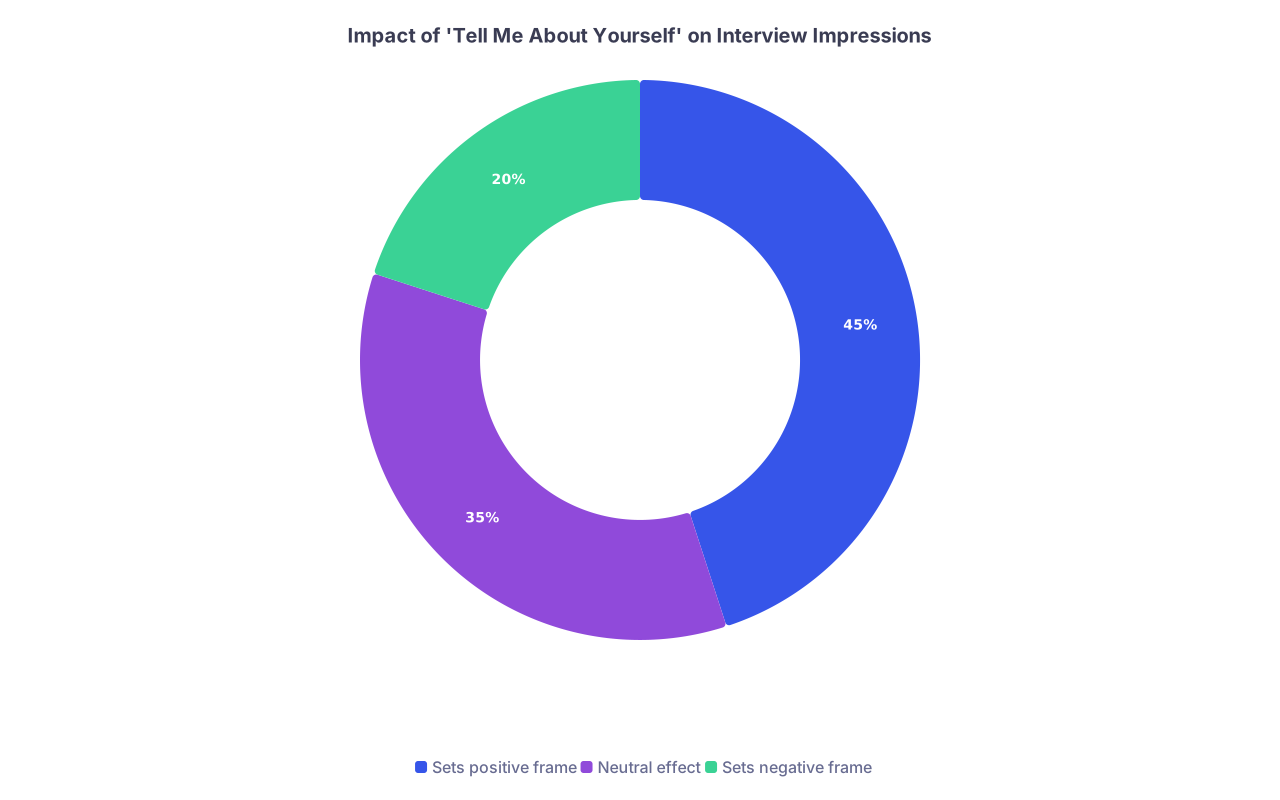
Final Reality Check
| Category | Value |
|---|---|
| Sets positive frame | 45 |
| Neutral effect | 35 |
| Sets negative frame | 20 |
Here’s the line most people never hear from the other side of the door:
“I knew in the first two minutes whether I was fighting for them or just letting the rest of the interview happen.”
That “first two minutes” is almost always your answer to “Tell me about yourself.”
So your job is not to impress. It’s to give us a clean, accurate, compelling snapshot of who you are as a near-resident.
Three things to walk away with:
- Treat “Tell me about yourself” as a professional identity question, not a biography prompt.
- Build a concise, present-focused answer with specific anchors that show how you function on a team and where you’re headed.
- Aim to make it easy for a PD to summarize you in one honest, memorable sentence when you leave the room.
Do that, and you’ll be shocked how many interviews suddenly feel like conversations with future colleagues instead of interrogations.