
How Faculty Test Your Professionalism With One Behavioral Question
It’s 2:37 p.m. You’re on your third interview of the day. You’ve already talked about research, “why this program,” and your greatest strength. Then one of the older faculty leans back, folds his arms, and drops it:
“Tell me about a time you had a conflict or disagreement with someone on your team.”
You start talking about a group project in M1… and I can tell you right now, you probably just failed the professionalism screen.
Let me tell you what’s really going on behind that one “simple” behavioral question.
The One Question That Outs You In 30 Seconds
There are many versions, but they all live in the same family:
- “Tell me about a time you had a conflict with a colleague or attending.”
- “Describe a difficult interaction you had with a nurse or staff member.”
- “Tell me about a time you received criticism you thought was unfair.”
- “Tell me about a time you made a mistake and how you handled it.”
Programs don’t ask these because they love stories. They ask them because they’re the fastest, most reliable way to expose:
- Blame tendencies
- Entitlement
- How you talk about people when they’re not in the room
- Whether you actually self-reflect or just say you do
On many rank lists, there’s a quiet column nobody tells you about: “Professionalism concern?” It’s binary. Yes or no. One bad answer here, and you land in the “No” column. You’ll never know it happened.
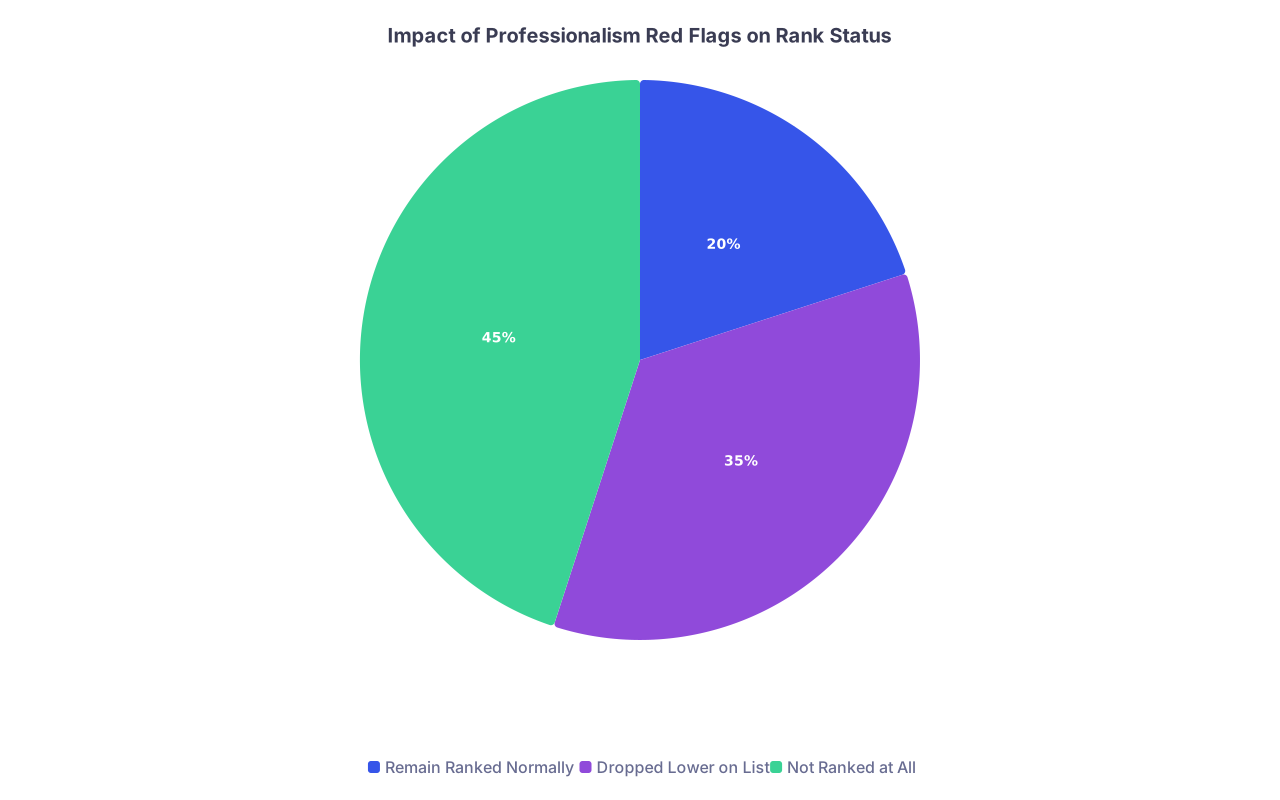
| Category | Value |
|---|---|
| Remain Ranked Normally | 20 |
| Dropped Lower on List | 35 |
| Not Ranked at All | 45 |
Those numbers are not fantasy. In private post-interview meetings, I’ve watched faculty go from “seems solid” to “do not rank” off a single story that revealed entitlement or lack of ownership.
What Faculty Are Secretly Scoring When You Answer
Nobody tells you the scoring rubric, so I will. When you start answering that conflict/criticism/mistake question, here’s what’s running silently in the room.
1. Do you throw people under the bus?
The fastest way to lose the room is to blame:
- “The nurse wouldn’t listen…”
- “The attending was just old-school and wouldn’t change…”
- “My co-intern was lazy and I had to do everything…”
You think you’re describing them. We hear you describing yourself.
Because here’s the thing: in residency, we will eventually be the target of that story. If you casually trash nurses, staff, or other residents in an interview — where you’re on your absolute best behavior — we assume that’s your default setting.
What gets you killed:
- Vague “everyone else was incompetent” vibes
- “I was right, they were wrong” narrative
- Retelling the story to make yourself the hero-victim
I’ve sat in debrief meetings where someone said, “He really dislikes nurses. Did you catch that?” and that alone sank his chances.
2. Do you actually hear feedback, or only tolerate it?
When we ask: “Tell me about a time you received critical feedback,” we’re not interested in your performance. We’re interested in your ego.
Bad answers sound like this:
- “Honestly I haven’t really gotten negative feedback.” (Translation: zero insight or zero honesty.)
- “They said I needed to work on time management, but that was because the service was so busy.”
- “The feedback wasn’t really fair, but I accepted it.”
There’s an internal checklist faculty run:
- Do you accept any responsibility?
- Do you show change in your behavior afterward?
- Do you sound defensive? Even slightly?
If your story ends with, “and then I improved,” but the middle is 90% justification, we don’t buy it.
3. Can you own a mistake without collapsing?
Another favorite: “Tell me about a clinical mistake you made.”
We’re not asking because we expect perfection. We know you’ve messed up. Frankly, if you claim you haven’t, most attendings either don’t believe you or assume you lack insight.
What we’re really looking at is your response:
- Do you minimize? (“It wasn’t a big deal…”)
- Do you catastrophize? (“I was devastated, I couldn’t sleep for weeks…”)
- Or do you act like a professional? (“Here’s what happened, what I learned, and what I changed going forward.”)
Resilience + accountability + systems thinking. That’s the trifecta.
The Structure Smart Candidates Use (That Nobody Teaches You)
You’ve probably heard of STAR (Situation, Task, Action, Result). That’s fine. But it’s generic. Faculty aren’t grading you on whether you can narrate chronologically. They’re grading what your story reveals about your professionalism.
Here’s the structure I’ve watched strong candidates use — usually unconsciously.
I call it the P-MOR framework: Problem, My role, Other perspectives, Resolution.
- Problem: What actually happened, stripped of drama.
- My role: Where you fit, and what you might have contributed.
- Other perspectives: Show that you can hold more than one view in your head.
- Resolution: What you did, what changed, what you learned.
Let me walk you through that with a real composite example.
Bad version: how applicants sabotage themselves
Prompt: “Tell me about a time you had a conflict with a nurse or staff member.”
Applicant:
“There was this one nurse on my surgery rotation who always paged me for stuff that wasn’t important and questioned my orders. One night she paged me three times about pain meds when the patient was stable and in no distress. I was busy admitting a new patient and felt she was just making my life harder. I told her that I was the one writing the orders and she needed to trust my judgment. She later complained to the chief that I was rude, but I was just trying to get my work done.”
This is a professionalism train wreck. Notice:
- The nurse is the problem. Full stop.
- The applicant takes zero responsibility.
- The “lesson learned” is non-existent.
When you answer like this, the panel stops listening. They’re just waiting politely for you to finish.
Strong version: same scenario, different mindset
Same prompt. Different answer:
“In my third year, on a busy surgery rotation, I had tension with a night nurse about pain control. I was covering two new post-ops and felt stretched. She paged me multiple times about one patient’s pain, and I initially felt she was over-calling.
My role was the cross-cover student relaying to the resident, but in the moment I got short with her and basically dismissed her concern. She was frustrated enough to escalate to the chief. Looking back, I realized I was viewing it only from my workload perspective, not the patient’s or hers.
The next day I sought her out in person. I apologized for being dismissive and asked how she typically flags pain issues and what had worried her that night. Hearing her describe the patient’s pattern — and prior issues with undertreated pain — changed how I approached those conversations. After that, I started asking nurses, ‘What are you seeing that’s worrying you?’ instead of assuming they were overreacting.
Since then, I’ve gotten feedback from residents that my communication with nursing is one of my strengths, especially on busy nights. That situation forced me to reframe nurses as partners catching what I might miss, rather than as interruptions.”
Same basic story. Entirely different signal:
- Takes clear ownership of dismissive behavior.
- Actively seeks out the nurse the next day.
- Explicit, behavior-level change that persisted.
That’s the answer that gets you described as “mature,” “coachable,” and “gets team dynamics.”
The Red-Flag Phrases Faculty Watch For
Over time, faculty become very good at hearing subtext. There are phrases that light up the “problem” column immediately.
Here are a few that hurt you more than you realize:
“I’m very Type A / a perfectionist.”
Translation for us: difficult to work with, rigid, poor at prioritizing.“I have high standards and can get frustrated when others don’t meet them.”
Translation: I’m going to be toxic when I’m stressed.“The main issue was that others weren’t as hardworking / dedicated.”
Translation: I think I’m better than my team.“The feedback wasn’t really accurate, but I took it professionally.”
Translation: I’m smiling while I disagree with you and will keep doing exactly what I was doing.
On the flip side, here are phrases that soften the room, when they’re supported by the story (not just thrown in):
- “At the time I thought I was right, but looking back…”
- “I realized I was only seeing it from my side.”
- “I didn’t handle the first conversation well.”
- “Here’s what I changed in my behavior going forward…”
Faculty aren’t impressed by your flawless performance. They’re impressed by your honest self-awareness paired with concrete change.
Why This Matters So Much More In The Match Era You’re In
In the current environment — more applicants, more Step 1 pass/fail, more noise — programs are terrified of taking on a professionalism nightmare. One bad hire can poison a whole cohort.
You see your application as:
- Step scores
- Research
- Letters
Programs see it as: “Will this person be a headache for 3 years?”

Behind closed doors, here’s what determines whether they’re willing to risk ranking you high.
| Factor | How It’s Really Weighed |
|---|---|
| Clinical competence | Expected baseline; not enough |
| Board scores | Screen-in, then quickly ignored |
| Research output | Tie-breaker, not the foundation |
| Professionalism / team fit | Major rank up or rank down driver |
| Communication style in interview | Primary driver of “Do not rank” |
You think that conflict question is just one more behavioral box to check. Many programs use it as the primary probe of “team fit” and professionalism. If you blow it, your research, scores, and shiny letters do not save you.
How To Build A Professionalism Story That Actually Works
Let me walk you through how to construct one strong core story you can adapt to multiple behavioral questions.
Step 1: Pick the right kind of story
Most applicants start with the wrong source material. They think of something where they were 100% right and everyone else was wrong. That’s useless.
You want:
- A real conflict or mistake
- That had some stakes (not “we disagreed on a presentation font”)
- Where you clearly had something to learn
Good sources:
- A miscommunication with a nurse or fellow student that affected patient care or workflow
- Feedback from an attending about your notes, demeanor, or prioritization
- A situation where you overstepped or under-communicated and it caused friction
Avoid:
- Complaining about “lazy” classmates or residents
- Stories that require you to explain how terrible someone else was
- HIPAA-adjacent oversharing of identifiable patient details
Step 2: Strip it down to the professional core
Ask yourself bluntly:
- What did I do here that I’d do differently now?
- What were the two or three perspectives in play?
- What changed in my behavior because of this?
If you can’t answer those, pick a different story.
Step 3: Run it through P-MOR out loud
Say it aloud, in roughly this flow:
- Problem – 3–4 sentences max. Set the scene, no editorializing.
- My role – Be uncomfortably honest; that’s where maturity shows.
- Other perspectives – Show that others weren’t “villains,” they had reasons.
- Resolution – What you did, and the concrete before/after difference.
You’re not giving a TED talk. You’re giving a 90-second snapshot that says, “I’ve seen my own flaws up close and worked on them.”

Variants Of The Same Test (And How To Pivot)
Programs reuse the same test in different clothing. If you understand the underlying theme — professionalism under stress — you can pivot one good story into multiple questions.
Here’s how they relate.
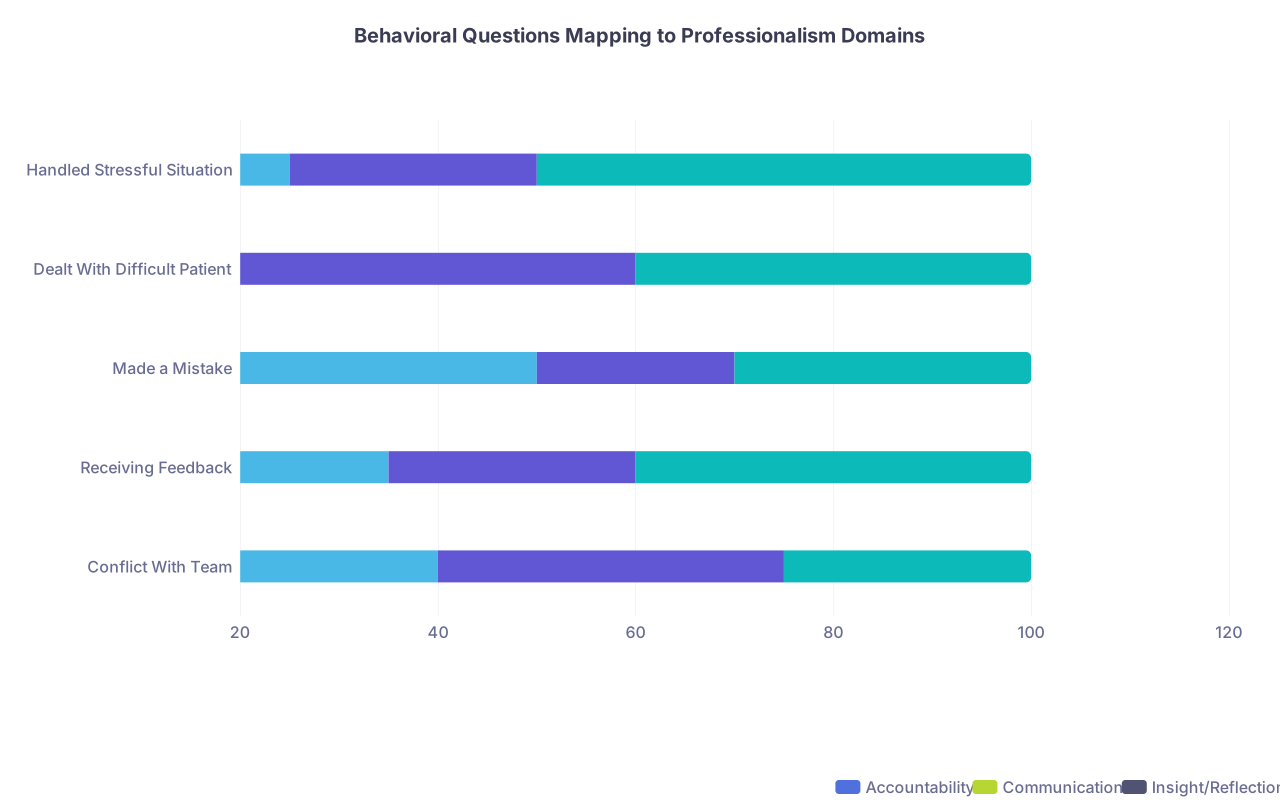
| Category | Accountability | Communication | Insight/Reflection |
|---|---|---|---|
| Conflict With Team | 40 | 35 | 25 |
| Receiving Feedback | 35 | 25 | 40 |
| Made a Mistake | 50 | 20 | 30 |
| Dealt With Difficult Patient | 20 | 40 | 40 |
| Handled Stressful Situation | 25 | 25 | 50 |
If they ask:
- “Tell me about a time you received critical feedback” — lean harder on the My role and Resolution parts.
- “Tell me about a time you made a mistake” — spotlight the systems thinking and patient-safety elements.
- “Tell me about a conflict on a team” — emphasize Other perspectives and relationship repair.
You’re basically answering the same question each time:
Can you be trusted to be self-aware, honest, and collaborative when things go wrong?
How Committees Talk About You After You Leave
You never hear this part, but you should.
Here’s what an actual post-interview discussion sounds like when that conflict question goes badly:
“Good scores, nice CV, but he really blamed the nurse in that story.”
“Yeah, he kept saying ‘they just didn’t listen.’ I wrote ‘defensive’ on my sheet.”
“We had that issue two years ago — I’m not taking the risk again.”
“Agreed. I’m fine not ranking.”
Contrast that with a candidate who told a thoughtful, self-aware story:
“She owned a mistake with no excuses. That was impressive.”
“Yes, and she talked about how she changed her handoff process. That’s what I want in an intern.”
“I wrote ‘great insight, values feedback.’ I’d be happy to work with her.”
“Rank her in our top 5.”

You’re not being graded on eloquence. You’re being graded on what your story tells us about how painful you will be to supervise.
Quick Fixes If You’ve Already Been Answering Poorly
If you’re reading this mid-interview season and realizing you’ve been bombing this question, you can course-correct. Not perfectly, but better.
Do this tonight:
- Write down 2–3 real situations that meet the “I learned something” criteria.
- For each, force yourself to write one sentence starting with: “Where I was wrong was…”
- Practice saying the story out loud to a human who will call you out when you sound defensive.
If you’re already scheduled for more interviews, subtly shift your narrative:
- Reduce how much airtime you give to other people’s flaws.
- Increase how specific you are about what you personally changed.
- Soften your language: “At the time I felt…” instead of “They were…”
You don’t need to become a new person. You just need to stop broadcasting red flags.
FAQ (Exactly 5 Questions)
1. What if I genuinely think I was right in the conflict? Should I pretend I was wrong?
You don’t need to pretend you were wrong. But you do need to show that being “right” wasn’t the only thing that mattered. You can say, “Clinically I still think my judgment was sound, but I mishandled the communication,” and then focus on what you changed in how you addressed people, escalated concerns, or built consensus. Faculty respect conviction paired with humility; they distrust righteousness without reflection.
2. Is it bad to use a preclinical or non-clinical example for these questions?
If you’re an MS4 or applying for residency, using only preclinical or undergrad stories looks weak. It telegraphs that you either haven’t had meaningful clinical interactions or you’re avoiding talking about them. One non-clinical example is fine as a backup, but at least one primary story should be from the wards or something adjacent to patient care or hospital teamwork.
3. Can I talk about conflict with an attending, or is that too risky?
You can, but you need to be very careful. If you make the attending sound unreasonable or incompetent, you’re done. If you describe a respectful disagreement about management that you resolved professionally, and that led to better understanding or learning, that can actually help you — it shows you can speak up thoughtfully. The attending in your story should come off as a normal human, not a villain.
4. What if I honestly haven’t made a “big” mistake yet?
You’re not on trial for malpractice. The mistake doesn’t have to be catastrophic. It can be a delayed lab follow-up, a missed page, a poorly handled family conversation, an incomplete note that caused confusion. The key is that you perceived it as a mistake, felt a sense of responsibility, and changed your behavior. If you insist you’ve never made a meaningful mistake, most interviewers will just conclude you’re lacking self-awareness.
5. How long should my answer be for these behavioral questions?
Ninety seconds to two minutes is the sweet spot. Under a minute usually means you’re giving a superficial, underdeveloped answer that doesn’t show reflection. Over three minutes and you’re rambling, defending yourself, or reliving the drama. If you run the story once or twice at home with a stopwatch using the P-MOR structure, you’ll naturally land in the right range.
Two things to leave with:
- That “tell me about a conflict / mistake / feedback” question is not filler. It’s the professionalism X-ray.
- You’re not being judged for having conflict or making mistakes. You’re being judged for whether you take ownership, respect others, and grow from it — or whether you blame and rationalize.
If you can show honest self-awareness and concrete change in one good story, you’ll pass a test most applicants do not even realize they’re taking.