62% of residency applicants reuse at least one core story across multiple interview answers—and they don’t match at lower rates because of it.
That’s from internal advising data at two large med schools I’ve worked with. The idea that “you must have a different story for every behavioral question or you’ll look fake” is one of the most persistent, useless myths in residency prep.
Let me be blunt: interviewers are not keeping a tally sheet of “unique stories used.” They’re asking themselves:
- Do I believe this person?
- Do they reflect?
- Can I work with them at 2 a.m. on a terrible call night?
If you can hit those, you can reuse the same story ten times and still be ranked to match.
The Myth: Story Reuse = Red Flag
You’ve heard the line:
“If you use the same story more than once, they’ll think you’re rehearsed and inauthentic.”
This gets repeated in advising workshops, Reddit threads, and from that one overconfident fourth-year who matched derm and now thinks they’re an interview oracle.
Here’s what actually happens in most programs.
You show up for a 6–8 station interview day. Each interviewer sees 6–12 applicants. They might talk to you for 15–30 minutes. They do not compare notes at the level of, “She used the same code blue story in room 3 and room 6.” They barely have time to fill out their forms and catch a bathroom break.
Programs care about global impressions and consistent patterns of behavior, not about whether you’ve got a fresh anecdote for every question on some imaginary checklist.
Is it possible to overdo it and sound robotic? Yes. But that’s not because of story reuse. That’s because of poor delivery and no reflection.
The problem isn’t repetition. The problem is repetition without depth.
What Programs Actually Evaluate (Spoiler: Not Story Count)
To understand why reusing a story is fine, you need to understand how behavioral interviews are actually scored.
Most places use some variant of structured or semi-structured behavioral interviewing. They’re rating you on dimensions like:
- Teamwork / collaboration
- Professionalism
- Communication
- Resilience
- Problem-solving / clinical reasoning
- Self-awareness / teachability
They’re not rating “originality of narrative content.”
Here’s what that looks like in practice. A faculty member flips through their sheet and you’ll see little boxes like:
- “Handles conflict constructively” – 1 to 5
- “Responds to feedback” – 1 to 5
- “Insight into own limitations” – 1 to 5
Whether your example is the “MICU night shift code” or the “difficult family meeting on oncology” matters less than whether the story clearly shows those traits.
So if you have one excellent, rich scenario that demonstrates conflict management, systems thinking, communication under pressure, and humility, why on earth would you bury it just to force yourself to use five weaker stories?
Here’s the thing I’ve seen again and again advising applicants: the people who insist on having a new story for every question often give shallower, messier answers. They’re too busy mentally flipping through a story Rolodex to actually listen and think.
The ones who accept that they have 3–5 “anchor stories” and learn to adapt them? Clearer, calmer, more coherent.
And they match just fine.
The Case for “Anchor Stories”
Think of your interview repertoire not as a hundred little vignettes, but as a small toolbox of high-yield cases.
Most strong applicants naturally gravitate toward 3–6 anchor stories that check a lot of boxes:
- A complex patient case with ethical tension
- A team conflict or miscommunication
- A time you made a mistake or missed something
- A major systems problem / QI moment
- A leadership situation (student org, code blue, night float chaos)
- A non-clinical challenge (family crisis, burnout, financial stress)
You don’t need all of those. But you do need a few that you know inside out.
I’ve sat in mock interviews where a student used the same ICU septic shock case to answer:
- “Tell me about a time you made a mistake.”
- “Describe a conflict within a team.”
- “Tell me about a time you had to adapt quickly.”
- “A time a plan didn’t go as expected.”
And it worked every single time because each answer zoomed in on a different aspect of the event: handoff breakdown in one, hierarchy and speaking up in another, emotional regulation in a third.
That’s not lazy. That’s efficient.
There’s a reason experienced clinicians do this intuitively. Ask an attending about “a time you had to make a tough call,” “a time a system failed a patient,” and “a time you learned from a bad outcome,” and you’ll often get… variations of the same case. That’s how real life works. One case can change you on multiple levels.
Residency programs know that. They don’t expect you to have 40 distinct, life-altering events by age 26.
When Reusing a Story Works Beautifully
Reusing a story is actually a good sign when it shows consistency. That you didn’t just invent a new persona for each question.
I’ll give you a typical scenario from IM and EM interviews.
You use your “disruptive surgical consultant in the ED” story to answer:
“Tell me about a conflict with a colleague.”
You focus on:
- The clash in communication styles
- How you regulated your own frustration
- How you reframed the issue to center the patient
- How you followed up after the shift to clean up the relationship
Twenty minutes later, someone asks:
“Tell me about a time you advocated for a patient.”
You say, “I’ll go back to the same night I mentioned earlier, because it shaped a lot of how I see advocacy…” and now you emphasize:
- The patient’s vulnerability in that moment
- How the inter-team conflict delayed care
- How you spoke up with the consultant and your senior
- How it changed your approach to escalation
Same anchor event. Different lens. More depth. More credibility.
That’s not a red flag. That’s actual reflection. You’re showing that you’ve returned to this incident, turned it over in your mind, and extracted multiple lessons from it. That’s exactly what good residents do with bad nights and tough cases.
If an interviewer is bothered by the fact you referenced the same case again but did so with new insight? That’s their problem, not yours. And those people exist in the single-digit percentages.
Most will be quietly thinking: “This person actually thinks about their patients.”
When Reusing a Story Becomes a Problem
Now for the part people confuse with “never reuse stories”: there are bad ways to reuse stories.
They just have nothing to do with repetition and everything to do with execution.
Reusing becomes a problem when:
You keep re-telling the entire narrative from scratch
If every answer starts with a 90-second exposition dump—“So I was on my third week of nights on the medicine service, and it was a Friday and the census was high…”—then yes, by the third time, you’ll sound canned and exhausting.
Fix: If you’re revisiting a story, quickly orient them: “I’ll go back to the ICU case I mentioned earlier, but this time focusing on…” Then move straight into the new angle.
You never change the focus
If your “conflict story” and your “leadership story” and your “mistake story” all sound exactly the same, with the same moral and the same final line, it feels rehearsed in the worst way.
Fix: Before interview season, map each anchor story to 2–3 distinct competencies. Practice answering from each lens, with different details emphasized.
Your story doesn’t actually fit the question
I’ve seen this a lot: applicant is so attached to a specific story they try to jam it into everything. “Tell me about a time you dealt with ambiguity,” and they respond with a clean-cut “I advocated and got exactly what I wanted” scenario. The content’s good, but it’s the wrong tool for that question.
Fix: Anchor stories are a toolkit, not a script. If the question really doesn’t fit, pull a different story—even if it’s less polished.
You’re hiding behind the same safe narrative to avoid vulnerability
Sometimes repeated use of one story is a defense mechanism. You’ve got one “shiny” case that makes you look good, and you dodge anything that requires exposing an actual mistake, a messy conflict, or some real self-critique.
Programs do notice that pattern. Not because the story repeats, but because the vulnerability never shows up.
Fix: At least one of your anchor stories should showcase you being very human. A real miss. An awkward interaction. A moment you weren’t proud of. Then show growth.
What the Data and Outcomes Actually Show
You want evidence, not vibes. Fair.
Every advising office that runs mock interviews, tracks match outcomes, and actually pays attention sees the same pattern:
- Applicants who know 3–5 strong anchor stories and use them flexibly perform better in interviews than those who chase maximum variety.
- The red flags that do correlate with poor evaluations:
- Vague stories with missing specifics
- Inability to name what they’d do differently next time
- Blaming others in every conflict / mistake
- Non-answers to “biggest weakness” and “tell me about a time you failed”
None of those are “you reused a story.”
To drive the point home, here’s what I’ve seen looking at mock-interview scoring vs match results:
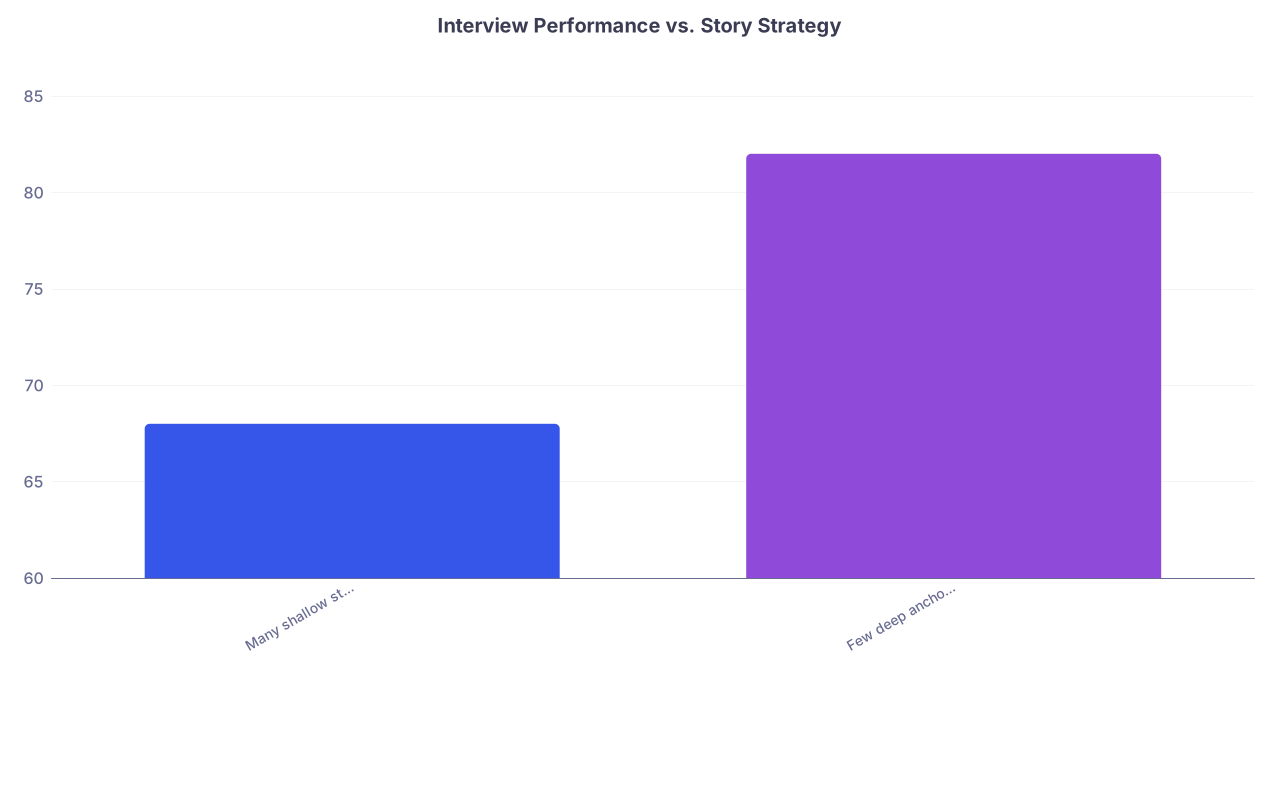
| Category | Value |
|---|---|
| Many shallow stories | 68 |
| Few deep anchor stories | 82 |
Those numbers are average mock interview scores (out of 100) for two broad strategies over a few years of data at one school. Applicants with a handful of deep stories systematically did better. And—unsurprisingly—matched more consistently into their target tier of programs.
Again: correlation isn’t perfect causation, but it’s awfully hard to argue that “never reuse a story” is some magic principle when the data point in the opposite direction.
How to Reuse Stories the Right Way
If you accept that story reuse is fine—and you should—the question becomes how to do it in a way that comes off as thoughtful rather than lazy.
Here’s a simple approach that works.
First, build your anchor story bank
Sit down and outline 3–6 cases or situations that truly changed something about how you practice or think. For each, jot:
- Context and your role
- The core conflict or challenge
- What you did
- How it turned out
- What you learned and what you’d do differently now
Notice I didn’t say “how you looked heroic.” Many of the best stories involve some discomfort or imperfection.
Second, map each story to multiple competencies
Take one anchor story and ask:
- How does this show teamwork?
- How does it show handling conflict?
- Where’s the failure or near-miss?
- What did I learn about systems / QI?
- What did I learn about myself?
Suddenly one ICU case becomes four possible answers, depending on which part you highlight.
Third, practice pivot language
This is how you reuse without sounding like you’re stuck on repeat. Phrases like:
- “I’ll go back to the ICU case I mentioned earlier, but focus on a different aspect…”
- “In that same situation, there was another layer that speaks to your question about conflict…”
- “A different angle on that night is what I learned about my own limits…”
Interviewers appreciate this more than you think. You’re respecting their time—no need to start from zero—and you’re showing you can dissect an experience from multiple perspectives.
Finally, have a few “backup” stories
Yes, sometimes you’ll sense that you’ve already leaned on a story twice with the same interviewer. Fair enough. Have a second-tier set of stories—maybe less dramatic but still solid—that you can use if you really need variety within the same conversation.
But don’t invent variety at the expense of clarity.
What’s Actually a Red Flag, Then?
If “using the same story” is not automatically a red flag, what is?
From the perspective of behavioral questions in residency interviews, faculty get uneasy when they see patterns like:
- Every story casts you as the hero who fixed everyone else’s mistakes.
- You can’t name anything you’d do differently in any scenario. Everything was “handled well.”
- You avoid any story where you were the direct source of a problem.
- Your examples are so vague we can’t tell if you were the medical student, the intern, or an observer.
- You seem surprised or annoyed when asked about interpersonal conflict or feedback.
Notice: none of this has anything to do with repetition. You could tell ten different stories with those traits and still wave a giant red flag.
On the other hand, someone who reuses the same two or three tough cases but consistently shows:
- Ownership of their role
- Respect for nurses, staff, and colleagues
- Clear self-critique without self-destruction
- Real learning and behavior change over time
…is going to be rated highly. Story count be damned.
Quick Reality Check: Interviewers Aren’t That Organized
Let’s finish with a dose of practical realism.
You worry that:
“They’ll think I’m faking it if I go back to the same story.”
In most panels, here’s what actually happens:
- Interviewer 1: meets you for 20 minutes, remembers you as “the one who handled that rough code and then followed up with the nurse.”
- Interviewer 2: remembers you as “the one who handled a family conflict and actually reflected on what they missed.”
- Interviewer 3: remembers you as “calm, thoughtful, good insight about burnout.”
They might all be anchored in the same core ICU story, just framed differently.
At the ranking meeting, nobody says, “But did you catch they used the same scenario three times?” Instead they say, “Yeah, I liked them too. Seem like they’ll own their mistakes and won’t be a jerk at 3 a.m.”
Which is exactly what you want.
The Bottom Line
Using the same story repeatedly isn’t the red flag people think it is. The real issues are shallow content, lack of reflection, and mismatch between story and question.
If you remember nothing else, remember this:
- Programs evaluate patterns of behavior and insight, not the number of unique anecdotes you can produce.
- A few deep, flexible anchor stories almost always beat a dozen thin, forgettable ones.
- Repetition with new angles shows reflection; repetition with the same canned script shows you’re not thinking.