
Residency programs are not magical lie detectors. They do not have a secret radar that beeps when your answer is “too scripted.” What they do have is pattern recognition and limited patience.
You’ve probably heard some version of this warning in med school hallways or on Reddit: “Do NOT script your behavioral answers. Programs can tell instantly and they hate it.” Like most strong opinions in medical training, this is based on anxiety, anecdotes, and half-truths.
Let me cut through it.
Programs do not “detect scripted answers” in the mystical way people imply. They respond to something else entirely: stale, generic, non-responsive, or incongruent performance. That can come from memorized lines. It can also come from winging it badly.
If you understand that distinction, you’ll prep smarter instead of sabotaging yourself in the name of “being authentic.”
The Myth vs. What Actually Happens in the Room
Here’s the myth in its purest form:
“If you prepare behavioral answers in advance, interviewers will know they’re scripted and think you’re fake. Just be yourself and talk naturally.”
This sounds romantic. It’s also how people end up rambling through a 6‑minute “Tell me about a conflict” story that never hits the question.
What programs actually experience is more mundane. I’ve seen the same pattern debriefing with faculty after interview days and reading dozens of rank meeting notes.
They complain about:
- “Every answer felt like a canned brochure.”
- “They never really answered what I asked.”
- “Super polished but I don’t feel like I know them.”
- “That sounded like something they memorized off a blog.”
- “Where was the reflection? They just told a story and stopped.”
Notice what they don’t say: “We detected a scripted answer using our telepathic abilities.”
They’re reacting to content and delivery:
- Recycled clichés: “I’m too hard on myself,” “I always go the extra mile,” “I learned the importance of teamwork and communication.”
- Overly polished, vague narratives that could belong to any applicant at any school.
- Lack of emotional specificity or reflective depth.
- Inability to adapt when the interviewer follows up or tweaks the question.
That’s not “we caught you memorizing.” That’s “you sound like you’re performing a role rather than having a conversation.”
The problem isn’t that you prepared. It’s that you prepared badly.
What Behavioral Questions Are Really Testing
People overcomplicate this. Programs are not asking behavioral questions to trap you. They’re trying to answer one blunt question:
“If I put this person on my team at 3 a.m., what am I getting?”
Behavioral questions are just a crude tool to infer that. “Tell me about a time you made a mistake,” “Describe a conflict with a teammate,” “A time you received critical feedback,” and so on.
They are looking for a handful of things:
Self-awareness
Do you actually understand your role in events, or do you sanitize and externalize everything?Emotional regulation and maturity
Can you talk about difficult situations without sounding defensive, resentful, or grandiose?Learning orientation
Do you show concrete changes in behavior after a mistake/conflict, or do you just tack on “I learned a lot” at the end?Interpersonal realism
Do your stories sound like real situations that happen in medicine, or like a fairy tale with you as the flawless hero?Communication under mild pressure
Can you express a coherent, relevant story in 1–3 minutes without getting lost?
None of that requires a magical ability to smell “script.” It requires listening to your words and watching how you respond when nudged.
A memorized, rigid answer usually fails on two or three of those dimensions. Not because it’s memorized. Because it was built as a performance, not as a reflection.
Can Programs Actually “Tell”? What the Data and Patterns Suggest
If you’re looking for a randomized trial titled “Detection of Scripted Behavioral Answers Among Residency Applicants,” it doesn’t exist. Nobody is strapping people to fMRI machines on interview day.
We do, however, have three useful sources of evidence:
Structured interviewing research
In other fields (business, law enforcement, HR), structured behavioral interviews are used precisely because they’re more reliable and less vulnerable to surface impressions. Interviewers rate candidates on content: situation, actions, outcome, and reflection. Training focuses them on substance, not vibes. Prep is actually encouraged.Program behaviors and tools
Look at what residency programs are adopting: standardized questions, scoring rubrics, sometimes multiple mini interviews (MMIs). The trend is toward structured, repeatable assessment. None of these systems say, “Deduct points if it sounds memorized.” They say: Did they answer the question? Provide a concrete example? Show insight?Post-interview evaluations
I’ve seen many written evaluations from attendings and residents. Actual phrases: “generic,” “vague,” “rehearsed,” “robotic,” “overly polished,” “didn’t answer question,” “no depth,” “excellent insight,” “very reflective,” “genuine, specific examples.” These are descriptors of quality, not of preparation style.
So: can interviewers “tell” a memorized answer? Sometimes, if it’s stiff, unnatural, or clearly mismatched to the question. But they’re not performing forensic linguistics. They’re just noticing when something doesn’t feel like a live conversation.
And the uncomfortable flip side:
They also can tell when you clearly didn’t prepare and are fumbling for an answer you should have seen coming.
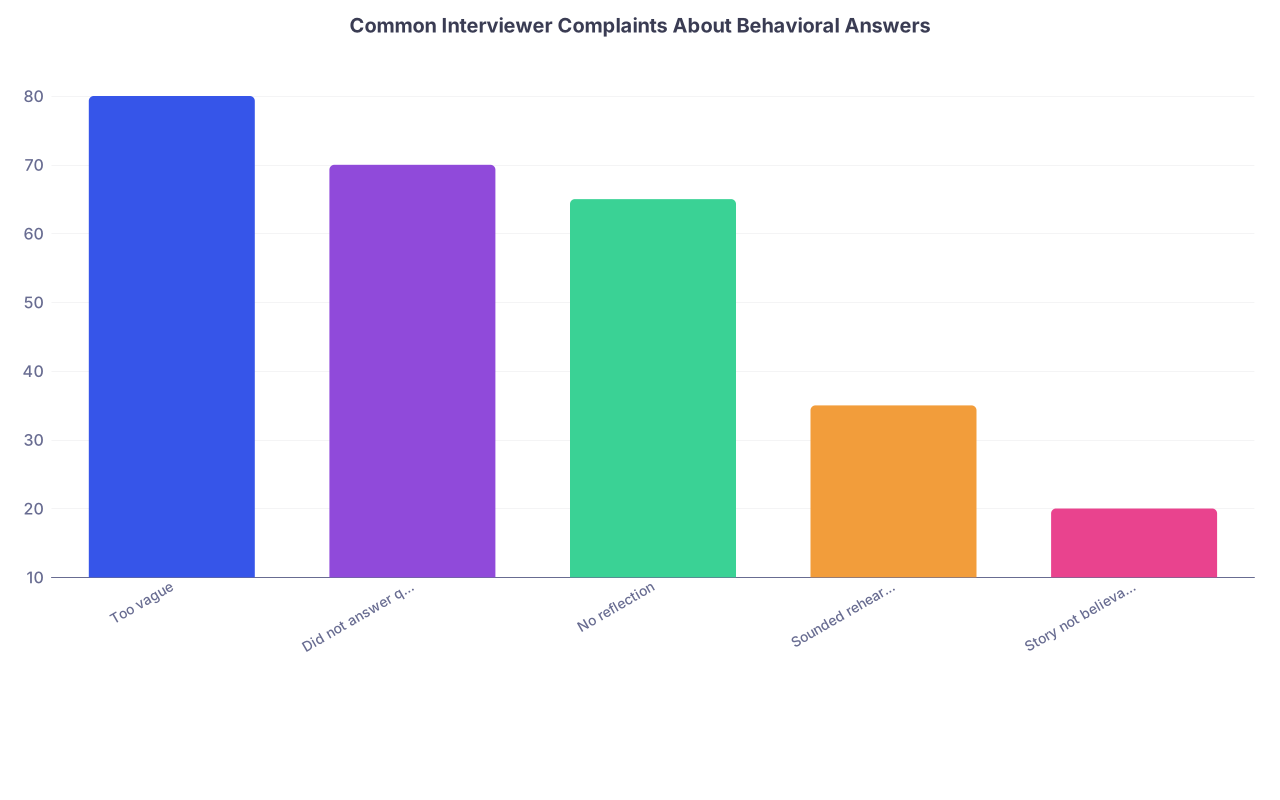
| Category | Value |
|---|---|
| Too vague | 80 |
| Did not answer question | 70 |
| No reflection | 65 |
| Sounded rehearsed | 35 |
| Story not believable | 20 |
If you want to fear something, fear being vague and unreflective. “Sounded rehearsed” is not at the top of the list.
Where “Scripted” Actually Kills You
Let’s be precise: when does preparation backfire?
There are four common failure modes I see over and over.
1. One-size-fits-all stories
You write a single beautiful “conflict” story, memorize it, and ram it into every vaguely related question.
Interviewer: “Tell me about a time you had to adapt to unexpected changes.”
You: trot out a prebuilt “conflict with a med student” narrative that barely touches adaptation.
Interviewers notice when you’re ignoring the question. That’s not about memorization; that’s about laziness. You’re answering the question you prepared for, not the one they actually asked.
2. Over-polished, under-human
Some answers sound like they were edited by a PR firm.
“I recognized that communication breakdown had occurred, so I proactively engaged key stakeholders, implemented a closed-loop communication strategy, and ensured patient-centered care remained at the forefront.”
No one talks like this in real life. It smells like something pulled from a leadership pamphlet. The underlying story might be fine, but the language screams “performance.”
Here’s the thing: you can 100% prepare in advance and still sound human. You do that by keeping your wording conversational, not academic, and letting a little imperfection through.
3. Inability to pivot
This is the biggest tell.
You deliver a clearly rehearsed answer. The interviewer asks a simple follow-up: “What would you do differently next time?” or “What feedback did you get from your senior?” You stumble. Long pause. Now the script is gone and there’s nothing underneath.
That’s when people write “felt rehearsed” on your eval. Not because they mind that you prepared. Because once they got past your script, there wasn’t much there.
4. Emotional mismatch
Scripted answers often sound… emotionally flat. A story about harming a patient that feels like you’re reading a weather report. Or a “conflict” story that never acknowledges frustration, discomfort, or regret.
Interviewers aren’t expecting tears. But they’ve all had real conflicts, real mistakes, real messy situations. If your tone never leaves neutral, they assume you’re either hiding, embellishing, or detached. None of those help you.
Structured ≠ Scripted: The Right Way to Prepare
The alternative to “script everything” is not “just be yourself and wing it.” That’s how smart people waste strong experiences on incoherent answers.
The move is to be structured, not scripted.
You absolutely should:
- Identify your core experiences: a real mistake, real conflict, time you were overwhelmed, major feedback, leadership example, failure, ethical tension. Not 20 stories. 6–10 good ones.
- Map each story using a simple framework (think STAR, but not robotically): situation, what you did, what happened, what you learned/changed.
- Actually say them out loud. Not once. Multiple times, to different people if you can.
- Pay special attention to the last part: “Here’s how this changed my practice / behavior.”
What you should not do is memorize them word-for-word like you’re performing a monologue.
Instead, memorize:
- The beats of the story (key points, sequence).
- The lesson and concrete follow-through (what you now do differently).
That gives you flexibility. If the question shifts slightly—“Tell me about a time you had to work with a difficult personality” instead of “conflict”—you can adapt the same core story to highlight a different angle without sounding like you ignored the question.

What Interviewers Actually Reward
Behind closed doors, here’s the kind of behavioral answer that tends to get praised:
- Specific, moderately detailed, but not a novel.
- Concrete actions: “I did X, then Y,” not just “We communicated better.”
- Honest about imperfection: you show where you struggled or misjudged, without falling apart.
- Clear change: “Now, when I…, I always…” – a behavioral upgrade.
- Natural language that sounds like you, not LinkedIn.
None of that is incompatible with preparation. In fact, hitting all of that on the fly is rare. The “naturally brilliant, effortlessly authentic” applicant is mostly a myth built from survivor bias.
Applicants who do well consistently usually did reps. They just didn’t memorize a script; they rehearsed a story.
| Aspect | Scripted (Bad) | Structured (Good) |
|---|---|---|
| Wording | Memorized sentences | Key points and beats |
| Flexibility | Low | High |
| Response to follow-ups | Brittle, thrown off | Can deepen story or add nuance |
| Emotional tone | Often flat or performative | More natural and variable |
| Interviewer impression | “Rehearsed, generic” | “Prepared, thoughtful, genuine” |
Red Flags Interviewers Notice (That You Can Fix)
Let me be very plain about a few things that do send up red flags—regardless of whether you prepped.
No clear “what I learned”
If you end a mistake or conflict story with “I learned the importance of communication,” you’ve said nothing. Interviewers want a behavioral change. For example: “Now, I always repeat back verbal orders in front of the team and ask the nurse to confirm the plan.”Blame-shifting
If every problem was basically someone else’s fault and you were the only mature person in the room, that’s a bad look. Even if you’re right.Inconsistent narrative
Saying you “value feedback” but giving an example where you argued with your attending for 5 minutes about a nitpick. They notice the mismatch more than any whiff of “script.”Evidence of invented stories
Interviewers don’t detect memorization. They do occasionally smell fiction: implausible scenarios, impossible timelines, or cartoonishly villainous colleagues. Medicine is dramatic enough; you don’t need Netflix-level writing.

| Step | Description |
|---|---|
| Step 1 | Behavioral Question |
| Step 2 | Prepared experiences? |
| Step 3 | Rambling, vague answer |
| Step 4 | Structured story |
| Step 5 | Generic, unmemorable |
| Step 6 | Specific, insightful |
| Step 7 | Positive interviewer impression |
| Step 8 | Clear reflection? |
Notice what’s missing from that diagram: “Detected as scripted.” Because that’s not the key decision point.
How to Tell If You’ve Gone Too Scripted
Quick self-check. If any of these are true, you’ve gone too far into the land of over-scripting:
- You get thrown off if the interviewer interrupts your story mid-sentence.
- You can only tell the story in one order; if someone says “briefly,” you can’t shorten it without panic.
- Your phrasing includes jargon or buzzwords you would never use talking to a co-resident.
- When a friend role-plays with you and changes the wording of the question slightly, you still give the exact same answer.
Fixing this doesn’t mean abandoning prep. It means:
- Rehearse with different people who’ll interrupt and ask follow-ups.
- Tell the same story at different lengths: 30 seconds, 90 seconds, 3 minutes.
- Strip out buzzwords. Replace “effective communication” with what you actually did: “I called them directly and said…”

The Reality: What You Should Actually Do
So here’s the bottom line, without the folklore:
Programs aren’t running a “script detector.” They’re watching for depth, specificity, and adaptability. “Sounded rehearsed” is only a problem when there’s nothing under the polish.
You should prepare your behavioral answers. Thoroughly. But as structured stories and lessons, not as exact scripts. If you can’t flex to slightly different questions or follow-ups, you’re over-prepped in the wrong way.
The real sin in behavioral interviews isn’t preparation. It’s generic, vague, and consequence-free answers. If your stories are specific, reflective, and tied to real changes in your behavior, nobody cares how many times you practiced them. They’ll just think you’re thoughtful.