
“Just be yourself” is how people give up on actually helping you.
For behavioral residency interviews, it’s not just lazy advice. It’s objectively bad strategy.
Programs are not trying to meet “the real you” in some abstract, poetic sense. They’re trying to answer one very specific question:
Can this person function safely, collegially, and reliably in our system for 60–80 hours a week while under pressure?
That’s it. Not: Are you authentic?
Not: Do you have a quirky personality?
Not: Are you “being yourself” enough?
You’re walking into a high‑stakes selection process, not a therapy session. Treating “be yourself” as a plan is how strong applicants tank their interviews while less “genuine” but more prepared candidates get ranked to match.
Let’s tear this apart properly.
What Behavioral Interviews Are Actually Measuring
Behavioral interviewing has a purpose. It’s not random storytelling time.
The whole “Tell me about a time when…” format is built on one evidence‑based assumption that’s repeated across industrial-organizational psychology literature: past behavior in similar contexts predicts future behavior better than hypothetical promises.
Programs don’t ask, “Would you be able to resolve conflict on the team?”
They ask: “Tell me about a time you had conflict on a team. What did you do?”
They’re probing for very specific constructs:
- Reliability and follow‑through
- Self-awareness and insight
- How you respond to stress, conflict, and feedback
- Integrity when no one is watching
- Patterns of blame vs. ownership
None of that is measured by raw “authenticity.” It’s measured by how clearly and coherently you demonstrate these traits using your actual experiences.
Look at what program directors themselves say. In the NRMP Program Director Survey, across multiple years, “interview” and “perceived professionalism/interpersonal skills” rank near the top of what determines how they rank applicants. They’re not scoring who felt the most “real.” They’re rating who looked safest, most functional, and easiest to work with at 2 a.m. on call.
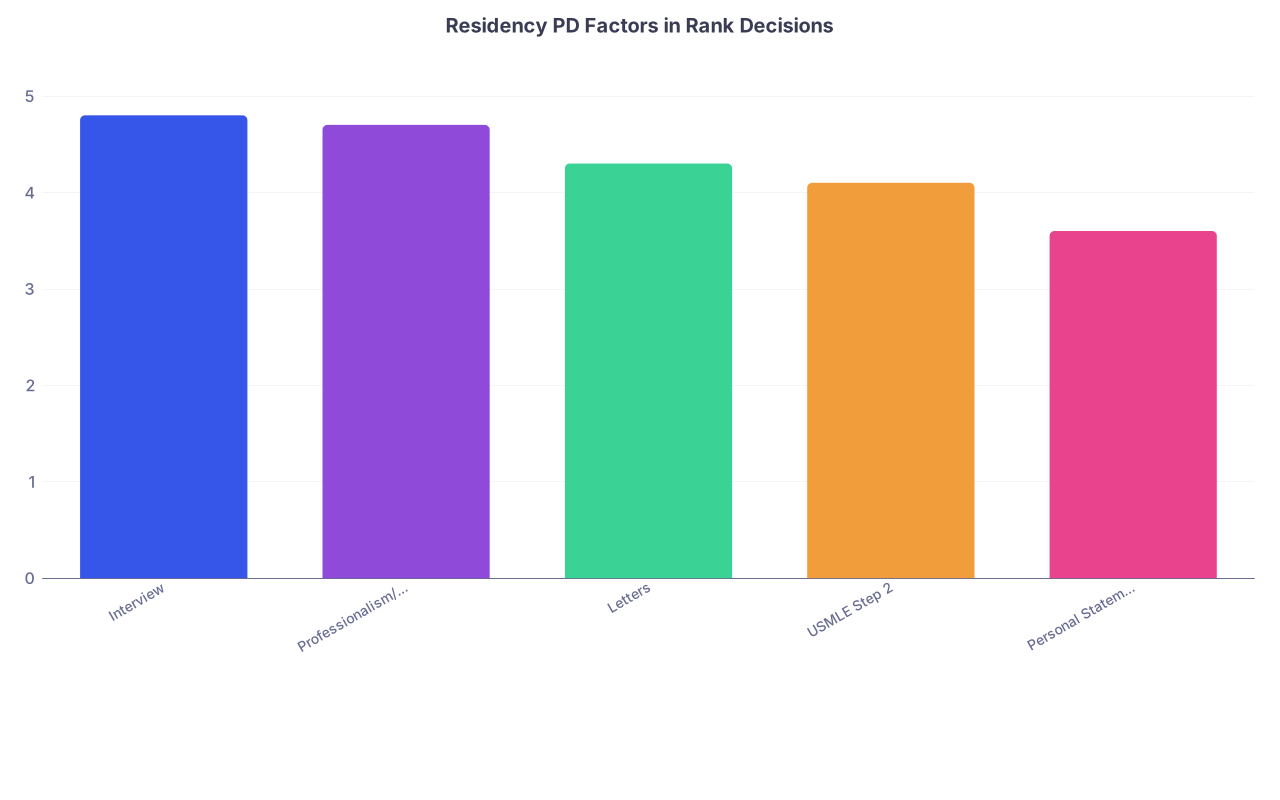
| Category | Value |
|---|---|
| Interview | 4.8 |
| Professionalism/Interpersonal | 4.7 |
| Letters | 4.3 |
| USMLE Step 2 | 4.1 |
| Personal Statement | 3.6 |
(Scale 1–5; representative of the pattern seen across recent NRMP PD Surveys.)
Behavioral interviews are structured around that reality. If you walk in thinking your job is to “be yourself,” you will underperform against someone who understands the actual scoring rubric.
The Myth of Authenticity: What “Just Be Yourself” Gets Wrong
Here’s the fundamental problem: “be yourself” confuses authenticity with unfiltered behavior.
You on your couch at midnight? That’s “yourself.”
You in the OR with a malignant attending? That’s also “yourself,” but heavily modulated.
You at your grandmother’s funeral? Still you, just in a different behavioral register.
Humans don’t have one “true self” that must appear in every context. We have context‑dependent selves. That’s not fake. That’s social functioning.
Professionalism is not lying about who you are. It’s choosing which parts of you to bring forward in a given situation.
So the real choice in a behavioral interview isn’t:
- Be yourself vs. be fake.
It’s:
- Be deliberate and strategic vs. be impulsive and unstructured.
When people say “just be yourself,” what actually happens in the interview?
I’ve watched it play out:
- The “authentic” applicant rambles. They start their “tell me about a conflict” story in 2016 and don’t land the plane. The interviewer writes: “disorganized, lacks insight.”
- The “authentic” applicant decides to be “real” about their burnout. They overshare without framing what they learned or how they changed. The interviewer hears: “possible liability, fragile under stress.”
- The “authentic” applicant tries to be funny to seem like themselves. It lands awkwardly. The interviewer notes: “poor judgment, immature.”
Meanwhile, another applicant who practiced is no less “real” as a person. They’re just coherent, appropriately vulnerable, and structured. Guess who gets ranked higher.
What the Data and Real Outcomes Actually Show
No one runs randomized controlled trials of “just be yourself” vs. “prepare strategically” for residency interviews. But we do have several strands of evidence that all point in the same direction.
First, structured interviews with scoring criteria and behavior‑based questions consistently outperform unstructured, “vibe‑based” interviews in predicting performance. That’s been shown over and over in the organizational psychology literature.
What does that imply? That the people who understand the structure and speak in the language of competencies do better.
Second, applicants who receive targeted interview coaching reliably report more confidence and higher match success, especially in competitive specialties. I’ve seen the same pattern informally across multiple cycles: the people who treat behavioral questions like a skill to be trained, not a “just be honest” moment, improve dramatically over 2–3 mock sessions.
Third, program directors themselves endorse structured, behavior‑focused interviews because they weed out red flags that aren’t obvious on paper: chronic deflection of blame, poor insight, inability to accept feedback. None of those show up because someone “wasn’t themselves.” They show up because someone revealed unedited patterns of thinking.
You are not being evaluated on your essence. You’re being evaluated on the behavior you choose to display in 20–30 minutes of controlled interaction.
So no, “just be yourself” does not reliably lead to better ratings. Prepared, self-aware, strategically honest behavior does.
The Real Problem: Unfiltered “Yourself” Under Stress
Let me be blunt: the version of “yourself” that comes out under stress is often the worst version to showcase.
Residency interviews are weird. High stakes. Artificial setting. Power imbalance. You’re sleep‑deprived from travel, maybe off a night shift, in a suit you rarely wear. This is not neutral ground.
If you walk in with no structure and tell yourself, “I’ll just answer like I normally would,” you’re betting your entire residency future on your default stress behavior.
Do you know what your default stress behavior is? I’ve seen a lot of them:
- The over‑explainer. Drowns every question in unnecessary backstory. Great in conversation, awful in 30‑minute interviews.
- The self‑deprecator. Thinks they’re being charmingly humble; comes off as insecure and unsure of their own skills.
- The over‑confessor. Feels obligated to mention every flaw and doubt in the name of being “genuine”; hands the interviewer a list of reasons not to rank them.
- The debater. When asked about conflict or feedback, instinctively defends their prior position. Looks argumentative and rigid.
- The comedian. Works fine with friends; undercuts professionalism on Zoom with an associate program director.
All of these people are “being themselves.” And all of them are shooting themselves in the foot.
What works in a pre‑call room or group chat doesn’t necessarily work across from a PD or chief resident.
You don’t need to become someone else. You need to decide which parts of you belong in that room and which parts belong with your co‑intern at 3 a.m. over vending-machine snacks.
Strategic Authenticity: The Right Way to Approach Behavioral Questions
Here’s the actual grown‑up version of “be yourself”: be selectively, coherently, and context‑appropriately yourself.
That means three things.
1. Pick your stories on purpose
Behavioral questions are predictable. The exact wording varies, but the buckets are the same every year:
- Conflict with a team member
- Difficult feedback you received
- A time you made a mistake
- Handling stress/burnout
- Working with someone difficult or very different from you
- Leading a team or project
- Failing at something and recovering
If you walk into interviews without at least one solid, thought‑through story for each bucket, you’re not being authentic. You’re being careless.
You should know, before interview day, which example you’ll probably use for:
- “Tell me about a conflict.”
- “Tell me about a time you failed.”
- “Tell me about a time you went above and beyond for a patient or teammate.”
Not scripted word‑for‑word. But chosen. Rehearsed enough that you can tell it cleanly under pressure.
2. Use structure without sounding like a robot
You’ve probably heard of STAR or PAR or whatever acronym your school likes.
They exist for a reason: under stress, your brain loves tangents. Structure keeps you honest.
Situation – one or two sentences.
Task – what you were responsible for.
Action – what you actually did.
Result – what happened and what you learned.
The result/learning part is where most applicants flail. They either:
- Over‑focus on the happy ending (“and then everyone loved my idea!”), or
- Dump a moral (“and I learned communication is important”) with zero depth.
Here’s what actually signals maturity: specific behavioral learning.
Not: “I learned communication matters.”
But: “I realized I tend to avoid early direct conversations, and by waiting I let resentment build. Since then, I’ve forced myself to have the awkward 5‑minute talk early, even if it’s uncomfortable.”
Same person. Same underlying story. One sounds like a cardboard residency brochure. The other sounds like someone I might actually trust with sick patients.
3. Be honest about weaknesses—but curated and contained
Total transparency is not a virtue in an interview. Strategic transparency is.
You should be willing to talk about real mistakes and weaknesses. But the way you present them matters. A lot.
Bad version: “I’m really bad at time management; I still struggle with it.”
Better version: “Earlier in third year I consistently underestimated how long notes would take. I got feedback from my senior after running behind on sign‑out twice. Since then, I’ve started pre‑charting and blocking my time more aggressively; on medicine sub‑I I consistently got sign‑out done on time.”
You didn’t lie. You didn’t pretend you’re perfect. You showed a trajectory.
That’s what interviewers are hunting for in behavioral answers: not whether you’ve ever messed up, but whether you learn and change. Whether you’ll still be making the same kind of mistake in PGY‑3 that you made as an M3.
How This All Plays Out in Residency Match Reality
Let’s tie this back to the only outcome that actually matters to you: matching.
Residency interviews, especially behavioral parts, are not about ranking who is most charismatic or “likable.” They’re about risk management.
Every time a PD or faculty member hears your answer, they’re subconsciously screening for:
- Will this person blow up the team dynamic?
- Will this person crumble when sleep‑deprived?
- Will this person own their mistakes or hide them?
- Will nurses and staff want to work with this person?
None of that is answered well by raw, unfiltered self‑expression. It’s answered by curated, coherent, honest but thoughtful behavior.
Applicants who internalize the “just be yourself” myth tend to:
- Under‑prepare
- Over‑share
- Ramble
- Fail to show growth or insight
Applicants who treat behavioral interviewing as a professional skill tend to:
- Calm down because they’ve already chosen their examples
- Answer more clearly and concisely
- Show a pattern of reflection and growth
- Come across as both human and safe

| Step | Description |
|---|---|
| Step 1 | Approach to Behavioral Interview |
| Step 2 | Unstructured answers |
| Step 3 | Rambling, oversharing, weak insight |
| Step 4 | Lower interview evaluations |
| Step 5 | Planned examples + structure |
| Step 6 | Clear, concise, growth-focused answers |
| Step 7 | Stronger interview evaluations |
| Step 8 | Strategy |
I’ve seen plenty of “quiet,” awkward, not‑naturally‑charming applicants dominate interviews because they did the work. And I’ve seen naturally charismatic people sink because they thought their personality alone would carry them.
Guess who ends up on the right side of rank lists.
What You Should Actually Do Instead of “Just Be Yourself”
Let me give you a practical, non‑fluffy alternative mantra:
Be accurate, be prepared, be human—on purpose.
That means:
- Accurate: Don’t fabricate or exaggerate stories. Don’t pretend you loved something you hated.
- Prepared: Have examples ready. Practice them out loud. Use a structure. Get feedback from someone who will actually tell you the truth, not just “you’re great, you’ll be fine.”
- Human: Show humility, limits, learning, and real reactions—but in a way that makes sense for someone about to be responsible for sick patients.
If you feel like you’re “acting,” you’ve probably over‑corrected into fakery. If you feel like you’re just chatting with a friend, you’ve probably under‑corrected into sloppy authenticity.
The sweet spot is: professional version of you. Like how you are on rounds with an attending you respect and want to impress. Still you. Just filtered, focused, and intentional.
One More Thing: Watch the Hero Stories
Quick myth‑related side note: the “be yourself” crowd often pushes you to tell your “best” stories—the times you saved the day.
Those can be useful, but interviewers often learn more from your failures, conflicts, and unflattering moments. Provided you handle them well.
If you only tell hero narratives—“I stepped up, I solved it, everyone thanked me”—you look self‑unaware or narcissistic. Real teams don’t work like that. And people who have actually taken care of patients know it.
The most impressive behavioral answers often sound like this:
- “I didn’t handle it well at first; here’s where I messed up.”
- “The feedback stung more than I expected; I was defensive for a while.”
- “I realized I’d been avoiding a difficult conversation for weeks out of discomfort.”
Then you show evolution. That’s real. That’s mature. And yes, that’s authentic. But it’s not “just be yourself.” It’s “show us the part of yourself that can grow.”
The Bottom Line
Three things to walk away with:
- “Just be yourself” is terrible advice for behavioral residency interviews because it encourages unstructured, unfiltered responses in a high‑stakes, structured evaluation.
- You’re not being judged on your essence; you’re being judged on the specific behaviors and patterns you choose to display in a short, artificial interaction.
- The winning strategy is strategic authenticity: pick your stories, use structure, show real growth, and bring the professional version of yourself that your future co‑residents will be relieved to see walking onto the night shift.