
The obsession with “perfect” interview answers is killing people’s actual performance.
Not metaphorically. I mean students who can recite a flawless STAR story about “a time they overcame conflict” and still walk out with silent committees and soft rejections. Meanwhile, the applicant who fumbled a detail or two but felt like a real human gets ranked to match.
The problem is simple: you’re optimizing for the wrong thing. You’re trying to win a scripted performance contest. Interviewers are trying to answer one blunt question:
“Do I want this person on my team at 3 a.m.?”
Those are not the same game.
Let’s strip this down to what programs actually look at, what the behavioral questions are really testing, and why your search for the “right” answer is a waste of time.
What Programs Actually Care About (That You Keep Ignoring)
Residency interviews are not oral board exams. No one is giving partial credit for textbook-perfect phrasing.
Look at program director surveys from NRMP and specialty organizations. Year after year the same things land near the top:
- Interpersonal skills
- Professionalism
- Teamwork
- “Fit” with the program culture
- Communication skills
- Reliability and work ethic
“Gave the textbook answer to ‘Tell me about a time you failed’” is not on that list.
The interview exists because your scores and CV can’t answer questions like:
- Will you freak out when you make a mistake and hide it?
- Are you insufferable when tired?
- Can a nurse correct you without you acting threatened?
- Will you take feedback like an adult or like a teenager whose phone got taken away?
That’s what behavioral questions are really doing. They’re stress-testing your default operating system as a person.
To put it more bluntly: they’re less interested in whether you “used the STAR method” and more interested in whether you sound like trouble.
The Fatal Flaw in “Perfect” Answers
Here’s the pattern I’ve seen repeatedly on selection committees and mock interviews.
You:
“Tell me about a time you had a conflict.”
Applicant launches a flawless monologue:
“Yes, I’d be happy to. During my third-year internal medicine clerkship, I was leading a small team of students when one colleague and I disagreed on the plan for a patient with decompensated heart failure…”
It hits all the steps. Situation. Task. Action. Result. Reflection.
And somehow, when they leave the room, the committee says:
“Technically good. But I don’t feel like I know this person.”
“Felt rehearsed.”
“Hard to tell how they really behave under stress.”
You over-optimized for polish. You under-delivered on authenticity and signal.
Perfect answers fail for a few predictable reasons:
They’re generic.
“There was a miscommunication on the team, but I took the initiative to speak to everyone and we resolved it.” Congratulations, that applies to half of the applicant pool. Nothing sticks.They feel low-risk and self-protective.
You only choose examples where you’re secretly the hero: the conflict wasn’t your fault, the mistake was trivial, the “weakness” is working too hard. Interviewers know exactly what you’re doing.They lack emotional content.
Not Hollywood drama. But basic human cues: what actually frustrated you, what you were afraid of, what you’d now do differently. When that’s missing, you sound like ChatGPT’s cousin.They don’t show your current operating system.
Telling me about a magically resolved conflict from M1 group work doesn’t predict what you’ll do when an attending shreds your note in front of the team.
Here’s the punchline:
Interviewers don’t reward perfection. They reward signal. Clear, credible evidence of how you think, relate, and recover.
What Behavioral Questions Are Really Testing
Strip away the wording and most behavioral questions boil down to 5–6 core constructs.
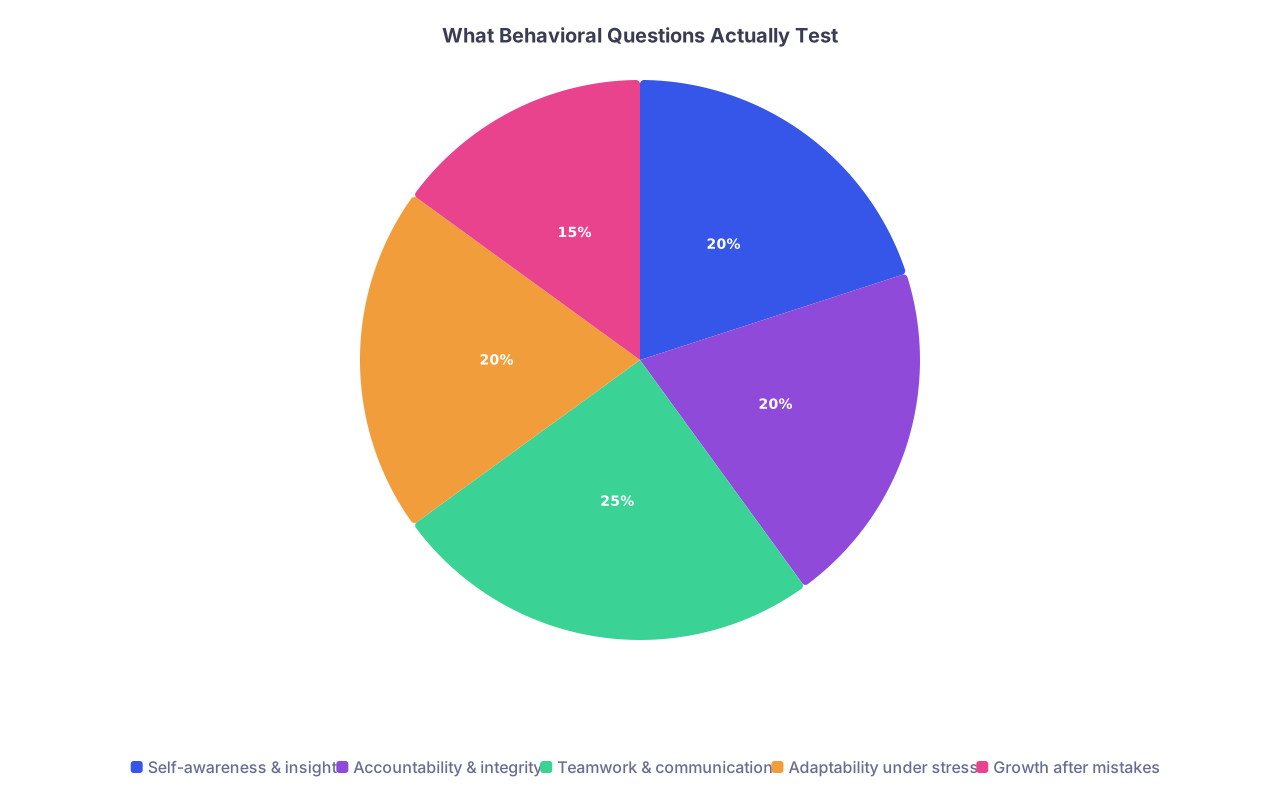
| Category | Value |
|---|---|
| Self-awareness & insight | 20 |
| Accountability & integrity | 20 |
| Teamwork & communication | 25 |
| Adaptability under stress | 20 |
| Growth after mistakes | 15 |
Let’s translate this into English.
1. Self-awareness
When they ask, “Tell me about a weakness,” the real question is:
“Can you see yourself clearly, or are you delusional?”
Bad signal:
- “I care too much”
- “I work too hard”
- “I’m just a perfectionist”
Good signal:
- You name something specific.
- You describe where it actually shows up.
- You show what you’re currently doing about it.
“I used to over-document and slow down the team” is more believable than “I care too much about my patients.”
2. Accountability
Any version of “Tell me about a mistake,” “Tell me about a time you failed,” or “Tell me about a conflict” is basically asking:
“When things go wrong, do you blame, hide, freeze, or own it?”
They’re looking for:
- You clearly admit what went wrong
- You do not spend 80% of the story explaining why it wasn’t your fault
- You demonstrate insight into impact on others
The content of the mistake matters less than your posture toward it.
3. Team fit and communication
Questions about difficult colleagues, interprofessional disagreements, or feedback are hunting for one key trait:
“Will this person be toxic?”
Signs of trouble:
- You always sound like the reasonable hero surrounded by incompetence
- You “solve” conflict by avoiding it
- You talk about nurses/other services with even slight contempt
They’re fine with residents who need teaching. They’re terrified of residents who burn bridges.
4. Resilience and adaptability
“Tell me about a stressful situation or heavy workload” isn’t about martyrdom. They’re not counting how many 28‑hour calls you survived.
They want:
- Evidence you prioritize under pressure
- You don’t catastrophize
- You have sustainable coping mechanisms beyond “I push through” and “I drink more coffee”
If your only strategy is to grind harder, that’s a red flag for future burnout, not a flex.
5. Capacity for growth
Reflection questions like “What did you learn?” are not filler. Programs want people who get better over time, not people who repeat the same year four times.
They’re scanning for:
- Specific behavior change (“Now I…” not just “I learned communication is important”)
- Recent examples that show you actually implemented the change
What Interviewers Actually Remember After a Long Day
Reality check: most programs interview dozens to hundreds of candidates. By the 7th “Tell me about a time you handled conflict” of the morning, answers blur.
What sticks is not your wording. It’s a handful of moments:
- The way your face changed when you described a mistake
- How you talked about a struggling classmate or difficult attending
- Whether your examples felt lived-in or suspiciously “optimized”
- That one specific detail that made the story feel real: “I still remember the nurse’s face when…” or “It was 6:45 p.m. and sign-out was in 15 minutes…”
Think of your answers less like essays and more like CT scans. Each one is a slice of how you behave. Interviewers are reading for pathology, not prose.
The Data: Where Interview Performance Actually Fits
Let’s ground this in something beyond anecdotes.
NRMP’s Program Director Survey repeatedly shows interview performance and “interpersonal skills” at or near the very top of factors used to rank applicants. Step scores and clerkship grades get you to the door. Your performance in the room often decides where you fall on the rank list.
| Factor | Relative Importance* |
|---|---|
| Interpersonal skills | Very High |
| Interview performance | Very High |
| Professionalism | High |
| Letters of recommendation | High |
| USMLE/COMLEX scores | Moderate–High |
*Summarized from multiple NRMP Program Director Surveys across specialties.
Notice what’s missing: “Use of perfect behavioral frameworks” and “Absence of verbal fillers.”
Programs care that you can interact like a decent, trainable human being. That’s it. Everything else is secondary.
How to Stop Chasing Perfection and Start Signaling What Matters
Let’s be practical. You still need structure so you don’t ramble. But you need to stop polishing your answers into lifeless LinkedIn posts.
1. Choose real stories with real stakes
If your conflict story could be told by any other applicant, it’s probably too generic.
Better:
- That time you and another student disagreed on whether to escalate care, and you later realized you’d been too avoidant
- The moment you realized your poor sign-out contributed to an overnight miss
- A time you got called out—fairly—by a nurse
You don’t have to incriminate yourself. But you do need to show that something real was at risk: patient safety, team trust, your integrity, etc.
2. Use structure, not a script
STAR/CARE/PAST–PRESENT–FUTURE are fine as scaffolds. The myth is that using them perfectly is the goal.
Your actual goals:
- Answer the question asked
- Be concrete and chronological
- Land the reflection
Think: 15–20 seconds to set the scene, 60 seconds on what you did and how you interacted with others, 20–30 seconds on what changed after.
If you’re spending 90 seconds just on background, you’re hiding.

| Step | Description |
|---|---|
| Step 1 | Question asked |
| Step 2 | Pick real example |
| Step 3 | Brief context |
| Step 4 | What you did & said |
| Step 5 | Impact on others |
| Step 6 | What you learned & now do |
3. Tell on yourself (a little)
Interviewers get suspicious when nothing you say involves you being wrong, frustrated, or uncertain.
Sprinkle in:
- “At the time, I was annoyed because…”
- “Looking back, I realized I’d made assumptions about…”
- “I remember feeling defensive when I first got that feedback.”
You’re not confessing sins. You’re demonstrating normal human reactions and then growth.
4. Translate reflection into behavior
“We improved communication” is meaningless. Program directors want to hear what you changed next week, not in theory.
For every “what I learned,” force yourself to add “which now looks like…” For example:
“I realized I was overloading my notes with irrelevant details, which slowed the team down. Now, I regularly ask residents what information they actually use from my notes and I pattern my templates on that. My notes are shorter, and I finish pre-rounding on time.”
That’s credible. It sounds like something a real intern might actually do.
5. Stop over-rehearsing the words. Rehearse the thinking.
Memorized answers fall apart the second the question is slightly different than what you drilled.
Instead of scripting full responses, practice:
- Rapidly generating 2–3 possible stories for each theme (conflict, failure, feedback, leadership, stress)
- Saying them out loud with different starting points
- Pivoting when faculty interrupt you or ask for more detail on a small part
You want flexible understanding, not perfect recitation.
Red Flags Interviewers Quietly Watch For
Since we’re debunking myths, let’s name some landmines that have nothing to do with “perfect answers” and everything to do with being rank-list poison.
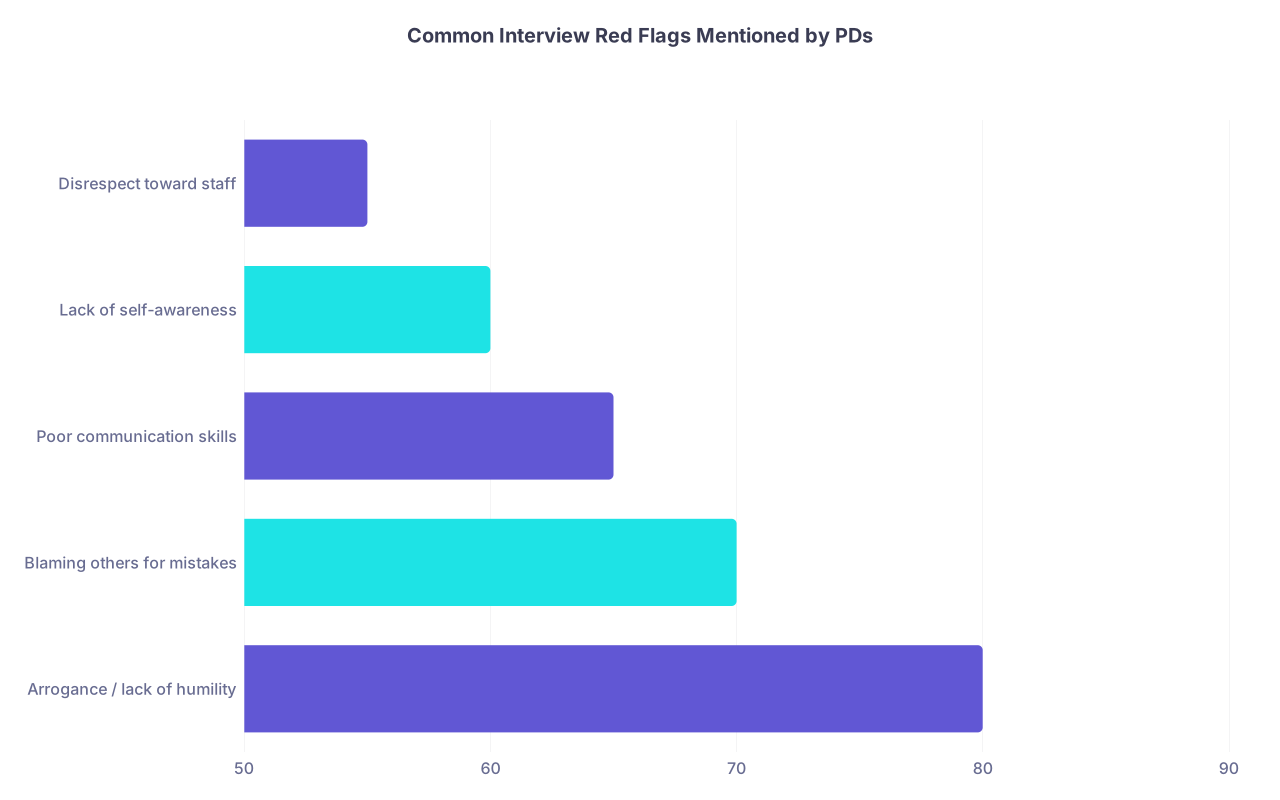
| Category | Value |
|---|---|
| Arrogance / lack of humility | 80 |
| Blaming others for mistakes | 70 |
| Poor communication skills | 65 |
| Lack of self-awareness | 60 |
| Disrespect toward staff | 55 |
These are the kinds of things that make people say “No” even if your Step score is glowing:
- You never describe being at fault—everyone else is the problem in your stories
- You talk about prior programs, classmates, or faculty with contempt
- You dodge weakness/mistake questions with transparent fluff
- You become defensive when pushed on an answer
- You “perform empathy” but never actually mention how others felt or were affected
If you’re anxious, fix this: don’t show up trying to prove you’re flawless. Show up trying to prove you’re safe to train.
What To Practice Before Interview Day (That Isn’t Memorizing Lines)
If you’ve read this far, you probably want concrete prep steps that don’t just feed the perfection machine. Good.
Here’s a smarter way to prep:
Build a story bank, not a script book.
10–15 real situations with:- A mistake
- A conflict
- A time you advocated
- A time you got hard feedback
- A high-stress stretch or heavy workload
Jot bullet points, not speeches.
Say them out loud to actual humans.
Not just in your head. Do mock interviews with someone who will interrupt you and ask, “Wait, what exactly did you say to the nurse?” That’s when you see if your story has bones.Record 2–3 of your answers on video.
Cringe and watch. Are you talking like a person or like a personal statement? Do you ever acknowledge uncertainty or emotion, or are you in robot mode?Get comfortable with follow‑ups.
Most attendings don’t just nod politely. They drill:- “Why did you think that was the right approach?”
- “What did the patient say?”
- “What would you do differently now?”
Your ability to think in the moment matters more than the initial story.
The Real Question You Should Prepare For
Underneath every behavioral prompt is one meta-question:
“If I’m on call with you and things go sideways, what version of you do I get?”
Not the version from your personal statement. Not the version from your perfectly rehearsed answer.
The tired, stressed, imperfect, real you.
If your interview performance gives them a believable glimpse of that person—someone who owns their mistakes, communicates clearly, respects the team, and keeps growing—you’re doing it right.
Years from now you will not remember the exact words you used to describe “a time you handled conflict.” You will remember whether you showed up as a polished act or as the kind of colleague you’d actually want at your side in the ICU at 3 a.m.—and programs will remember too.