
Most people are lying when they say their “conflict” stories never involve power dynamics.
You’re not crazy for worrying that your only real conflict story is with an attending or resident. That’s… how medicine actually works. The hierarchy is where the tension lives.
But I get why you’re panicking. You’re imagining the interviewer thinking:
“So this student is a problem. They fight with attendings. Red flag. Next.”
Let’s untangle that.
Why This Feels So Dangerous (And Why It Actually Isn’t)
You’re scared of three things:
- That any conflict with a supervisor automatically makes you look unprofessional.
- That you’ll sound like you’re throwing an attending or resident under the bus.
- That they’ll assume you’re “difficult” and won’t fit into their program.
Those are valid fears. Programs are hypersensitive about “problem residents.”
But here’s the part no one tells you:
Program directors and interviewers know that almost all of your meaningful clinical conflict has probably been with someone above you in the hierarchy. You’re not managing teams of employees. You’re not the boss. You’re a med student. Your “disagreements with peers” are often just group project annoyance, not serious professional conflict.
So when they ask, “Tell me about a time you had a conflict with a colleague or team member,” and your brain only pulls up:
- That attending who snapped at you in front of the team
- The resident who shrugged off your concern about a patient
- The senior who dismissed your question and then you were actually right
…that’s not a problem. That’s normal.
The danger isn’t that the conflict involved an attending or resident.
The danger is:
- Sounding victim-y
- Sounding self-righteous
- Sounding like you don’t understand hierarchy and professionalism
- Focusing on how wrong they were instead of what you did
You can absolutely use an attending/resident conflict story. You just have to be ruthless about how you shape it.
The Quiet Secret: They’re Not Testing The Story, They’re Testing You
, Blame vs Ownership, Outcome & Follow-up](https://cdn.residencyadvisor.com/images/articles_svg/chart-what-interviewers-actually-listen-for-in-conflict--6122.svg "What Interviewers Actually Listen For In Conflict Stories")
| Category | Value |
|---|---|
| Insight & Self-awareness | 35 |
| [Professionalism Under Stress](https://residencyadvisor.com/resources/behavioral-interview-questions/how-faculty-test-your-professionalism-with-one-behavioral-question) | 30 |
| Blame vs Ownership | 20 |
| Outcome & Follow-up | 15 |
Interviewers don’t actually care whether the other person was a resident, attending, nurse, or scrub tech. That’s background noise.
They’re listening for:
- Do you understand your own role in the conflict, even if you were mostly right?
- Do you show respect for the system and the people above you, even when they’re wrong or harsh?
- Do you escalate appropriately, or do you blow things up?
- Do you learn anything, or are you just bitter?
I’ve literally heard a PD say after an interview:
“The fact that it was with an attending doesn’t bother me. It’s how they told the story. They were clearly still angry and saw themselves as the hero.”
That’s what kills applicants. Not the topic. The framing.
Using an Attending/Resident Conflict Story Without Setting Yourself on Fire
Let’s be blunt. You’re scared they’ll think:
- “This person will complain to GME the second something doesn’t go their way.”
- “This person can’t handle being corrected.”
- “This person thinks they know more than their supervisors.”
So you have to build your answer specifically to block those assumptions.
Here’s the structure I’d use, no fluff:
Set the context in a neutral way
You’re not on a crusade. You’re describing a normal day that turned tense.
Example: “On my internal medicine rotation, I worked with a resident who had a very fast-paced style and a different communication approach than I was used to.”Describe the conflict briefly and specifically
No character assassination. No adjectives like “rude,” “disrespectful,” “lazy,” “incompetent.” Stay factual.
Example: “During rounds, I brought up a concern about a patient’s increasing oxygen requirement. The resident dismissed it quickly and moved on, and I felt uncomfortable because it didn’t match what I was seeing in the chart.”Shift fast to your internal response
This is where you show emotional maturity.
Example: “I remember feeling frustrated and a bit embarrassed in front of the team, but I also knew I was at the bottom of the hierarchy. I didn’t want to challenge them publicly or make it seem like I didn’t respect their judgment.”Show how you handled it professionally
This is the core: your behavior in a system where you’re not in charge.
Example: “After rounds, I asked the resident privately if we could revisit the patient for a moment. I framed it as wanting to understand their thinking better. I said something like, ‘I might be missing something, but I noticed X and Y—could you walk me through how you’re thinking about it?’”Acknowledge their perspective, even if you still think they were wrong
You don’t have to agree. But you have to show you get it.
Example: “They explained they were worried about over-ordering tests and slowing the team down, and they’d been told to be more efficient. That helped me understand they weren’t careless—they were under pressure from above.”Share the outcome without gloating
Even if you turned out to be right, drop the victory dance.
Example: “We ended up going back to reassess the patient together and decided to escalate care sooner. The patient ultimately did well, and I appreciated that the resident was willing to reconsider the plan.”End with your learning, not their flaw
This is the part 90% of anxious applicants skip. Don’t.
Example: “It taught me that I can raise safety concerns without being confrontational, and that framing my questions as curiosity rather than challenge tends to be better received, especially in a hierarchy.”
Notice what’s missing?
No rant about how “toxic” the culture is. No revenge, no “and that’s why I don’t trust residents” vibe. You sound like someone who can survive real-life residency.
But What If The Attending/Resident Was Actually Really Wrong?
You might have a story that wasn’t just “tone mismatch.” It might’ve been:
- Unsafe discharge plan
- Inappropriate comment to a patient
- Ignoring sepsis signs
- Screaming at you in front of a patient
And you’re thinking, “If I water this down, I’m lying. If I tell it honestly, I’m dead.”
You’re in a tight spot. But not hopeless.
The trick here is to keep three threads running at the same time:
- Patient safety matters, and you care about it.
- You understand power dynamics. You’re not reckless.
- You use appropriate channels, not nuclear options.
Here’s a rough example with a more serious situation:
“I was on surgery, and there was a patient post-op who was more tachycardic and hypotensive than earlier. I mentioned my concern during table rounds, and the resident brushed it off, saying the patient was just in pain. I felt uneasy, but I also knew I wasn’t the decision-maker.
After rounds, I double-checked the vitals trend and fluid balance, and it still didn’t sit right with me. I went back to the resident privately and said, ‘I know I’m just the student, but could we look at this together? I’m worried I might be misinterpreting something, but this pattern is making me nervous.’ Framing it that way helped—he did come back to reassess, and we ended up calling the attending. The patient got additional workup and fluids.
I wasn’t angry with the resident; I could see he was juggling a lot and trying not to overreact. For me, the takeaway was that even as a student, I have a responsibility to speak up for patients, but that how I do it—timing, tone, privacy—really affects how people respond.”
You can hear the difference, right? You’re not the “brave hero who saved the patient from the idiot resident.”
You’re someone who cares, respects hierarchy, and still advocates.
The Big Red Flag To Avoid: Making It Sound One-Sided

There’s one pattern that absolutely kills these stories:
You: “So this attending was super rude and just wrong, and I did the right thing, and that’s the story.”
If you walk out of that interview saying, “I was 100% right and they were 100% wrong,” the interviewer hears:
- Poor insight into your own behavior
- Fixed mindset
- Probably hard to supervise
Even if you were basically right, you still need to own something:
- You could’ve reacted internally with less defensiveness
- You could’ve asked a clarifying question earlier
- You could’ve managed your tone better
- You could’ve followed up differently afterward
Owning 10–20% of the mess doesn’t make you weak. It makes you safe to train.
You want the interviewer thinking:
“Okay, this applicant has had some friction with supervisors, but they process it well and stay professional. I can work with that.”
Should You Avoid These Stories If You Can?
If you have a clean, rich conflict story with:
- A peer on a research project
- A co-leader in a student group
- A teammate on a QI project
…yeah, that’s usually the safer first choice. Not because attending/resident stories are forbidden, but because peer-level conflict is easier to frame without tripping hierarchy wires.
But here’s the part that’s probably making you sweat:
Sometimes you don’t have a good peer story that actually matters. It’s all small stuff: “my classmate submitted the survey late.” Nobody wants to hear that.
In that case?
Use the attending/resident story. It’s okay.
Just be laser‑focused on these:
- Respectful language when describing them
- Clear, calm explanation of what you did
- A believable, non-smug lesson learned
- Zero “I showed them I was right” energy
If the most real growth you had came from clashing with an attending, that’s valid. That’s actually what growth often looks like in med school.
Quick Reality Check: What Programs Actually Care About
| What You Worry About | What Programs Actually Worry About |
|---|---|
| Mentioning conflict with an attending at all | You sounding arrogant or insubordinate |
| Admitting you disagreed with a resident | You not respecting hierarchy under pressure |
| Being judged for speaking up | You not speaking up for safety when it truly counts |
| Saying you felt hurt or frustrated | You holding grudges and creating drama |
| Saying you think you were right | You refusing feedback or refusing to self-reflect |
You’re obsessing over the wrong part of the equation.
The content of the story is less important than your mindset in the story.
If your answer screams:
“I was uncomfortable. I tried to handle it professionally. I learned something. I still respect the people above me even when we disagree.”
…you’re fine. Really.
If You’re Still Terrified, Do This

| Step | Description |
|---|---|
| Step 1 | Pick conflict with supervisor |
| Step 2 | Strip out blaming language |
| Step 3 | Identify your emotions & reactions |
| Step 4 | Highlight what you did professionally |
| Step 5 | Clarify what you learned |
| Step 6 | Practice telling it out loud |
Take your story and run it through a few tests:
The Adjective Test
Any words like “toxic, rude, impossible, incompetent, crazy”?
Cut them. Replace with neutral description of behavior.The Hero Test
Do you sound like the only reasonable person in the story?
If yes, find one thing you could’ve done differently and say it.The Tone Test
Practice out loud. If someone listened to your tone with the words muted, would they hear anger, bitterness, or superiority? Or calm reflection?The “If They Were Sitting Here” Test
Could you tell this story if that attending/resident were in the room?
You should be able to. You’re not assassinating their character; you’re describing a situation.
If you can pass those, your attending/resident conflict story is not a landmine. It’s actually a strong answer.
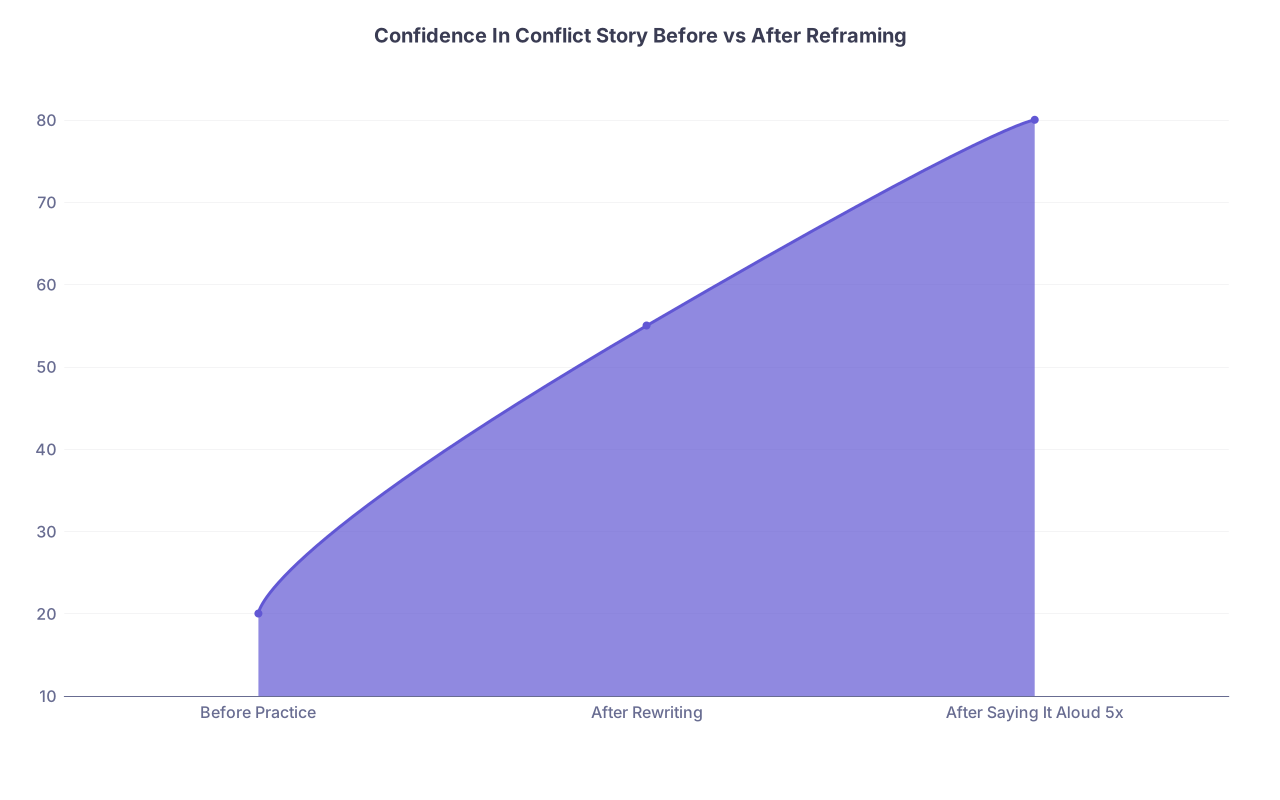
| Category | Value |
|---|---|
| Before Practice | 20 |
| After Rewriting | 55 |
| After Saying It Aloud 5x | 80 |
FAQ (Exactly 5 Questions)
1. Will using a conflict story with an attending or resident automatically hurt my chances?
No. Interviewers expect most of your real conflict to involve the hierarchy. It only hurts you if you come across as blaming, arrogant, or unaware of your own role. If you sound reflective and respectful, it can actually help because it shows you’ve already dealt with the power dynamics you’ll face as a resident.
2. Should I change the attending to “a senior team member” to hide the hierarchy?
You can soften the label a bit (“a supervising physician,” “a senior resident”), but don’t lie. Most interviewers will figure it out anyway. What matters isn’t the title; it’s how you talk about them. Neutral tone, no name-calling, and a clear focus on your actions and growth are far more important than the exact label.
3. What if I was genuinely mistreated or yelled at—should I use that story?
You can, but only if you’re far enough away from it emotionally to tell it calmly and with perspective. If you’re still boiling inside, skip it for now. When you describe mistreatment, you need to sound grounded: “This was hard, here’s how I handled it, here’s what I learned,” not, “Let me tell you how awful they were.”
4. Do I have to admit fault even if I really believe I was right?
You don’t have to pretend you were wrong clinically. But you do need to own something—your initial reaction, your communication, or the timing of how you brought it up. Residents who are “always right and never at fault” are miserable to work with. Show that you can be correct about the issue while still humble about your behavior in the moment.
5. Is it better to use a weaker peer conflict story than a strong attending conflict story?
If the peer story is trivial or fake-sounding, it’ll fall flat. A real, meaningful conflict with a supervisor, told well, is better than a shallow “we disagreed on a project deadline” story. Depth beats safety. As long as you show respect, insight, and professionalism, the attending/resident story is absolutely usable.
Key points to keep in your head:
Your conflict story involving an attending or resident is not the problem. The way you tell it is.
If you strip out blame, keep your respect for hierarchy obvious, and end with a real, specific lesson, that story can actually make you look more ready for residency—not less.