
Should You Admit Fault in “Tell Me About a Mistake” Questions?
You’re sitting in a residency interview room. The program director leans back, glances at your ERAS printout, and says the classic line:
“Tell me about a time you made a mistake.”
Your brain panics.
Do you actually admit fault?
Do you give some fake “I cared too much” non-answer?
If you’re like most applicants, you’re trying to be honest without torching your chances.
Let me answer the core question first, then we’ll unpack how to do this without self-destructing:
Yes, you absolutely should admit fault in “tell me about a mistake” questions.
If you don’t, you look defensive, immature, and unsafe to supervise.
The trick isn’t to hide fault.
The trick is to admit the right kind of fault, in the right way.
Let’s go through exactly how.
What Programs Are Actually Testing With This Question
They are not trying to trap you into confessing some catastrophic error so they can blacklist you. They’re testing four things:
- Self-awareness – Can you see your own role in a problem without excuses?
- Accountability – Do you own what you did, or do you blame “the system” and everyone else?
- Growth – Did you actually change your behavior afterward, or just feel bad and move on?
- Safety – If you screw up as an intern (you will), are you likely to hide it or speak up?
Here’s the harsh truth:
If you dodge fault, they assume you’ll dodge responsibility on the wards.
Interviewers hear this question all day. They’ve heard:
- “I’m a perfectionist and sometimes I work too hard.”
- “Sometimes I care too much and forget about my own needs.”
- “We as a team could have communicated better.”
Those are non-answers. They don’t show insight. They show fear.
You want to come across as the resident who will say:
“I messed up, here’s how, and here’s exactly what I changed.”
That’s who people want on their team at 3 a.m.
So… How Much Fault Should You Admit?
You want to land in the “mature and honest” zone. Not the “liability risk” zone.
Think of it as three tiers:
| Tier | Example Type | Use in Interview? |
|---|---|---|
| Low-risk | Communication, organization, time management | Yes – ideal choices |
| Medium-risk | Clinical judgment with good supervision and recovery | Maybe – if framed well |
| High-risk | Gross negligence, lying, boundary violations | No – avoid these |
Let’s break that down.
Good mistake categories to admit
These are fair game. They show growth without making you look dangerous:
- Communication: Not updating a senior, unclear handoff, assuming someone else would follow up.
- Organization/time management: Overcommitting, not planning well, missing a deadline.
- Professionalism-lite: Late to something once, dropped the ball on an email, informal tone with a consultant.
- Early training judgment errors: Mis-prioritizing tasks as an early MS3, not asking for help early enough (but you did eventually).
Example:
“I didn’t clarify who was updating the patient’s family, and it led to confusion and frustration for them. I realized I’d assumed instead of confirming roles.”
This is a real mistake. You own it. No one hears that and thinks, “Malpractice risk.”
Mistakes to handle carefully
These are okay if you show good supervision, prompt correction, and strong learning:
- Minor clinical judgment errors that were caught
- Documentation issues that were fixed the same day
- Missing a subtle finding but escalating appropriately when things didn’t fit
You must emphasize:
- You were supervised
- The patient was ultimately safe
- You changed your practice in a concrete way
Mistakes to avoid entirely in an interview
Just don’t.
- Lying in documentation
- Falsifying anything (notes, hours, research data)
- Repeated professionalism problems, big conflicts
- Major safety violations, ignoring direct instructions, hiding an error
- Anything involving serious legal/ethical red flags
Moral: Admit real fault, not career-ending fault.
The Right Way to Admit Fault (Without Digging a Hole)
Here’s the structure that works over and over. Simple, clean, adult.
I like a 4-step framework:
- Context (brief)
- Clear fault admission
- Impact (what went wrong or almost went wrong)
- What you changed – with specifics
Keep it tight. If your answer is a 5-minute saga, you’re doing too much.
1. Context (15–20 seconds)
You’re not writing a novel. They don’t need every lab value.
Bad:
“I was on my internal medicine rotation, and there was this super complex patient with cirrhosis, renal failure, diabetes, and social issues, plus it was a weekend and the ED was slammed…”
Better:
“On my IM rotation, I was covering several new admissions on a busy evening.”
That’s enough.
2. Clear fault admission
This is where most applicants get cute and ruin it.
Bad versions:
- “We as a team didn’t communicate well.”
- “The system wasn’t set up for success.”
- “In hindsight, things could’ve gone better.”
That’s dodging. Interviewers notice.
Good version:
- “I didn’t call the senior early enough.”
- “I assumed someone else would handle X and didn’t confirm.”
- “I didn’t prioritize this correctly and it led to a delay.”
Use an “I” sentence. Short. Direct.
3. Impact: what actually happened
You don’t need drama, but you do need a real consequence.
- A delay (labs, imaging, consult, discharge)
- Confusion (family, patient, team)
- Extra work for someone else
- Emotional impact (family upset, patient frustrated)
Example:
“As a result, the patient’s family didn’t get an update until much later in the evening, and they were understandably upset.”
That’s enough. You showed that the mistake wasn’t just “in theory.” It affected someone.
4. What you changed (this is the payoff)
If this part is weak, the whole answer dies.
You need:
- A specific process change
- Evidence that you’ve used it since
- Ideally, a quick example of improved outcomes
Weak:
“I learned the importance of communication.”
“I realized I need to manage my time better.”
Strong:
“Now at the start of my shift, I write a quick list of which families need updates and by what time. I also explicitly assign who is doing the update if there are multiple team members. I’ve used this consistently and I’ve had far fewer issues with families feeling in the dark.”
That sounds like someone I’d trust as a resident.
A Few Polished Sample Answers (So You Can Hear the Tone)
Here are three realistic, residency-level answers where you admit fault clearly but safely.
Example 1: Communication mistake
“You asked about a mistake. On my medicine rotation, I once dropped the ball on family communication.
We had a patient with worsening respiratory status. The team made a plan to transfer him to a higher level of care. I assumed my senior would call the family, and my senior assumed I would handle it since I’d been talking with them earlier in the day. I didn’t clarify.
The patient was transferred before the family got an explanation, and when they arrived later that evening, they were understandably upset and anxious. That was on me for not explicitly confirming who would call them.
Since then, I’m very deliberate about closing that loop. If there’s a major change in status or location, I either make the call myself or confirm, in words, ‘Are you okay with calling the family, or should I?’ I also add “family updated?” as a mental checklist item when we make big decisions. It’s a small thing, but it’s prevented similar situations since.”
Clear fault. Real consequence. Concrete fix.
Example 2: Time management / overcommitment
“In my second year, I made a mistake overcommitting to a research project timeline.
I told my PI I could complete a data abstraction phase in three weeks, on top of classes and an exam block. I underestimated the work and didn’t build in any buffer. I fell behind, didn’t communicate early, and ended up sending a panicked email three days before the deadline. He was understanding, but it delayed his grant submission and created stress for the whole group.
I realized I’d treated the deadline as flexible because I didn’t want to say no, which wasn’t fair to anyone. Since then, I’ve started using a very simple rule: I estimate how long something will take, then double it before I commit. I put interim checkpoints on my calendar, and if I’m not hitting those, I update the person before it becomes urgent. My more recent projects have actually finished ahead of the revised deadlines, and my PI has commented that my planning has improved a lot.”
You admit fault. You don’t call it “poor time management” in vague terms; you show exactly what changed.
Example 3: Early clinical judgment error (safely framed)
“On my first clerkship, I made a mistake in judgment around when to escalate.
I saw a post-op patient who mentioned some new shortness of breath. Vitals were okay, exam was fairly normal, and I attributed it to pain and limited mobility. I documented it but didn’t immediately bring it to my senior’s attention. A few hours later, the nurse was concerned, my senior re-evaluated, ordered imaging, and the patient was found to have a small PE. The patient did well, but I realized I’d been too reassured by ‘normal enough’ vitals and my narrow differential.
That was a wake-up moment. I changed two things: first, I have a much lower threshold to say to my senior, ‘Something feels off, can you take a look?’ even if I can’t fully articulate it. Second, for post-op or high-risk patients, I consciously think, ‘What’s the worst thing this could be?’ and ask whether we’ve ruled that out. Since then, I’ve caught issues earlier and have been more comfortable erring on the side of over-communicating rather than under-communicating.”
You admit fault. You show you learned. You emphasize safety and supervision.
Common Ways Applicants Screw This Up
You can absolutely blow this question even with a decent story if you do one of these:
Blame everyone else.
“The nurse never told me.”
“The system is broken.”
“The attending didn’t explain.”
You get one sentence of context max. Then you own your part.Use a fake mistake.
The classic “I care too much” garbage. Interviewers can smell this from the door. It’s lazy and makes you look coached and insecure.Confess something catastrophic.
You do not need to “bare your soul” with the worst thing you’ve ever done in medicine. This is not therapy. Use a moderate, representative example.Stay vague.
“I learned to communicate better.”
“I grew from that experience.”
Say what you do differently now in specific terms.Sound ashamed instead of accountable.
You’re not on trial. You’re showing maturity. Calm, matter-of-fact, “this is how I improved” energy plays much better than self-flagellation.
Quick Mental Checklist Before You Answer
Right before you start your story, silently ask yourself:
- Am I clearly admitting my role?
- Is this mistake fixable, not catastrophic?
- Can I describe one or two specific changes I made afterward?
- Do I end sounding more competent, not less?
If you can hit those four, you’re in good shape.
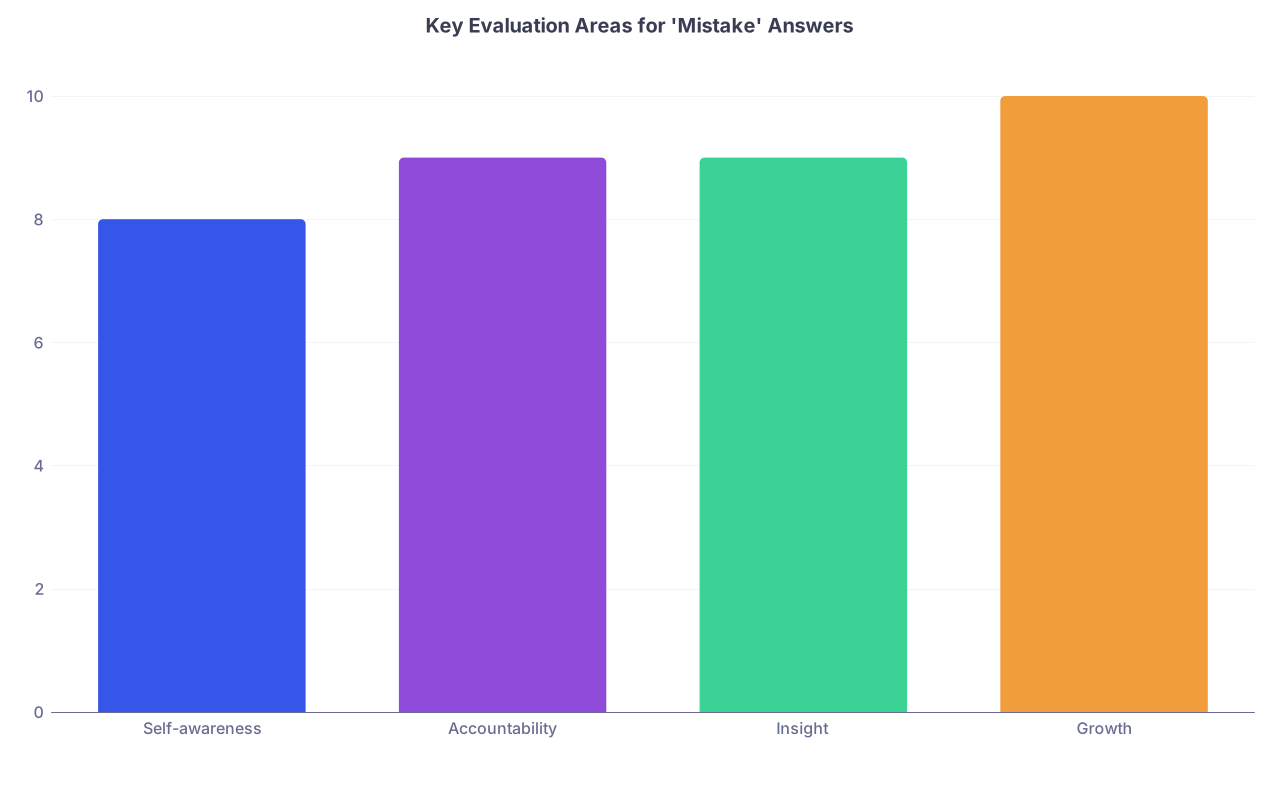
| Category | Value |
|---|---|
| Self-awareness | 8 |
| Accountability | 9 |
| Insight | 9 |
| Growth | 10 |

| Step | Description |
|---|---|
| Step 1 | Hear question |
| Step 2 | Pick moderate, real mistake |
| Step 3 | State brief context |
| Step 4 | Clearly admit fault with I statement |
| Step 5 | Describe impact/consequence |
| Step 6 | Explain specific changes you made |
| Step 7 | End on growth and current practice |


FAQ: “Tell Me About a Mistake” in Residency Interviews
Should I always admit that the mistake was my fault?
Yes, you should clearly own your part. You don’t have to say you were the only one at fault, but you must say what you did wrong. Use an “I” statement: “I didn’t escalate early enough,” “I overcommitted and didn’t communicate,” etc. Dodging with “we” and “the system” is an instant red flag.Can I use a non-clinical example (e.g., research or student org)?
Yes, especially if your clinical experience is limited. A research, leadership, or scheduling mistake is fine as long as it’s real, shows impact on others, and you clearly explain what you changed afterward. If you’ve done clinical rotations, I’d lean toward a patient-care-adjacent mistake (communication, handoffs) that still feels relevant to residency.What if my biggest mistake is actually pretty serious?
You don’t owe them your worst life story. Choose a moderate, representative mistake that shows growth without raising concerns about safety or ethics. If your “biggest mistake” involves dishonesty, serious boundary violations, or major safety lapses, don’t use that in an interview answer. Pick something real but less explosive.How long should my answer be?
Aim for about 60–90 seconds. Enough time to set context, admit fault, describe the impact, and clearly outline what changed. If you’re talking for over two minutes, you’re including irrelevant detail. Practice once or twice out loud; you’ll hear when you’re rambling.What if they push and ask for another example?
Have a backup ready in a different category. For example, one communication mistake and one time-management or research mistake. The structure stays the same: brief context → clear fault → impact → change. If they ask for another, they’re not punishing you; they just want to see consistency.Can I mention that I cried, felt terrible, or was really upset about it?
You can briefly acknowledge that it was emotionally tough, but don’t linger there. One line is enough: “I felt awful about it at the time.” Then move quickly to what you did next and how you changed. They’re not grading your level of guilt; they’re grading your maturity and growth.
Key takeaways:
- Yes, you should admit fault in “tell me about a mistake” questions—clearly and directly.
- Choose a real but moderate mistake, and spend most of your time on what you changed afterward.
- If you sound honest, specific, and growth-oriented, this question becomes a strength, not a trap.