
How Many Behavioral Stories Do You Really Need for Residency Interviews?
What happens when the fourth interviewer in a row asks you, “Tell me about a time you made a mistake,” and you realize you’ve already burned your only good mistake story?
Let me be direct: you do not need 30 perfectly polished stories to survive behavioral residency interviews. But you also cannot walk in with two vague examples and hope “I’ll just wing it.” That’s how people end up rambling about group projects from undergrad and losing programs that would’ve ranked them.
Here’s the real answer, plus a framework that actually works when you’re sleep‑deprived, flying between interviews, and your brain is fried.
The Short Answer: Your Behavioral Story Number
If you just want the number, here it is:
You need 8–12 solid, distinct behavioral stories to be well‑prepared for residency interviews.
Not 3. Not 25. Around 10. Here’s how it breaks down:
| Category Type | Minimum | Ideal |
|---|---|---|
| Conflict / Difficult Interactions | 2 | 3 |
| Mistakes / Failure / Feedback | 2 | 3 |
| Teamwork / Collaboration | 1 | 2 |
| Leadership / Initiative | 1 | 2 |
| Ethics / Professionalism | 1 | 2 |
| Stress / Resilience / Burnout | 1 | 2 |
Notice something: that’s not “tell me about a time you…” 60 different ways. It’s really 6 core buckets, with 1–3 stories each.
If you build those right, you can answer 80–90% of behavioral questions they throw at you by flexing or reframing one of those stories.
The 6 Core Story Buckets You Actually Need
Let’s walk through what those 6 buckets really look like in residency interviews—because programs recycle the same themes.
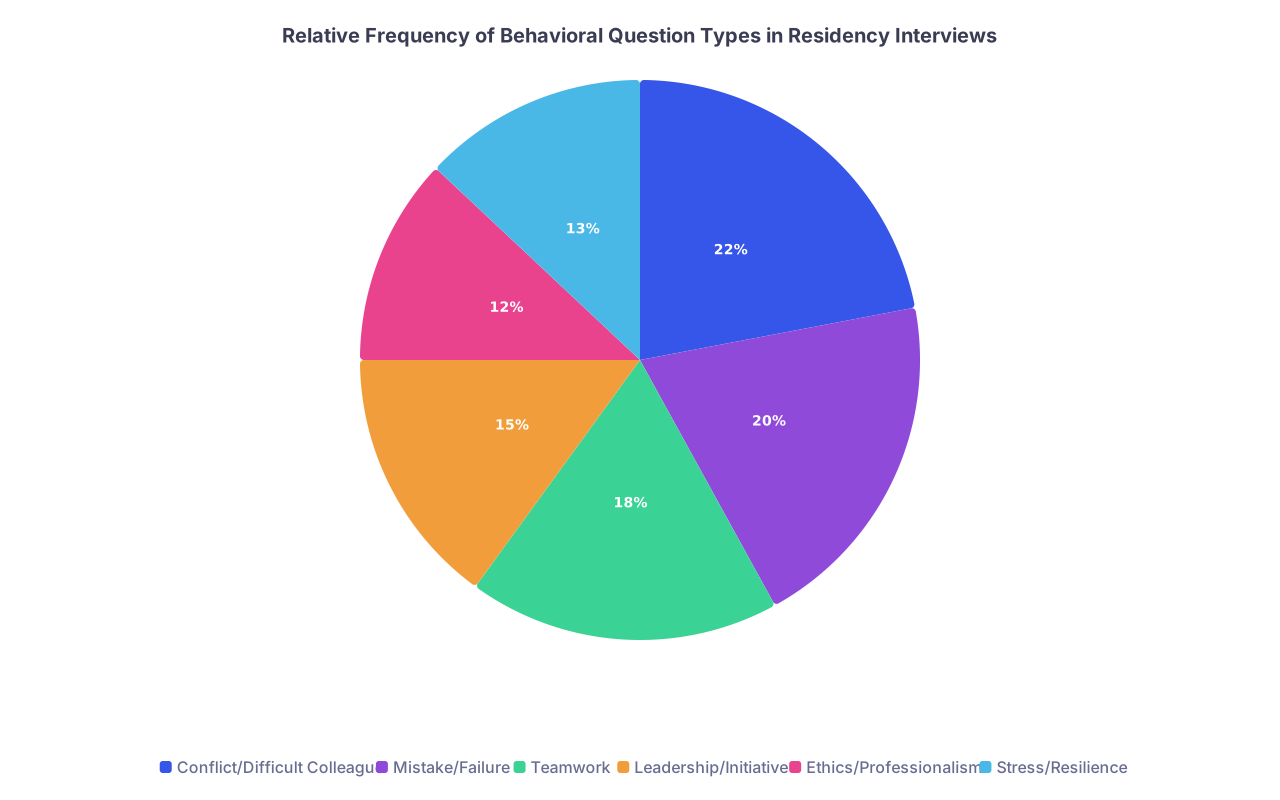
| Category | Value |
|---|---|
| Conflict/Difficult Colleague | 22 |
| Mistake/Failure | 20 |
| Teamwork | 18 |
| Leadership/Initiative | 15 |
| Ethics/Professionalism | 12 |
| Stress/Resilience | 13 |
1. Conflict / Difficult Interactions (2–3 stories)
This is the most abused category. They love asking you about:
- “Tell me about a conflict with a colleague or team member.”
- “Describe a time you had to give difficult feedback.”
- “Tell me about a conflict with a patient or family.”
You want at least two stories here:
- One with a peer (co‑student, co‑resident, nurse, consultant).
- One with a patient or family.
If you have a third, great: maybe a disagreement with a supervising resident or attending where you handled hierarchy well.
Key: conflict story ≠ drama story. If your story makes you look like the hero surrounded by idiots, you will sound arrogant. The best conflict stories show:
- You tried to understand the other side.
- You protected patient care.
- You used calm, specific communication.
- The relationship or system improved, even a little.
2. Mistake / Failure / Feedback (2–3 stories)
Programs are obsessed with this. Why? Because residency is a 4‑year buffet of failure and correction. They want proof you:
- Admit mistakes without excuse.
- Take feedback without collapsing or getting defensive.
- Actually change your behavior.
Common question frames:
- “Tell me about a time you made a clinical mistake or almost made one.”
- “Tell me about a time you received tough feedback.”
- “Describe a failure and how you handled it.”
You should have:
- One clinical‑adjacent mistake (near miss, follow‑up dropped, communication error).
- One non‑clinical failure (exam, project, leadership thing) that still shows growth.
- Optional third: a feedback transformation story (you changed your approach based on specific feedback).
If all your “failures” are actually humble‑brags (“I care too much”), they’ll see right through it.
3. Teamwork / Collaboration (1–2 stories)
Medicine is a team sport. They want to know if you’re the person nurses roll their eyes at, or the one they’re relieved to see.
Common formats:
- “Tell me about a successful team experience.”
- “Describe a time your team was struggling and what you did.”
- “Tell me about a time you had to work with someone very different from you.”
Have at least one strong story that shows:
- Multidisciplinary teamwork (RN, RT, social work, pharmacy, etc.).
- Clear goal (stabilize patient, safely discharge, fix a broken process).
- Your role is specific, not “I helped the team.”
A second story, if you have one, can be outside the hospital (community project, QI, research team) as long as it’s concrete and mature.
4. Leadership / Initiative (1–2 stories)
You don’t have to have been class president. They’re not only looking for “titles”; they’re looking for initiative.
Common prompts:
- “Tell me about a time you led a project.”
- “Describe a situation where you saw a problem and took action.”
- “Tell me about a time you motivated others.”
Good leadership stories often look like:
- You noticed a recurring problem on the wards (e.g., discharge confusion, poor handoffs) and started a small fix.
- You organized or revamped something (teaching series, student schedule, clinic workflow).
- You led in a moment of crisis (code, rapid response, short‑staffed night).
Do not confuse “I did everything myself because no one else stepped up” with leadership. That reads as poor delegation and poor boundaries.
5. Ethics / Professionalism (1–2 stories)
People underestimate this one until they get blindsided:
- “Tell me about an ethical dilemma you faced.”
- “Describe a time you saw unprofessional behavior. What did you do?”
- “Tell me about a time you advocated for a patient.”
You want at least one story where:
- There was a genuine tension: autonomy vs. beneficence, resource limits, confidentiality, hierarchy vs. speaking up.
- You struggled with the decision but still acted.
- You didn’t just dump the problem on someone else and walk away.
That might be:
- A questionable documentation situation.
- A colleague speaking disrespectfully in front of a patient.
- Pressure to discharge too early.
If you watched bad behavior and did literally nothing, that’s not your story. Or you change the story to what you wish you had done now, and frame it as learning.
6. Stress / Resilience / Burnout (1–2 stories)
Residency breaks people who can’t manage stress or ask for help. Programs know this.
You’ll hear:
- “Tell me about a time you were overwhelmed.”
- “Describe a time you had to juggle multiple responsibilities.”
- “Tell me about a challenging period in your life and how you got through it.”
You need at least one authentic story that shows:
- Real stress (not “I studied a lot for Step 1” and that’s it).
- How you prioritized, communicated, or reset expectations.
- How you now prevent or manage similar situations.
This can be clinical (insane cross‑cover night) or personal (family crisis during rotations) as long as you connect it back to who you are as a physician now.
Why 8–12 Stories Is Enough (If You Build Them Right)
Programs don’t ask 15 totally unique behavioral questions. They just rephrase the same themes.
“Tell me about a time you had a disagreement.” “Tell me about a time you had to advocate for someone.” “Tell me about a time you stood up for what you believed in.”
Those might all be answered with the same ethics/conflict story from different angles.
With 8–12 stories, you can flex:
- One conflict story can answer:
- Conflict with a peer
- Handling a difficult nurse interaction
- Working with someone different from you
- One mistake story can answer:
- Failure
- Feedback
- Growth over time
- One leadership story can answer:
- Initiative
- Motivating a team
- Process improvement
The trick is to know your story so well that on the spot you can emphasize the piece that fits the question.
The Matrix Method: Map Stories to Multiple Question Types
Here’s how efficient people prep: they build a story matrix, not a huge script.

Take your 8–12 stories and map them like this:
| Story ID | Primary Category | Can Also Cover |
|---|---|---|
| S1 | Conflict | Teamwork, Communication |
| S2 | Mistake | Feedback, Growth |
| S3 | Teamwork | Leadership, Stress |
| S4 | Leadership | Initiative, Systems Improvement |
| S5 | Ethics | Advocacy, Professionalism |
| S6 | Stress | Time Management, Resilience |
You’ll see quickly:
- Which buckets are thin (e.g., you have 4 leadership stories and zero ethics stories).
- Which stories are doing too much work (relied on for everything).
- Where you’re repeating the same rotation or patient over and over.
If three of your best stories are all from one ICU month, force yourself to pull something from ambulatory, preclinical years, or even before med school.
Programs notice variety.
What Makes a Story “Good Enough” for Interview Day?
You don’t need TED‑talk‑level perfection. You need clarity, structure, and reflection.
Use a simple version of STAR:
- Situation – 1–2 sentences. Set the scene. No long backstory.
- Task – What you were supposed to do / what the problem was.
- Action – What you actually did. Focus here.
- Result + Reflection – What happened and what you learned/changed.
What makes a story strong:
Specific
“I had a conflict with a nurse” is vague.
“On my IM sub‑I, a night nurse refused to give a PRN medication I’d ordered for uncontrolled pain because she was worried about respiratory depression” is a story.You have a clear role
If your “action” is mostly “my attending did X,” it’s not your story.It shows growth
Programs care less about the mistake and more about: are you coachable? Will you be better after this?It doesn’t raise red flags
If the story makes them wonder, “Would I trust this person on night float?”—throw it out.
How Many Stories Per Interview Day?
You’re thinking about fatigue—and you should. Most interview days:
- 3–6 interviews
- 25–45 minutes each
- Some will be conversational and barely touch behavioral questions
- Some will hit you with five in a row
In practice, on a heavy behavioral day, you might use 6–8 of your stories, with 2–3 of them doing double duty in slightly different forms.
The trick is to rotate. Don’t tell the same story to every single interviewer when they ask slightly different questions. They talk afterwards.
Here’s a simple way to keep track on the fly:

| Step | Description |
|---|---|
| Step 1 | Start of Day |
| Step 2 | First Interview |
| Step 3 | Use Best-Fit Story |
| Step 4 | Choose Different Story |
| Step 5 | Note Story Used |
| Step 6 | Next Interview |
| Step 7 | Same theme as earlier? |
After each interview, jot down in your notes app: “Dr. Smith – conflict story #1, mistake story #2, ethics story #1.” That way, if you get a PD last, you’re not recycling the same two stories you told everyone else.
Dialing Up or Down Your Preparation Based on Specialty
Not every specialty hits behavioral content with the same intensity.
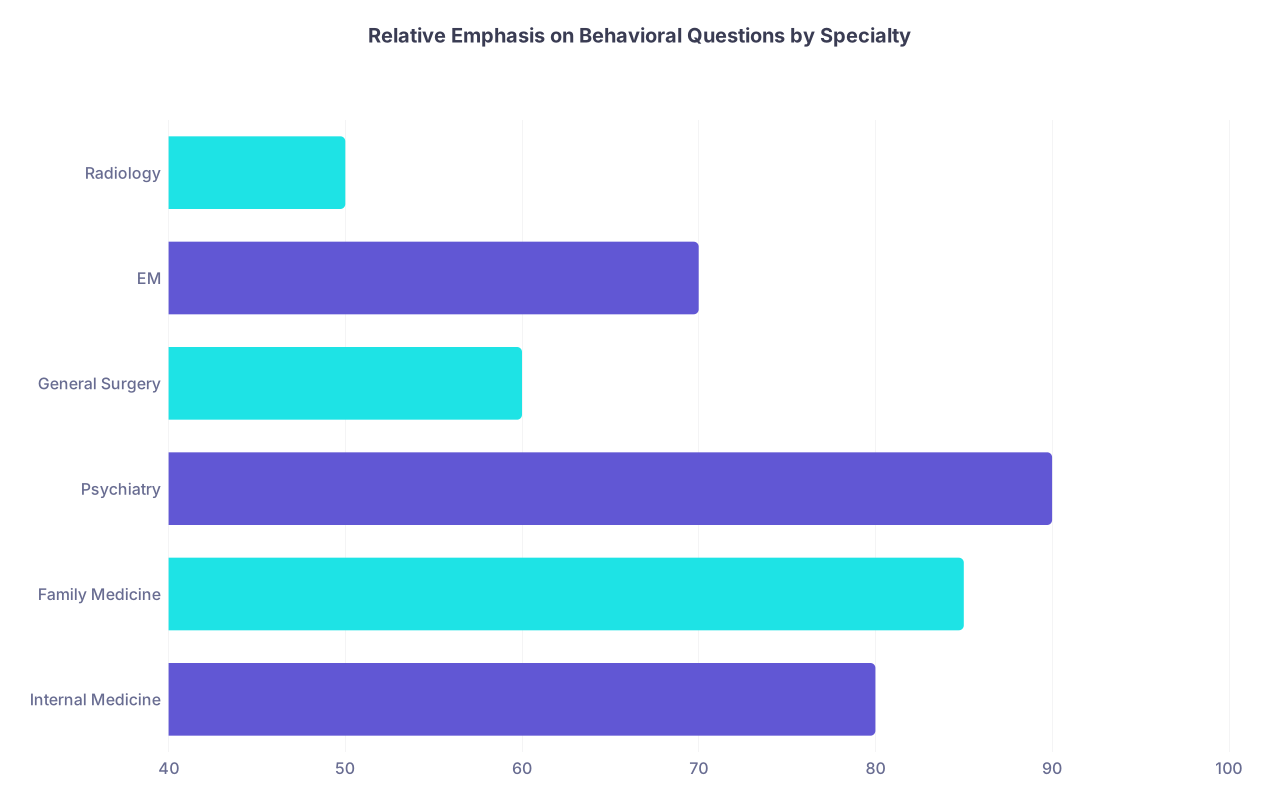
| Category | Value |
|---|---|
| Internal Medicine | 80 |
| Family Medicine | 85 |
| Psychiatry | 90 |
| General Surgery | 60 |
| EM | 70 |
| Radiology | 50 |
If you’re applying to:
Psych, FM, IM, Pediatrics, EM:
Stick to the 10–12 story range. They hammer communication, professionalism, conflict, and resilience.Surgery, OB/GYN, Anesthesia:
You can get away with 8–10 if they do more technical/“why this specialty” questions, but do not skip the ethics and stress buckets. Surgical programs especially want to see how you handle hierarchy and pressure.Radiology, Path, Radiation Oncology:
You might see fewer behavioral questions, but faculty are increasingly trained to ask them. I’d still have at least 8 stories ready.
Bottom line: no specialty is exempt. The ACGME milestones are the same; they’re all rating you on professionalism, communication, systems‑based practice.
Common Mistakes People Make with Behavioral Stories
I’ve watched strong applicants tank parts of an interview because of this stuff:
Overusing one “super story.”
That heroic ICU save you love? If you tell it to four different people, by the fourth time it sounds rehearsed and self‑congratulatory.Using undergrad stories when you have clinical ones.
Unless it’s extremely powerful (major life event, genuine leadership), stick to med school and clinical contexts.No true “bad” moment.
If every story paints you as flawless, you sound fake or self‑unaware. Have at least one real “I screwed up” story with a clean resolution and clear learning.Blaming others.
Even when others were at fault, your interviewer is silently asking: “What did you own?”Going on forever.
A behavioral story should usually be 1.5–3 minutes. Past that, they’re glancing at the clock.
How to Build Your 8–12 Stories in One Focused Weekend
You do not need a 3‑month curriculum to do this. Give yourself a weekend and do this:
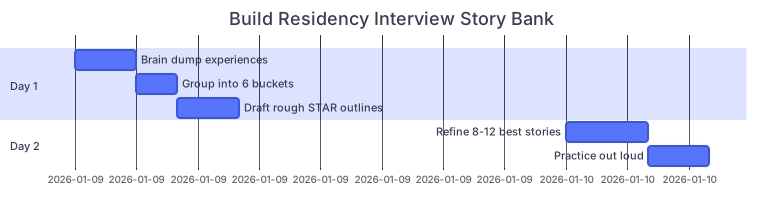
| Task | Details |
|---|---|
| Day 1: Brain dump experiences | a1, 2026-01-09, 3h |
| Day 1: Group into 6 buckets | a2, after a1, 2h |
| Day 1: Draft rough STAR outlines | a3, after a2, 3h |
| Day 2: Refine 8-12 best stories | b1, 2026-01-10, 4h |
| Day 2: Practice out loud | b2, after b1, 3h |
Day 1:
- Brain dump: 30–40 minutes per phase (pre‑clinical, core rotations, sub‑Is, life outside medicine). Write every memorable situation, good or bad.
- Label each with a primary bucket: conflict, mistake, teamwork, leadership, ethics, stress.
- Pick 2–3 from each bucket that seem richest.
Day 2:
- Turn each chosen story into a rough STAR outline in bullet form.
- Say them out loud, not just silently in your head. You’ll hear where you ramble.
- Trim unnecessary detail. Focus on your actions and your reflection.
You’re not memorizing a script. You’re memorizing anchors—so under pressure, your brain has something solid to grab.
Your Next Step (Today)
Open a blank page and write the 6 headings:
- Conflict
- Mistake/Failure
- Teamwork
- Leadership/Initiative
- Ethics/Professionalism
- Stress/Resilience
Under each one, force yourself to list at least two real situations from your training or life, even in shorthand.
That’s it. Do that today. Once those 12 rough ideas exist on paper, turning them into 8–12 strong behavioral stories becomes a straightforward, mechanical process instead of a panic spiral the night before your interview.