
You’re sitting in a Zoom waiting room for a residency interview. The program uses a lot of “Tell me about a time when…” questions. You know they’ll ask about challenges, resilience, conflict. And in the back of your mind is the biggest challenge you’ve actually faced: a real episode of depression, burnout, anxiety, or another mental health struggle.
You’re wondering: Do I bring that up? Is that brave and honest… or career suicide?
Here’s the answer you’re looking for.
The Short Answer: Usually No, Sometimes Yes, Never Unprepared
Let me be blunt.
Most applicants should not disclose significant personal mental health struggles in residency behavioral interviews.
Not because it’s shameful. But because:
- Interviewers are human and biased.
- They’re trying to predict reliability, stamina, and risk.
- You have very limited time to frame your story, and if you misjudge it, you pay the price.
There are exceptions where it can be appropriate, strategic, and powerful:
- If your mental health struggle is clearly resolved, well-managed, and led to specific growth that’s directly relevant.
- If it’s already in your application (LOA, major gap, remediation) and you need to contextualize it.
- If it directly shaped your career path (e.g., psych, addiction, resilience work) and you can explain it crisply and confidently.
But this is not something you improvise. If you’re going to mention it, you need a very deliberate framework.
Let’s walk through that.
What Interviewers Are Actually Evaluating
Forget idealism. Here’s what’s going through a PD or faculty’s mind during behavioral questions:
- Can this person show up consistently for patients and the team?
- Will this resident crumble under stress or cope effectively?
- Are they self-aware, or are they walking red flags wrapped in nice Step scores?
- If something goes wrong, will they ask for help early or disappear?
They are not obligated, in their heads, to be your therapist or to fix stigma. They’re thinking:
- “Will this person be a call-out risk?”
- “Is this someone who will need a lot of accommodations?”
- “Do I want to be the PD navigating FMLA, impaired physician issues, and coverage for their shifts?”
You might think, “But programs shouldn’t judge.” True. And also irrelevant. They do.
So you don’t answer, “Tell me about a time you faced adversity” with a raw, unfiltered breakdown of your worst depressive episode in M2 unless you’re absolutely certain you can frame it in a way that screams: stable, functional, reliable, stronger because of this.
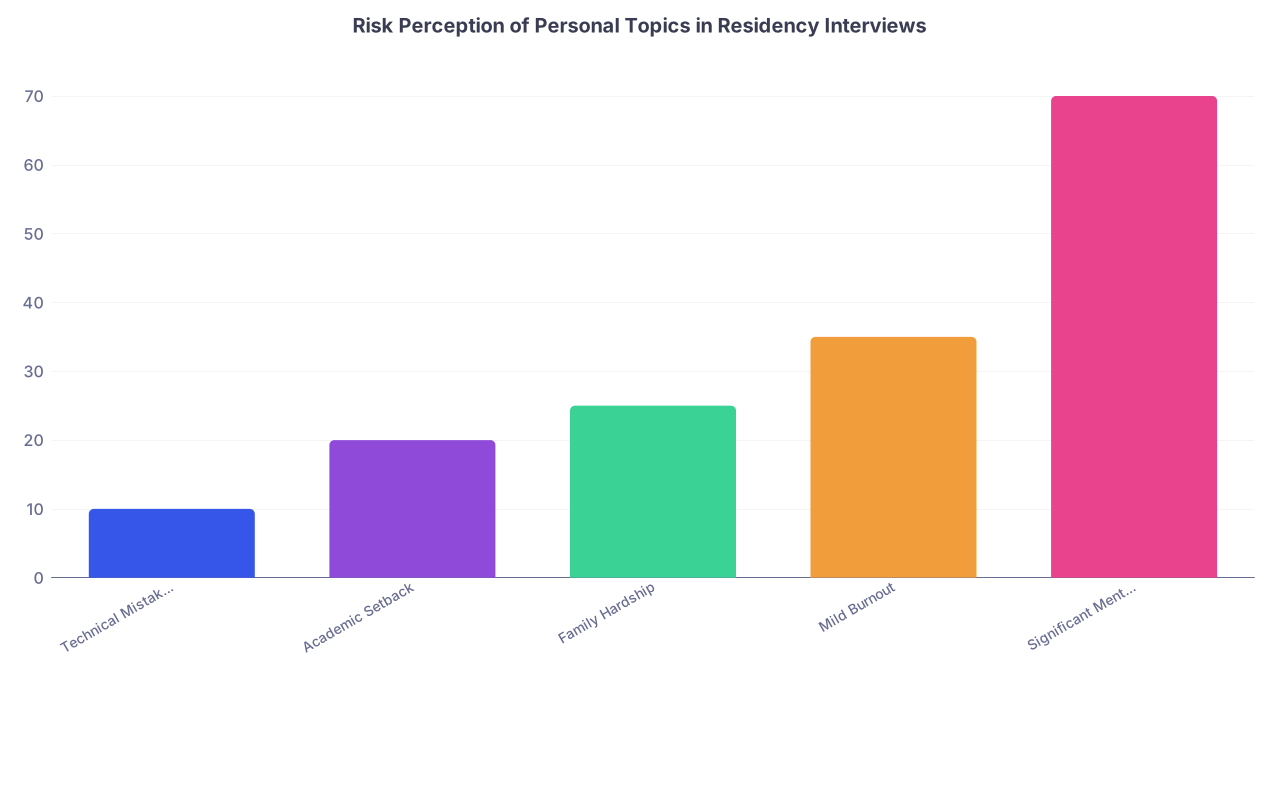
| Category | Value |
|---|---|
| Technical Mistake Story | 10 |
| Academic Setback | 20 |
| Family Hardship | 25 |
| Mild Burnout | 35 |
| Significant Mental Illness | 70 |
(Those numbers aren’t from a study; they reflect how high the perceived “risk” tends to feel to many faculty when they hear these topics.)
When It’s Usually Better Not to Disclose
Here are scenarios where I’d tell you: don’t go there in an interview.
1. The struggle is recent, raw, or still unstable
If you:
- Just came off leave last semester
- Are still in intensive therapy or med changes
- Don’t have a clear, stable pattern of functioning since
…then it’s not time to make it a selling point. Interviewers are asking, “What evidence do I have this person will be okay in a 28-hour call, 80-hour weeks, and nights?”
If your honest answer is “We’re still seeing,” do not make it a centerpiece story. Use another challenge.
2. You can’t tell the story without getting visibly emotional or dysregulated
Crying isn’t inherently disqualifying. But losing composure to the point that you:
- Can’t answer follow-ups
- Need time to recover
- Change the tone of the interview completely
…will make most committees nervous. They don’t want their intern to decompensate when things get intense.
Practice with someone ruthless. If they say, “You look like you’re reliving trauma,” pick another story.
3. You’re planning to disclose details that raise red flags
For example:
- Suicide attempts
- Psychiatric hospitalization
- Self-harm
- Substance use disorder within training years
These can absolutely be part of a longer-term physician story. But for a first impression in a competitive process where they have plenty of safer choices, that level of disclosure is almost always high risk.
You don’t have to lie. You also don’t have to give every truth in this particular setting.
4. You’re using it because you “don’t have another story”
I’ve heard this a lot: “My only big adversity is my depression.”
No, it isn’t. You’ve:
- Been on tough rotations
- Dealt with family issues
- Handled a conflict on a team
- Managed a complicated patient interaction
- Recovered from a failed test or project
Dig deeper. Don’t use mental health as your default “hard thing” if you have safer, equally meaningful examples.
When It Can Be Appropriate to Mention Mental Health
Now for the other side. There are times when mentioning mental health can actually strengthen your application.
1. You have an obvious gap or LOA you need to explain
If your transcript shows:
- One or more leaves of absence
- A semester or year off
- Major drop in performance
They’ll ask. If it’s related to mental health, you can’t just say, “Personal reasons” five times in a row. That sounds evasive.
Here’s how to handle it:
- Use broad, non-graphic language: “I went through a significant mental health challenge in my second year.”
- Emphasize what you did: sought care, followed a treatment plan, used school support.
- Show the outcome: stability, strong recent performance, letters saying you’re reliable.
- Connect to resilience and judgment: “I learned to recognize early warning signs and ask for support before I’m in crisis.”
You maintain privacy but still show maturity and insight.
2. Your struggle clearly shaped your career path or advocacy work
Example: You had well-treated, now-stable anxiety that pushed you into:
- Developing a wellness curriculum
- Running a peer support program
- Doing research in physician mental health
- Choosing psychiatry, addiction med, or palliative care
In that case, a brief, controlled disclosure can be powerful.
Something like: “I’ve had my own experience with anxiety during the early years of medical school. Getting effective treatment and support was transformative for me and made me deeply interested in how we care for trainees and patients with mental health conditions. That led me to join our wellness committee and work on…”
See the structure there:
- Name it clearly
- Keep it short
- Immediately pivot to actions and growth
3. You can demonstrate a long track record of stability afterward
If your mental health episode was:
- Early in college or M1–M2
- Followed by several years of stable performance (good evals, solid clerkships, strong Step 2)
- Well-managed with ongoing care
You have evidence. You’re not asking them to trust a vague promise — you can point to specific, recent years of functioning.
Then, a concise version may actually make you look more grounded and self-aware.

How to Talk About It If You Decide To
If you decide to mention mental health at all, use a tight structure. Don’t wing it.
Use the “3-Sentence Rule”
Aim to get the “mental health” part into about three sentences, then pivot to growth and outcomes.
Name it at a high level, no graphic detail.
“During my second year, I experienced significant depression related to a combination of academic pressure and family stress.”Show responsible action.
“I took a brief leave with my school’s support, engaged in therapy, and worked with a psychiatrist to get effective treatment.”Show the stable outcome.
“Since returning, I’ve maintained strong performance clinically and have built consistent routines to protect my health.”
Then move to:
- Specific habits you now use (schedule, boundaries, exercise, supervision)
- Evidence of performance (evaluations, leadership, letters)
- How this experience improved your empathy, communication, or team functioning
Keep it professional, not confessional
You’re not in a support group. You’re in a job interview.
Wrong approach:
- Over-sharing symptoms
- Describing self-harm
- Detailing relationship drama
- Making the interviewer feel like your therapist
Right approach:
- Factual
- Bounded
- Oriented toward function and responsibility
Anticipate follow-ups
If you open the door, they may walk through it. Be ready for:
- “How do you manage your mental health now during busy stretches?”
- “What would you do if you felt those symptoms returning during residency?”
- “How can we be confident you’ll be reliable on call?”
Have clean answers:
- Specific strategies (“I schedule nonnegotiable sleep blocks, I use therapy, I check in with mentors when I see early warning signs…”)
- Past evidence (“I managed a heavy sub-I schedule while maintaining my self-care routines and strong evals.”)
No bitterness. No blaming your school or classmates. Professional, steady, matter-of-fact.

| Step | Description |
|---|---|
| Step 1 | Thinking about mentioning mental health |
| Step 2 | Prepare brief, structured explanation |
| Step 3 | Use concise, growth-focused version |
| Step 4 | Choose a different adversity example |
| Step 5 | Mention with evidence of stability |
| Step 6 | Avoid or keep extremely high-level |
| Step 7 | Discuss other professional challenges |
| Step 8 | Is there a visible gap or LOA? |
| Step 9 | Is it central to your story or specialty choice? |
| Step 10 | Stable performance since? |
Safer Alternatives for “Challenge” Behavioral Questions
You’ll get variations of:
- “Tell me about a time you faced a significant challenge.”
- “Describe a failure and how you responded.”
- “Tell me about a time you were overwhelmed and what you did.”
You don’t have to use mental health here.
Good alternative categories:
- A tough clinical situation or complication
- A serious conflict on a team you helped resolve
- A big academic setback (bad exam, remediation, OSCE failure) and recovery
- A family responsibility you managed while staying functional in school
The key is:
- Clear problem
- Your specific actions
- Concrete, professional outcome
- What you learned that applies to residency
If the question is wide open and you’re on the fence, default to a non–mental health example. You can still show resilience without crossing into highly personal territory.

A Quick Decision Framework
Use this to decide what to do.
| Question | If Yes | If No |
|---|---|---|
| Do I have a visible gap/LOA? | Prepare a brief, structured explanation. | No need to bring it up. |
| Is my condition clearly stable for 1–2+ years? | You *may* safely reference it if useful. | Avoid as a featured story. |
| Is it central to my specialty choice/advocacy? | Consider a controlled, high-level mention. | Choose another example. |
| Can I talk about it without losing composure? | Practice and refine, then decide. | Don’t use this story. |
| Do I have safer, still-meaningful challenges? | Use those instead in most cases. | Get help crafting a bounded version. |
How to Prepare If You’re Unsure
Don’t guess alone. Here’s what I’d actually tell you to do this week:
- Write out your “mental health story” in bullet form, brutally honest.
- Then rewrite it in 3–5 tight sentences that:
- Omit graphic details
- Focus on actions and outcomes
- Emphasize stability and functioning
- Come up with two non–mental health challenge stories you can use instead.
- Run all of this by:
- A trusted attending
- A dean or advisor who’s residency-savvy
- Someone who’s sat on selection committees if possible
If they look nervous hearing your mental health version? Listen to that.
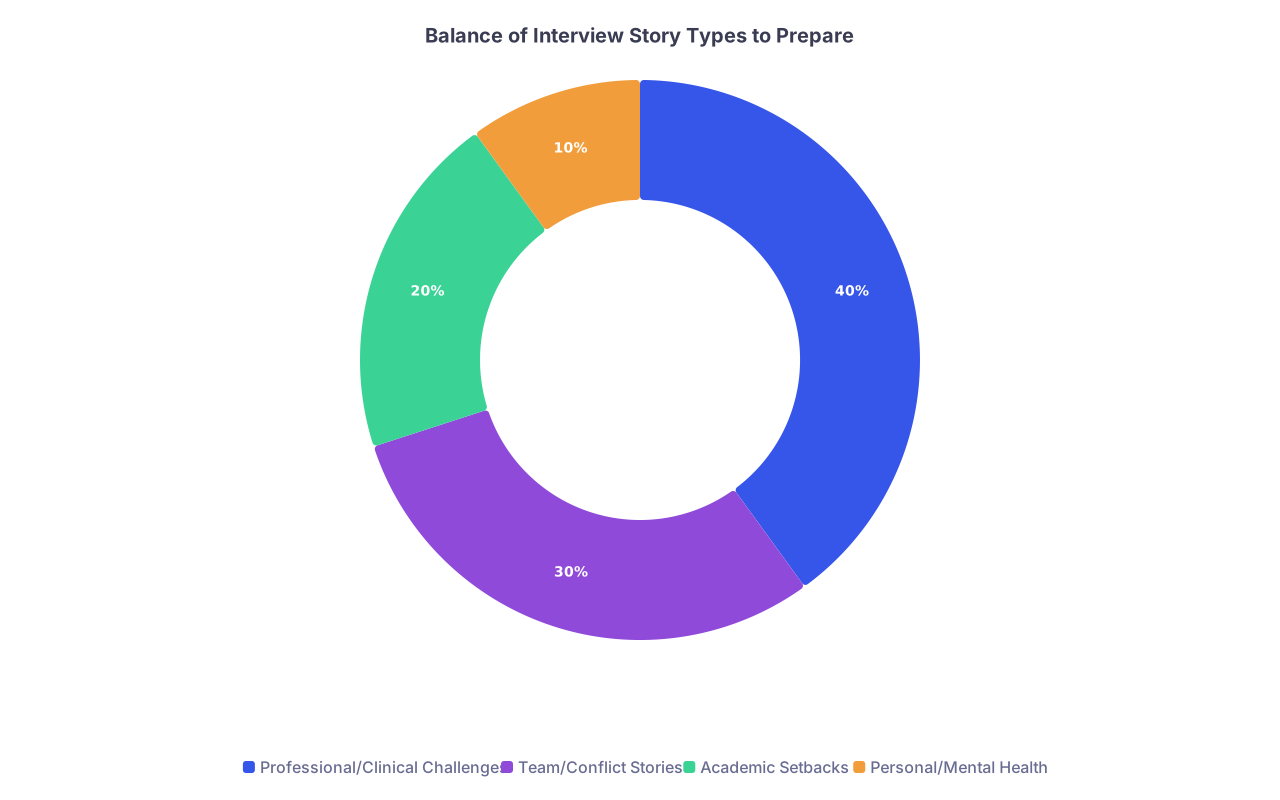
| Category | Value |
|---|---|
| Professional/Clinical Challenges | 40 |
| Team/Conflict Stories | 30 |
| Academic Setbacks | 20 |
| Personal/Mental Health | 10 |
That’s roughly the distribution I’d aim for in your prep: mental health stories as a backup, not the core.
Final Thoughts: What Actually Matters
You don’t owe a residency program your entire psychiatric history. You owe them evidence that you’ll show up, learn, care for patients, and seek help early if you’re struggling.
Three key points to keep:
- Default to privacy unless you have a strategic, well-prepared reason to disclose. Mental health is not your only path to demonstrating resilience.
- If you must or choose to mention it, keep it high-level, action-focused, and backed by evidence of stability and strong recent performance.
- Practice your stories like you practice your OSCEs. Don’t discover in real time that a topic is too raw or too risky in front of a PD.
You can be honest, protect your future, and still honor your mental health journey. You just need to be intentional about where, when, and how you tell that story.