
It’s 8:17 p.m. You’ve got a residency interview tomorrow. You’re pacing in your apartment, asking yourself, “Tell me about a time you made a mistake,” and your answer is… either a 20‑second shrug or a 4‑minute ramble.
You know content matters. But you also know: if you talk too long, you lose them; if you’re too short, you sound shallow or unprepared.
Here’s the direct answer you’re looking for.
The Real Answer: Ideal Length in Seconds and Sentences
Let me be blunt: most residency applicants talk way too long.
For behavioral interview questions (“Tell me about a time when…”) in residency interviews, the sweet spot is:
- Ideal length: 60–90 seconds
- Absolute max: 2 minutes (and that’s only for a complex story)
- Structure: About 6–10 sentences, clearly structured
If your answer consistently goes past 2 minutes, it’s almost always a problem. Faculty get bored. PDs tune out. They stop listening after the first good sentence and just wait for you to finish.
If your answer is under 30 seconds, it’s almost always too thin. You’ll sound like you don’t have real examples or you didn’t think deeply about your experiences.
So: Aim for 60–90 seconds per behavioral answer. That’s long enough to show depth, but short enough to respect their time.
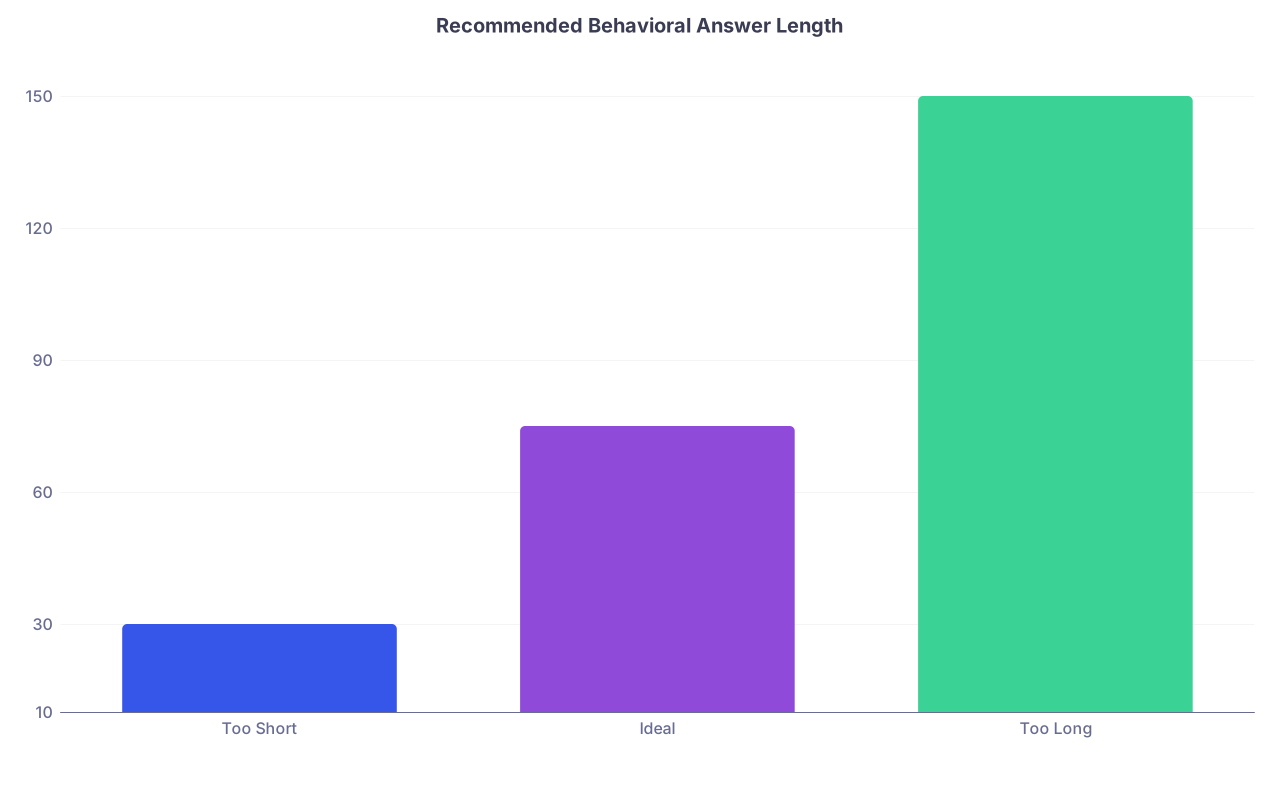
| Category | Value |
|---|---|
| Too Short | 30 |
| Ideal | 75 |
| Too Long | 150 |
The “ideal” range (around 75 seconds) lets you do three things:
- Set the scene very briefly
- Walk through your actions
- Land the takeaway
If you can’t do that in a minute and a half, the problem isn’t the content. It’s the structure.
Why Length Matters So Much in Residency Interviews
Length isn’t just about politeness. In residency interviews, your answer length is a proxy for:
- How concise you’ll be on rounds
- Whether you can present a patient without spiraling
- Whether you respect other people’s time
- If you can think in a structured way under pressure
I’ve watched PDs literally write “rambling” on score sheets. I’ve also watched them circle “weak insight” when someone gives a 20‑second, surface‑level answer.
You’re not only being judged on what you say. You’re being judged on how efficiently you say it.
Think of it like a SOAP note. If your “Subjective” section is three pages long with no assessment, you look unorganized. If your “Assessment” is one vague sentence, you look unprepared.
Same thing here.
The Right Structure: Use STAR, But Adjust for Medicine
You’ve heard of STAR: Situation – Task – Action – Result. Good. Use it. But tighten it for residency.
Here’s what actually works in this context:
- S/T (Situation/Task): 10–20 seconds
Very short. Just enough to orient them. - A (Action): 30–45 seconds
This is your main content. What you did. - R (Result) + Reflection: 20–30 seconds
What happened and what you learned/changed
So structurally, a strong 75‑second answer looks roughly like:
- 1–2 sentences of background
- 3–5 sentences on your actions
- 2–3 sentences on outcome and takeaway
If your “Situation” is a full story with background characters and multiple subplots? You’re already losing.
If your “Result” is one sentence like “And it went fine”? That’s a missed opportunity.
Concrete Timing Examples (With Script Snippets)
Let’s make this real.
Example 1: 30‑Second Answer (Too Short)
Question: “Tell me about a time you dealt with a conflict on your team.”
Answer (bad, too short):
“On my surgery rotation, another student and I disagreed about who would scrub into a case. We talked it out, I suggested we alternate cases for the rest of the week, and it worked well and we both got the experience we needed.”
Length: ~15–20 seconds.
Problem: Thin. No detail. No insight. Sounds like you’re hiding or haven’t thought deeply.
Example 2: 3‑Minute Answer (Too Long)
Same question, but now the bad long version:
“So this was on my third‑year surgery rotation at a community hospital about 40 minutes from campus. It was actually my first sub‑specialty rotation, and I was really excited, because I’d been thinking about surgery before med school. The team had two attendings, three residents, and there were three medical students including me. One of them wanted to go into ortho, the other wasn’t sure. Anyway, there was this Whipple case that everyone was excited about, and the chief had mentioned earlier in the week that one student could scrub in. I had been pre‑rounding on the patient, so I kind of assumed it might be me…”
Stop. That’s already too long and you’re still in the setup. Faculty are checking their watches mentally. No one needs this much context.
Example 3: 75‑Second Answer (Strong)
Now, here’s a tight, appropriately detailed answer:
“On my surgery rotation, there was a complex case that only had room for one student to scrub in. I’d been following the patient all week and was excited to be involved, but another student also really wanted the spot and felt they hadn’t had as many opportunities.
Initially, there was some tension and it felt like it might become a bigger conflict. I asked if we could step aside for a minute and talk it through. I acknowledged that I’d been following the patient clinically, but also listened to their concern about limited OR exposure. I suggested we look at the schedule for the week and see where we could both get meaningful experiences. We ended up agreeing that I’d scrub this case since I knew the patient well, and I helped advocate for them to scrub a big trauma case later in the week where I stepped back.
The attending appreciated that we’d worked it out ourselves, and both of us ended the week feeling like we’d been treated fairly. The main thing I took from it was that addressing small conflicts early, directly, and collaboratively prevents them from affecting the team dynamic.”
Length: ~75–85 seconds when spoken at a normal pace. That’s the zone you want.
You gave:
- Just enough context
- Clear actions that highlight communication and teamwork
- A real result
- A reflection that shows maturity
No fluff. No rambling. No flexing.
How to Calibrate Your Answer Length Practically
You won’t magically “feel” 60–90 seconds. You need to practice it.
Step 1: Time Yourself Once
Pick 5 common behavioral prompts:
- Tell me about a time you made a mistake.
- Tell me about a time you had a conflict with a team member.
- Tell me about a time you received critical feedback.
- Tell me about a time you went above and beyond.
- Tell me about a time you had to adapt quickly.
Record yourself on your phone.
Don’t script it. Just answer naturally.
Then check the time.

Most people discover one of two things:
- They’re consistently at 25–40 seconds (too short)
- Or they’re at 2:30–4:00 minutes (way too long)
That awareness alone fixes half the problem.
Step 2: Rewrite for STAR + Reflection
Take each answer and tighten it into the structure:
- 1–2 sentences: Situation/Task
- 3–5 sentences: Actions
- 2–3 sentences: Result + Reflection
Then re‑record. Aim for 75 seconds. Not 45. Not 2:15. Around a minute and a quarter.
Step 3: Ask for Brutal Feedback
Ask a classmate, resident, or advisor and say specifically:
“Tell me if this feels: too short, about right, or too long. Don’t be nice. Be accurate.”
Most people can’t tell you it was 73 seconds, but they can tell you if halfway through they were waiting for you to land the plane.
Different Question Types = Different Ideal Lengths
Not every answer should be the same length. But they shouldn’t be wildly different either.
Here’s a simple guide:
| Question Type | Target Length |
|---|---|
| Simple “why this program” follow-up | 20–40 sec |
| Quick clarification questions | 10–30 sec |
| Standard behavioral questions | 60–90 sec |
| Complex leadership/ethics scenarios | 90–120 sec |
| “Tell me about yourself” | 60–90 sec |
If you treat every question like an essay, you’ll burn time and attention. The behavioral questions are where you earn your keep. That’s where the 60–90 second rule matters most.
Common Length Mistakes (And How to Fix Them Fast)
1. Over‑detailing the background
Symptom: 45 seconds of context, 15 seconds of what you actually did.
Fix: Force yourself to describe the setup in one breath. If you can’t say the context in one breath, it’s too long.
Bad:
“So this was during my third year, the first week of my internal medicine rotation, at a large academic center where the census was particularly high because…”
Better:
“During my IM rotation, our team was short‑staffed and our patient load was heavy.”
Done. Move on.
2. Listing tasks instead of telling a story
Symptom: Feels like reading your CV aloud. No clear arc.
Fix: Pick one specific moment, not a general pattern. Anchor it in time.
Bad:
“I often take initiative on my teams. For example, I usually help coordinate tasks and make sure things get done.”
Better:
“On my medicine sub‑I, there was a day when our senior resident was pulled to cover nights unexpectedly, and the intern was overwhelmed. I stepped in by…”
3. Weak or missing reflection
Symptom: You end with “and it went well” or “the patient improved” and stop.
Fix: Add 1–2 sentences answering: “What changed about how you practice now?”
Example improvement:
“Since then, I’m much more proactive about clarifying roles at the start of a rotation, because I’ve seen how small misunderstandings can snowball into conflict.”
That’s mature. That’s what PDs want to hear.
Quick Check: Is Your Answer the Right Length?
Use this three‑question mental checklist while you answer:
- Have I spent more than 15–20 seconds on setup?
If yes, cut details. Move to action. - Have I clearly said what I did, not just what “we” did?
If not, focus more on your specific behavior. - Did I end with a concrete result and a short reflection?
If not, add 1–2 sentences to close the loop.
If you hit those three, your timing will almost always be in range.

| Step | Description |
|---|---|
| Step 1 | Hear Question |
| Step 2 | Brief Situation/Task |
| Step 3 | Your Actions |
| Step 4 | Result |
| Step 5 | Reflection |
| Step 6 | Stop Talking |
How This Plays Out in a Real Interview Day
On a typical 20–30 minute residency interview:
- You’ll get maybe 3–6 behavioral questions
- If each one is 3–4 minutes, you’ve eaten the whole interview
- The interviewer doesn’t get to ask follow‑ups or program‑specific questions
- You come off as unfocused, even if your content is good
If each behavioral answer is 60–90 seconds, you leave room for:
- Follow‑ups
- Clarifying details
- A real conversation
Interviewers love that. They’d rather ask two follow‑ups on a concise answer than sit through one monologue.
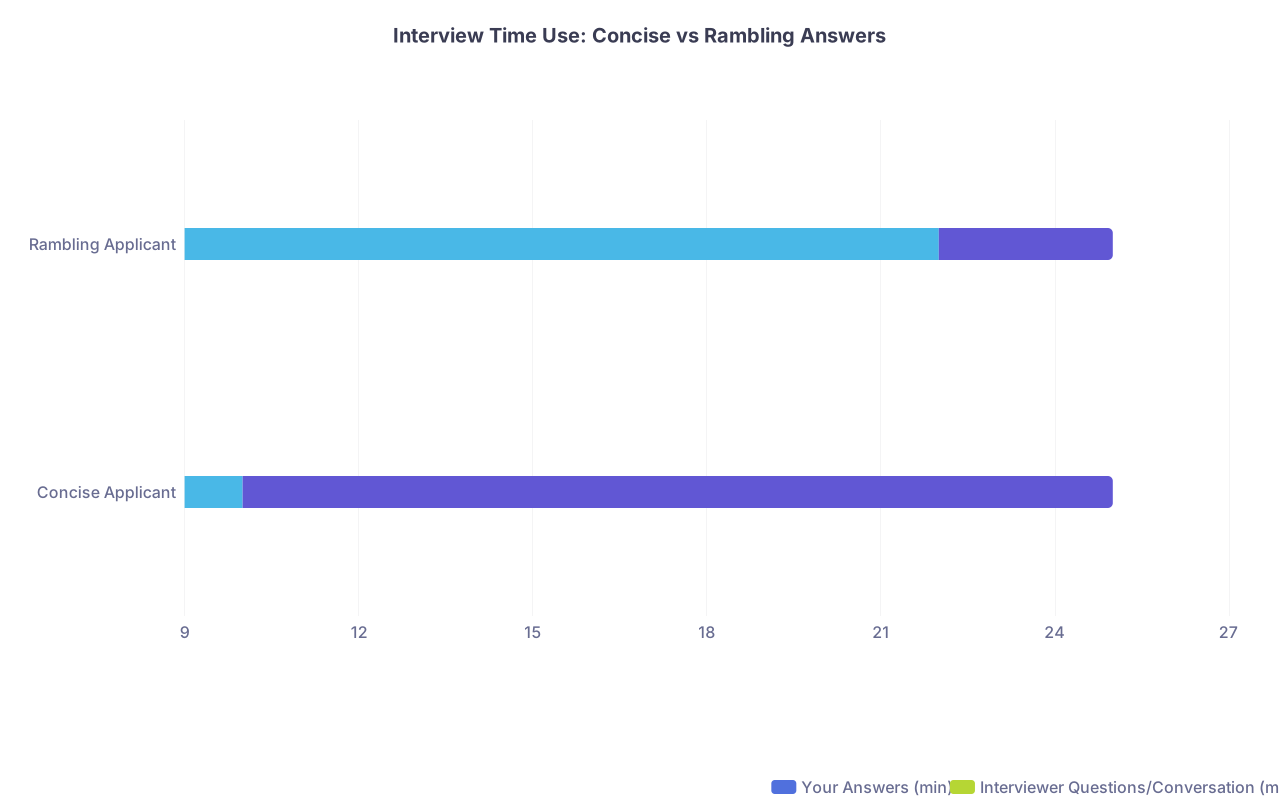
| Category | Your Answers (min) | Interviewer Questions/Conversation (min) |
|---|---|---|
| Concise Applicant | 10 | 15 |
| Rambling Applicant | 22 | 3 |
Simple Practice Template You Can Steal
Here’s a 4‑line template you can literally write out and plug stories into:
- Context (1–2 lines): “During my ___ rotation, when ___ was happening…”
- Conflict/Challenge (1 line): “The challenge was that…”
- Actions (3–4 lines): “I did X, then Y, and I also made sure to Z…”
- Result + Reflection (2–3 lines): “As a result…, and I learned that…”
Say it out loud. Adjust until it’s consistently 60–90 seconds.
Repeat for your top 8–10 stories.

Once those are locked in, you’ll be able to adapt them to almost any behavioral question without rambling.
FAQs
1. Is a 2‑minute behavioral answer automatically bad?
No. 90 seconds is ideal, but up to 2 minutes is fine for complex situations (big leadership roles, ethically tricky cases) if you’re structured and engaging. Once you drift past 2 minutes, it’s rarely helping you.
2. What if the interviewer keeps nodding and seems interested—should I keep going?
Not necessarily. Nodding isn’t always “Please say more.” Often it’s “I hear you, wrap it up.” Give your 60–90 second answer, then pause. If they ask a follow‑up, then add detail.
3. How many behavioral stories should I prepare at this length?
Prepare 8–10 core stories, each practiced to around 60–90 seconds:
- 2 conflict/teamwork
- 2 mistake/failure
- 2 leadership/initiative
- 2 resilience/stress
- 1–2 ethics/professionalism
You’ll reuse them in different ways.
4. Is it better to be slightly too short or slightly too long?
Slightly too short. A 50‑second answer that’s clear and reflective is safer than a 2:30 ramble. If you’re brief, they can always ask, “Tell me more about that.” If you ramble, they usually won’t rescue you.
5. Do virtual interviews change the ideal answer length?
Not really. On Zoom, attention spans are worse, if anything. The 60–90 second guideline is even more critical. Long answers feel excruciating online. Keep it tight, watch their facial cues, and let them jump in.
6. Should I script my answers word‑for‑word to hit the perfect time?
No. Script structure, not exact sentences. Bullet out key points for S/T/A/R, then practice until you consistently hit the timing. Memorized monologues sound fake and stiff, and PDs can tell.
7. How do I stop myself mid‑ramble if I realize I’m going long?
Land the plane. Say something like, “So, to summarize,” then give a 1–2 sentence result + takeaway and stop talking. Interviewers don’t penalize self‑correction. They do penalize ongoing rambling.
Bottom line:
- Aim for 60–90 seconds per behavioral answer.
- Use short setup, clear actions, real results, explicit reflection.
- Practice with a timer until that length feels natural—not like a performance.