The same behavioral questions show up in residency interviews over and over. Programs are not that creative.
They are testing three things:
- Are you safe?
- Are you decent to work with at 3 a.m.?
- Will you survive in this program?
Behavioral questions are how they answer all three. Let me walk you through the ones that are almost guaranteed, what they’re really asking, and how to answer them without rambling or panicking.
The Core Behavioral Questions You’ll Almost Definitely Get
These are the “I’d bet money on it” questions. Assume they’ll show up in some form.
1. “Tell me about a time you had a conflict with a colleague or teammate.”
This is almost universal. They want to know if you’re going to blow up the team.
What they’re really asking:
- Do you become defensive or blame others?
- Can you handle disagreement without drama?
- Do you resolve things like a professional?
Good structure (classic and it works):
- Situation
- Task / your role
- Action (what you did)
- Result (what changed / what you learned)
Bad answers:
- “I’ve never really had conflict.” (They don’t believe you.)
- “My classmate was lazy so I told the attending.” (You sound petty and untrustworthy.)
Good answer pattern:
- Pick something real but not catastrophic.
- Show you tried to understand their perspective.
- Show you communicated directly (not gossip).
- End with what you’d do differently now.
Example skeleton you can adapt:
- “On my surgery rotation, a co-student and I disagreed about dividing tasks, and I felt I was doing more scut work…”
- You talk to them first privately, clarify expectations, maybe loop in chief or resident if needed.
- Result: better task division, preserved relationship, you realized you need to speak up earlier.
2. “Tell me about a time you made a mistake.”
Everyone dreads this. You cannot dodge it.
What they’re really asking:
- Are you honest about your own fallibility?
- Do you hide errors or own them?
- Do you learn and change your behavior?
Bad moves:
- “I care too much / work too hard.” (Transparent fake weakness.)
- “Once I almost missed a lab but I caught it.” (Non-mistake.)
You need:
- A real clinical or professional mistake, but not something that screams “unsafe to graduate.”
- Clear description of what you did wrong.
- Immediate steps you took to fix it.
- Concrete change you made to your system or behavior.
Example categories that work well:
- Communication miss (didn’t clarify plan with team, family misunderstanding).
- Time management error (underestimated how long notes or pre-rounding would take).
- Missed follow-up (delayed calling a consultant, forgot a non-urgent result until later in the day).
If your answer doesn’t include “Here’s exactly what I changed so it won’t happen again,” it is not done.
3. “Tell me about a time you received critical feedback.”
Programs are allergic to residents who cannot take feedback.
What they’re really asking:
- Do you get defensive?
- Do you hold grudges?
- Can you actually improve?
Strong answer pattern:
- Feedback was specific and a little painful (e.g., “Your notes are disorganized,” “You seem disengaged on rounds,” “You talk too fast with patients.”)
- You did not argue or shut down.
- You clarified expectations or asked for examples.
- You created a simple plan to improve.
- You followed up and can show a measurable change.
Do not:
- Trash the person who gave the feedback.
- Just say “I appreciated the feedback” without explaining your concrete response.
4. “Tell me about a time you worked on a team and had to show leadership.”
Even for intern-level positions, they want to see signs of leadership.
What they’re really asking:
- Can you coordinate people without bulldozing them?
- Do others trust you?
- Can you step up under pressure?
This doesn’t have to be chief-of-everything level. Good sources:
- Leading a small QI project.
- Running a student-run free clinic shift.
- Coordinating care for a complex inpatient discharge.
- Organizing your class OSCE review sessions.
Key elements:
- You identified a problem / need.
- You took initiative.
- You delegated or coordinated.
- You got buy-in.
- There was a concrete outcome (clinic flow better, fewer missed labs, smoother discharge, etc.).
5. “Tell me about a time you had to deal with a difficult patient or family.”
If they don’t ask this, it will be a cousin of it: “challenging communication situation,” “upset caregiver,” etc.
What they’re really asking:
- Are you empathetic under pressure?
- Do you escalate appropriately?
- Do you avoid power struggles?
Answer pattern:
- Pick one specific incident, not “I see difficult patients all the time.”
- Patient or family is angry, non-adherent, or distrusting.
- You stay calm, avoid arguing facts at first.
- You validate their concern (“I can see this has been frustrating…”).
- You clarify expectations, involve the right people (nurse, attending, social work).
- Outcome doesn’t need to be perfect, but it should show de-escalation and some improved understanding.
Avoid:
- Stories that sound like you’re mocking or judging the patient.
- “Then security came” as your main move, unless it was truly a safety threat.
6. “Tell me about a time you had to manage competing priorities or were overwhelmed.”
This is the resident life question. Paging, notes, consults, admissions. All at once.
What they’re really asking:
- Will you drown on a busy call night?
- Do you prioritize well?
- Do you ask for help when needed?
Strong elements:
- Multiple real tasks competing (e.g., cross-cover calls, a new admit, a sick patient, and notes all pending).
- You pause and triage: what is time-sensitive vs what can safely wait.
- You communicate with your team (“I’m going to see the sick patient first; can you start the admission H&P?”).
- You use simple tools (task lists, checklists, time blocks).
- You recognize your limit and reach out early if unsafe.
If your story doesn’t show any system or process, just “I worked harder,” it is weak.
7. “Tell me about a time you disagreed with an attending or supervisor.”
This one tests your professionalism and backbone at the same time.
What they’re really asking:
- Will you blindly follow unsafe or questionable orders?
- Or will you argue every plan?
- Can you disagree respectfully?
Good answer structure:
- Honest disagreement (not trivial) but also not “attending was grossly unethical.”
- You clarify reasoning: “Help me understand why we’re not doing X…”
- You present your concern humbly but clearly.
- If they stick with their plan and it’s safe, you follow it.
- You might debrief later or read more to understand the decision.
If you paint the attending as an idiot and yourself as the hero, you just failed the test.
The Behavioral Themes Programs Always Probe
Interviewers will wrap these into many wordings, but they’re circling the same themes. Let’s translate.

1. Conflict and interpersonal dynamics
Likely wordings:
- “Tell me about a difficult coworker.”
- “Time you had to give tough feedback.”
- “Time you had to advocate for a patient against resistance.”
Your job: demonstrate you can disagree without being destructive, and you use direct, respectful communication rather than gossip or avoidance.
2. Resilience and stress response
Likely wordings:
- “Tell me about a time you failed at something.”
- “Most stressful situation you’ve faced in medical school.”
- “Time you felt burned out or overwhelmed.”
They’re watching:
- Do you collapse?
- Do you have any coping strategies beyond “I just pushed through”?
- Do you recognize early warning signs in yourself?
You don’t need a sob story. You need a real challenge + a thoughtful response.
3. Professionalism and ethics
Likely wordings:
- “Time you saw unprofessional behavior.”
- “Ethical dilemma you faced.”
- “A time you had to admit you didn’t know something.”
Your answer needs:
- Recognition of right vs wrong.
- Clear personal responsibility (if involved).
- Appropriate escalation if there was risk to patient or learner.
- Reflection on what you learned about your own boundaries and values.
Examples of “Almost Guaranteed” Questions and How to Prepare
Here’s a quick side-by-side to make this less abstract.
| Question Theme | Common Wording You Might Hear |
|---|---|
| Conflict | "Tell me about a conflict with a team member and how you resolved it." |
| Mistake | "Describe a time you made a mistake in clinical care or training." |
| Feedback | "Tell me about critical feedback you received and what you did with it." |
| Difficult Patient/Family | "Time you had to manage a challenging patient or family interaction." |
| Overload/Prioritization | "Describe a time you had too much to do at once. How did you handle it?" |
| Disagreement with Senior | "Tell me about a time you disagreed with a supervisor’s decision." |
If you have a strong, concise story ready for each row of that table, you’re in much better shape than 80% of applicants.
How To Build Your Behavioral Answer Bank (Without Spending 20 Hours)
You do not need 50 stories. You need 8–12 good ones you can flex to different questions.
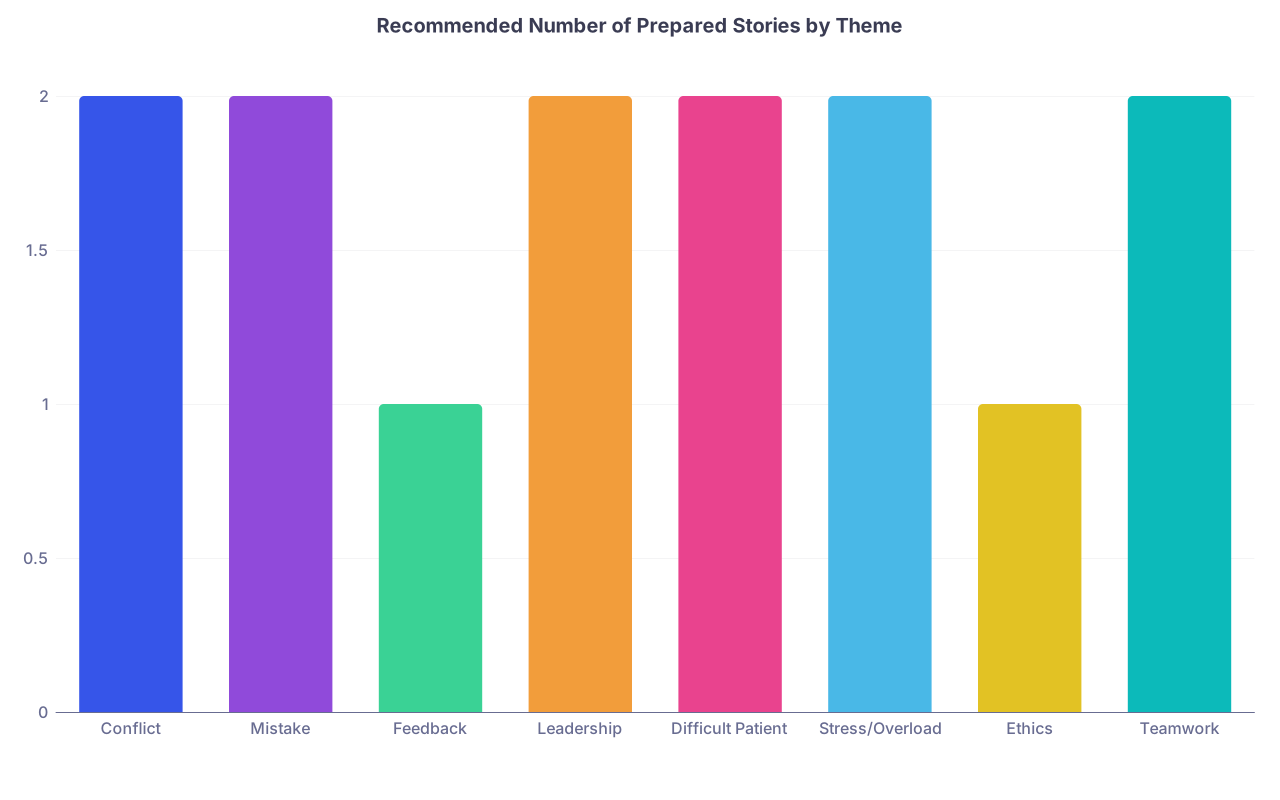
| Category | Value |
|---|---|
| Conflict | 2 |
| Mistake | 2 |
| Feedback | 1 |
| Leadership | 2 |
| Difficult Patient | 2 |
| Stress/Overload | 2 |
| Ethics | 1 |
| Teamwork | 2 |
Do this:
List these themes on a blank page:
- Conflict
- Mistake
- Feedback received
- Leadership / initiative
- Difficult patient / family
- Overwhelmed / multiple priorities
- Ethical or professionalism challenge
- Working with a diverse team / bias / cultural issue
For each, brainstorm 2–3 experiences from:
- Core clinical rotations
- Sub-internships / audition rotations
- Research projects
- Work before med school
- Volunteer or leadership roles
For each experience, jot 4 bullets:
- One-line situation
- What was hard about it
- What you did (especially communication and problem-solving)
- Concrete outcome + what you learned
This becomes your “story bank.” You will use the same story three different ways depending on how they phrase the question.
How Programs Evaluate Your Answers (What They’re Scoring Quietly)
Interviewers are not just listening for “good stories.” They’re paying attention to behaviors embedded in your answer.
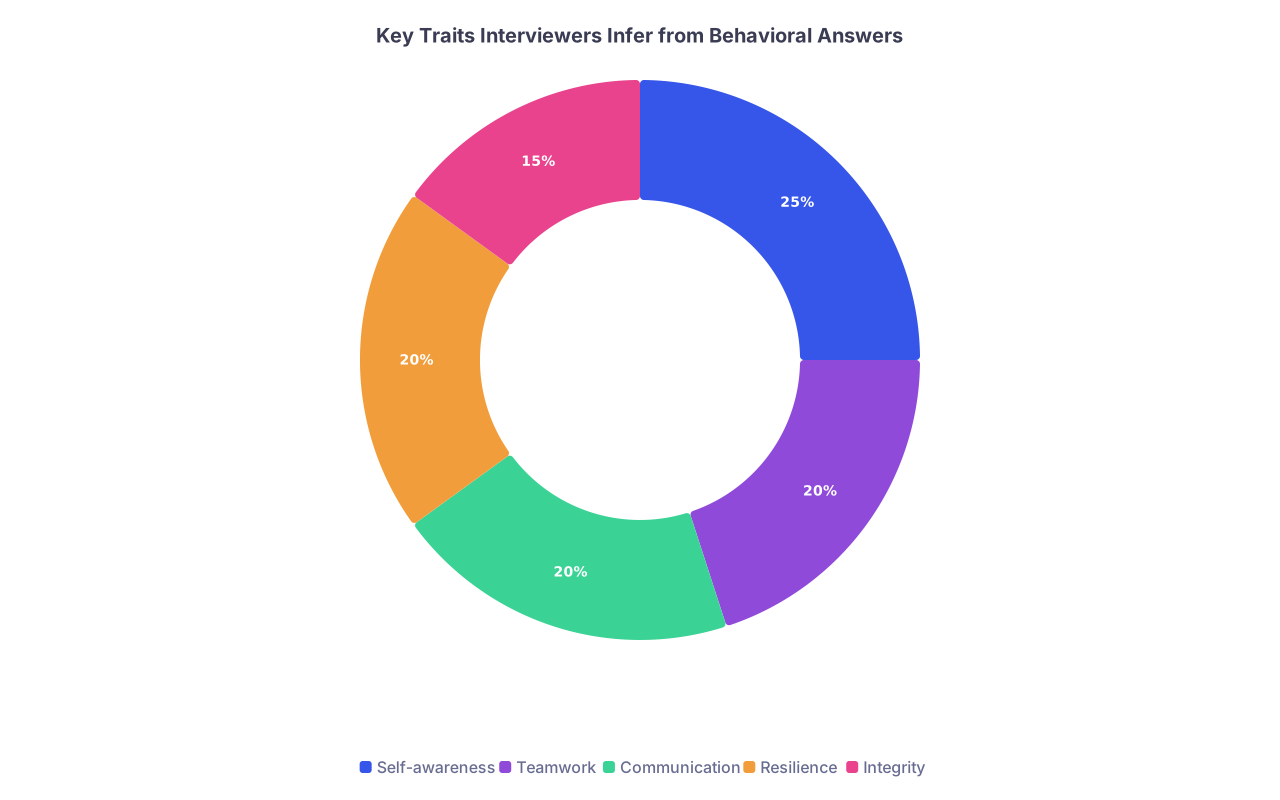
| Category | Value |
|---|---|
| Self-awareness | 25 |
| Teamwork | 20 |
| Communication | 20 |
| Resilience | 20 |
| Integrity | 15 |
They’re asking themselves:
- Did you clearly describe your role, or did you hide in “we” and “they”?
- Do you sound bitter, victimized, or arrogant?
- Do you take at least partial responsibility where appropriate?
- Are your “lessons learned” actually specific and believable?
- Would I want this person on my night team?
If your stories consistently show:
- Ownership
- Calm communication
- Respect for others (even when they were wrong)
- Concrete behavior change
You score high, whether they tell you that or not.
Quick Red Flags to Avoid in Behavioral Answers
I’ve heard these in real interviews. They tank otherwise strong applicants.

Avoid:
The martyr story
“I did everything, no one else helped, I saved the day.”
Translation: you can’t collaborate.The blame dump
Long explanation of how someone else was incompetent, rude, or lazy — with zero reflection on what you could have done differently.The non-answer
Vague, generalized “I always handle conflict by…” with no specific example. Behavioral questions demand a story.The “I’ve never had X” claim
Never had conflict, never made a mistake, never felt overwhelmed? They don’t believe you and you sound out of touch.The HIPAA horror story
Giving way too many clinical details, hospital names, or patient identifiers. You just showed poor judgment.
How to Practice So You Don’t Sound Scripted
Yes, you need to practice. No, you should not memorize paragraphs.
Do this instead:
For each story, memorize:
- 1-sentence opener (Situation + your role)
- 3–4 key beats (conflict, your action, outcome, lesson)
Practice out loud, but vary the words each time. Record yourself once. If you’re going longer than 2 minutes per answer, tighten it.
Ask a friend, resident, or advisor to listen and tell you:
- Where did you lose their attention?
- Where did you sound defensive?
- What part of the lesson felt generic?
You do not need to sound like a TED Talk. You need to sound like a functioning adult who has actually reflected on their own behavior.
A Simple Mental Checklist to Run During the Interview
When they throw you a behavioral question and your heart rate jumps, run this checklist in your head:

| Step | Description |
|---|---|
| Step 1 | Hear Question |
| Step 2 | Pick 1 Specific Story |
| Step 3 | State Situation in 1-2 Sentences |
| Step 4 | Describe Your Actions Clearly |
| Step 5 | Give Concrete Outcome |
| Step 6 | End with What You Learned or Now Do Differently |
If you hit all five nodes, your answer will be fine. Even if it is not perfect. Even if you’re nervous.
FAQs: Residency Behavioral Interview Questions
1. How long should my behavioral answers be?
Aim for 60–90 seconds. Under 45 seconds usually means you were too vague. Over 2 minutes and you’re probably rambling. Practice your top 8–12 stories with a timer until they reliably land in that range.
2. Can I reuse the same story for different questions?
Yes, and you should. Strong stories are flexible. A conflict story can answer “teamwork,” “leadership,” or “communication challenge” questions depending on what part you emphasize. Just don’t repeat the exact same story three times in the same interview day if you can help it.
3. Is it okay to use non-clinical examples (like from pre-med jobs or sports)?
Yes, especially for leadership, long-term resilience, or deep conflict. For things like “clinical mistake” or “difficult patient,” clinical examples are stronger. A good rule: if you experienced a similar situation in medical school or rotations, use that first. If not, a well-told non-clinical story is much better than a weak clinical one.
4. What if my mistake or conflict was actually pretty bad?
You need judgment here. If it calls your basic safety or ethics into question — repeated exam failures with no recovery, serious patient harm due to your negligence, professionalism citations — do not volunteer it unless they specifically dig. For most mid-level mistakes or conflicts, honesty plus clear remediation is far better than pretending your worst flaw is “I’m too detail-oriented.”
5. How honest should I be about burnout or mental health in behavioral questions?
You can absolutely talk about feeling overwhelmed, discouraged, or temporarily burned out, as long as the story includes what you did to address it (support systems, boundaries, therapy, schedule changes, etc.) and shows that you’re currently stable and functional. Avoid sharing still-raw, unresolved issues that might make them worry about your ability to handle intern year.
6. What’s one concrete thing I can do this week to improve my behavioral answers?
Today, open a document and write down 10 bullet-point stories: 1–2 for each of the themes in the table above. For each, write one line for situation, your role, your key action, outcome, and what you learned. Then record yourself answering two of those as if you’re in an interview. Listen once, and adjust your next practice based on what sounds vague or defensive.
Now, actually do that last step: pick one behavioral question from this article, say your answer out loud, and time it. If it’s over 2 minutes or under 30 seconds, tighten or flesh it out until it lands in that 60–90 second sweet spot.