
The way most applicants end behavioral answers is forgettable. That’s the problem.
They trail off, re-explain the story, or stop with something vague like, “So… yeah, that was that.” Interviewers move on, but nothing sticks.
If you want interviewers to remember you, you need to end every behavioral answer with intention. That means a clear, sharp closing line that:
- Shows what you learned
- Connects to residency/relevant skills
- Signals you’re done—without rambling
Let’s walk through exactly how to do that, with scripts you can steal and use tomorrow.
The Simple Formula: How to End Any Behavioral Answer
Here’s the answer you’re looking for:
End every behavioral answer with one sentence that ties your story to who you are as a resident.
Use this structure:
“This experience really reinforced [SKILL/TRAIT], and it’s something I bring to [TEAM/PATIENT CARE/RESIDENCY].”
Examples:
- “That experience really reinforced how important clear, calm communication is under pressure, and it’s something I bring to every rapid-response situation now.”
- “Since then, I’ve been very intentional about closing the loop with patients and the team, and I’d bring that same follow-through to my residency training.”
- “That situation made me much more proactive about asking for feedback early, and that’s a habit I’ve carried into every rotation since.”
Notice what’s happening:
- You’re not re-telling the story.
- You’re extracting a takeaway.
- You’re branding yourself: “I am the person who does X.”
That’s what makes you memorable.
The 3-Part Framework for a Strong Behavioral Answer (So the Ending Works)
If your ending feels weak, usually the problem is the whole answer is messy. Use this 3-part skeleton:
- Brief context – 1–2 sentences
- What you did – 3–5 clear actions
- What changed + what you learned – 1–2 outcomes, then your closing line
You probably know STAR/CARE/whatever acronym your school pushes. Fine. Use it if you like. But for residency, I care less about perfect structure and more about: Can you tell a focused story and land the plane?
Here’s how it looks fully built:
- Question: “Tell me about a time you had a conflict with a team member.”
- Answer skeleton:
- Context: “On my surgery clerkship, a senior resident and I disagreed about post-op orders for a complex patient…”
- What you did: “I clarified expectations, reviewed guidelines, escalated appropriately, followed up with the nurse, documented the plan…”
- What changed: “The patient got consistent care, the team aligned, miscommunication decreased…”
- Ending: “That experience reinforced how important it is to address disagreements early but respectfully, and I’ve carried that into every team I’ve worked on since.”
That last sentence is the hook. That’s what sticks.
The 5 Exact Ending Styles That Make You Memorable
Let’s get very concrete. Here are five ending “templates” you can use, with residency-specific examples.
1. The “Skill Branding” Ending
Use when the story clearly shows a core residency skill (teamwork, communication, ownership, efficiency, resilience).
Formula:
“Overall, that situation really solidified my [SKILL] and it’s something I consistently bring to [SETTING].”
Examples:
- “Overall, that situation really solidified my ability to prioritize under pressure, and it’s something I consistently bring to busy inpatient services.”
- “That experience really sharpened my communication with nursing and consultants, and I bring that same collaboration to every team I’m part of.”
When to use:
Most standard questions — conflict, time you failed, time you solved a problem — this works.
2. The “Habit I Still Use” Ending
This one is gold. It signals growth that actually stuck.
Formula:
“Since then, I’ve [SPECIFIC HABIT], and it’s become a consistent part of how I practice.”
Examples:
- “Since then, I’ve made it a habit to clarify the plan with nursing before I leave the floor, and it’s dramatically cut down on after-hours pages.”
- “Since that rotation, I always review new protocols before starting a block, and it’s become a consistent part of how I prepare for each service.”
Why it’s memorable: Interviewers hear “I learned a lot” 200 times. They rarely hear, “Here’s the precise habit I changed and still use.”
3. The “Tie to Your Chosen Specialty” Ending
Use this especially for your top-choice specialty or program.
Formula:
“That experience really shapes how I see [SPECIALTY/POPULATION], and it’s a perspective I’m excited to bring to [SPECIALTY] training.”
Examples:
- “That experience really shapes how I see family medicine as longitudinal care, not just clinic visits, and it’s a perspective I’m excited to bring to residency.”
- “That situation is a big part of why I value clear sign-out so much in emergency medicine, and it’s something I’m very intentional about on every shift.”
This moves you from “generic good applicant” to “this person actually understands our specialty.”
4. The “What My Evaluations Reflect” Ending
This is subtly powerful. You’re backing up your story with external validation without sounding arrogant.
Formula:
“Since then, [MENTOR/EVALS] have often commented on my [TRAIT], and that started with this experience.”
Examples:
- “Since then, my attendings have often commented on my ability to stay calm during rapid responses, and that really started with this experience.”
- “My later evaluations often mention my follow-through with patients, and that’s something this situation really pushed me to develop.”
Don’t overuse this one. But dropping it once or twice in an interview can anchor your strengths.
5. The “What I’d Do Next Time” Ending
Use for questions about failure, mistakes, or conflict where you need to show insight and humility.
Formula:
“If I faced a similar situation now, I’d still [THING YOU DID WELL], but I’d also [UPGRADE], and that growth is something I’m proud of.”
Examples:
- “If I faced a similar situation now, I’d still escalate early, but I’d also loop in the bedside nurse sooner, and that growth is something I’m proud of.”
- “If I were in that situation again, I’d still clarify expectations, but I’d ask for feedback earlier instead of waiting until the end of the rotation.”
This shows maturity. You’re not perfect. You’re improving.
Concrete Before-and-After Examples
Let’s fix some bad endings you’ve probably heard (or used).
Example 1: Handling Conflict
Question: “Tell me about a time you disagreed with a team member.”
Weak ending:
“…and in the end, we figured it out and it was fine.”
Memorable version:
“…we aligned on a plan that was safe and consistent for the patient, and the attending appreciated that we’d worked it out independently.
That experience really reinforced for me that it’s possible to disagree respectfully while keeping the patient at the center, and that’s something I’m intentional about on every team I join.”
See the shift? Same story. Different impact.
Example 2: A Time You Failed
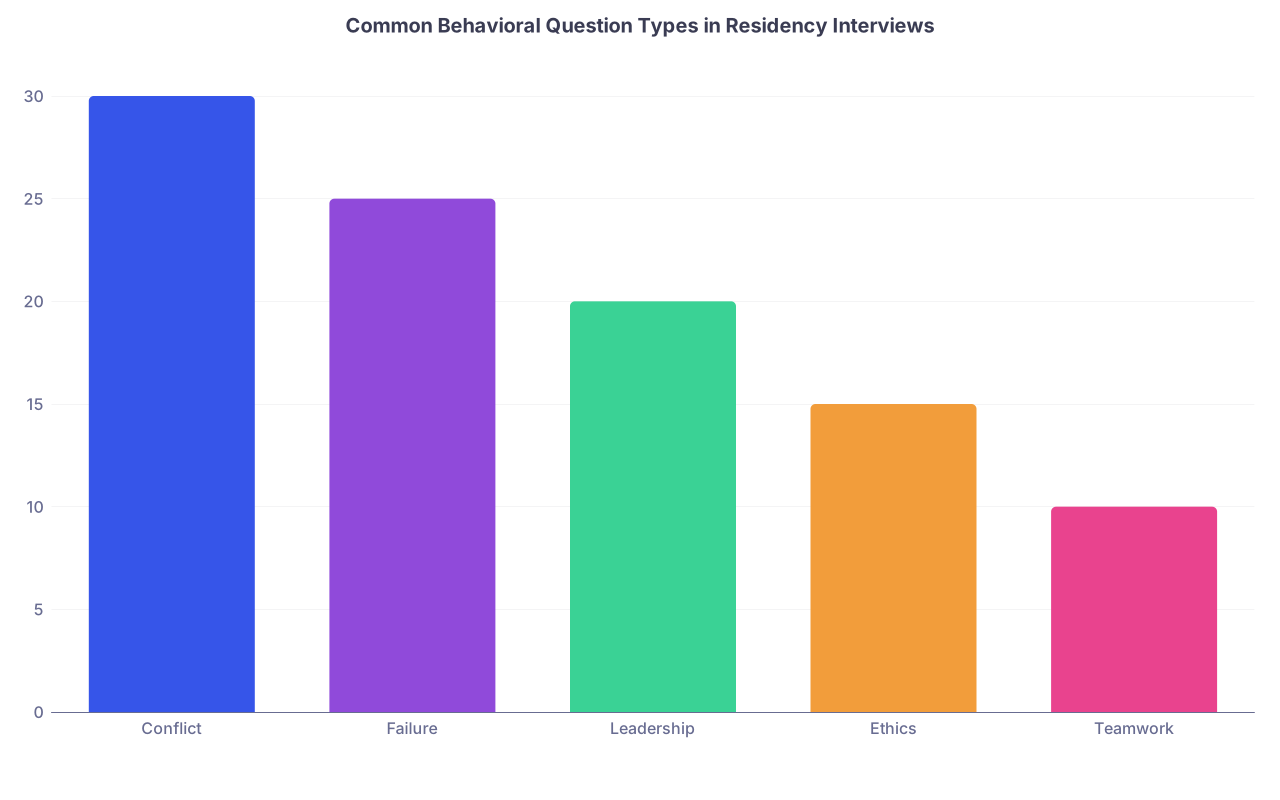
| Category | Value |
|---|---|
| Conflict | 30 |
| Failure | 25 |
| Leadership | 20 |
| Ethics | 15 |
| Teamwork | 10 |
Question: “Tell me about a time you made a mistake.”
Weak ending:
“…so yeah, I felt bad, and I haven’t done that again.”
Memorable version:
“…after debriefing with my attending, I apologized to the patient, clarified the plan, and documented everything clearly in the chart.
Since then, I’ve built a habit of pausing to summarize the plan out loud with patients before I leave the room, and it’s become a consistent part of how I practice on the wards.”
That’s sticky. The interviewer now associates you with clear patient communication and learning from mistakes.
Example 3: Leadership/Initiative
Question: “Tell me about a time you took initiative.”
Weak ending:
“…and the project went well and everyone was happy.”
Memorable version:
“…our discharge times improved, nurses reported fewer last-minute orders, and the residents actually liked the template because it saved clicks.
That project really solidified for me that small workflow changes can have a big impact, and it’s why I’m excited to keep working on quality improvement in residency.”
Now you’re not just “someone who did a project.” You’re “the QI-minded applicant who cares about workflow and efficiency.”
Practical Tricks So You Don’t Ramble at the End
You can have great content and still blow the landing if your delivery is messy. Here’s how to tighten it up.
1. Use a “Landing Phrase”
Train yourself to use a short phrase that signals you’re wrapping up:
- “So overall…”
- “In the end, what I took from that was…”
- “Since then…”
- “Looking back, the main lesson for me has been…”
Then hit your one-sentence takeaway.
This helps your brain stop from launching into another paragraph.
2. Aim for 10–20 Seconds for the Ending
The ending should not be another story. It’s a summary + takeaway.
Rough timing for a solid behavioral answer:
- 60–90 seconds: story
- 10–20 seconds: outcome + final line
If your answer is hitting 3–4 minutes, the ending doesn’t matter. They’re already mentally tired.
3. Write and Rehearse 5–7 Go-To Closers
Don’t “wing” your endings. Script them. Out loud.
For example, pre-write versions of:
- A “skill branding” ending for teamwork
- A “habit I still use” ending for communication
- A “what I’d do next time” ending for failure
- A “tie to specialty” ending for why this field
- A “evaluations reflect this” ending for your biggest strength
Then plug and play based on the question.
How to Practice This Without Sounding Robotic
You’re probably worried about sounding rehearsed. Good. The worst interview vibe is “over-memorized Step 1 anki deck, but as a person.”
Here’s how to avoid that:

| Step | Description |
|---|---|
| Step 1 | Pick 10 Common Questions |
| Step 2 | Outline Stories in Bullet Form |
| Step 3 | Write Only the Final Sentence for Each |
| Step 4 | Record Yourself Answering 3 Questions |
| Step 5 | Listen and Adjust Length and Endings |
| Step 6 | Practice With Friend or Mentor |
- Don’t write full scripts. Write bullets: context, key actions, outcome.
- Do fully script your last sentence only.
- Practice saying the story in your own words but always hit that last line exactly.
That’s the balance: flexible story, consistent takeaway.
What Interviewers Actually Remember
Here’s the ugly truth from the interviewer side: after a full interview day, I don’t remember your exact story. I remember:
- A few phrases
- A couple of strong impressions
- One or two “this is who they are” traits
That’s what your behavioral answer ending should be doing for you—delivering that “this is who I am” line.
You want them leaving with:
- “She’s very intentional about communication.”
- “He really learns from mistakes and changes his habits.”
- “They’re the one who’s big on QI and systems.”
- “She clearly cares about complex, underserved patients.”
Your last sentence is where you plant that seed.

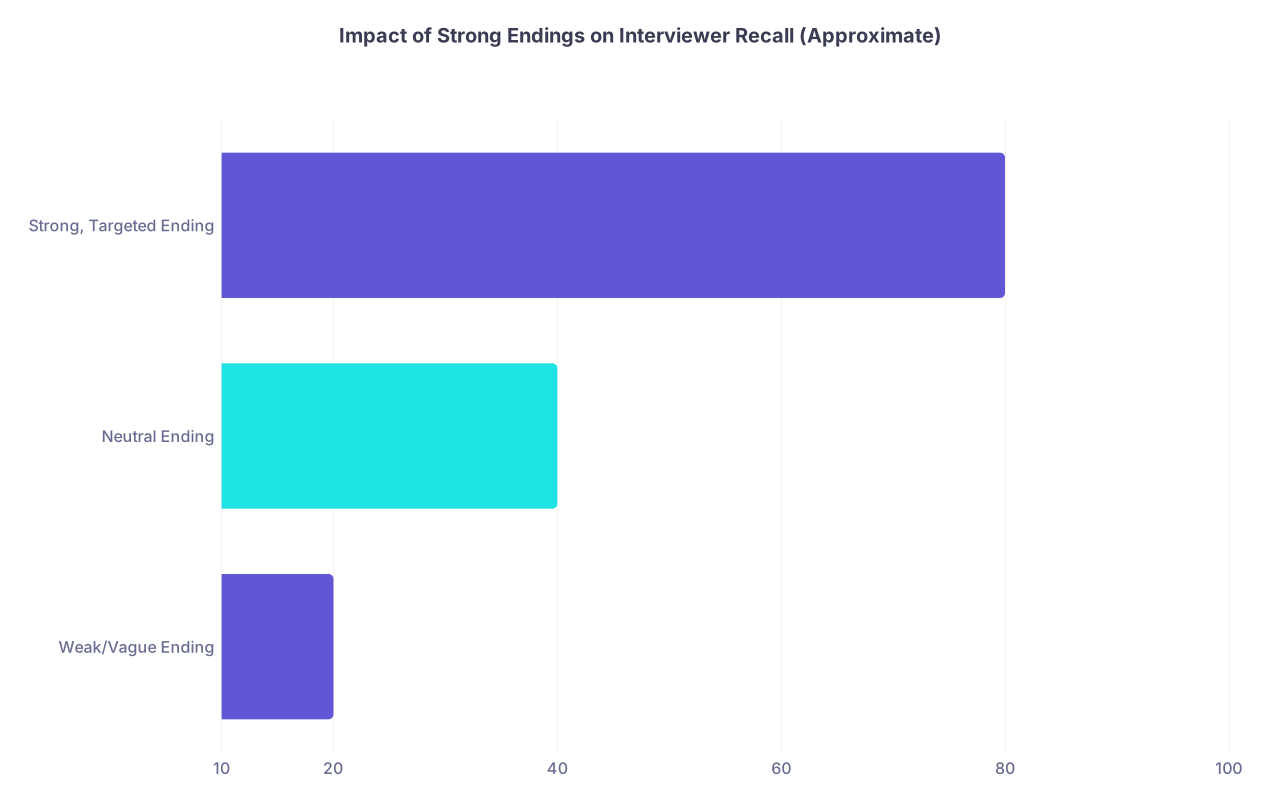
| Category | Value |
|---|---|
| Weak/Vague Ending | 20 |
| Neutral Ending | 40 |
| Strong, Targeted Ending | 80 |

Quick Templates You Can Use Today
Steal these. Edit the bracketed parts. Practice them.
“That experience really reinforced how important [SKILL] is, and it’s something I’m very intentional about bringing to [SPECIALTY/TEAM].”
“Since then, I’ve made it a habit to [SPECIFIC BEHAVIOR], and it’s become a consistent part of how I take care of patients.”
“My evaluations since then often mention my [TRAIT], and that really grew out of this experience.”
“That situation really shaped how I see [SPECIALTY/POPULATION], and it’s a perspective I’m excited to bring into residency.”
“If I faced a similar situation now, I’d still [THING YOU DID WELL], but I’d also [IMPROVEMENT], and I think that growth mindset will serve me well in residency.”
Use one of these for basically every behavioral answer, and you’re already ahead of most applicants.
| Question Type | Weak Ending | Strong Ending Snapshot |
|---|---|---|
| Conflict | “We figured it out.” | “Reinforced respectful disagreement with patient focus.” |
| Failure | “I felt bad and moved on.” | “Built a habit of summarizing plans with patients.” |
| Leadership | “It went well.” | “Showed me small workflow changes have big impact.” |
| Time Management | “I managed everything.” | “Now I triage proactively at the start of each shift.” |
| Ethics/Professionalism | “I learned a lot.” | “Confirmed I’ll always escalate when safety’s at stake.” |
FAQ (Exactly 7 Questions)
1. How long should a behavioral answer be in a residency interview?
Aim for 70–120 seconds total. If you’re consistently going past two minutes, you’re over-explaining. The ending itself should be 10–20 seconds: one clear outcome line, one clear takeaway line. Practice with a timer and record yourself; your perception of time in an interview is usually wrong.
2. What if I don’t have some dramatic story—can I still have a strong ending?
Yes. The story doesn’t need to be dramatic; it needs to be specific. A small example with a sharp takeaway beats a dramatic ICU disaster with a vague “I learned communication is important.” Focus your ending on a concrete habit you changed or a perspective that stuck, even if the event itself was routine.
3. Should I always tie my ending back to my chosen specialty?
Not always, but do it a few times. For generic questions (conflict with a nurse, time management on wards), you can keep it broad and focus on core skills. For questions where the content overlaps your specialty—critical care for anesthesia, continuity for FM, complex patients for IM—use that chance to link your growth directly to the field.
4. How many behavioral stories should I prepare ahead of time?
Prepare 8–12 solid stories that you can flex: conflict, failure, leadership, initiative, difficult patient, time you went above and beyond, working with limited resources, ethical/gray area. For each, write just three things: the key actions, the outcome, and the exact closing sentence you want to use. That’s enough.
5. What’s the biggest mistake people make in their endings?
They either:
a) Re-summarize the whole story again (“So basically, what happened was…”) or
b) Stop abruptly with a filler phrase (“So yeah, that was it”).
Both waste the most valuable real estate—the last thing the interviewer hears. Replace that with one sentence that defines who you are as a resident in that context.
6. Can I reuse the same ending style multiple times in one interview?
Yes, reuse the style; vary the content. You can use the “habit I still use” or “skill branding” endings many times as long as what you’re highlighting is different each time (communication in one answer, ownership in another, efficiency in a third). Consistent structure actually helps you sound polished, not fake.
7. How do I know if my ending is actually memorable?
Test it on a human. Say the full answer to a friend, resident, or mentor. Afterward, ask them: “What do you remember most about that story?” If they repeat back a trait or habit you care about (“You’re really big on follow-through”), your ending is doing its job. If they say, “Um… something about a patient on nights?” your takeaway needs to be sharper and more explicit.
Key points:
End with one intentional sentence that brands you as a certain kind of resident.
Make that sentence about a specific skill, habit, or perspective you actually carry forward.
Practice those endings on purpose—because that last line is what they’ll remember when they rank you.