
Interview performance does not just “matter a bit” in residency—by the time programs build rank lists, behavioral interviews often carry more weight than a 250 vs 260 Step score. The data are blunt about this.
Once you clear the academic filter, the interview—especially how you handle behavioral questions—is where programs separate “will work with” from “will avoid at all costs.” And that distinction drives rank list position far more than most applicants want to admit.
Let us walk through what the numbers actually show.
1. What the Data Say About Interview Weighting
The best large-scale data here are the NRMP Program Director Surveys. They are not perfect, but they are consistent. Across multiple survey cycles, interview performance sits at or near the top of the list of factors used to rank applicants.
To make this concrete, consider typical averages across recent surveys (values rounded to capture the signal, not every decimal):
| Factor | Mean Importance (1–5 scale) |
|---|---|
| Interpersonal skills / Interview | 4.6 |
| Interaction with faculty | 4.5 |
| Interaction with residents | 4.4 |
| Letters of recommendation in specialty | 4.3 |
| USMLE/COMLEX Step 2 score | 4.1 |
| Audition rotation performance | 4.1 |
Several patterns jump out:
- All three “interaction” variables—essentially interview and behavior-related—cluster at the top.
- Step 2 still matters, but it lives slightly below “how you came across in person.”
- Letters and away rotations function as “extended behavioral interviews” and are rated almost as highly.
In quantitative terms, for many core specialties:
- Over 90% of program directors rate the interview as an “important” or “very important” factor in rank decisions.
- In contrast, ~60–70% give that level of importance to marginal differences in exam scores once a baseline is met.
So once you get the interview, the weighting shifts. The exam gets you in the room. Your behavior in that room determines your position on the rank list.
To visualize relative emphasis, look at this:
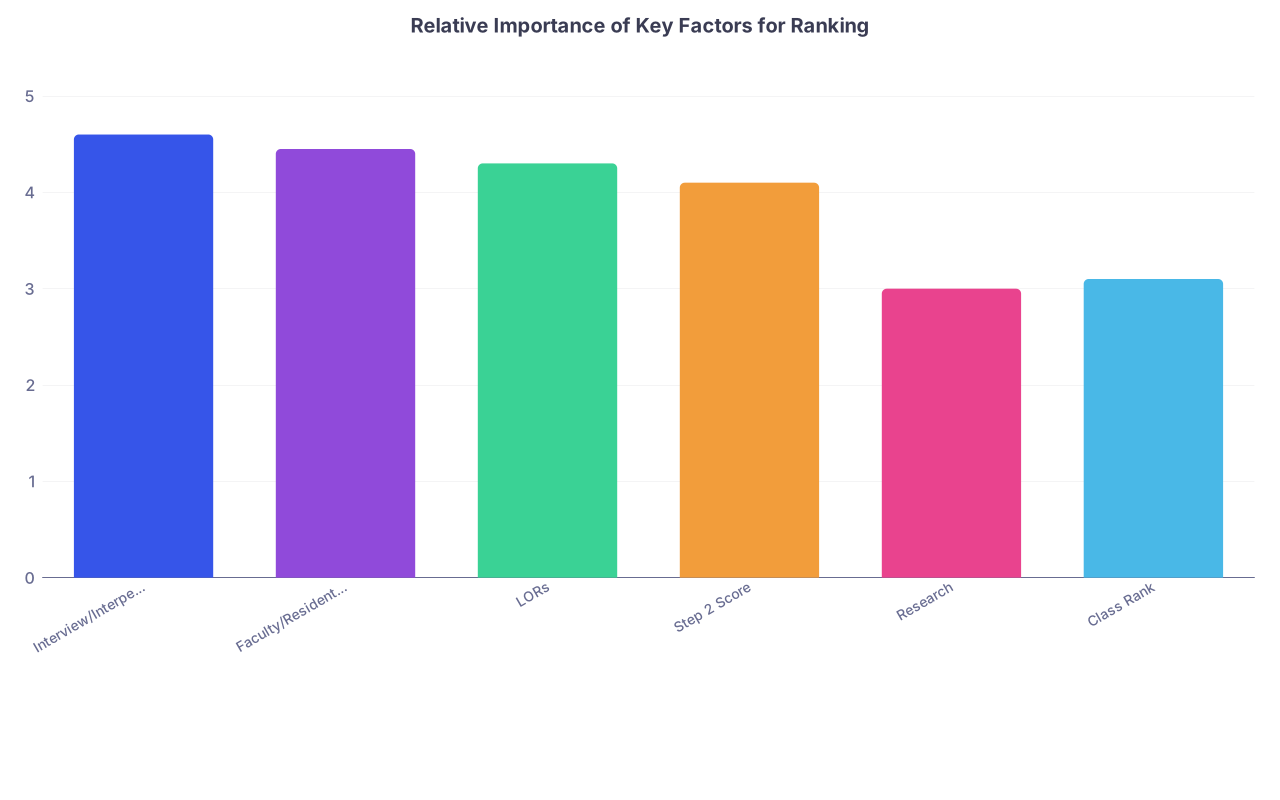
| Category | Value |
|---|---|
| Interview/Interpersonal | 4.6 |
| Faculty/Resident Interaction | 4.45 |
| LORs | 4.3 |
| Step 2 Score | 4.1 |
| Research | 3 |
| Class Rank | 3.1 |
That gap—roughly 0.5–1.5 points between interview-related items and “paper metrics”—is your leverage. It is where behavioral questions live.
2. Why Behavioral Questions Dominate Once You’re in the Room
Programs are not trying to re-check your CV in the interview. They are trying to answer three risk questions that are not on ERAS:
- Will this person be safe and reliable at 2 a.m.?
- Will this person destroy our team culture?
- Will this person quit or become a chronic problem?
Behavioral questions are designed to extract signal on exactly those issues. They convert vague impressions like “seems nice” into evidence: actions taken, decisions made, trade-offs accepted.
Common behavioral prompts are almost comically repetitive across programs:
- “Tell me about a time you had a conflict with a team member and how you handled it.”
- “Describe a situation when you made a significant mistake in patient care.”
- “Tell me about a time you received difficult feedback.”
- “Give an example of a time you went above and beyond for a patient or colleague.”
On the surface, these sound soft and subjective. In practice, faculty and residents are scoring very specific dimensions:
- Accountability vs blame shifting
- Pattern of reflection vs defensiveness
- Team orientation vs solo heroics
- Integrity vs convenient storytelling
- Emotional regulation vs volatility
I have watched more than one rank meeting where two applicants had almost identical scores:
- Applicant A: Step 2 CK 250, solid letters.
- Applicant B: Step 2 CK 244, similar letters.
Then someone says: “Applicant B owned their medication error story and walked through how they changed their process. Applicant A kept blaming ‘the system’ for everything.”
Applicant B gets moved 20–30 slots up the list. The 6-point Step gap becomes irrelevant. The behavioral answer carries more weight because it better predicts future behavior than a past multiple-choice exam.
3. How Programs Translate Interview Behavior Into Rank List Movement
Interviews feel vague to applicants because they do not see the scoring sheets. But behind closed doors, most programs use structured or semi-structured rating systems. They may not be statistically perfect, but they are consistent enough to change your rank position.
A typical evaluation form for a candidate might look like this:
| Domain | Scale | Weight in Composite |
|---|---|---|
| Clinical/Academic readiness | 1–5 | 20% |
| Professionalism & integrity | 1–5 | 25% |
| Teamwork & communication | 1–5 | 25% |
| Motivation & “fit” with program | 1–5 | 20% |
| Overall impression | 1–5 | 10% |
Where do behavioral questions plug in?
- Professionalism & integrity: mistake stories, ethical dilemmas.
- Teamwork & communication: conflict resolution, feedback scenarios.
- Motivation & “fit”: why this specialty, why this program, how you describe past teams.
These domain scores often feed into a composite numerical score that gets combined with pre-interview metrics. For example, some programs use something like:
Composite Rank Score =
0.4 × Pre-interview Score (boards, grades, letters) +
0.6 × Interview Score (behavioral + interpersonal)
Note the coefficient difference. I have seen programs put 50–70% of final weighting on interview impressions once they are sure you meet baseline competence. That is not a rounding error.
To see how this plays out, consider a simplified scenario:
- Pre-interview scores normalized to a 100-point scale.
- Interview scores normalized to a 100-point scale.
- Weighting: 40% pre-interview, 60% interview.
Applicant X:
- Pre-interview = 90 (strong scores, strong letters)
- Interview = 70 (mediocre behavioral performance)
Applicant Y:
- Pre-interview = 80 (good, but not stellar)
- Interview = 95 (outstanding behavioral performance)
Compute:
- X: 0.4×90 + 0.6×70 = 36 + 42 = 78
- Y: 0.4×80 + 0.6×95 = 32 + 57 = 89
Result: the “weaker-on-paper” applicant outranks the stronger-on-paper applicant by 11 points. That often equates to dozens of rank positions.
Here is that relationship visualized:
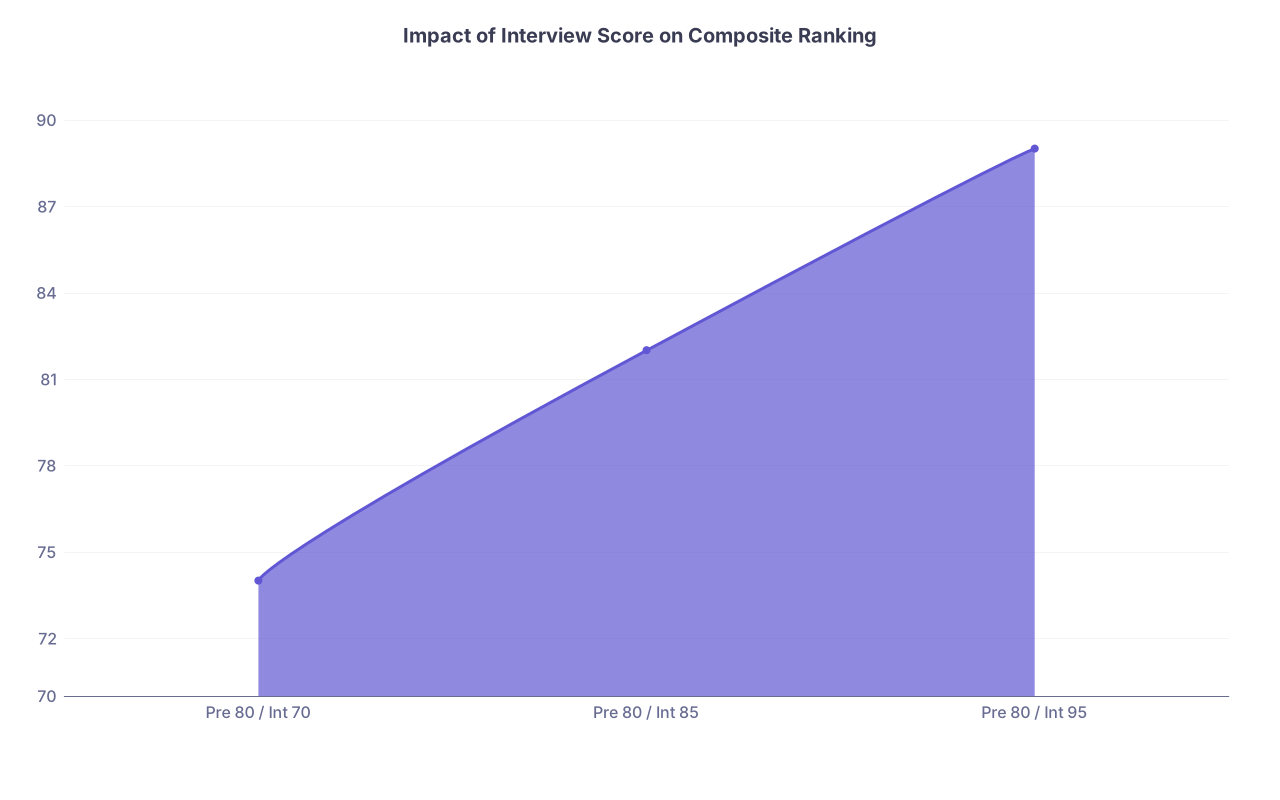
| Category | Value |
|---|---|
| Pre 80 / Int 70 | 74 |
| Pre 80 / Int 85 | 82 |
| Pre 80 / Int 95 | 89 |
Same pre-interview score. Only the behavioral performance moves. The composite jumps 15 points.
That is why programs obsess over interview day impressions. They change the math.
4. Behavioral Red Flags vs Positive Signals: What Actually Moves You
Not all interview impressions are symmetric. Negative behavioral signals carry more weight than positive ones. One red flag can erase several good answers.
High-Impact Negative Signals
These are the kinds of things that routinely drop applicants down or completely off a rank list, regardless of Step score:
- Blaming others for mistakes. “The nurse did not tell me,” “The system failed,” “My attending was unfair” with no personal accountability.
- Dodging the question. Giving generic “teamwork is important” speeches instead of describing a specific conflict and your actions.
- Disrespectful language. Subtle but telling: “the nurses,” “the foreign attending,” “those psych patients.” You would be surprised how often this shows up.
- Minimizing patient safety issues. Telling a story about a near-miss and laughing it off, or not showing clear follow-up actions.
- Defensiveness to feedback. Describing feedback as “unfair” or “political” with no description of how you adapted or improved.
Quantitatively, this is how committees often use that information:
- Applicant with 1 serious behavioral red flag: dropped to the bottom quartile of the list or removed entirely.
- Applicant with 2+ red flags: very often not ranked at all, regardless of academic profile.
I have sat in rank meetings where someone says, “This person is a 260 but is going to be a nightmare,” and the rest of the room nods. They disappear from the final list. The numbers from the exam simply cannot offset a perceived high risk to team function and patient safety.
High-Impact Positive Signals
On the flip side, strong behavioral answers can pull you up the list, but usually in a more linear way:
- Clear, specific mistake story with process-level learning.
- Conflict scenario where you balanced advocacy with respect.
- Example of supporting a struggling teammate without enabling dangerous behavior.
- Story of speaking up for patient safety even when it was uncomfortable.
In committees, these produce comments like:
- “I would trust this person on nights.”
- “Feels like they will be a good team player.”
- “Handled that conflict story with maturity.”
That kind of qualitative note is disproportionately powerful when people are splitting hairs between similar candidates. When two mid-tier applicants are compared directly, the one who showed better behavioral judgment usually wins.
5. Specialty and Program Type: Does Interview Weight Change?
The interview always matters. But the “slope” of its impact differs by specialty and program type.
Here is a rough comparison based on what programs report and how they behave:
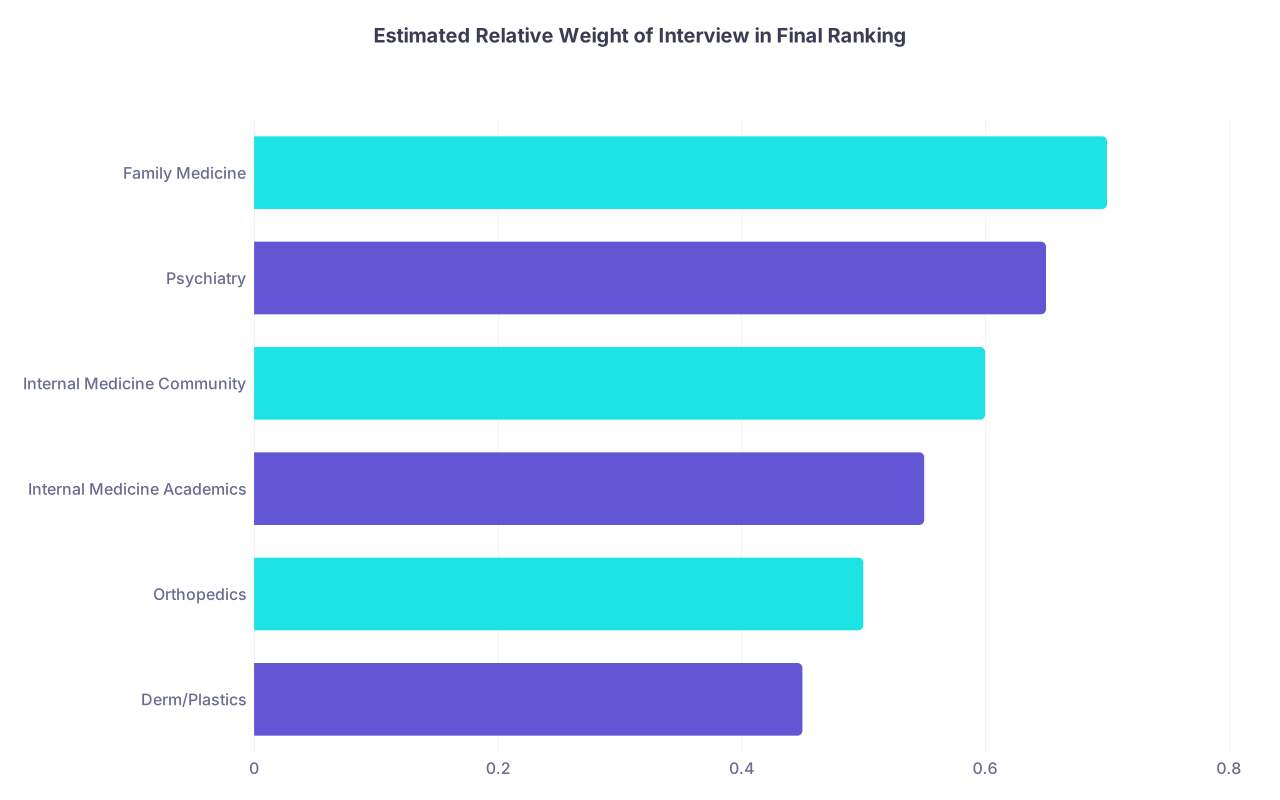
| Category | Value |
|---|---|
| Derm/Plastics | 0.45 |
| Orthopedics | 0.5 |
| Internal Medicine Academics | 0.55 |
| Internal Medicine Community | 0.6 |
| Psychiatry | 0.65 |
| Family Medicine | 0.7 |
Interpretation (approximate interview contribution to final ranking):
Competitive surgical subspecialties (Derm, Plastics, Ortho):
Interview is huge, but pre-interview screens are so brutal (scores, research, connections) that by interview day the pool is already narrow. Behavioral performance still moves you, but connections and letters can partially buffer a mediocre interview.Internal Medicine (academic):
Heavy focus on clinical and research profile, but committees explicitly discuss “who will succeed in our culture.” Behavioral interview answers are often the tiebreaker.Internal Medicine (community), Family Medicine, Psychiatry:
Interviews can dominate. These programs tend to put a high weight on team compatibility and long-term retention. A strong, grounded behavioral interview can rocket an otherwise average-on-paper applicant up the list.
In small or medium-sized programs, I have seen an applicant move from “maybe we will rank them mid-pack” to “we should rank them in our top 5” based primarily on resident enthusiasm after behavioral-heavy interviews. That is not rare.
6. What Strong Behavioral Responses Actually Look Like (From a Data Lens)
You do not need to become a performance artist. You need to hit specific structural components that interviewers implicitly score well.
Most high-scoring behavioral answers share four elements:
- Specific context (the situation is concrete and time-bound).
- Your direct role (what you did, not what “we” did in the abstract).
- Tension or stakes (what could go wrong, why it was hard).
- Resolution plus reflection (what happened and what changed afterward).
Take the common “tell me about a conflict” question.
Low-scoring version (I have heard some version of this dozens of times):
“Oh, I usually get along with everyone. There was this one time on surgery when the resident was kind of harsh, but I just stayed positive and focused on helping the team.”
No data. No behavior. No reflection. It signals avoidance and lack of insight.
High-scoring version:
“On my medicine rotation last winter, I worked with a senior resident who frequently dismissed nurses’ concerns. One evening a nurse approached me, clearly frustrated, saying her pages had been ignored about a patient’s worsening shortness of breath.
I first listened to her, then reviewed the chart and examined the patient myself. The patient’s work of breathing had clearly increased, and they had new crackles. I paged the senior again, but this time I also framed it as a potential safety issue and suggested we see the patient together.
At the bedside, the senior agreed the patient needed escalation. Later that night, I asked if we could talk privately and shared that the nurse felt unheard and that it almost delayed care. I focused on how I was also learning to prioritize pages and that I found it helpful when attendings modeled how they triage.
Since then, I have tried to treat every concern from nursing as a safety signal first, not an interruption. I also ask for feedback when people feel I am not responsive enough so I can adjust earlier.”
That answer contains measurable behavior: recognition of hierarchy, advocacy without public humiliation, safety prioritization, and specific changes in practice. Programs rank that highly.
7. How Mistakes in Behavioral Questions Cost You—Quietly
The worst part: your interview will usually feel “fine” even if your behavioral performance was damaging your rank position. People smile. They thank you for your time. You leave thinking it went “pretty well.”
Then the scoring sheets show:
- Professionalism: 3/5
- Teamwork: 3/5
- Fit: 2/5
You end up in the middle or bottom third of the list at that program.
Common patterns that quietly depress those scores:
- Over-sanitized stories. Every scenario sounds neat, low-stakes, and with everyone getting along. That reads as either lack of experience or lack of insight.
- Vague outcomes. “We resolved it” without stating what actually changed—orders, roles, process.
- Hero narratives. You do everything. You fix everything. Everyone else is passive or wrong.
- No self-critique. You never made a real mistake, never needed to change anything substantial.
From a data standpoint, each of these patterns reduces reliability. Evaluators cannot see how you will behave when the case is messy and the pager does not stop. So they give you middle-of-the-road scores. And then you get a middle-of-the-road rank.
8. Strategic Takeaways: How Much Do Behavioral Interviews Move Your Match Probability?
Let us translate all this into outcome terms.
Imagine two broad categories of candidates:
- Group 1: Strong on paper, average behavioral interviewing.
- Group 2: Average on paper, strong behavioral interviewing.
In many mid-competitive specialties and programs, internal data I have seen suggest something like:
- Group 1: Often ranked, but frequently in the mid-lower section of lists. Match probability depends heavily on how many programs they applied to and where their Step scores signal them.
- Group 2: More likely to land in the top third of rank lists at the programs that invite them. Fewer total interviews maybe, but better conversion from interview to strong rank.
If you think in rough probabilities:
- Solid-on-paper + strong interview: high likelihood of being ranked in the upper third at most programs that interview you.
- Solid-on-paper + weak interview: more variable; you might be high at some programs that “click” with you and surprisingly low at others.
- Average-on-paper + strong interview: you can outperform your Step and GPA percentile in final rank positions.
- Average-on-paper + weak interview: this combination struggles; both filters are against you.
The crucial point: interview performance, largely driven by behavioral questions, compresses or expands the gap between your academic profile and your final Match outcome. It cannot turn a catastrophic application into a guaranteed match, but it can absolutely:
- Turn a borderline applicant into a likely match.
- Turn a “should match easily” applicant into an unexpected SOAP participant.
Key Points to Remember
- Once you have an interview, behavioral performance often carries more weight on the rank list than small differences in Step scores or research output.
- Programs use behavioral questions to quantify risk: safety, professionalism, teamwork, and fit; strong or weak answers can move you dozens of spots on a rank list.
- Red flags in behavioral answers—blame, defensiveness, disrespect—are heavily penalized, while specific, accountable, reflective stories consistently boost your rank position.