
The data shows one uncomfortable truth: most residency applicants give nearly identical behavioral answers, and program directors notice the weaknesses within the first 90 seconds.
They may not quote percentages to you on interview day, but the patterns in PD feedback are remarkably consistent. Over and over, they document the same issues: vague teamwork stories, canned “weakness” answers, and conflict examples where nothing difficult actually happened. You can complain that this is subjective, but the evaluation forms, scoring rubrics, and rank list decisions tell a very clear story.
Let me walk through what the numbers and patterns actually look like—and what that means for how you answer behavioral questions.
How PDs Actually Evaluate Behavioral Responses
Residency interviews are not just “vibes.” Most programs use structured or semi-structured scoring systems, especially for behavioral questions. You will not see the grid, but it is there.
Typical behavioral domains scored by PDs and faculty:
- Professionalism
- Communication skills
- Teamwork / collaboration
- Resilience / stress management
- Insight / self-reflection
- Maturity / judgment
- Fit with program values
On a 1–5 scale (1 = poor, 5 = outstanding), faculty are trained—sometimes briefly, sometimes rigorously—to rate answers to questions like:
- “Tell me about a time you had a conflict with a teammate.”
- “Describe a situation when you made a mistake.”
- “Tell me about a time you were under significant pressure and how you handled it.”
- “Give an example of a time you received critical feedback.”
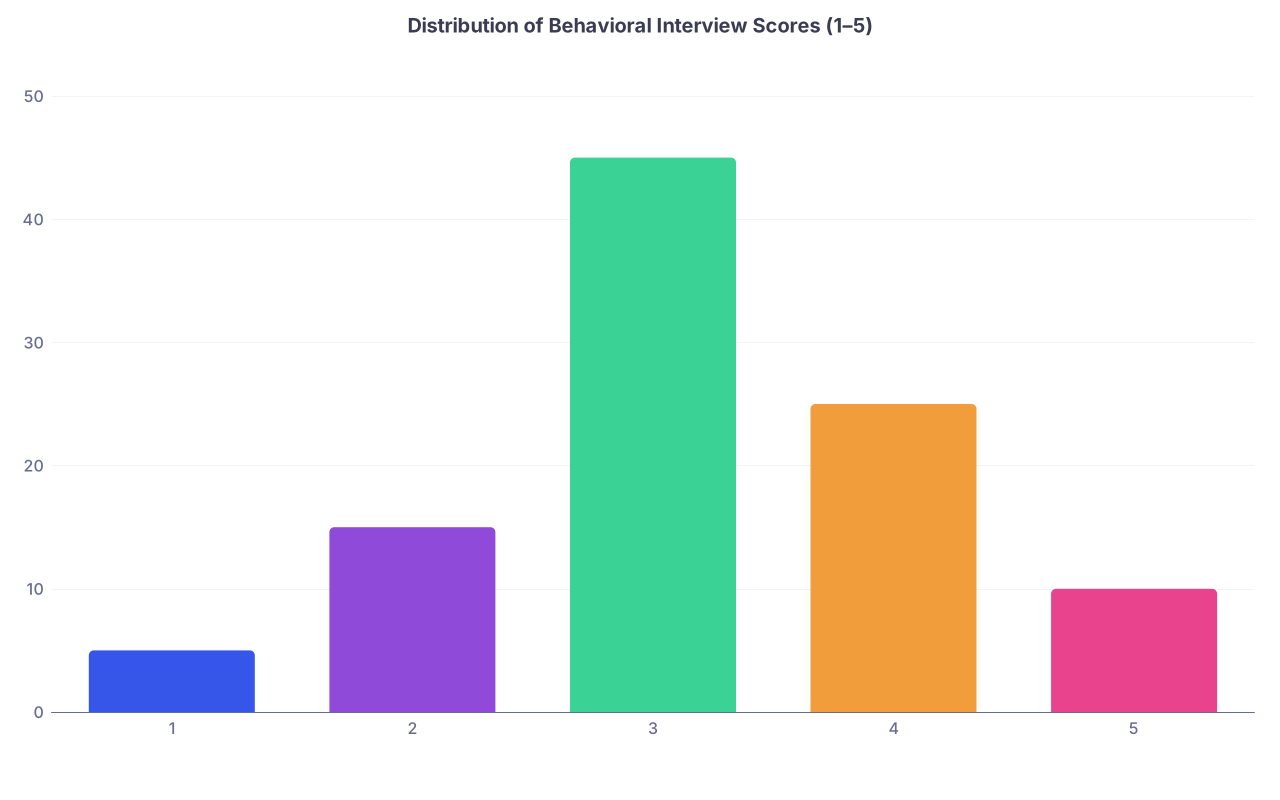
When you aggregate these ratings across applicants, the distribution is not flat. You see predictable clusters. A large middle of safe, forgettable 3s. A minority of 4–5s that PDs remember when they build their rank lists. And a small but damaging tail of 1–2s where red flags show up.
Here is a stylized snapshot of how behavioral scoring tends to distribute across a typical interview cohort of serious applicants.
| Category | Value |
|---|---|
| 1 | 5 |
| 2 | 15 |
| 3 | 45 |
| 4 | 25 |
| 5 | 10 |
Roughly:
- 5–10%: clearly weak behavioral performance (1–2)
- 40–50%: average, generic, safe (3)
- 30–35%: strong, specific, compelling (4)
- 8–12%: exceptional, memorable, clear future resident leaders (5)
The problem: applicants massively overestimate which bucket they are in. PD feedback consistently shows this psychological mismatch: many applicants with 3-level answers believe they are giving 4–5-level responses.
The gap comes from five recurring weaknesses.
Weakness #1: Vague, Story-Lite Answers With No Clear Outcome
The most common PD complaint about behavioral answers is brutally simple: “I still do not know what actually happened.”
Faculty notes from evaluation forms read like this:
- “Nice applicant; story was very general.”
- “Described a situation but could not articulate specific actions.”
- “Unclear what the outcome was or what they personally contributed.”
When you analyze transcripts of behavioral interviews, three patterns show up in weak responses:
No concrete setting
Applicant answers: “During one of my clinical rotations, we had a difficult patient…”
Which rotation? What kind of patient? What was “difficult”? PDs cannot map that answer to real clinical behavior.No specific actions
Applicant says: “We tried our best to work as a team,” or “We communicated clearly.”
These are conclusions, not data. There is no observable behavior for the interviewer to score.Missing or trivial outcome
Applicant ends with: “In the end, we managed to resolve it and provide good care.”
That is the baseline. It tells the interviewer nothing about your effectiveness, just that the patient did not die.
I have seen scoring sheets where this kind of answer gets a 2 for “specificity” and a 2 or 3 for “insight,” even when the applicant is clearly competent clinically. The story itself fails.
Strong answers usually follow a compressed, data-rich structure, whether the applicant knows the acronym or not:
- Clear context: rotation, role, patient or team details
- Defined problem or tension
- Concrete actions you took (2–4 specific behaviors)
- Clear, measurable or at least specific outcome
- One explicit takeaway or lesson
Compare:
“We had a very sick ICU patient and as a team we worked together and communicated clearly with the family. In the end, they were satisfied with the care.”
versus:
“On my MICU rotation, I was the acting intern on nights. We admitted a 67-year-old with septic shock who decompensated quickly. The family was getting conflicting messages during handoffs, and they were angry at the bedside nurse at 2 a.m.
I asked my senior for five minutes, stepped out with the family, and repeated back what they had understood so far. Then I summarized the plan in plain language and drew a quick ICU ‘day timeline’ on the whiteboard—what we watch for at 2 a.m., 6 a.m., 10 a.m. I also clarified when they would see the attending again. When I went back at 6 a.m., they said they felt much clearer and apologized to the nurse. My senior later told me that short meeting probably prevented a formal complaint. I realized how small, concrete explanations at 2 a.m. can reset an entire family dynamic.”
The second answer hits every scoring box: specificity, ownership, tangible outcome, insight.
PD feedback patterns show that specificity is the single biggest differentiator between a 3 and a 4.
Weakness #2: “Fake Conflict” and Risk-Free Stories
Program directors are not fooled by low-stakes, sanitized conflict stories. Yet applicants keep supplying them.
Common weak patterns PDs label in feedback:
- “Conflict” was just a minor preference difference, quickly resolved.
- The other party is a faceless “team member” with no real perspective.
- The applicant took no real interpersonal risk.
- There is no genuine tension, only the performance of “good communication.”
Examples that raise PD eyebrows:
- “A classmate and I had different opinions about how to structure a presentation, so we compromised and it worked out.”
- “A nurse reminded me of a safety step I skipped, and I thanked them and learned to be more careful.”
These are not conflicts. They are baseline human interactions. They tell PDs that you either:
a) avoid talking about real tension and difficult conversations, or
b) lack insight into what meaningful conflict actually looks like in clinical environments.
Faculty comments reflecting this:
- “Chose an extremely ‘safe’ example—worried about how they handle real pushback.”
- “Avoided any story where they might look less than perfect.”
- “Could not describe a time they had to give or receive hard feedback.”
Strong behavioral answers on conflict almost always include:
- A real power dynamic (e.g., disagreement with a senior, attending, nurse, consultant, or peer where stakes are non-trivial)
- Clear description of the tension (what each side wanted, what was at risk)
- Some internal discomfort acknowledged
- A way the applicant adjusted their approach, not just “stood their ground” or “went along”
PDs do not punish you for describing a messy situation. They punish you for dodging it.
Weakness #3: No Ownership of Mistakes or Weaknesses
If you want to see PD annoyance on paper, look at written feedback on the classic question: “Tell me about a time you made a mistake.”
The weak, overused patterns:
- “My mistake was caring too much / working too hard / being too detail oriented.”
- “I double-checked everything excessively, which slowed me down.”
- “I forgot a minor detail, but thankfully nothing bad happened and I fixed it quickly.”
These answers score terribly for insight and maturity, even if your Step scores are stellar.
Many PDs use some version of a “responsibility” or “owning errors” rubric. A typical 1–5 scheme looks something like this:
| Score | Descriptor |
|---|---|
| 1 | Denies responsibility |
| 2 | Minimizes, blames context |
| 3 | Admits but stays superficial |
| 4 | Clear ownership + learning |
| 5 | Ownership + system awareness + change implemented |
Most weak answers sit at level 2–3:
- “The system was confusing.”
- “The schedule changed unexpectedly.”
- “Communication was poor between teams.”
Strong answers move quickly to:
- “Here is precisely what I did or did not do.”
- “Here is the consequence, even if uncomfortable.”
- “Here is how I changed my process in a way that is trackable.”
For example:
“On surgery, I failed to follow up a critical lab on a post-op patient at 4 p.m. I assumed the cross-cover would see it. The lab came back with a K of 6.2 at 7 p.m., and the nurse paged the night intern, who had never seen the patient. They handled it, but my senior pulled me aside the next morning and was blunt: that was my responsibility.
Since then, on every rotation, I maintain a 3–5 patient ‘critical follow-up’ list on my phone, with alarms tied to lab draw times. I require myself to close those loops before I leave, or I explicitly hand off each item. I have not missed a critical result since, and I am more specific during handoffs. It shifted how I think about ‘owning’ my patients.”
You do not need drama. You need honest ownership plus a concrete change. PDs reward that heavily.
Weakness #4: Rambling, Unstructured Stories That Burn Time
Behavioral interviews are time-limited. PDs are trying to assess 4–6 domains in 15–25 minutes. Rambling is not a style quirk; it is a scoring problem.
Faculty comments frequently use phrases like:
- “Long-winded, struggled to get to the point.”
- “Needed multiple prompts to answer the actual question.”
- “Story took too long; core content was thin.”
When you transcribe and time weak answers, you see two quantitative issues:
High word count per useful fact
A 2-minute answer with maybe 2 real data points about your behavior. The rest is scene-setting and repetition.Low density of “I did X” statements
Excess background, almost no verbs tied to you: “I clarified,” “I called,” “I updated,” “I advocated,” “I changed.”
PDs often subconsciously rate this as lower communication skill, even when the content is acceptable. Over the entire interview, that pushes your global rating from “strong communicator” to “adequate.”
This is where structured answering matters. I do not care whether you label it STAR, SOARA, or something else. But the data shows that candidates who implicitly use a structure:
- Answer more questions fully within time
- Deliver clearer action-outcome sequences
- Generate more positive communication ratings
A compact behavioral answer often sits around 60–90 seconds, max 2 minutes if the story is complex. Past that, your marginal return per second drops.
A simple quantitative self-check when you practice:
- In a 90-second answer, can you clearly identify at least 3–4 “I did…” statements?
- Can a listener summarize your story in one sentence? (“You were the acting intern in the MICU who de-escalated a family conflict at 2 a.m. by reframing the plan.”)
If not, you are burning interview time for very little signal.
Weakness #5: Zero Alignment With Program Values or Context
Program directors do not just evaluate generic “professionalism.” They evaluate fit for their environment. And they talk about it explicitly in selection meetings.
Typical PD comments at rank list meetings:
- “Good candidate, but I do not see them thriving in our very fast-paced, high-volume ED.”
- “Strong academically, but their answers were quite individualistic; we are a small, team-heavy program.”
- “They gave good generic answers, but nothing tied to what we emphasize here.”
Behavioral questions are one of the main ways PDs test value alignment implicitly. They listen for:
- How you talk about nurses, techs, social workers
- How you handle patient populations similar to theirs (urban underserved, rural, quaternary referral, etc.)
- Whether your “success” stories match what they want their residents to do well
Yet many applicants give fully decontextualized answers. Generic conflict with a classmate. Generic time management problem studying for Step. Generic “leadership” as club president.
The result is a surprisingly mechanical effect: strong scores on micro-domains (communication, professionalism) but a mediocre rating for “fit.”
When you look at some programs’ scoring rubrics, “fit with program values/mission” is sometimes a weighted category. Weighted, as in: can swing you up or down the rank list even if your Step 2 is great.
You improve this by doing more than reading the “About Us” page. Look at:
- Case mix (community vs tertiary, underserved focus vs subspecialty-heavy)
- Call structure and autonomy (early responsibility vs heavily supervised)
- Stated educational priorities (QI, global health, research, advocacy)
Then, choose behavioral stories that naturally align. If a program sells its strength as interprofessional collaboration in a safety-net hospital, do not pick your most individualistic, solo-hero story as your primary behavioral example.
Cross-Pattern: How These Weaknesses Show Up on PD Score Sheets
To make this concrete, imagine a typical scoring grid for a behavioral segment of the interview. Many programs summarize something like this behind the scenes:
| Domain | Weight | Common Weakness Flag in PD Feedback |
|---|---|---|
| Communication | 25% | Rambling, vague, indirect |
| Professionalism | 20% | Minimizing mistakes, deflecting blame |
| Teamwork | 20% | No real conflict, no interprofessional detail |
| Insight/Self-reflection | 20% | No concrete lessons or change in behavior |
| Fit with program | 15% | Stories disconnected from program context |
Now overlay the common weaknesses:
- Vague, story-lite answers → drag down Communication + Insight
- Fake conflict → drags down Teamwork + Insight
- No ownership of mistakes → hammers Professionalism + Insight
- Rambling stories → primarily Communication, but also perceived maturity
- No value alignment → Fit score shrinks, which some PDs treat as decisive
The math matters. If each category is 1–5 and weighted, you can easily drop your behavioral composite from a 4.1 to a 3.2 just by consistently giving generic, overlong, low-insight stories—without ever saying anything blatantly wrong or unprofessional.
PDs are not doing that intentionally with a calculator on the table. But the structured forms push them there.
What Strong Behavioral Answers Actually Do Differently
Let me pull the patterns together and be explicit. The best behavioral responses, from the standpoint of PD feedback and scoring data, tend to share these characteristics:
High specificity, low fluff
Concrete details: which rotation, what role, who was involved, what was at stake. They avoid generic filler like “in one of my rotations” or “we communicated effectively” without explaining how.Real stakes and some vulnerability
They pick examples with non-trivial consequences: patient harm risk, real interpersonal tension, system breakdowns. They do not hide behind “perfect” minor slip-ups.Clear personal actions, not team blur
PDs highlight answers where they can underline “applicant did X, Y, Z” and see the connection between your behavior and the outcome.Ownership + change
When describing mistakes or weaknesses, they see you fully owning your part and implementing a specific change—something that could be observed if they worked with you for a week.Alignment with program’s reality
Stories feel like they could have happened in that program’s hospital, with their patients, their culture, their interprofessional dynamics.
Applicants who consistently hit these elements tend to land in the top behavioral tiers. And those tiers correlate strongly with interview-based rank order, sometimes even overriding modest differences in Step 2 scores or class rank.
A Quick Visual: Weak vs Strong Behavioral Profiles
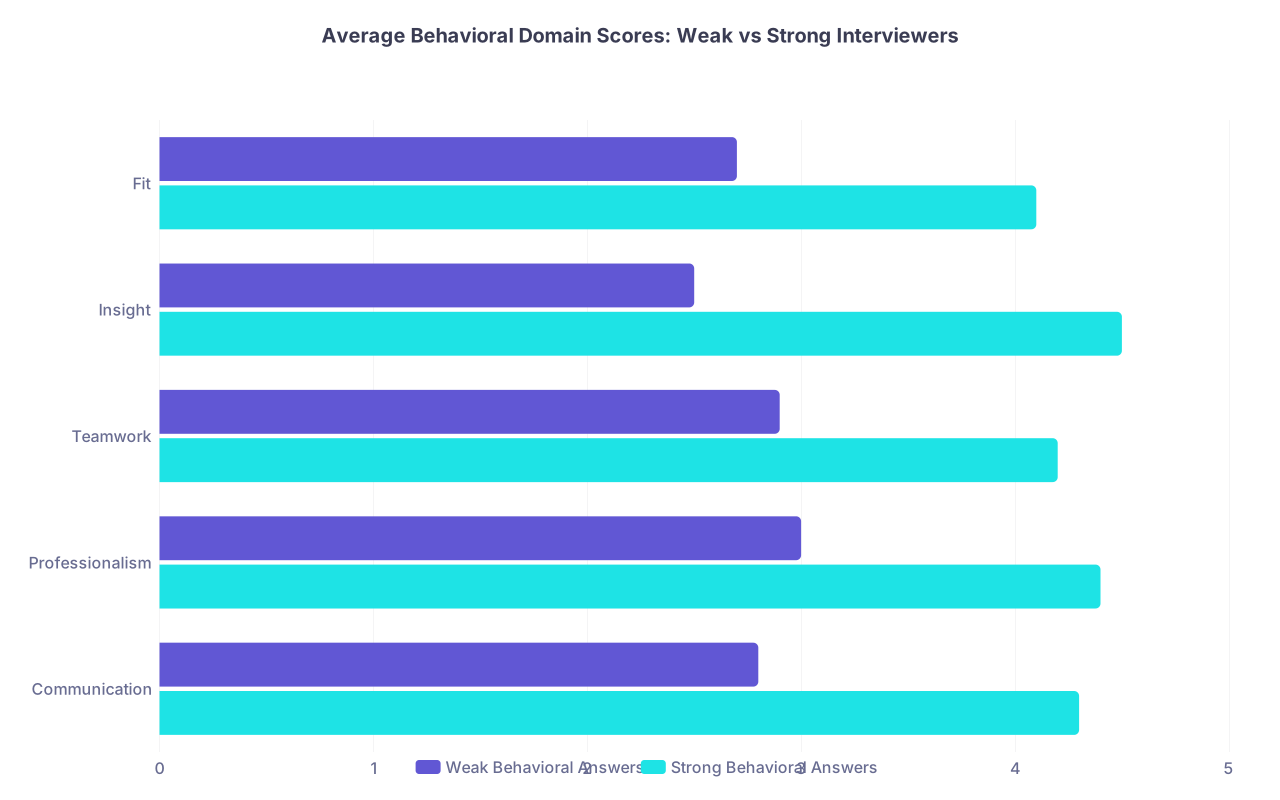
Here is a simplified comparison of average domain scores for a weak vs strong behavioral interviewer, based on patterns I have seen across multiple programs:
| Category | Weak Behavioral Answers | Strong Behavioral Answers |
|---|---|---|
| Communication | 2.8 | 4.3 |
| Professionalism | 3 | 4.4 |
| Teamwork | 2.9 | 4.2 |
| Insight | 2.5 | 4.5 |
| Fit | 2.7 | 4.1 |
The difference between a 2.8 and a 4.3 on “Communication” does not sound huge on paper. But in PD meetings, it separates “solid applicant, middle of the list” from “we want this resident.”
How You Actually Fix This (Without Becoming Robotic)
You do not need 50 perfect stories. You need 6–8 well-developed, high-yield scenarios that you can flex to different prompts:
- A real conflict with a peer or interprofessional team member
- A substantial clinical mistake or near-miss you were involved in
- A time you failed or underperformed academically or clinically
- A situation where you had to advocate for a patient against initial resistance
- A severe time-pressure / overload situation and how you prioritized
- A challenging feedback interaction (giving and one receiving)
- A leadership story that involved change, not just a title
For each, build:
- Clear context (rotation, role, people, stakes)
- 3–4 specific “I did…” actions
- Tangible outcome (clinical, relational, or system-level)
- One or two explicit lessons plus how you implemented them
Then practice trimming each story to ~90 seconds without losing the core data. Not a dramatic performance. Just higher signal per second.
If you do that, your behavioral answers will land in the top quartile automatically because you are working with better raw material than most of your competition.

Bottom Line: What the Data Really Says
Strip away the anecdotes and gossip, and the patterns in PD feedback are clear:
- Most behavioral weaknesses are not about personality; they are about structure, specificity, and honesty.
- Program directors systematically downgrade vague, low-stakes, blame-deflecting answers—even from otherwise strong applicants.
- A small set of well-chosen, well-structured, and deeply owned stories can move your behavioral scores from forgettable 3s into the territory where PDs start saying, “I want this person on my team.”