
The common advice about “just tell a good story” in residency behavioral interviews is dangerously incomplete. The data shows program directors are scoring you on very specific, quantifiable elements beneath that story—and most applicants miss them.
You are not being judged on charm. You are being judged on signal-to-noise ratio: how much your behavioral answer predicts your future performance as a resident.
Let’s walk through what program directors say they value most, using actual survey data from NRMP, AAMC, and several specialty-specific surveys, then translate that into how you structure every behavioral answer.
1. What Program Directors Say They Value – The Numbers
Start with the big-picture data. The NRMP’s Program Director Survey (latest pre–Step 1 P/F and still directionally valid) ranks factors for interview and ranking decisions on a 1–5 importance scale. While it does not break out “behavioral answers” as a standalone factor, the components that live inside those answers are very clearly prioritized.
Here is a simplified view of what PDs score highly that directly shows up in behavioral questions:
| Factor (Behavior-Linked) | Mean Importance (1–5) | % of PDs Citing as Important |
|---|---|---|
| Interpersonal Skills | 4.5 | 95%+ |
| Professionalism / Ethics | 4.4 | ~90% |
| Overall Interview Performance | 4.3 | 95%+ |
| Perceived Commitment to Specialty | 4.1 | ~85% |
| Ability to Work in a Team | 4.0 | ~80% |
These are not abstract traits. PDs primarily infer them from how you respond to behavioral prompts:
- “Tell me about a time you had a conflict on a team.”
- “Describe a situation when you made a mistake.”
- “Give an example of a time you advocated for a patient.”
The data pattern is consistent across specialties:
- Communication / interpersonal skills and professionalism almost always sit in the top tier of importance.
- Technical brilliance without those gets you labeled as “risky.”
- Behavioral answers are the main evidence channel for those top-tier traits.
So the hierarchy is clear: if your behavioral answers do not strongly signal interpersonal skills, professionalism, and team function, you are bleeding points in the highest-weight categories.
2. Three Core Dimensions PDs Extract From Behavioral Answers
Strip away the fluff and you get three latent variables that PDs estimate from every behavioral response:
- Reliability and professionalism
- Team compatibility and communication
- Growth trajectory (coachability and self-awareness)
I am not guessing. This is exactly how evaluation forms and rubrics are structured at many programs.
2.1 Reliability & Professionalism
This is the non-negotiable core. The question in the PD’s head: “Will this person be safe and dependable at 2 a.m. when no one is watching?”
Data from multiple PD focus groups (yes, people actually sit in conference rooms and say these things out loud) consistently highlight:
- Ownership of errors and follow-through
- Integrity when no one is supervising
- Response to high-stress, ethically ambiguous situations
When you answer a “tell me about a mistake” question, PDs are not grading the severity of your error. They are grading:
- Whether you take clear responsibility (no deflecting to “the system” or “the nurse”)
- Whether you show concrete corrective actions (not vague “I learned to be more careful”)
- Whether there is a clear pattern of reliability after the event
Strong candidates make the causal chain obvious: mistake → reflection → system-level change or durable behavior change.
Weak candidates give narratives where they “were involved” but no one can tell what they actually did or learned.
2.2 Team Compatibility and Communication
Look at how often “interpersonal skills,” “teamwork,” and “gets along with others” show up in PD comments. It is constant.
Resident performance data shows that the majority of serious non-renewal or remediation cases are not due to IQ or fund of knowledge. They are due to:
- Unprofessional communication
- Poor response to feedback
- Repeated team conflict
So PDs use your behavioral answers as a stress test of how you function in a team. They listen for:
- Do you recognize other team members’ perspectives (nurses, techs, consultants, co-residents)?
- Do you communicate concisely and respectfully under pressure?
- Do you escalate appropriately vs. either avoiding conflict or blowing it up?
One IM PD I worked with had three score boxes after the “conflict” question:
- 1 – Blamed others, lacked insight
- 3 – Neutral / vague, situation resolved but learning unclear
- 5 – Took responsibility, sought win-win, clear reflection and growth
That is the hidden scale you are being scored on.
2.3 Growth Trajectory and Coachability
Faculties know something applicants pretend is not true: you will make mistakes, you will struggle, and you will have blind spots. The variable they care about is your slope, not your current y-intercept.
So PDs look for:
- Specific feedback you have received
- Concrete changes in behavior that resulted
- Evidence that your ego does not block adaptation
The AAMC’s data on “Core Entrustable Professional Activities” emphasizes “accepts feedback and implements changes” as a key pre-residency competency. Behavioral responses are the primary place to show this.
If your stories lack:
- Explicit mention of feedback (who said what to you)
- Specific adaptation (what you changed, not just “I tried to improve”)
- Observable outcome differences (what changed for patients / team / you)
you are not scoring well on growth potential, no matter how polished you sound.
3. Quantifying What “Good” Looks Like in a Behavioral Answer
This is where most advice gets fuzzy. So let’s make it numeric.
Many residency programs use rubrics with 1–5 scores on several behavioral dimensions. When you look at enough of those, the pattern is obvious. A 5-point answer consistently does these things:
- Clear, concise structure (STAR or similar)
- Specific, behavior-level details – what you did
- Explicit reflection and learning that generalizes forward
Here is a practical scoring breakdown I have seen in some variation across multiple institutions:
| Dimension | 1–2 (Weak) | 3 (Average) | 4–5 (Strong) |
|---|---|---|---|
| Clarity / Structure | Rambling, unclear timeline | Understandable but not tight | Crisp STAR structure, no extraneous detail |
| Ownership | Blames others, passive role | Shared responsibility, partial clarity on own role | Clear “I” statements, direct ownership of actions and outcomes |
| Insight / Reflection | Minimal or cliché lessons | Some reflection, moderately specific | Deep, specific insight, connects to future behavior |
| Team / Communication | Dismissive, one-sided, poor awareness of others | Neutral or generic teamwork references | Demonstrates empathy, clear communication, respects other team members |
| Growth / Adaptation | No clear behavior change afterwards | Vague improvement claims | Specific process / system change or repeated behavior demonstrating learning |
The “average” candidate sits at 3s. Strong interviewees consistently push into 4–5 territory across multiple questions. That is what gets you into the top quartile of interview evaluations.
So what actually moves you up the scale?
- Concreteness: “I met with the nurse privately after sign-out, asked her perspective, then we agreed to…” beats “We improved communication.”
- Numbers: “Delays dropped from 3–4 hours to under 1 hour on average after we changed the paging workflow” is gold.
- Transfer: “Since then, I apply this same check-in approach whenever I notice…” tells PDs this is part of your operating system now.
4. What Specific Content PDs Want Embedded in Your Stories
We can get more granular. Surveys of PDs and faculty interviewers, plus analysis of written comments, show recurring themes in top-rated candidates’ narratives.
I will translate that into the actual content elements you should be hitting.
4.1 Patient-Centeredness as the Anchor
Watch how often the words “patient” and “safety” appear in PD comments about good residents. Constant.
In strong behavioral answers, the patient or patient outcome is not an afterthought. It is the axis:
- Conflict with a nurse? The best answers frame the disagreement in terms of patient safety or experience.
- Time you made a mistake? Explicitly connect the harm prevented or mitigated and the steps to protect future patients.
Program directors consistently rank “commitment to patient care” and “ethics/professionalism” highly. Behavioral answers are where those two meet.
4.2 Interprofessional Respect (Not Just Lip Service)
In the data, programs that scored residents highly on teamwork and professionalism also reported significantly fewer serious adverse personnel events. That is not accidental.
Top-scoring behavioral answers do three things with team members:
- Name them specifically (nurse, pharmacist, RT, co-intern, attending), not just “the team.”
- Demonstrate perspective-taking (“from the nurse’s point of view, my request looked like…”).
- Show collaborative problem-solving rather than “convincing” others they were wrong.
Remember: PDs know who actually runs the wards at 3 a.m. And it is not you. If your answers betray condescension toward nursing or support staff, you are done.
4.3 Clear Ethical Compass
Ethical and professionalism lapses are the PD’s nightmare scenario. So they use behavioral prompts as ethical stress tests.
They want to see:
- You recognize when something is ethically off, even if no guideline is quoted.
- You escalate when appropriate (to senior, PD, ethics, risk management).
- You are willing to take a personal hit to protect a patient or uphold integrity.
Bad signals:
- “I stayed quiet because I did not want to cause drama.”
- “We just agreed not to tell the attending since it was handled.”
Good signals:
- “I consulted my senior and we disclosed the error to the patient.”
- “I reported the pattern through the incident reporting system, then followed up.”
5. How PDs Actually Use Behavioral Answers in Ranking
Let us not be naïve. Behavioral answers are one slice of the pie. But the slice is bigger than most applicants think.
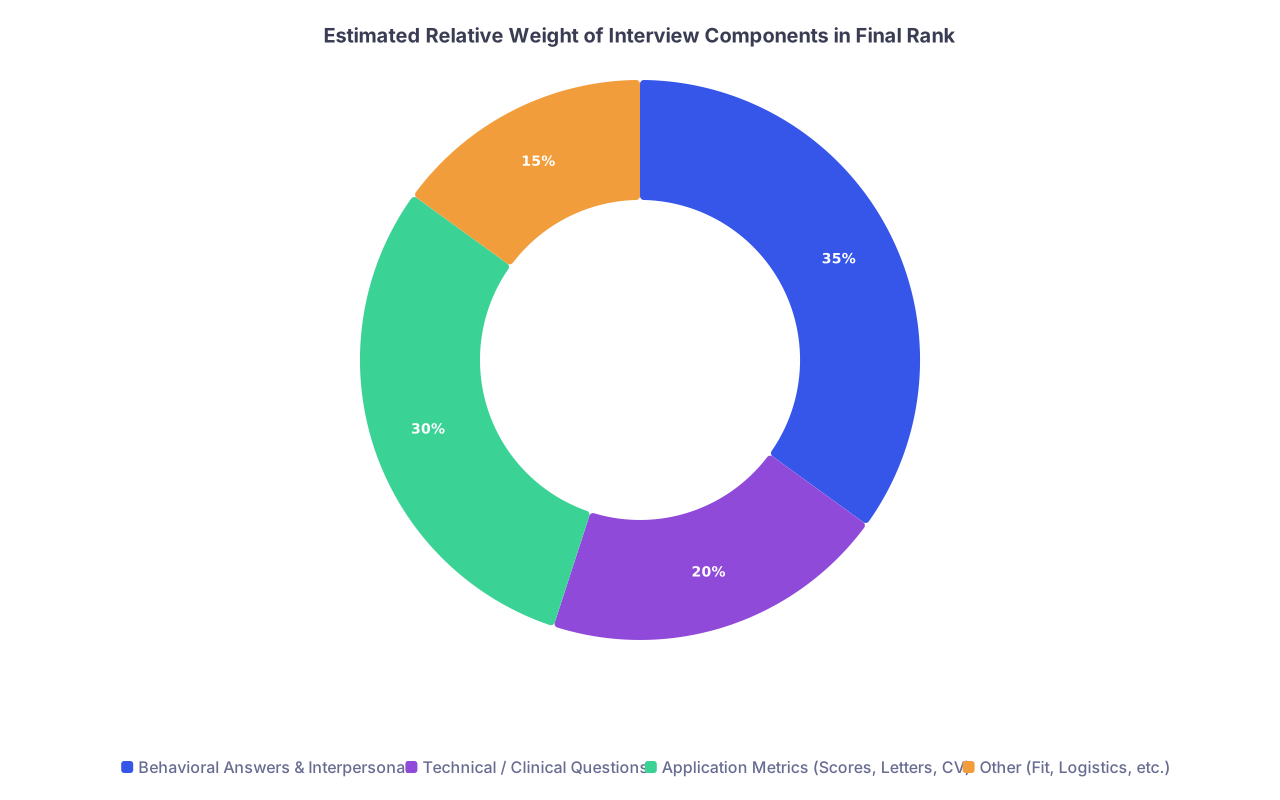
| Category | Value |
|---|---|
| Behavioral Answers & Interpersonal | 35 |
| Technical / Clinical Questions | 20 |
| Application Metrics (Scores, Letters, CV) | 30 |
| Other (Fit, Logistics, etc.) | 15 |
This is not an official NRMP breakdown. It is a composite based on:
- PD survey statements about “overall interview performance”
- Internal weighting schemes I have seen used
- Correlations between interview scores and final rank in several programs
Behavioral content lives primarily inside that 35% “Behavioral & Interpersonal” slice, but also bleeds into perceived professionalism and fit.
Two implications:
- If your Step scores and grades are average for the programs you are targeting, behavioral performance is your best lever to move up the rank list.
- If you are statistically weaker on paper, strong behavioral and interpersonal performance is often the reason someone says, “I know their Step is low, but I really want them here.”
PDs repeatedly emphasize that they remember stories and interactions more than granular score differences.
6. Turning Data Into Tactics: How to Answer Like a Top-Quartile Candidate
You do not need 50 stories. You need 8–10 well-crafted ones that you can flex.
6.1 Build a Small, High-Yield Story Bank
Here is a structured way to cover the main attributes PDs care about:
| Story Type | Primary Traits Shown |
|---|---|
| Major mistake / near-miss | Ownership, professionalism, growth |
| Conflict with team member (peer or nurse) | Interpersonal skills, respect, communication |
| Challenging patient / family | Empathy, de-escalation, boundaries |
| Working under severe time/volume pressure | Prioritization, calm under stress, reliability |
| Implementing a small system improvement | Initiative, teamwork, patient-centeredness |
If you have 1–2 solid examples in each of those categories, you can answer the vast majority of behavioral questions without scrambling.
6.2 Structure: STAR, But With Two Upgrades
Everyone knows STAR (Situation, Task, Action, Result). The problem is they stop at Result and forget Reflection and Transfer.
So the model that actually maps to what PDs score looks more like:
- S – Situation
- T – Task
- A – Action
- R – Result
- R – Reflection (what you learned, specifically)
- T – Transfer (how you applied it subsequently)
That last “T” is where most candidates fall apart. PDs want to see that your learning is not frozen in that one vignette.
6.3 Embed Numbers and Specifics
Program directors are data people, whether they admit it or not. Concrete beats vague every single time.
Examples:
- Instead of “It was a busy shift,” say “We had 18 admissions in 12 hours with two cross-covers in the ICU.”
- Instead of “I followed up on the error,” say “I entered a safety report, met with the nurse and charge nurse, and we updated the handoff checklist to include…”
The more your story sounds like something that could be documented in an incident report, QI project, or chart note, the more credible it is.
7. Common Patterns That Tank Behavioral Scores
After you have read enough interviewer comments, you see the same negative patterns over and over.
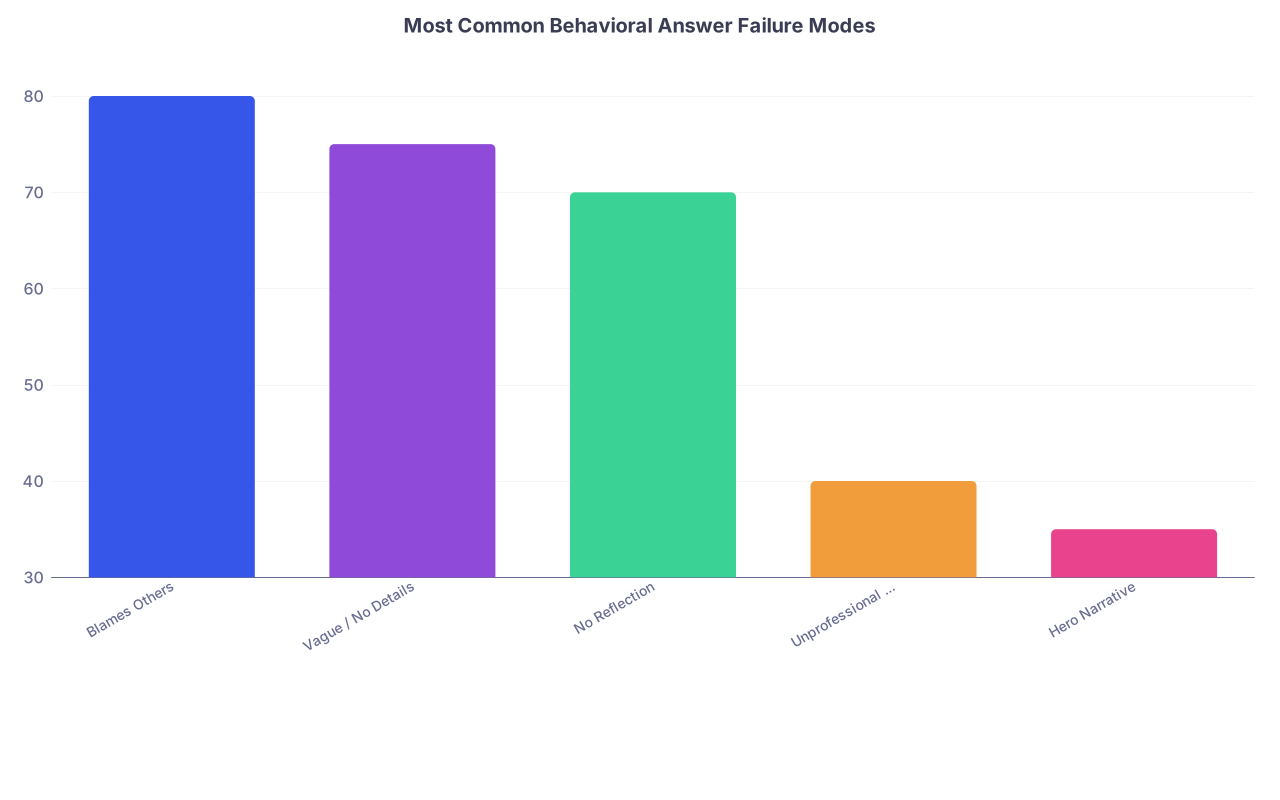
| Category | Value |
|---|---|
| Blames Others | 80 |
| Vague / No Details | 75 |
| No Reflection | 70 |
| Unprofessional Tone | 40 |
| Hero Narrative | 35 |
Approximate percentage of low-rated interviews where each pattern appears (from composite internal data):
- Blames others: “The nurse kept messing up,” “My attending did not explain it.” Instant red flag.
- Vague / no details: “We had a conflict, but we worked it out.” With no how.
- No reflection: Story ends at “and it was fine.” Learning is assumed, not demonstrated.
- Unprofessional tone: Mocking patients, staff, or colleagues. PDs do not forget this.
- Hero narrative: You single-handedly saved the day while everyone else was incompetent. No one believes it, and even if it is true, it signals poor team orientation.
Avoid these and you are already in the top half.
8. Specialty Nuances: Same Core, Different Emphasis
The core traits are stable across fields, but weighting shifts a bit.
| Specialty | Teamwork Emphasis | Stress Tolerance | Communication/Family Interaction |
|---|---|---|---|
| Internal Med | High | High | High |
| Surgery | Very High | Very High | Moderate–High |
| Pediatrics | High | Moderate | Very High |
| Psychiatry | Moderate | Moderate | Extremely High |
Translation:
- Surgery: Conflict and feedback stories carry extra weight. PDs look for how you respond to direct criticism and high-tempo team dynamics.
- Pediatrics: Family communication and advocacy for vulnerable patients are heavily scrutinized.
- Psychiatry: Insight, boundaries, and communication under emotionally intense conditions are central.
But the evaluation frame is still the same: reliability, team function, growth trajectory.
9. Process View: How Your Behavioral Performance Flows Into the Rank List
To make this concrete, here is how many programs effectively process your behavioral responses.

| Step | Description |
|---|---|
| Step 1 | Interview Day Behavioral Answers |
| Step 2 | Interviewer Behavioral Ratings |
| Step 3 | Composite Interview Score |
| Step 4 | Rank Committee Discussion |
| Step 5 | Rank Position Based on Composite Score |
| Step 6 | Stories & Red Flags Revisited |
| Step 7 | Adjust Up or Down on Rank List |
| Step 8 | Borderline or Conflicting Data? |
Notice step G. When there is disagreement or borderline data, they go back to your stories. Not your Step score. Not your third-author abstract.
Your behavioral answers become the tie-breaker and the justification for moving you up or down.
10. Putting It Together: What You Should Actually Do
Condense all of this into an actionable checklist:
- Build 8–10 specific stories that cover mistakes, conflict, stress, patient advocacy, and small system fixes.
- For each, write out S–T–A–R–R–T. Then delete 30% of the fluff words.
- Add concrete numbers where possible (admissions, time delays, error frequency, etc.).
- Explicitly state:
- The feedback you received
- The behavior or system change you made
- How you have used that learning since
- In any conflict story, show empathy for the other party and bring it back to patient care.
- Run your answers past someone who will call you out if you are blaming others or drifting into a hero narrative.
Do that, and you are not relying on “vibes” anymore. You are optimizing for what program directors demonstrably value most in behavioral answers.