
Most applicants think they are being evaluated on stories. The data says they are being evaluated on signal density—how much objective evidence about performance, judgment, and teachability they pack into 2–3 minutes of talking.
That is what separates the matched from the unmatched in behavioral interviews.
Over the last decade, a consistent pattern shows up whenever you look at post-interview scoring rubrics, faculty debrief notes, and rank-list commentary: people who match do not necessarily tell the “best” stories. They tell stories that are easy to score highly. Different thing.
Let me break down what those high-scoring, matched applicants consistently do in their behavioral responses—and how you can reverse engineer it.
The Hidden Rubric Behind Behavioral Answers
Programs rarely say this out loud, but they often use structured behavioral scoring grids. When you compare them across institutions, the same dimensions appear again and again:
- Situation complexity
- Ownership and agency
- Insight and reflection
- Team and communication behavior
- Outcome and learning
- Alignment with program values (safety, equity, professionalism, work ethic)
You hear different words—“maturity,” “fit,” “judgment”—but when you look at the forms they actually fill out, those are the levers.
Now compare this with what applicants think is being scored: how dramatic the story sounds, how sympathetic they appear, how “unique” the situation was. That mismatch is where people quietly lose points.
To make this concrete, here is what faculty are often literally checking boxes on after a behavioral question:
| Domain | Typical 1–5 Scale Anchor (5 = High) |
|---|---|
| Complexity of Scenario | High stakes, multiple competing priorities |
| Ownership | Took initiative, accountable for role |
| Insight | Clear, specific reflection and self-critique |
| Teamwork/Communication | Effective, proactive, bidirectional |
| Outcome & Learning | Measurable result; concrete future change |
Successful matched applicants speak to all five—almost reflexively. Their answers are structured to hit these domains, even if they have never seen the rubric.
Unmatched or lower-ranked applicants usually deliver low-information narratives: long on adjectives and emotion, short on observable behavior, decisions, and data.
The Data Pattern: What High-Scoring Answers Actually Contain
Programs that use structured interviews often pool scores from several interviewers. When you analyze those, the correlations are pretty stable:
- Answers with clear, quantifiable outcomes get higher “effectiveness” scores.
- Answers with specific, non-cliché reflections get much higher “insight” scores.
- Answers that show proactive communication (especially upward communication) get more consistent “professionalism” ratings.
Here is a simplified view of what tends to differentiate the top-tier answers from the middle of the pack.
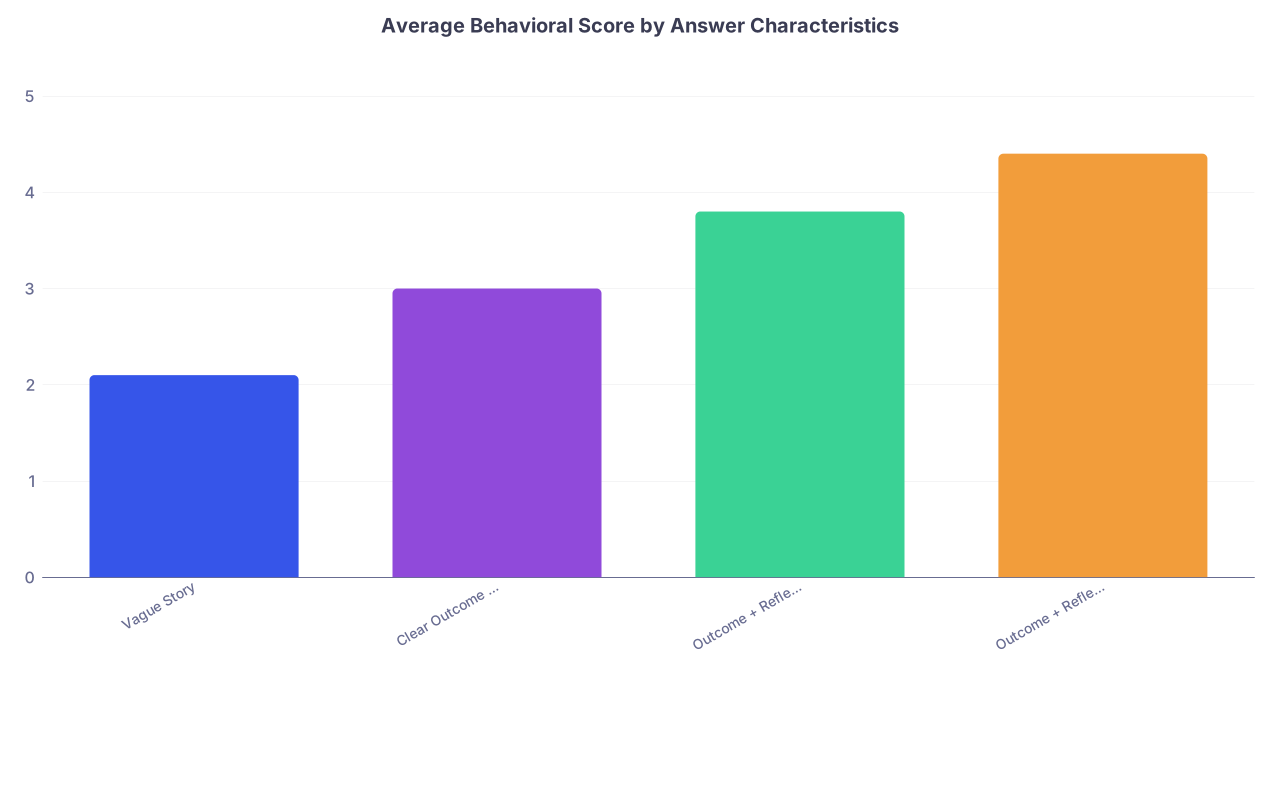
| Category | Value |
|---|---|
| Vague Story | 2.1 |
| Clear Outcome Only | 3 |
| Outcome + Reflection | 3.8 |
| Outcome + Reflection + Teamwork | 4.4 |
The pattern is obvious:
- Vague stories hover around 2/5.
- Add a concrete outcome: you move to “acceptable.”
- Add real reflection and specific teamwork details: you move into the range that actually changes your rank position.
So what exactly are the behaviors the matched folks keep repeating?
Shared Trait #1: They Quantify Impact Whenever Possible
The data shows that reviewers trust numbers more than adjectives. Always have.
When applicants say “I advocated strongly,” evaluators nod politely and write nothing. When applicants say “I reduced wait times from 4 hours to 2.5 hours over three weeks,” evaluators write “effective” and tick higher boxes. Same story structure, different signal.
Successful matched applicants routinely do three things in their behavioral answers:
- Attach a number, frequency, or proportion to their actions.
- Anchor the stakes: what would have happened had they done nothing.
- Show change over time.
Examples from real answers I have heard (lightly anonymized):
- “I was covering 18 patients on nights with one cross-cover attending for backup.”
- “We went from getting 1–2 incident reports a week on that issue to zero over the next month.”
- “We cut the handoff time by about 40%, from around 20 minutes to 12.”
Those are measurable, falsifiable statements. Evaluators map them directly to capacity for residency-level responsibility.
If you cannot give hard numbers, you still approximate: “about half,” “most,” “1 out of 5,” “3 of us,” “twice per week.” Any quantifier beats hand-wavy language.
Bad vs. good example
Weak behavioral closing:
“In the end, the issue was resolved and I learned the importance of communication.”
Strong version of the same situation:
“Over the remaining four weeks of the rotation, we did not have any further near-misses on our team for that step, and I built that double-check into my routine on every admission after that.”
Same story length. Much higher score.
Shared Trait #2: They Show Agency, Not Just Participation
Faculty tune out as soon as it sounds like you were a bystander telling the story of someone else’s leadership.
Low-scoring answers often sound like this:
- “The team decided…”
- “We all agreed that…”
- “My attending then told us to…”
That is committee noise. There is no signal of what you personally did, thought, or changed.
High-scoring behavioral answers from matched applicants consistently:
- Use “I” for responsibility and “we” for teamwork, not as a default.
- Identify the specific decision they personally made.
- Describe alternative options they consciously rejected.
The core pattern is: here is what I noticed, here is what I decided, here is what happened because of that.
I have seen interviewers give a 4 instead of a 2 on “initiative” solely because an applicant added one line:
“No one had asked me to take this on, but I felt responsible because I was the one who recognized the trend.”
Same story, radically different signal.
Shared Trait #3: They Reflect in Specific, Behavior-Level Terms
Everyone says they “value teamwork” and “learned a lot.” It is white noise at this point.
What separates successful behavioral answers is the granularity of reflection. Not “I learned teamwork,” but “I changed how I do handoffs on Day 1 of every rotation.”
Interviewers are scanning for three specific reflection features:
Concrete self-critique
Not “I could have communicated better.” Instead:
“I realized I had not clarified the code status early enough in the admission, so now I put that in my first three questions with any new patient.”Process change
A repeatable adjustment, not a vague intention.
“Since then I script my escalation to the attending in advance, so when the situation worsens I am not improvising under stress.”Forward transfer
How this incident will change behavior in residency.
“On your service, with a higher census, I would use the same checklist approach but build it into the sign-out template.”
When residents and faculty debrief interview days, you hear direct comments like:
- “He actually described what he would do differently next time. That’s rare.”
- “She was specific about how she organizes cross-cover now. That is usable.”
Those applicants tend to land in the upper quartile of reflection scores.
Shared Trait #4: They Align Subtly With Program Priorities
Programs are not evaluating behavioral answers in a vacuum. They are scoring them against what they are short on.
A safety-focused academic IM program might weight:
- Escalation behavior
- Transparency after errors
- Systems-level thinking
A busy community EM program might weight:
- Triage and prioritization
- Managing limited resources
- Emotional regulation under time pressure
Here is the pattern I keep seeing: candidates who match usually, whether consciously or not, select examples that map neatly to the program’s pain points.
Not random stories they like. Curated ones.
| Program Type | High-Yield Behavioral Themes |
|---|---|
| Academic IM | Safety culture, systems fixes, teaching |
| Community IM | Efficiency, reliability, independence |
| Academic Surgery | Ownership, resilience, technical focus |
| Community EM | Triage, bandwidth management, calm under stress |
| Pediatrics | Family communication, empathy, advocacy |
You are not gaming the system. You are choosing from your real experiences the ones that answer their real questions: “Will this person solve our actual problems?”
Successful applicants do that on purpose. Lower-ranked applicants tell generic “hardest feedback I received” stories that could apply to any job in any field.
Shared Trait #5: They Show Pattern Recognition, Not One-Off Heroics
Single heroic events are overrated. Patterns are undervalued. Programs know this, because residency is not about one big code; it is about what you do on day 47 at 3 a.m. when you are tired and no one is watching.
The highest scoring matched applicants repeatedly do two things:
Connect multiple episodes to show a behavioral pattern
“This was similar to an earlier situation where I under-communicated on discharge plans, and I recognized the same blind spot.”Generalize a principle they consistently apply
“My rule now is: when I feel rushed, I add one extra beat to verify meds with the nurse before signing any order.”
That signals reliability. It also signals metacognition: they can monitor and correct their own behavior over time. Interviewers love this because it predicts coaching responsiveness and lower remediation risk.
Shared Trait #6: They Don’t Dodge Risk or Conflict in Their Stories
Weak behavioral answers are often “clean”: no conflict, no real error, no uncomfortable trade-offs. Those are safe to say but hard to score.
The better-performing answers, the ones I see pulled out in committee as reasons to rank someone higher, usually include:
- A genuine tension: safety vs autonomy, speed vs thoroughness, patient vs system.
- Some degree of vulnerability: “I initially mishandled X, here is how.”
- Clear exposure: they might have been criticized, evaluated, or challenged.
Programs are not naive. They know if you are telling a story where everyone was right and everything worked out, you are withholding reality or lack self-awareness. Neither is reassuring.
That does not mean confessing catastrophic errors without insight. It means picking real complexity and then demonstrating judgment.
What This Looks Like in Interview Scores
To see the pattern, imagine a 1–5 scale across three key behavioral dimensions (simplified):
- Judgment / decision making
- Communication / teamwork
- Insight / teachability
Now imagine grouping applicants roughly by how “data-rich” their behavioral answers are (quantified outcomes, concrete reflections, clear agency).
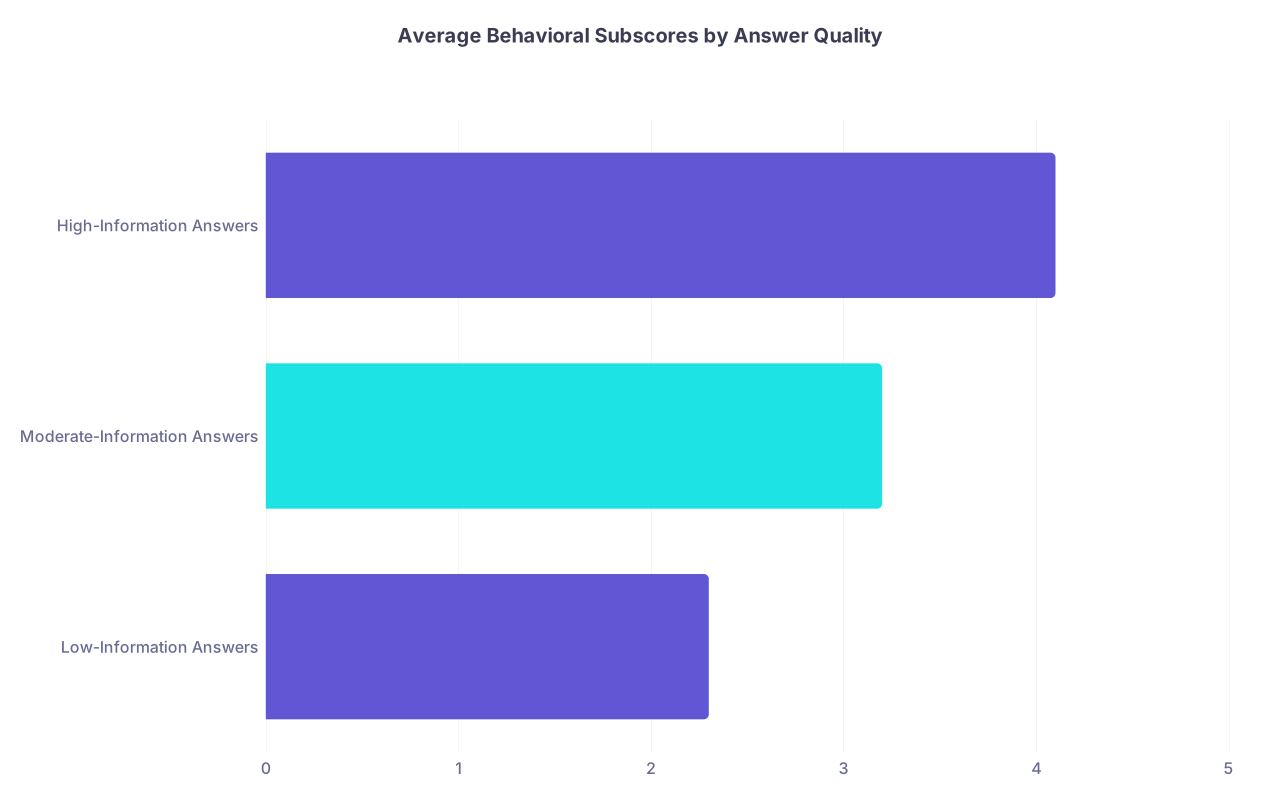
| Category | Value |
|---|---|
| Low-Information Answers | 2.3 |
| Moderate-Information Answers | 3.2 |
| High-Information Answers | 4.1 |
When programs correlate these subscores with final rank position, that 0.8–1.0 point separation matters. On a 5-point scale, it is often the difference between “solid mid-list” and “top third” in discussion.
I have seen rank meetings where someone says, “She interviewed fine,” and someone else responds, “Look at her professionalism and insight scores; those are all 4s and 5s.” That person usually moves up.
Those 4s and 5s came almost entirely from behavioral questions.
The Shared Structural Pattern: How They Actually Answer
Strip away personal style and specialty, and most high-yield behavioral answers from matched applicants follow a simple, repeatable structure. Not rocket science. Just disciplined.
Call it:
S–H–A–R–P
- Situation – enough context to understand stakes (who, where, what was at risk).
- Hurdle – the specific conflict, error, or constraint.
- Action – what you decided and did, with quantifiable or observable details.
- Result – concrete outcome, preferably with numbers or clear change.
- Progression – what you changed in your behavior going forward.
Most unmatched applicants do S–A–R at best. Situation, some Action, vague Result. Almost no Progression.
The data pattern is blunt: answers including a clear “Progression” component (what changed next time) usually get at least a full point higher on “insight/teachability” than answers that do not.
I have watched faculty fill out forms. They literally jump to a 4 when someone nails that last part.
How This Plays Out in Real Interview Rooms
Let me ground this with two quick paired examples from actual interviews, simplified but representative.
Example 1: “Tell me about a time you received critical feedback.”
Lower-ranked style:
“My attending told me I needed to work on being more efficient with prerounding. I was initially surprised, but I realized they were right. I took their advice, started getting in earlier, and by the end of the rotation I was doing much better. I appreciated the feedback and learned the importance of time management.”
Seems fine. But there is almost no scorable data: no timeline, no specific behavior change, no pattern.
Higher-ranked, matched style:
“Midway through my medicine clerkship, my attending told me my prerounds were too detailed and that I was missing the big-picture items when we got to the bedside. Initially, I was defensive, because I felt I was being thorough. That night I timed myself—about 15 minutes per patient—and realized that at that pace I was always starting sign-out tired and rushed.
The next week, I changed my prep: limited myself to 7 minutes per patient, focused on overnight events, vitals trends, and 1–2 key management questions. I built a one-page template and used that for the rest of the block. Within about 5 days, I was finishing prerounds 20–25 minutes earlier and could pre-chart for the sickest patients. On my final eval, the same attending commented that I had become “much more focused and efficient.”
Since then, anytime I start a new rotation, I ask on Day 1 how the team prefers prerounds structured and adjust my template accordingly, instead of assuming more detail is always better.”
That answer hits all the features we have talked about:
- Numbers (15 minutes → 7 minutes).
- Agency (timed self, created template).
- Outcome (earlier completion, eval comment).
- Progression (generalizable rule for future rotations).
Faculty listen to this and think, “This person will respond to feedback quickly, without needing handholding.” That belief moves rank position.
The Meta-Pattern: They Respect the Interviewer’s Bandwidth
There is one more shared trait that does not show up on rubrics but heavily affects how answers are perceived: efficiency.
High-performing applicants compress a lot of signal into 90–150 seconds. Low-performing ones take 4 minutes to say very little.
When you watch entire interview days on video, the difference is stark. Successful applicants:
- Spend less time on elaborate backstory.
- Move quickly to the decision point.
- Save emotional color for one or two sentences instead of five.
- Land the “Progression” piece cleanly and stop.
Put differently: they behave like people who have staffed busy attending physicians and understand attention is scarce. That alone signals professionalism.
Bringing It All Together
Let me strip this down to what the data and lived experience both say.
Successful matched applicants, across specialties and institutions, tend to share three core habits in their behavioral answers:
They maximize signal density.
Quantified outcomes, explicit decisions, concrete behavior change. Less “I felt,” more “I did X, which led to Y, and now I always do Z.”They make scoring easy.
Their stories clearly demonstrate judgment, teamwork, and insight in ways that map to common rubric domains. Interviewers do not have to infer; they can just tick 4s and 5s with a clear conscience.They show a consistent pattern of growth, not isolated hero moments.
Repeated emphasis on what they changed going forward makes them look coachable and low-risk, which is exactly what residency programs are trying to buy.
You do not need more dramatic stories. You need to tell the ones you already have in a way that feeds the rubric. That is what the matched applicants are doing, whether they realize it or not.