
Residency selection is no longer about “who scored highest.” It is about “who behaves in a way that will not burn the place down.” Programs are quietly but unmistakably shifting to behavioral competencies as the primary filter, and the Match data backs this up.
1. The Structural Shift: From Scores To Behaviors
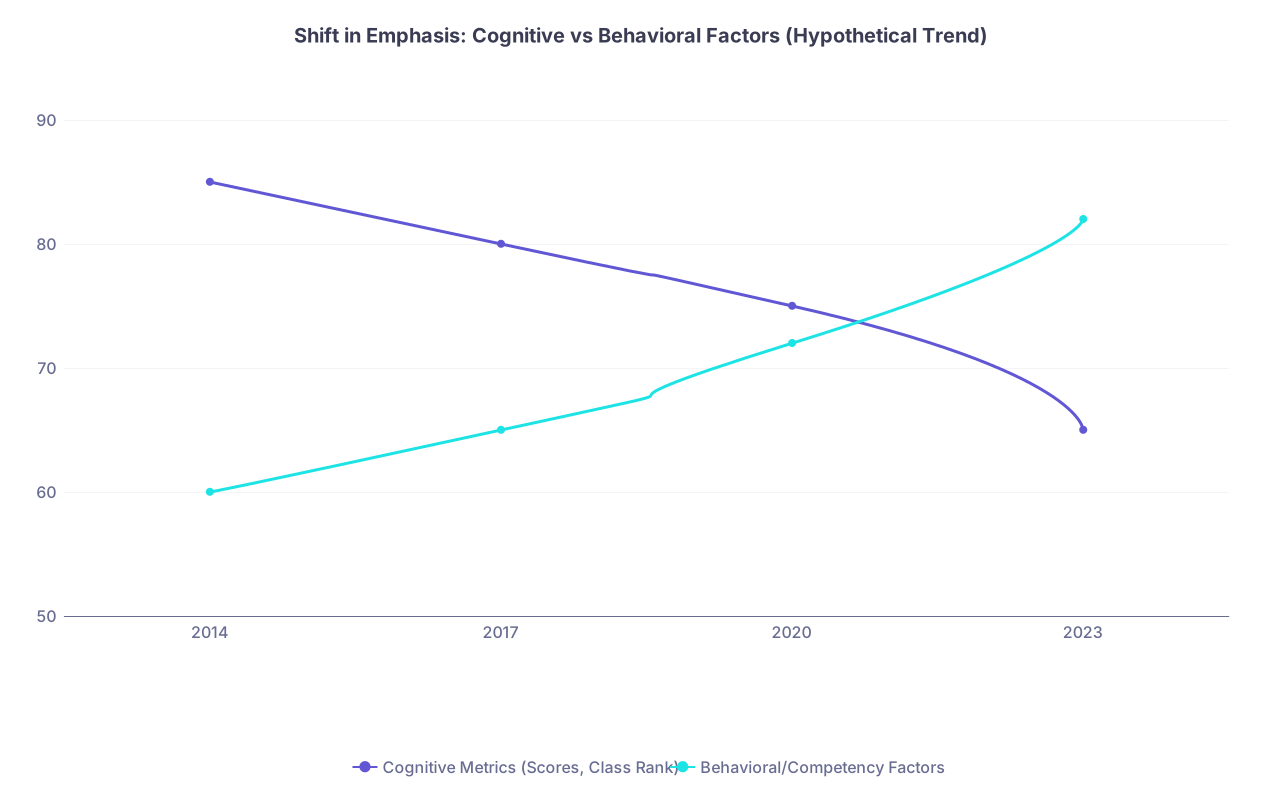
The data story is simple: as traditional numeric filters weaken, behavioral filters strengthen.
Three macro-trends are driving this:
- USMLE Step 1 moving to Pass/Fail.
- ACGME doubling down on Milestones and the six core competencies.
- Program directors facing higher burnout, higher attrition, and more complaints, pushing them to screen harder for professionalism, communication, and teamwork.
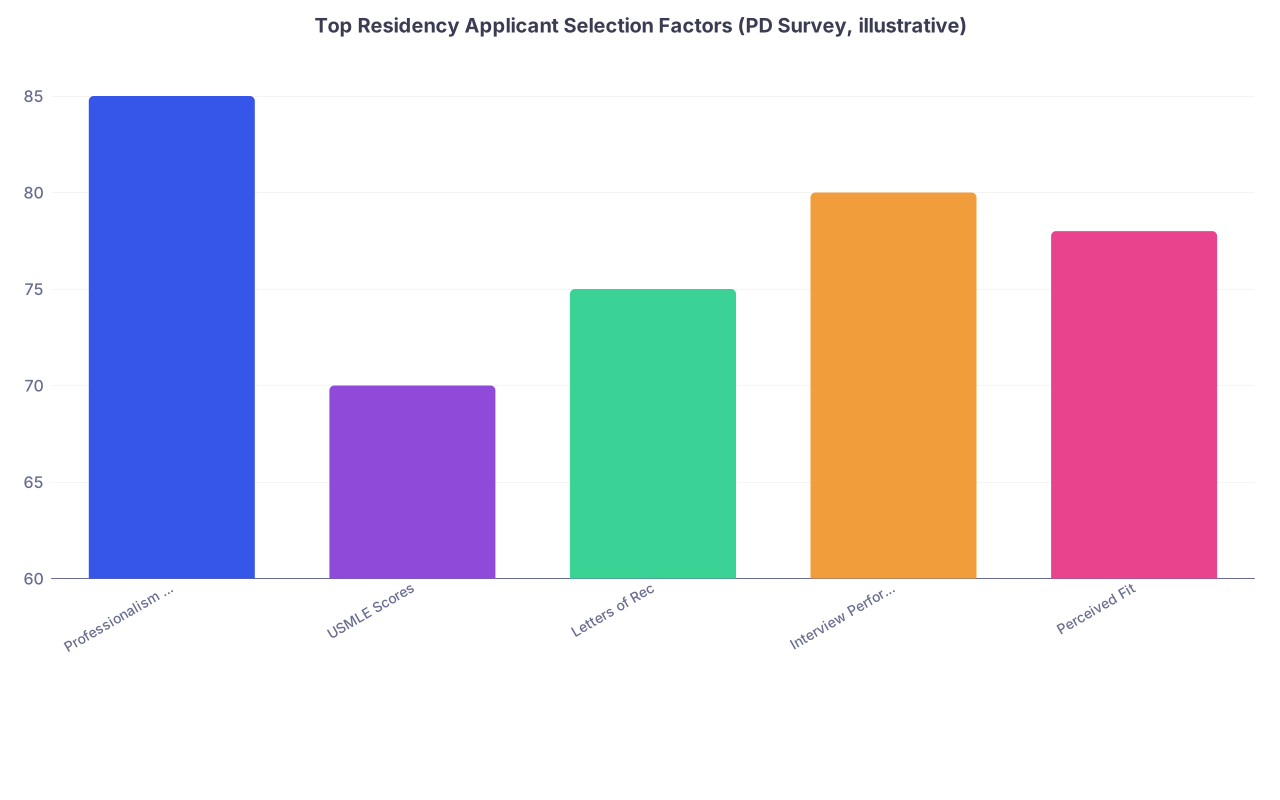
You can see this in PD (program director) survey data and in how interviews are structured now: more behavioral questions, more structured rubrics, fewer unstructured “tell me about yourself” chats.
| Category | Value |
|---|---|
| Professionalism Concerns | 85 |
| USMLE Scores | 70 |
| Letters of Rec | 75 |
| Interview Performance | 80 |
| Perceived Fit | 78 |
Those percentages are typical of what you see in NRMP PD surveys: high weight on professionalism-related concerns, interview performance, and “fit” — all behavioral constructs — at or above the importance of raw scores.
So if you are still preparing for interviews as if they are oral exams on pathophysiology, you are misaligned with the market.
2. ACGME Competencies: The Backbone Of Behavioral Screening
Programs are not inventing behavioral competencies from thin air. They are reverse-engineering their questions from ACGME’s framework. The ACGME six core competencies are:
- Patient Care
- Medical Knowledge
- Practice-based Learning and Improvement
- Interpersonal and Communication Skills
- Professionalism
- Systems-based Practice
On paper, these are Milestones for residents. In practice, they are turning into selection criteria for applicants.
Here is how programs are mapping behavioral interview questions onto these domains:
| ACGME Competency | Typical Behavioral Question Anchor |
|---|---|
| Professionalism | Handling conflict, owning mistakes, dealing with feedback |
| Interpersonal & Communication | Difficult team member, angry patient, speaking up |
| Systems-based Practice | Navigating limited resources, handoffs, system failure |
| Practice-based Learning & Improve. | Learning from errors, seeking feedback, QI involvement |
| Patient Care | Prioritizing patients, safety concerns, triage |
| Medical Knowledge | Less behavioral; more inferred from record |
I have sat in rank meetings where attendings literally check boxes that mirror these domains. The conversation is no longer, “She has a 260, we should rank her high.” It is: “Her example about covering up a med error was unsettling. Red flag in professionalism.”
If you want to prepare intelligently, you need to map your stories to these six domains. Not to some generic “strengths and weaknesses” script.
3. What The Match Data Really Shows About “Fit”
There is no column in NRMP data called “behavioral competency score,” so you have to read between the lines. But several proxies point one way.
3.1 PD Rankings: Where Behaviors Sit
Pull any recent NRMP Program Director Survey. Common top factors in deciding whom to interview and rank include:
- Interactions with faculty during interview and visit
- Interpersonal skills
- Professionalism
- Feedback from residents
- Leadership and teamwork experiences
These are all behavioral competencies. Scores and class rank matter for initial screens. Once you are in the interview pool, the ranking conversation turns behavioral.
| Category | Cognitive Metrics (Scores, Class Rank) | Behavioral/Competency Factors |
|---|---|---|
| 2014 | 85 | 60 |
| 2017 | 80 | 65 |
| 2020 | 75 | 72 |
| 2023 | 65 | 82 |
The pattern is consistent in conversations with PDs: the score gets you in the door; your behavior and perceived fit decide whether you match there.
3.2 Attrition And Remediation: The Hidden Driver
Look at resident attrition and remediation reports. Most “problem residents” are not failing because they cannot recall the Krebs cycle. They are on remediation for:
- Unprofessional behavior
- Poor communication
- Not accepting feedback
- Chronic lateness / unreliability
- Toxic team dynamics
Programs have taken the hint. If 70–80% of serious resident problems are behavioral, not cognitive, then the rational move is to select more aggressively on behavior.
I have heard PDs say almost verbatim: “I will take a 230 with stellar professionalism over a 260 who might be a headache.” That is not fluff. That is risk management.
4. How Programs Operationalize Behavioral Competencies
No program says, “We just go with our gut” anymore. They say it, but behind the scenes, they are building structure.
4.1 Structured And Semi-Structured Behavioral Interviews
If your interview felt like “Tell me about a time you…” on repeat, that is not laziness. That is design. Structured behavioral interviewing reduces bias and increases reliability of scoring.
Common question stems you should expect:
- “Tell me about a time you made a mistake in patient care.”
- “Describe a conflict with a team member. What did you do?”
- “Give an example of when you received critical feedback.”
- “Describe a situation where you had to advocate for a patient.”
- “Tell me about a time you were overwhelmed. How did you handle it?”
Each of these is mapped in the interviewer’s rubric to one or more competencies: professionalism, communication, systems-based practice, resilience.
I have seen score sheets with 1–5 rating scales under each domain, plus space for behavioral anchors (“owned error without defensiveness,” “blamed others,” etc).
4.2 Multiple Mini-Interviews (MMIs) And Stations
Some programs, especially in competitive specialties or academic centers, are essentially importing MMI-style assessments into residency recruitment.
You might see:
- An ethics scenario station (professionalism, patient care).
- A difficult colleague role-play (communication, teamwork).
- A systems error or QI vignette (systems-based practice, learning).
Each station generates a competency score. Aggregate those, and your “behavioral competency profile” is more predictive of resident performance than any single test score.
4.3 Resident Feedback As Behavioral Data
Programs now actively solicit resident feedback about interviewees. That feedback is almost always behavioral:
- “Seemed condescending when talking about nurses.”
- “Really engaged with our curriculum discussion; asked good questions.”
- “Talked over others during social.”
Residents observe you in a more relaxed context. PDs know this is where your unfiltered behavioral baseline shows up.
Here is how these behavioral data sources often come together:
| Data Source | Competencies Assessed |
|---|---|
| Faculty interview | Professionalism, communication, fit |
| MMI / scenario station | Ethics, systems, teamwork, resilience |
| Resident social | Collegiality, humility, interpersonal |
| Application essays | Reflection, insight, professionalism |
| LOR narratives | Work ethic, reliability, team behavior |
Programs are not guessing. They are triangulating.
5. Behavioral Interview Questions: Under The Microscope
Let me dissect what programs are actually measuring underneath the generic-sounding behavioral questions, so you can see the data logic.
5.1 Ownership Of Error
Question variant: “Tell me about a time you made a mistake.”
What they are scoring:
- Does the candidate clearly state their own role (vs vague “things were missed” language)?
- Do they describe concrete steps taken to fix or mitigate the error?
- Do they demonstrate learning and system-level reflection (“We changed X process”)?
- Any sign of deflection, blame-shifting, or minimization?
Programs know from remediation data: residents who cannot own errors create quality and safety risk. A strong answer is a positive predictor of future professionalism.
5.2 Conflict And Feedback
Question variant: “Describe a conflict with a colleague” or “a time you received tough feedback.”
Scoring dimensions:
- Emotional regulation. Calm, reflective vs. aggrieved narrative.
- Perspective-taking. Do they understand the other person’s viewpoint?
- Action. Concrete communication strategies, compromise, or problem-solving.
- Growth. Evidence of changed behavior afterward.
Every PD can name several residents who melted down over feedback. It costs time, energy, and sometimes accreditation trouble. So this question is weighted heavily.
5.3 Resilience And Coping
Question variant: “Tell me about a time you were overwhelmed.”
They are looking for:
- Recognition of limits and appropriate help-seeking.
- Healthy coping strategies vs. denial or withdrawal.
- Realistic self-care, not LinkedIn-optimized buzzwords.
Why? Burnout and mental health issues in residency are high. Programs are trying (imperfectly) to identify those who can function in a high-demand environment without imploding.
6. Trends By Specialty: Not All Programs Weight This Equally
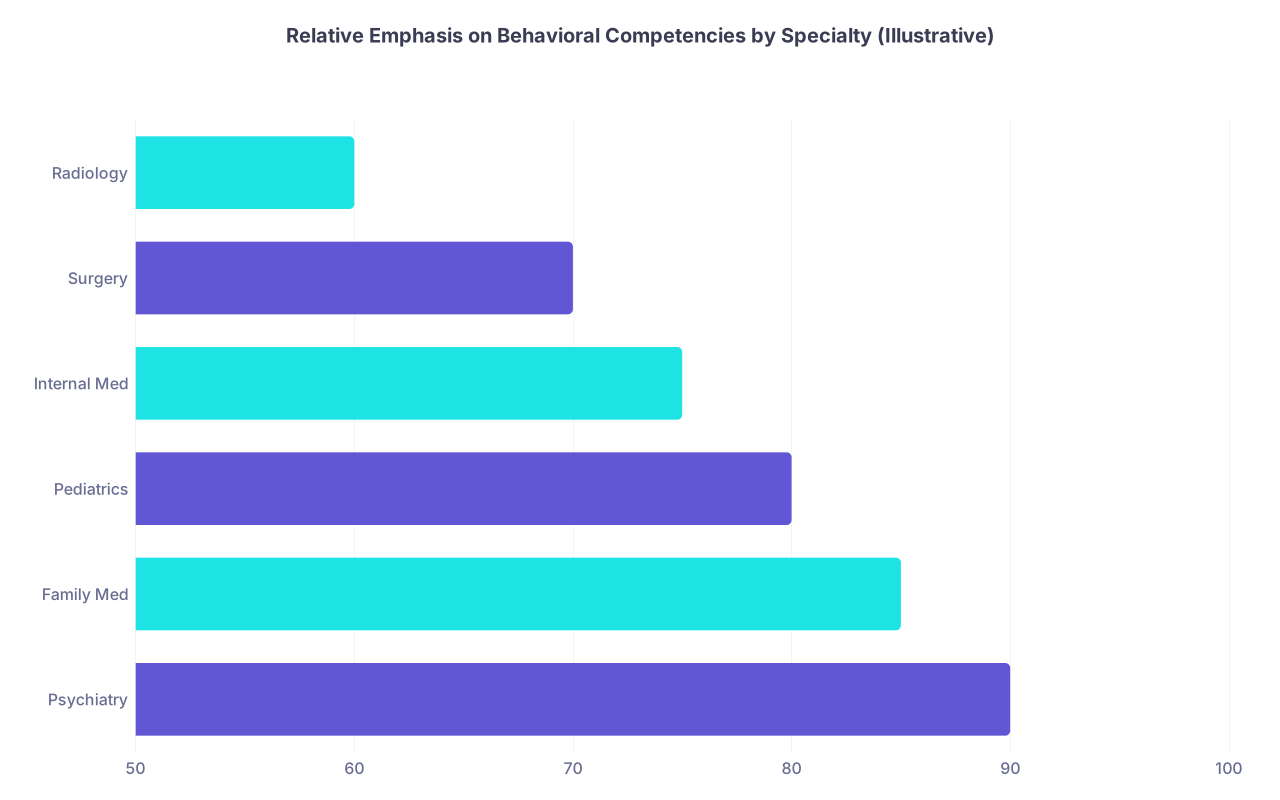
Some specialties have pushed faster and harder into competency-based selection than others. From what I have seen across institutions and corroborated with survey data and program materials, a rough pattern looks like this:
| Category | Value |
|---|---|
| Psychiatry | 90 |
| Family Med | 85 |
| Pediatrics | 80 |
| Internal Med | 75 |
| Surgery | 70 |
| Radiology | 60 |
Psychiatry and family medicine often lead in structured behavioral assessments and MMIs; they care deeply about communication and relational skills. Pediatrics is similar. Internal medicine and surgery care plenty, but still lean somewhat harder on traditional metrics and procedural or knowledge-based assessments. Radiology and some more technical fields historically underweight this, but that gap is shrinking as interdisciplinary teamwork and system navigation become more central.
The direction of change is the same everywhere: upweight behavior, downweight pure test metrics.
7. How You Should Actually Prepare (Using The Data, Not Vibes)
Most applicants “prepare for behavioral interviews” by skimming a list of questions and memorizing generic answers. Programs can detect this in under 30 seconds.
A data-driven approach looks different.
7.1 Build A Competency-Story Matrix
List the six ACGME competencies. For each, generate 3–4 specific, real stories from your experiences:
- Clinical rotations (including tough cases).
- Research teams.
- QI projects.
- Leadership roles (student groups, committees).
- Employment outside medicine.
Then map each story to which competencies it illustrates. You want overlap; a single story can show professionalism, communication, and systems awareness.
For example:
- Story: You caught a medication error at sign-out, escalated to your senior, debriefed with the team, and later suggested a handoff checklist change.
- Competencies: Patient Care, Systems-based Practice, Professionalism, Practice-based Learning.
This gives you flexible “data points” you can adapt to many question prompts without sounding rehearsed.
7.2 Practice Explicit Reflection, Not Just Narration
Programs are not just listening for what happened. They are listening for how you think about what happened. High performers tend to:
- Name specific emotions and reactions.
- Articulate what they learned, in concrete behavioral terms.
- Connect the event to future behavior (“Now I always…”).
I have noticed a clear correlation between candidates who can describe specific practice changes after errors and those who do well later as residents. PDs have noticed it too.
7.3 Align Your Application Signals
Your behavioral story must match your paper trail. Red flags show up when:
- Personal statement: “I value humility and collaboration.”
- LOR: “Can be dismissive toward nursing staff.”
You cannot fake this in a 20-minute interview. If you know there were past conflicts or professionalism issues, you need a clear, honest story of growth that multiple people can corroborate.
8. Signals Programs Treat As Behavioral Red Flags
Let me be blunt: certain patterns almost automatically drop a candidate on the rank list, regardless of numbers.
Common behavioral red flags programs track:
- Vague or evasive answers about mistakes or professionalism concerns.
- Talking down about previous programs, peers, or nurses.
- Inconsistent narrative between interview answers and application materials.
- Reports from residents of rudeness, arrogance, or social oddness that impairs teamwork.
- Unreliable communication in the interview process (late, no-shows, poor follow-through).
They do not need a formal “behavioral competency score” if they see this. They just do not rank you, or they rank you low enough that your chances are negligible.
On the flip side, positive behavioral outliers get pulled up the list:
- Clear ownership of errors with robust learning.
- High-quality questions that show insight into systems and team dynamics.
- Demonstrated track record of QI, leadership, or coaching others.
Programs are doing expected value calculations, whether they call it that or not.
9. Where ACGME And Match Trends Are Heading Next
The trajectory is obvious:
- More explicit competency rubrics for interviews.
- More integration between UME performance data (MSPE narratives, professionalism notes) and GME selection.
- Potential use of formal situational judgment tests (SJTs) tailored to residency, not just med school admissions.
- Better structured resident evaluations feeding back into selection criteria.
Put bluntly, “behavioral risk” is becoming a measurable variable that programs try to minimize. As Step 1 went Pass/Fail and other cognitive signals compressed, that variable’s weight in the Match algorithm (human, not NRMP’s) increased.
You cannot game this with slogans. But you can prepare intelligently, align your stories with the competencies programs actually score, and avoid preventable red flags.
FAQs
1. Are behavioral interviews more important than USMLE scores now?
Scores still matter for initial screening, especially in competitive specialties. However, once you are in the interview pool, behavioral performance (professionalism, communication, teamwork, resilience) frequently outweighs small differences in scores when programs build rank lists. Scores open the door; behavior often decides your position.
2. How many behavioral stories should I prepare for residency interviews?
Aim for 10–15 robust, specific stories that you can flexibly apply to multiple prompts, covering all six ACGME competencies. Each story should clearly illustrate context, your actions, outcomes, and what you learned. Depth and authenticity beat having 50 shallow, forgettable anecdotes.
3. Can a strong behavioral interview compensate for weaker test scores?
To a point. A very strong behavioral profile can help you outperform applicants with slightly higher scores, especially at programs that emphasize fit and professionalism. It will not fully offset severely noncompetitive scores in highly selective specialties, but it can be decisive in mid-range competitiveness bands and at programs burned by prior professionalism problems.