
The residents who end up in remediation almost never get there because of a single bad test. The data show they get there because of patterns of behavior that were already visible at the interview stage—if you knew exactly what to look for, and how to quantify it.
Residency programs love to talk about “fit” and “professionalism.” That is vague. Remediation, however, is not. It is specific, documented, and expensive. And certain behavioral traits correlate with it far more strongly than others.
This is where you, as an interviewer or applicant, should stop hand-waving and start thinking like a data analyst.
What The Data Actually Say About Remediation
Let’s anchor this in numbers first. Across multiple large academic centers, remediation rates for residents typically range from 5–15% at some point in training. The most robust pattern: the majority of remediation is for non‑cognitive issues, not raw knowledge deficits.
Programs that have published or presented internal reviews tend to converge on a similar breakdown of primary remediation drivers:
- Professionalism / reliability lapses
- Interpersonal or communication problems
- Chronic disorganization and time management failure
- Failure to accept feedback or change behavior
Knowledge gaps appear on the list, but far less often as the “only” issue.
Here is a synthesized snapshot from several program‑level reviews and multi‑program surveys (numbers rounded but directionally accurate):
| Driver Category | Share of Remediation Cases* |
|---|---|
| Professionalism / Reliability issues | 30–40% |
| Communication / Teamwork problems | 20–25% |
| Chronic disorganization / time mgmt | 15–20% |
| Resistance to feedback / attitude | 15–20% |
| Pure knowledge deficit only | 5–10% |
*Many residents have >1 category; table reflects primary documented driver.
When you connect this to behavioral interviews, the conclusion is blunt: if your interview questions are heavily weighted toward “tell me about a challenge” and “why this program,” you are flying blind with respect to your single biggest future cost center—behavior-driven remediation.
You should be systematically probing, and scoring, for the behavioral traits that map to those failure categories.
The Behavioral Traits That Correlate With Remediation
Let me be concrete. Across studies on professionalism lapses, struggling residents, and faculty remediation committees, the same traits surface again and again.
I will group them in four clusters, because they tend to travel together.
1. Reliability and Follow‑Through
Programs do not remediate people for being “introverted” or “quiet.” They remediate them for being late. For not doing what they said they would do. For missing critical steps.
Behavioral traits in this cluster:
- Poor punctuality and weak respect for deadlines
- Low conscientiousness: incomplete notes, loose ends, inconsistent follow‑through
- Excuse‑heavy mindset: externalizing reasons for missed tasks (“the system,” “the nurse,” “Epic”)
- Poor habit formation: no apparent personal systems for tracking tasks or obligations
Several internal reviews I have seen put “documented pattern of unreliability” as either the first or second most common professionalism concern in remediation dossiers.
Now map that back to the interview. What does unreliable look like before someone has a pager?
- They send in materials late.
- They ignore instructions in pre‑interview communications.
- Their examples of “overcoming adversity” contain a lot of last‑minute rescues and little evidence of consistent prep.
- Reference letters hint at “needs oversight,” “when closely supervised,” “can perform well when expectations are clear.”
In personality research, this is essentially low conscientiousness. And the correlation is not subtle. Meta‑analyses in occupational psychology show conscientiousness as the single best Big Five predictor of job performance and counterproductive work behavior. Residency is just a particularly high‑stakes version of that.
2. Interpersonal Friction and Communication Breakdowns
Next cluster: the people who generate conflict density. Every team has disagreements; some individuals generate a disproportionate share of them.
Correlated traits here:
- Difficulty adjusting communication style to audience
- Tendency to blame others during conflict narratives
- Low empathy signal: minimal perspective‑taking in stories about colleagues or patients
- Excessive dominance or defensiveness in group interactions
These are the residents who end up in remediation for “teamwork,” “communication,” or “disruptive” behavior. The specific labels vary; the pattern does not.
What do we know quantitatively?
- Multicenter PGY-specific reviews consistently show that a large fraction of professionalism concerns originate from interpersonal complaints: nursing staff, co‑residents, or faculty reporting difficult interactions.
- One widely cited internal review at a large academic program (no names, but the numbers are typical) found >40% of professionalism remediation cases involved conflict with staff or peers as a key component.
The warning signs usually show before Match:
- Their “difficult team” story centers mostly on how unreasonable everyone else was, with little reflection on their own role.
- When describing a conflict, their language is pejorative (“lazy,” “dramatic,” “incompetent”) rather than descriptive.
- They struggle to articulate what the other person’s goals or pressures might have been.
- In MMI or group interview settings, they subtly talk over others or fight for airtime.
Those are not abstract red flags. They are predictors of the same friction that will absorb faculty hours, GME resources, and committee time.
3. Disorganization and Poor Self‑Management
This one often masquerades as “just needs to adapt to the workload” in PGY‑1, until it does not improve and becomes a remediation plan.
Key traits:
- Weak planning skills: no evidence of structured approaches to exams, projects, or time‑intensive tasks
- Chronic last‑minute scrambling as a proud identity (“I always pull it off in the end”)
- Difficulty prioritizing when overloaded; paralysis rather than triage
- Lack of realistic self‑monitoring of bandwidth (“Sure, I can do that too”)
In objective data, you see:
- Residents with lower self‑reported organizational skills have higher rates of late notes, missed clinics, and near‑miss events documented in quality systems.
- GME offices that track this systematically often find that “disorganization/time management” appears explicitly in 15–20% of remediation plans.
Again, you can often see it in the interview and pre‑interview behavior:
- Repeated rescheduling of interviews without plausible external constraints
- Struggling to answer questions about “how did you structure your X” with anything specific
- Vague descriptions of study methods or project planning
- Referee comments like “benefits from clear structure” or “does well when expectations are spelled out”
Low executive function in a residency context is not a mild inconvenience. It is a high‑risk pattern for error, burnout, and extended training.
4. Feedback Resistance and Attribution Style
If you want one trait that nearly guarantees difficulty in remediation, it is this: the inability or unwillingness to internalize feedback and translate it into behavior change.
I have seen remediation cases where knowledge deficits were steep but recoverable—because the resident took feedback seriously, built a plan, and executed. I have also seen relatively strong test‑takers stuck for years on “professionalism” because every coaching session turned into a debate.
Correlated traits:
- Defensiveness when confronted with mistakes
- Habitual external attribution (“the attending did not like me”, “the exam was unfair”)
- Minimal ownership language (“I could have communicated differently”)
- Shallow or cosmetic remediation plans with no concrete behavior change
From the data side:
- Studies on struggling learners in health professions education consistently highlight “lack of insight” or “limited self‑awareness” as a major factor in persistent difficulties.
- Programs that code remediation notes often show “limited receptivity to feedback” as a moderator: the residents with this trait tend to require longer or repeated remediation plans.
At the interview, you can see the seeds:
- Their biggest mistake story still sounds like a legal defense. There is more context than ownership.
- When asked about feedback that changed them, they struggle to give a specific example where they truly shifted behavior.
- Language patterns: lots of “they said I was…” with very little “so I started doing X differently.”
That is not just “personality.” It is a predictive variable for how effective any later remediation attempt will be.
How Behavioral Interview Questions Can Surface These Traits
Talking about traits is nice. Scoring them systematically is better.
If you are serious about predicting remediation risk, your behavioral questions need to be mapped to these trait clusters and evaluated with structured rubrics—not gut feeling.
Let us outline the mapping.
| Trait Cluster | Interview Focus Question Type | Key Scoring Dimensions |
|---|---|---|
| Reliability / Follow‑Through | Deadlines, long‑term projects | Planning, contingency, ownership |
| Interpersonal / Conflict | Team conflict, difficult colleague | Empathy, shared responsibility, respect |
| Disorganization / Time Mgmt | Competing priorities, heavy workload | Prioritization, structure, proactivity |
| Feedback / Insight | Receiving criticism, growth moments | Ownership, behavior change, reflection |
Scoring Reliability: Past Behavior Under Time Pressure
Ask: “Tell me about a time you were responsible for an important deliverable (exam, project, patient‑facing task) with a hard deadline. How did you ensure you met it, and what happened?”
You are not hunting for heroics. You are extracting process.
High‑reliability indicators:
- Mentions specific systems: calendars, lists, check‑ins, buffers.
- Plans for contingencies: “I started earlier than needed because X might happen.”
- Uses self‑initiated follow‑up: “I checked with my team / supervisor a week before to be sure we were aligned.”
Remediation‑risk indicators:
- Proud of “pulling it off the night before.”
- Blames others or “the schedule” for near‑misses.
- No mention of personal systems; everything is vibe and adrenaline.
Over multiple candidates, you can score these 1–5 on structure, ownership, and contingency planning, and you will quickly see who lives on the edge of disaster as a lifestyle.
Probing Interpersonal Strain: How They Tell the Story
Ask: “Describe a time you had significant disagreement with a colleague or team member. What was the conflict, and how was it resolved?”
What you listen for is not the outcome, but the narrative geometry.
Positive pattern:
- Describes the other person’s perspective in neutral language.
- Acknowledges their own contribution to the conflict.
- Focuses on repairing the relationship or improving the process, not winning.
High‑risk pattern:
- The other party is “difficult,” “lazy,” “overreacting.”
- The resident is the misunderstood hero.
- Resolution is basically “they finally came around” or “we agreed to disagree,” with no evidence of adjustment on the candidate’s side.
Programs that systematically rate these stories for empathy and shared responsibility often find that low scorers appear more frequently later in staff complaints and 360 evaluations. Not a perfect predictor, but better than the usual “seems nice.”
Exposing Disorganization: Competing Demands Stories
Ask something like: “Think of a time when you had multiple major responsibilities at once (clerkships, exams, research, leadership). How did you allocate your time and attention?”
You are mapping their internal scheduling algorithm.
Strong self‑management:
- Breaks tasks into components with clear sequencing.
- Mentions explicit prioritization criteria (“what was urgent vs important”).
- Explains trade‑offs they made and why (and whether they informed stakeholders).
High‑risk disorganization:
- Story is chaotic and mostly chronological, not structured.
- Relies on “I just worked harder” and “it somehow worked out.”
- No mention of saying no, renegotiating deadlines, or structured planning.
In remediation files, the same disorganized pattern reappears in a higher‑stakes context: missing pre‑rounding data, notes left unsigned, clinic follow‑ups not scheduled. The substrate is the same.
Testing Feedback Receptivity: Real Behavior Change Or Empty Story?
Ask: “Tell me about a piece of critical feedback you received that really stung. What did you do with it?”
You are trying to see whether there is an actual feedback loop from input to sustained behavior change.
Healthy feedback pattern:
- Admits emotional reaction but does not stop there.
- Names concrete changes they implemented (specific behaviors, not vague intentions).
- Shows downstream evidence: “Since then, I now… and my evaluations improved / team dynamics changed.”
Feedback‑resistant pattern:
- Minimizes the feedback or frames it as unfair.
- Changes described are cosmetic or generic (“I tried to be more professional”).
- Outcome is framed as “eventually they realized I was fine.”
Residency remediation committees repeatedly identify “limited insight” as the friction point that keeps issues from resolving. The interview is your earliest and cheapest chance to see that trait under a microscope.
Quantifying Behavioral Risk: From Gut Feel To Structured Data
If you want to make this truly data‑driven, stop at nothing less than scoring and correlating.
At minimum, for each candidate:
Define 4–6 behaviorally anchored rating scales tied to the trait clusters above.
Train interviewers with example answers at each point on the scale.
After each match cycle, track:
- Who enters remediation
- Their pre‑interview behavioral scores
- Their objective metrics (Step scores, grades)
Then run the simplest analysis imaginable: compare the distributions.
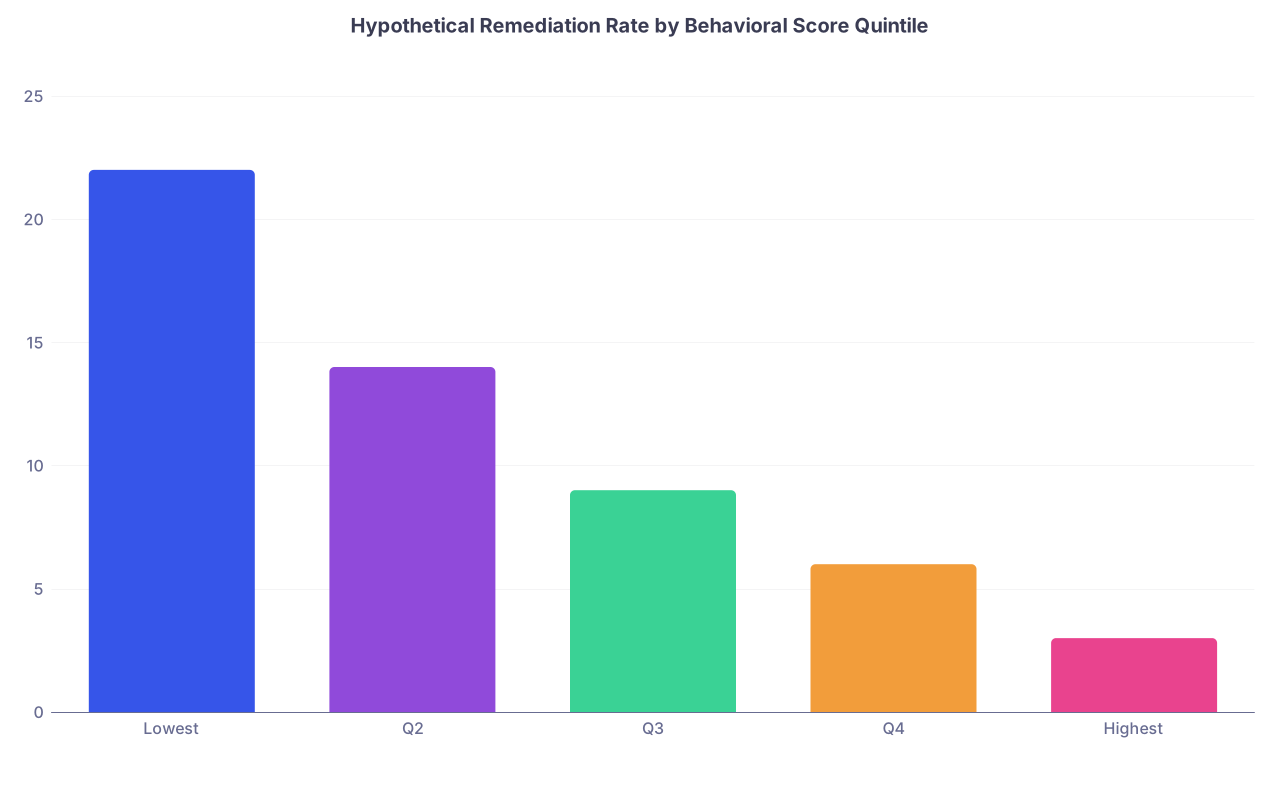
| Category | Value |
|---|---|
| Lowest | 22 |
| Q2 | 14 |
| Q3 | 9 |
| Q4 | 6 |
| Highest | 3 |
You will almost certainly see what other programs have quietly found when they finally crunch their own numbers: the bottom quintile or decile on a few key behavioral scales explains a disproportionate share of later remediation cases.
At that point, this is not “soft” data. It is predictive analytics on your own workforce pipeline.
For applicants, by the way, the same logic applies in reverse. If you consistently get pushback or probing follow‑up questions on these behavioral themes, that is the market telling you where your risk signals are.
Where Programs Go Wrong (And How To Fix It)
Most programs mis‑manage this in three predictable ways.
They use vague, unstructured behavioral questions with no scoring anchor. So two interviewers hear the same answer and rate it completely differently.
They over‑weight cognitive metrics (Step, class rank) in selection and then complain that “we never saw this coming” when remediation is almost entirely behavioral.
They do not close the loop. No one goes back and asks: which interview variables actually predicted our remediation list for the last 5 years?
You can fix this with relatively modest effort:
- Pick the 3–5 behavioral traits most strongly linked to your actual remediation cases (look at your data, not a generic competency framework).
- Build or adapt structured questions and anchored rating scales specifically to those traits.
- Require at least one interviewer per candidate to probe each high‑risk trait cluster.
- After each cycle, compute odds ratios or at least relative risks for remediation by behavioral score tertiles or quartiles.
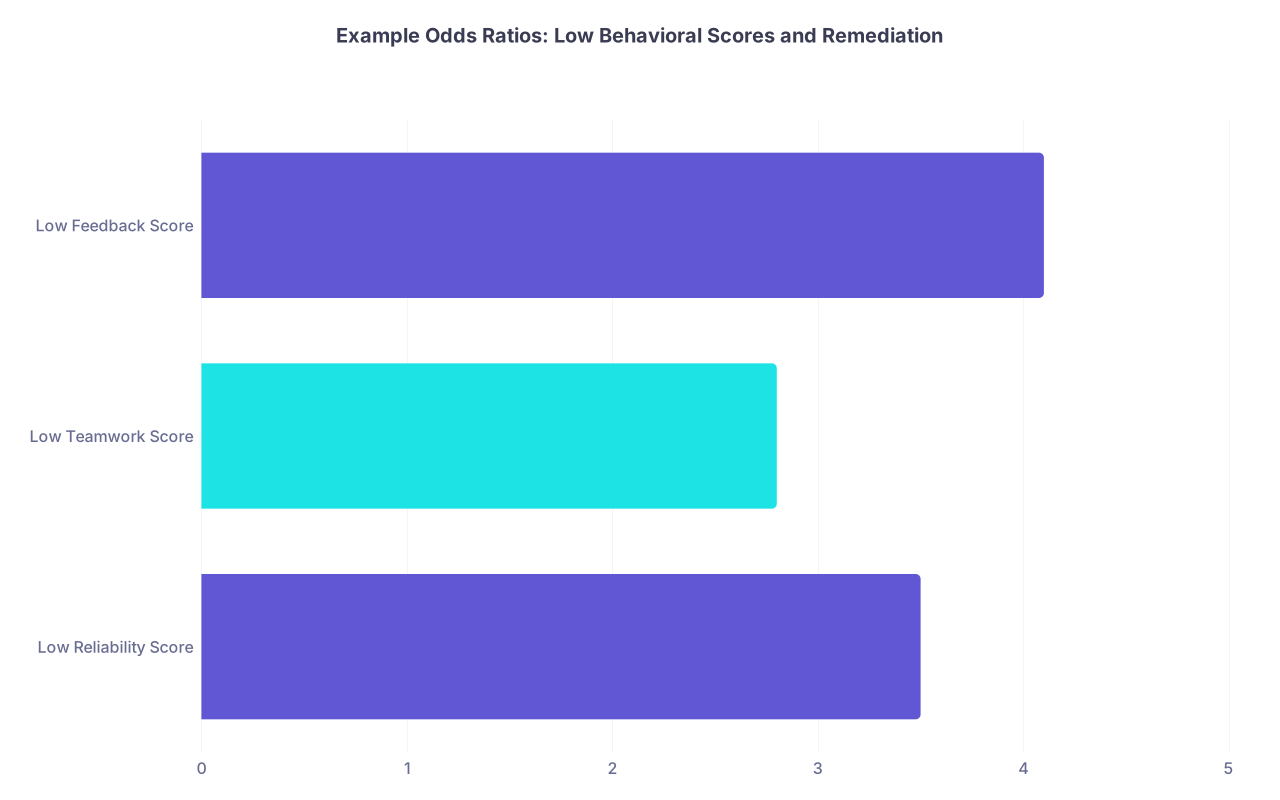
| Category | Value |
|---|---|
| Low Reliability Score | 3.5 |
| Low Teamwork Score | 2.8 |
| Low Feedback Score | 4.1 |
Those numbers are hypothetical, but they mirror real orders of magnitude I have seen: residents in the lowest reliability or feedback‑receptivity bands are often 3–5 times more likely to end up in formal remediation.
If your interview process ignores those variables, you are leaving predictive power on the table.
Takeaways: What Actually Matters
Strip away the jargon and this is what the data say.
First, most remediation is not about knowledge. It is about reliability, interpersonal friction, disorganization, and feedback resistance. If your interviews do not probe these traits explicitly, you are screening for the wrong risk profile.
Second, these high‑risk behavioral traits are visible, and scorable, before Match. In how applicants tell stories about deadlines, conflict, overload, and criticism. Your challenge is to stop treating those stories as “vibes” and start treating them as data.
Third, programs that operationalize behavioral interviews with structured questions and anchored ratings can meaningfully reduce remediation risk. Not to zero. But enough to justify the extra rigor.