
The question “Why our program?” is not about your answer. It is about your behavior.
I’m going to say that again because most applicants do not get this: program directors are not really listening for content when they ask “Why our program?” They are running a behavioral test in disguise. They want to see how you think, how you prepare, how you talk about others, and how you handle power sitting three feet away from you in a blazer.
Let me walk you through what’s actually happening on the other side of the table.
What “Why Our Program?” Is Really Testing
Directors and faculty have heard every version of “great learning environment,” “strong research,” and “supportive culture” for the last fifteen years. Nobody cares. They already know their ICU is high volume. They already know they have a night float.
The real question behind “Why our program?” is something closer to:
“Show me how you behave when you want something from someone who has more power than you.”
That breaks down into a few very specific behavioral checks:
- Did you respect us enough to prepare like a professional?
- Can you read the room and respond like a colleague, not a premed robot?
- Are you aligned with how we actually function, or are you just saying what you think we want to hear?
- When you’re under subtle pressure, do you get fake, defensive, or disorganized?
They use one harmless-sounding question to watch all of that at once.
You think it’s about your script. They think it’s about your habits.
How This Question Gets Used in Rank Meetings
You need to understand how “Why our program?” answers show up in the rank meeting, because that’s where the hidden behavioral piece suddenly matters.
I’ve sat in those meetings. It’s not polite. People are tired and blunt.
Picture this: 7 a.m., conference room, cold coffee, 40 applicants on the board.
The coordinator pulls up Applicant #17. Notes on the screen: “Strong grades, average letters, OK Step 2. Interviewers: Dr. Patel, Dr. Nguyen, Chief Resident Alexis.”
Program director: “Thoughts?”
Dr. Patel: “Honestly, sounded like we were just another dot on their map. Generic answer to ‘Why our program?’ – said they liked ‘diversity and research.’ Didn’t mention a single concrete thing that was actually ours.”
Translation: “Behavioral red flag – not invested, or too lazy to prepare.”
Applicant sinks.
Now Applicant #19.
Coordinator: “Mid-tier school, some remediation second year, strong Step 2, strong sub-I comments.”
Dr. Nguyen: “When I asked ‘Why here?’ they referenced our specific ICU schedule, said they’d spoken with one of our current PGY-2s, and clearly understood we’re heavy on community sites. Seemed genuinely into our workflow, not just prestige hunting.”
Program director: “So engaged, realistic, actual interest.” Check mark. Up the list.
Nobody says “We’re rewarding their behavioral profile,” but that’s exactly what’s happening.
The Four Behavioral Traits Hidden Inside Your Answer
1. Preparation vs. Entitlement
Faculty use this question to sort “workers” from “tourists.”
They don’t expect you to recite their website. They do expect you to know something that only a person who actually cared would bother to learn.
Here’s what they’re looking for behaviorally:
- Did you bother to look past the first page of the website?
- Did you reference something concrete that shows effort?
- Do you understand their structure enough to not sound ridiculous?
I’ve watched a PD at a big-name IM program literally say, “If you can’t spend 20 minutes looking us up before asking us to invest three years in you, I’m out.”
Translation: lack of specific detail = lack of respect + entitlement.
This is not about “right content.” It’s about the signal of preparation. They are testing: When the stakes are high, are you the kind of person who prepares or the kind who wings it and hopes your raw talent bails you out?
They assume you’ll act the same way with consults, notes, and night calls.
2. Authenticity vs. Performance
There is a behavioral sniff test happening the entire time you answer.
Faculty have heard thousands of applicants. They can tell when you’re performing. The behaviors that flag you as “performer, not partner”:
- Overly polished, memorized monologue
- Zero pauses, zero “natural” moments
- Generic adjectives: “amazing culture,” “incredible training,” “really supportive” with no personal twist
- Over-selling: “This has been my dream program for years” when you’re from three time zones away with no connection
What PDs are actually asking: When you want something from authority, do you default to flattery and theater, or can you still show up as a real human?
Because residents who perform in interviews tend to:
- Avoid giving bad news to patients directly
- Sugarcoat problems on the team
- Struggle to advocate honestly when attendings are watching
I remember a surgery PD leaning back after one of those polished performances and saying, “If he’s this scripted now, he’s going to tell me what I want to hear on rounds and nothing else. No thanks.”
The applicant’s answer was “perfect.” And completely wrong behaviorally.
3. Alignment vs. Fantasy
Some of you are unknowingly telling programs you do not belong there.
Not because you state the wrong interest, but because you reveal that you never bothered to understand who they actually are.
Behaviorally, programs are watching for: Do you choose environments that fit your stated values, or are you chasing labels and prestige?
Here’s what that looks like on their side:
You tell a heavy-county, high-volume, safety-net program that your top priority is “strong didactics, wellness, and protected research time.”
Translation to them: You’re going to be miserable here. And probably complain.You tell a research monster like Hopkins or Penn that your dream is “to be a community doc with no research obligations” and you “really value balance.”
Translation: You either haven’t read anything about us or you think we’ll change for you. Neither is good.
They want to see if your behavior matches your claimed priorities. Someone who says one thing on paper and behaves differently in person gets labeled as unreliable, even if nobody uses that word aloud.
This is why “Why our program?” is not a throwaway answer. It’s them testing: Do you actually know yourself, and do you pick your environment accordingly?
4. Professionalism Under Low-Grade Pressure
This question hits you early. Often first or second in the interview.
Your adrenaline is still high. You’re still settling in. Faculty know this. They intentionally use a “simple” question to see how you perform under mild internal chaos.
The behaviors they watch:
- Do your thoughts stay organized, or do you ramble?
- When you lose your train of thought, do you recover cleanly or spiral?
- Do you make the answer about you only, or do you acknowledge them as a real place with needs and constraints?
I’ve seen residents in rank meetings say, “I liked them, but they talked in circles for like three minutes on ‘Why here’ and I couldn’t follow the thread.” That becomes: “Questionable communication skills under stress.”
They’re extrapolating: If you do this now, you’ll do it at 2 a.m. with a sick patient and a grumpy attending on the phone.
“Why our program?” is the behavioral fire drill: low stakes, but they watch you like it’s real.
The Sub-Questions They’re Actually Asking
Let me translate “Why our program?” into the messy internal monologue happening in real time.
When a PD or faculty member asks you that, here’s what’s running in the background:
- “Have you done the minimum professional homework?”
- “Can you speak about us without reading from a script in your head?”
- “Are you chasing clout or fit?”
- “If I put you on my team, will you be grateful for the opportunity or bitter you did not match somewhere shinier?”
- “Will you adapt to our reality, or will you fight it and call it ‘advocacy’?”
All from one question.
You answer with three sentences. They respond with behavior labels:
Prepared / Unprepared
Grounded / Delusional
Genuine / Performative
Colleague / Customer
Those labels matter a lot more at rank time than whether you mentioned their new cath lab.
What Strong Behavioral Answers Actually Look Like
Notice I said behavioral answers, not “beautiful answers.”
The best answers sound like a third-year resident summarizing a plan: specific, calm, honest, no drama.
I’ll give you three composites I’ve heard that scored very high in rank meetings, and I’ll show you what trait each revealed.
Example 1: The Prepared Realist
“I’m really drawn to the way your program combines a heavy county experience with strong subspecialty exposure. On my sub-I here I saw that most mornings start with early work rounds on the county side, but then we were staffing complex patients with your transplant team by mid-morning. That combination fits how I learn best—seeing a lot of bread-and-butter but with regular exposure to really sick, complex patients. I also talked with Dr. Lewis, one of your PGY-3s, who mentioned that the senior residents really run the MICU night shifts. That kind of graduated autonomy is exactly what I’m looking for.”
Behavioral signals: did actual homework, talked to residents, understood workflow, prioritized volume and autonomy. Calm, specific, zero flattery.
Example 2: The Honest Switch
“I used to think I wanted a smaller, more suburban program. My home institution is like that. But on my away rotation here, I realized I actually thrive in a busier environment with more pathology, even if that means longer days. I liked that on wards here, the attending let the senior run most of the list. It felt like the kind of place that will push me, which I know I need. So for me, it’s the mix of patient population, the autonomy I saw, and honestly, the culture I picked up from residents—they were tired, but they weren’t bitter.”
Behavioral signals: self-awareness, flexible thinking, not deluded about workload, values challenge over comfort. That “tired but not bitter” line? Every PD loves hearing that. It says: I see the reality and I still want in.
Example 3: The Targeted Fit
“I’m interested in cardiology fellowship, but I want to train in a place where I’m not just a cog in a machine. I was really struck by how your program sends residents to that community affiliate clinic and still gets people into cards. The fact that two of your last three chief residents matched into cardiology tells me you can support that path while still training well-rounded internists. That balance—between strong fellowship opportunities and genuine community exposure—is exactly what I’m after.”
Behavioral signals: goals realistic, understands program outcomes, not blinded by prestige alone, sees themselves as part of a system.
Notice what’s missing in all three: “top-notch,” “amazing,” “world-class,” “perfect fit.” Nobody in a real interview room talks like that and sounds credible.
How Programs Compare Applicants’ Behavioral Profiles
Here’s how this plays out when programs are triaging dozens of similar applicants.
| Applicant Type | Behavioral Read by Committee |
|---|---|
| Generic answer | Unprepared, low interest, possible rank drop |
| Over-flattering | Performative, people-pleaser, trust discount |
| Hyper-misaligned | Poor self-knowledge, will be unhappy |
| Specific & grounded | Prepared, mature, culture add |
| Mildly awkward but real | Trainable, authentic, probably fine |
If you think they’re not doing this kind of informal categorization, you’re kidding yourself.
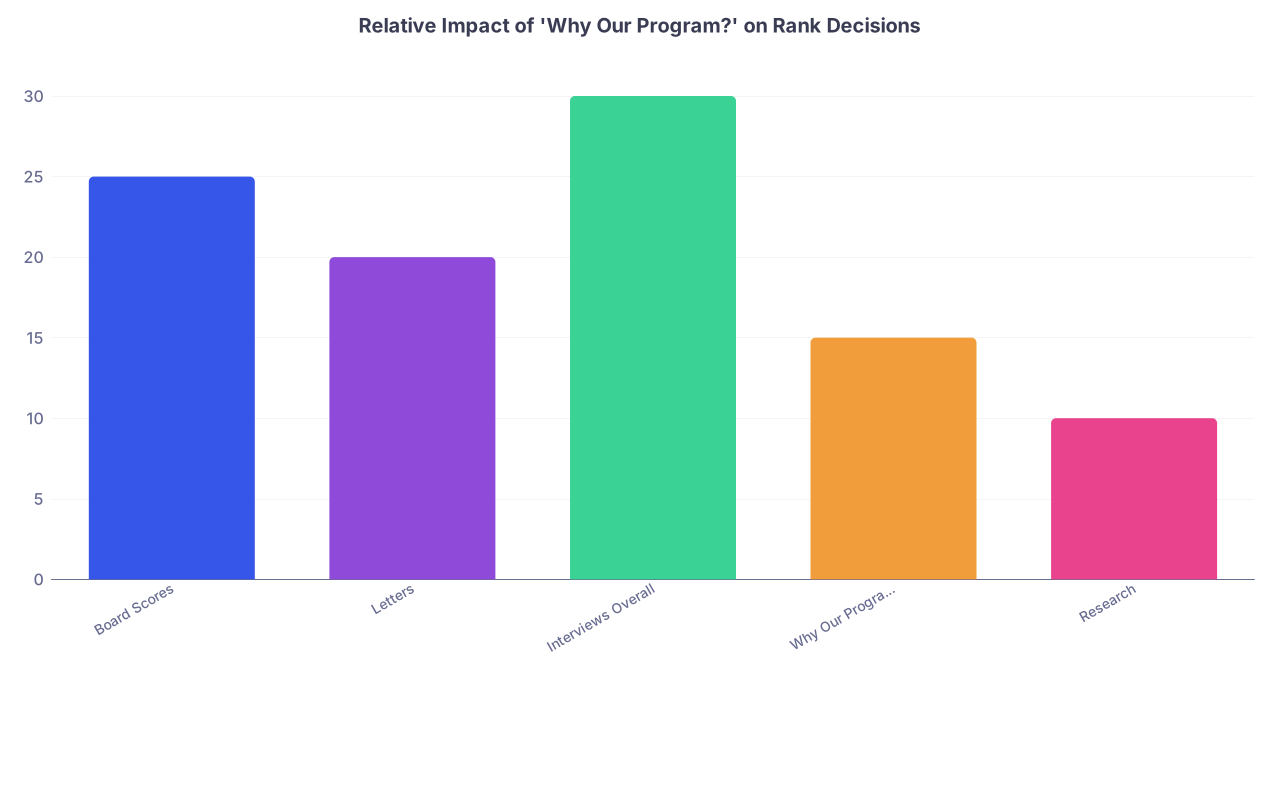
| Category | Value |
|---|---|
| Board Scores | 25 |
| Letters | 20 |
| Interviews Overall | 30 |
| Why Our Program? Behavior | 15 |
| Research | 10 |
That 15% behavioral chunk from “Why our program?” and similar questions is often the tiebreaker between you and three other people who look exactly like you on paper.
How to Train the Right Behaviors Before Interview Day
This isn’t about memorizing lines. It’s about training your behavioral pattern around the question.
You want three habits:
- Always know 2–3 concrete program-specific details that genuinely match your priorities.
- Always answer like you’re debriefing with a senior you respect, not auditioning on Broadway.
- Always show you’ve thought about their reality, not just your convenience.
An easy way to practice is out loud, on video, answering this sequence for each program:
- “What’s one structural thing about this program that actually affects my day-to-day work?” (e.g., night float style, ICU coverage, clinic structure)
- “How does that line up with what I know about how I learn and what I want?”
- “What did I see or hear from current residents that either confirmed or changed my expectations?”
Record. Watch yourself. If it sounds like a brochure, start over. You want it to sound more like a case presentation: “Here’s the data. Here’s what I think. Here’s why.”
One More Hidden Piece: How You Talk About Other Programs
You will occasionally get a follow-up like: “So, what other types of programs are you considering?” or “How do we compare to your home program?”
That’s when the subtext really cranks up.
They’re now checking:
- Are you respectful about other institutions, or do you trash them to win favor?
- Do you sound strategic and honest, or manipulative?
If you say, “Oh, you’re way better than my home program, the teaching there is terrible,” every experienced interviewer will put a mental red X next to your name. Because if you talk about them that way to their face, you’ll talk about this place that way to someone else next year.
Behavioral read: disloyal, ingratiating, untrustworthy. Doesn’t matter how nice your answer sounded.
Visualizing the Hidden Decision Flow
Here’s roughly how the “Why our program?” behavioral logic runs in your interviewer’s head.

| Step | Description |
|---|---|
| Step 1 | Ask Why our program? |
| Step 2 | Unprepared\nLow interest flag |
| Step 3 | Performative\nTrust discount |
| Step 4 | Misaligned\nRisk for dissatisfaction |
| Step 5 | Prepared\nGrounded\nPositive behavior tag |
| Step 6 | Program-specific details? |
| Step 7 | Authentic tone? |
| Step 8 | Realistic fit? |
You never see this flowchart. But it’s running anyway.
FAQ: The Real Questions You’re Afraid to Ask
1. Do I have to say this is my top choice?
No. And in most cases, you shouldn’t. Faculty can smell fake “number one!” declarations. What they want is believable enthusiasm and clear reasoning. “You’re one of my top choices because of X and Y” is far more credible than “You’re my absolute #1” repeated ten times to ten programs.
2. What if I honestly do not know much about the program?
Then your behavior needs to show humility and curiosity, not improvisation. You can say: “I’m still learning about your program, but what has stood out to me so far is…” and mention whatever you genuinely know (resident interactions, a specific clinic, a reputation for a certain patient population). The behavioral win is honesty plus effort, not omniscience.
3. Is it okay to mention location or family as a reason?
Yes, if it’s not your only reason. Saying, “My partner is here, so I’m really hoping to stay in this region, and I’d be lucky if that’s at a program like yours where X and Y” is perfectly fine. If you only talk about being near the beach or your boyfriend, you look like someone who picked based on lifestyle alone.
4. What if my real reason is prestige?
Then keep that to yourself and translate it into something they can respect. Prestige usually means strong subspecialty exposure, strong fellowship placement, high-acuity patients. Talk about those. Saying, “You’re top-ranked” is lazy and shallow. Everyone in that room already knows where they sit on Doximity.
5. How long should my answer be?
About 45–75 seconds. Long enough to show you’ve thought, short enough to not turn into a monologue. If you go past two minutes, you look disorganized. Behaviorally, that reads as “can’t summarize,” which is death in a profession that lives on sign-outs and consult calls.
If you remember nothing else, remember this:
First, “Why our program?” is a behavioral exam, not a trivia quiz. They’re grading your habits, not your poetry.
Second, specificity plus honesty beats polished generic every time. They’d rather have a slightly awkward but real human than a perfectly smooth actor.
Third, your answer tells them whether you’ll complain about the reality you signed up for or accept it and get to work. Show them you know who they are, you know who you are, and you’re choosing the match on purpose. That’s what gets you moved up the list.