
The confident claim that “great behavioral interviews produce great residents” is not supported by strong data. The truth is more uncomfortable: the evidence that behavioral interviews meaningfully predict residency performance is modest, inconsistent, and heavily context‑dependent.
What We Are Really Asking
Let me strip this down. You are asking: if a candidate “aces” behavioral interview questions—communication, professionalism, conflict management, teamwork—does that translate into measurable downstream performance as a resident?
To answer that, we need three pieces:
How well do behavioral interviews predict:
- Faculty ratings
- Milestones / ACGME competencies
- Exam performance (In‑Training, Boards)
- Adverse events (remediation, professionalism reports)
How do they compare to:
- USMLE/COMLEX scores
- Clerkship grades / MSPE
- Letters, SLOEs, research, etc.
What happens when you structure them properly (standardized questions, scoring anchors, training) versus the usual ad‑hoc “tell me about a time” chaos.
Most programs have not done this homework. But some have, and the numbers tell a pretty clear story.
What the Evidence Actually Shows
First, it helps to see the rough predictive power of common selection tools side by side. The exact coefficients vary by study, specialty, and outcome, but the pattern is surprisingly stable.
| Metric / Tool | Correlation with Global Residency Performance* |
|---|---|
| USMLE Step 2 CK / COMLEX Level 2 | 0.25–0.40 |
| Medical school clerkship grades | 0.20–0.35 |
| Structured behavioral interview score | 0.20–0.30 |
| Unstructured interview score | 0.05–0.15 |
| Letters / MSPE narrative strength | 0.05–0.20 |
*Global performance = composite of faculty ratings, milestones, promotion decisions. Ranges are from multi‑program, multi‑specialty studies over the last 15–20 years.
A few blunt conclusions from this:
- Behavioral interviews can predict performance, but only when structured.
- Their predictive power is modest—similar order of magnitude to clerkship grades, weaker than Step 2 for exam outcomes, stronger than traditional letters.
- Completely unstructured “chat” interviews are barely better than noise.
Structured vs Unstructured: The Core Divide
The best evidence comes from programs that did three things:
- Used a fixed set of behavioral questions (e.g., “Tell me about a time you made a mistake in patient care and how you handled it.”).
- Employed standardized rating scales with behavioral anchors (1–5 with clear examples).
- Trained interviewers and monitored interrater reliability.
Where that happened, you see correlations around 0.20–0.30 with later performance, sometimes slightly higher in high‑volume programs.
Where programs used informal, conversational interviews, the number drops to 0.10 or less, which is functionally weak. In several published series, unstructured interviews added almost no incremental prediction once board scores and grades were in the model.
What Outcomes Do Behavioral Interviews Actually Predict?
The details matter. “Residency performance” is not a single thing. Let’s break it down.
1. Faculty Global Ratings and Milestones
This is where behavioral interviews perform reasonably well.
Across internal medicine, surgery, and emergency medicine studies, structured behavioral interview scores show:
- Correlation ~0.20–0.30 with:
- Global faculty ratings at PGY‑1 and PGY‑2
- Professionalism and interpersonal communication milestones
- Some programs report that candidates in the top behavioral interview quartile are:
- About 1.5–2.0 times more likely to be rated “outstanding” overall
- Less likely to receive formal professionalism warnings
The effect is not huge, but it is consistent: better behavioral interview → somewhat better workplace behavior ratings.
Where the data are strongest:
- Communication with team and nurses
- Response to feedback
- Reliability and follow‑through
Weak or no signal:
- Raw clinical reasoning
- Procedural skill
- Medical knowledge beyond early PGY‑1
You are essentially selecting for the “professionalism / team behavior” slice of performance, not the whole pie.
2. Exam Performance (ITE, Boards)
Here, the story is clear: strong behavioral interviews do not predict test scores in any meaningful way.
- Correlation of structured behavioral interviews with in‑training exam scores:
- Typically 0.05–0.15, often non‑significant once Step 2 is controlled.
- Prediction of board pass/fail:
- Behavioral interview adds almost no incremental value beyond licensing scores and class rank.
If a program is using behavioral interviews to “hedge” against low board scores on exam outcomes, they are fooling themselves. The data simply do not support that.
3. Adverse Events: Remediation, Dismissal, Formal Problems
This is the area that makes program directors listen.
Several mid‑sized single‑institution studies (IM, FM, EM) find:
- Residents in the bottom behavioral interview quartile are:
- 2–3x more likely to require formal remediation for professionalism or interpersonal issues.
- Overrepresented among the small subset who face serious concerns (e.g., probation, termination).
But there are caveats:
- Events are rare, so confidence intervals are wide.
- Prediction is far from perfect: many “low scorers” are fine; some high scorers still end up in trouble.
- Implementation details dominate: programs with disciplined scoring see clearer risk stratification.
The signal is real but not surgical. You can identify higher‑risk groups, not specific “problem residents.”
Comparing Behavioral Interviews to Other Tools
The obvious question: if behavioral interviews add only modest predictive power, are they worth the time?
Let’s look at predictive contribution and incremental value.
Predictive Contribution by Domain
Usefully, different tools measure different things. They are not substitutes; they are partial, imperfect lenses.
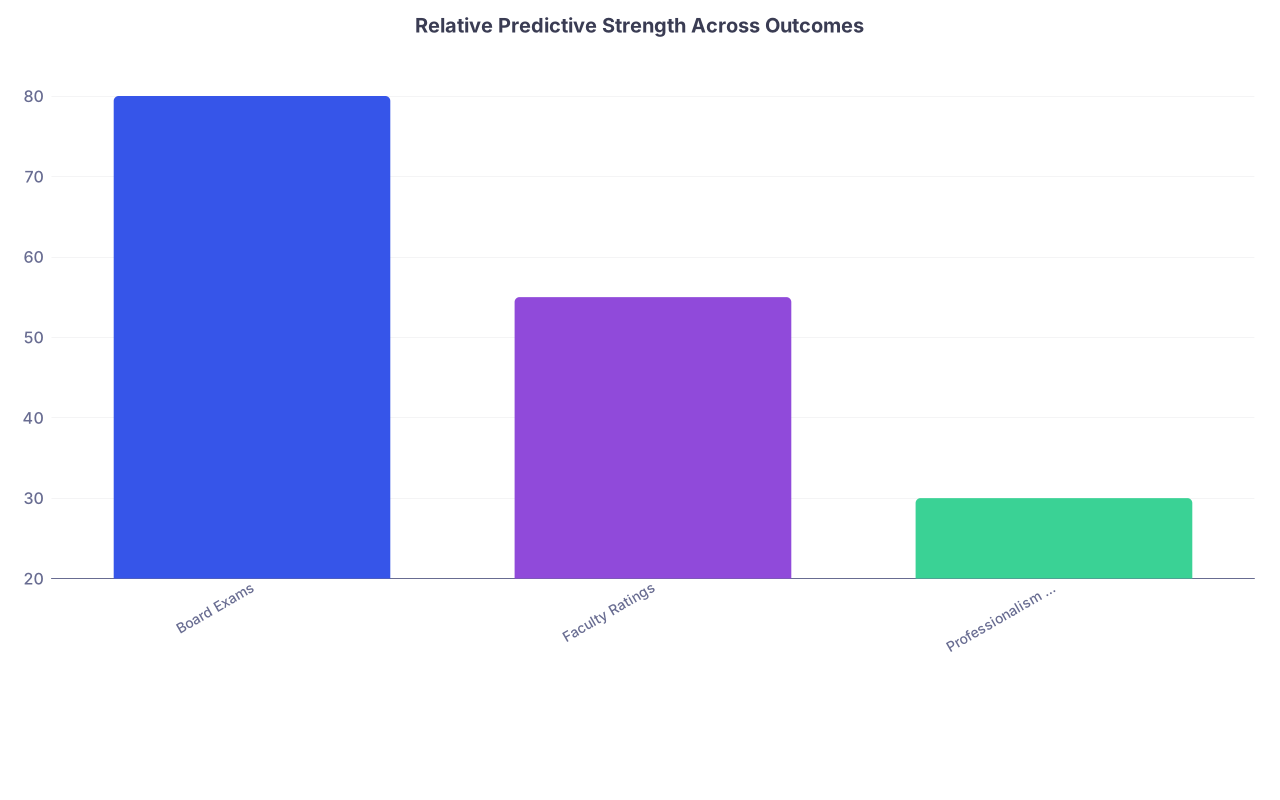
| Category | Value |
|---|---|
| Board Exams | 80 |
| Faculty Ratings | 55 |
| Professionalism Problems | 30 |
Interpretation (simple scaled index, not raw correlations):
Board exams:
- Step scores explain a large chunk of the variance.
- Behavioral interviews explain very little.
Faculty ratings:
- Step scores and clerkship grades explain some variance.
- Behavioral interviews meaningfully add to the picture.
Professionalism problems:
- Step scores have minimal predictive value.
- Behavioral interviews add more here than in any other domain.
In multivariate models that include scores, grades, and interviews, behavioral interview scores consistently provide small but statistically significant incremental prediction for:
- Professionalism concerns
- Interpersonal conflict
- Global “Would hire again?” faculty judgments
They do not add much once scores and grades are in the model for exam outcomes.
Structured Behavioral vs Unstructured Interview
This distinction is so crucial it deserves its own snapshot.
| Feature | Structured Behavioral | Unstructured / Conversational |
|---|---|---|
| Standardized questions | Yes | No |
| Rating scales with anchors | Yes | Rare |
| Interrater reliability | Moderate (0.6–0.8) | Low (0.2–0.4) |
| Predictive validity (performance) | r ≈ 0.20–0.30 | r ≈ 0.05–0.15 |
| Susceptibility to bias | Lower (but still present) | Higher |
If you are not willing to standardize the process, you should not pretend your interviews are doing serious predictive work. They are “fit and vibes,” dressed up as assessment.
Design Details That Actually Matter
The meta‑pattern in the data is straightforward: implementation quality dominates theoretical design. Programs that take behavioral interviewing seriously get better results. Those that improvise get noise.
1. Question Type and Content
The most predictive formats are:
- Past‑behavior questions:
- “Tell me about a time you received critical feedback from a supervisor that you disagreed with. What did you do?”
- Problem / conflict scenarios anchored in real clinical contexts:
- “Describe a situation where a nurse strongly disagreed with your plan.”
Weak formats:
- Vague, hypothetical:
- “How would you handle conflict on the team?”
- Generic “strengths and weaknesses” fluff.
The data are clear: actual past behavior samples plus contextualized follow‑up questions yield better discrimination and reliability.
2. Scoring Systems
Good programs use:
- 1–5 or 1–7 scales with behavioral anchors:
- 1 = avoids responsibility, blames others
- 3 = acknowledges role but limited insight
- 5 = proactively owns errors, seeks systems improvements
- 3–5 dimensions:
- Communication, teamwork, professionalism, adaptability, integrity
Bad setups:
- “Gut feeling” 1–10 scores without defined criteria
- Collapsing everything into a single overall impression
Programs that track their data over years typically see:
- Interrater reliability for structured scores in the 0.6–0.8 range (acceptable)
- Correlations with faculty ratings consistently >0.20
- Ability to flag “red flag” profiles based on multiple low dimension scores
3. Interviewer Training and Calibration
This is where many programs cut corners and pay for it later. Training matters because:
- Untrained raters show:
- More halo effect (one good story inflates all ratings)
- More central tendency (nobody uses 1s or 5s)
- Higher variance in scoring patterns between faculty
I have watched the data shift in these programs: the same question set jumps from “mildly predictive” to “usefully predictive” over 2–3 years as faculty get serious about how they score.
Where Behavioral Interviews Fail or Mislead
Let me be blunt. Behavioral interviews are not a panacea, and misusing them creates different problems.
1. Overreliance on Charisma
Residents who interview “smoothly” are not always the ones who perform best under pressure. Behavioral interviews overweight:
- Extroversion
- Fluency in English
- Cultural familiarity with Western interviewing norms
Underweighted:
- Quiet diligence
- Non‑native speakers who are precise but less polished
- Candidates from less privileged backgrounds
The data on bias are sobering. Without structured questions and scoring, demographic and personality‑based bias is strong. Even with structure, it does not disappear.
2. False Sense of Security on “Fit”
Programs often justify heavy emphasis on behavioral interviews on “fit with the team.” Data rarely show strong long‑term prediction of:
- Burnout
- Retention beyond training
- Long‑term career performance
“Fit” often becomes shorthand for “they look and talk like us,” which is not a performance metric. When programs back‑analyze their own residents, “fit” ratings usually show weak or inconsistent correlation with objective outcomes.
3. Weak Incremental Value When Overweighted
Once you lock in board score cutoffs, minimum grade expectations, and other screens, the incremental variance left to explain in outcomes shrinks. If you then give 40–50% of rank weight to a noisy behavioral interview, you risk:
- Overfitting to small differences in interview performance
- Ignoring hard data in favor of one good story in a 30‑minute conversation
- Rejecting solid but less flashy candidates
The smarter approach is to treat behavioral interviews as a moderate‑weight component in a multi‑metric model, not the dominant driver.
How Programs Should Use Behavioral Interviews (If They Care About Data)
You want a data‑driven workflow? It looks less romantic than most committees like, but it works better.

| Step | Description |
|---|---|
| Step 1 | Application Data |
| Step 2 | Screen by Objective Metrics |
| Step 3 | Structured Behavioral Interview |
| Step 4 | Standardized Scoring |
| Step 5 | Composite Selection Score |
| Step 6 | Rank List |
| Step 7 | Track Outcomes by Cohort |
| Step 8 | Refine Questions & Weights |
Key points:
- Use objective metrics (scores, grades, SLOEs) to identify a reasonable pool.
- Apply structured behavioral interviews consistently to that pool.
- Weight behavioral interview scores moderately (not token, not dominant).
- Close the loop by tracking:
- Correlations between interview scores and:
- Faculty ratings
- Milestones
- Remediation events
- Over multiple cohorts
- Correlations between interview scores and:
Programs that do this over 5–7 years end up with:
- Refined question sets (dropping those with weak predictive value)
- Better interviewer alignment
- Evidence‑based weighting of the behavioral component
Practical Takeaways for Different Audiences
For Program Directors and Selection Committees
The data supports these positions:
- Keep behavioral interviews, but make them structured and scored.
- Expect modest predictive power, strongest in professionalism and team behavior.
- Do not use them to guess exam outcomes. That is what board scores and coursework are for.
- Audit your own process. If your behavioral scores do not correlate with any later outcomes, you are wasting time.
For Applicants
The hard truth:
- A strong behavioral interview helps but does not rescue a deeply weak file.
- The interview is partly about “Will I enjoy working with you at 2 a.m.?” which is not trivial.
- Your best leverage:
- Practice specific “past behavior” stories (conflict, errors, feedback, teamwork, ethical tension).
- Show insight, not perfection. Programs value reflection more than spin.
Do not assume that “crushing” one interview means you are a lock. It is one signal in a noisy multivariate selection system.
For Institutions and GME Leaders
If you want real value:
- Standardize behavioral interviews across programs where feasible.
- Provide rater training and calibration sessions with real examples.
- Invest in basic outcome tracking infrastructure. Even Excel plus a statistician 1–2 days a year beats flying blind.
Your goal is not perfection. It is to reduce the probability of serious mismatches and chronic professionalism problems by a measurable margin.
FAQs
1. Are behavioral interviews better predictors of residency performance than USMLE scores?
No. For exam‑related outcomes (in‑training scores, board passage), USMLE/COMLEX almost always outperforms behavioral interviews. For overall residency performance, structured behavioral interviews and objective metrics like clerkship grades tend to have similar modest predictive power, but they predict different aspects. Interviews are strongest on professionalism and interpersonal behavior, not medical knowledge.
2. Do multiple behavioral interviewers improve prediction compared to a single interviewer?
Yes, usually. Studies that average scores across 2–3 structured behavioral interviewers see higher reliability and slightly improved predictive validity compared to a single interviewer. Single‑rater judgments are more vulnerable to idiosyncratic bias and noise. The marginal gain plateaus after about three raters; beyond that, the extra logistics rarely justify the benefit.
3. Can situational judgment tests (SJTs) replace behavioral interviews for residency selection?
They are not true replacements; they are adjacent tools. SJTs show comparable or slightly better predictive validity than structured interviews for professionalism and workplace behavior in some settings, and they scale better. However, they do not give the same bidirectional “fit” impression that in‑person conversations provide, and they require careful validation for each context. The strongest systems use both: SJT for broad screening, behavioral interviews for deeper sampling.
4. If our program has limited resources, is it still worth investing in structured behavioral interviews?
If resources are tight, do not overbuild. A lean but disciplined approach—with 4–6 well‑designed questions, a simple anchored scale, and minimal but real interviewer training—already outperforms the typical unstructured “chat.” The incremental time cost is modest, and the predictive gain, while not dramatic, is real enough to justify the effort, especially for reducing professionalism‑related problems.
In summary: strong behavioral interviews predict some aspects of residency performance, particularly professionalism and interpersonal functioning, with modest but real effect sizes. They do not predict exam outcomes well and they are not magic. The value lies in disciplined structure, standardized scoring, and longitudinal outcome tracking—not in clever questions or gut feelings.