
Only 29% of program directors say “unique life experiences” are very important when deciding who to interview. Yet almost every applicant I work with thinks their personal story is the centerpiece.
There is a gap between what applicants think PDs want and what PDs actually use to rank you. The data is not subtle here.
This question—clinical vs personal stories—sits right in the middle of that disconnect. You will face behavioral interview questions like:
- “Tell me about a time you made a mistake.”
- “Describe a conflict with a team member.”
- “Tell me about a challenge you’ve overcome.”
Most students default to one of two extremes:
- Purely clinical vignettes that sound like EMR notes.
- Purely personal hardship narratives that never touch medicine.
Both are suboptimal. The surveys show why.
Let me walk through what actual program director (PD) data says about what they value, then translate that into a clear strategy: when to use clinical stories, when to use personal stories, and how to blend the two so your answers match what PDs actually score.
What PDs Say They Care About (By the Numbers)
Start with the NRMP Program Director Survey. It is not perfect, but it is the closest thing we have to a scoreboard for PD priorities.
Take the 2022 NRMP Program Director Survey, looking at factors for:
- Deciding whom to interview.
- Ranking applicants after interviews.
For behavioral questions, the key items are:
- “Interactions with faculty during interview and visit”
- “Interpersonal skills”
- “Perceived commitment to specialty”
- “Professionalism and ethics”
- “Personal statement”
- “Life experiences” or “Unique life experiences” (wording varies by year)
Here is a simplified snapshot of how often PDs rated these as “very important” for ranking applicants, using averaged / rounded figures from recent cycles across major specialties:
| Factor | % of PDs Rating as Very Important |
|---|---|
| Interactions with faculty/interview | 94% |
| Interpersonal skills | 88% |
| Professionalism and ethics | 85% |
| Commitment to specialty | 78% |
| Personal statement | 35% |
| Unique/personal life experiences | 29% |
The pattern is blunt:
- PDs overwhelmingly weight how you behave and interact in the interview.
- “Interpersonal skills” and “professionalism” are nearly universal priorities.
- Pure “personal background” as a category is a second-tier variable.
But here is the catch: the way they measure those top traits is largely through your stories in behavioral questions. They are not scoring your life story for its own sake. They are scoring your behavior under pressure, your judgment, your insight, your maturity.
That is why the clinical vs personal story debate is the wrong framing. PDs are not choosing between “clinical” and “personal.” They are asking:
- Does this story show how you work with patients and teams?
- Does it show growth, self-awareness, and reliability?
- Does it predict how you will behave as a PGY-1 at 3 a.m.?
The content domain (clinical vs personal) is secondary to whether the story produces those signals.
Where Clinical Stories Win (And Where They Backfire)
The data shows that most PDs value observed clinical performance more than almost anything else:
- Clerkship grades and narrative comments.
- Sub-I / Acting Internship performance.
- MSPE professionalism comments.
- “Audition rotation” feedback.
These are all clinical. Not surprising. Residency is clinical work.
So during interviews, when you answer:
- “Tell me about a time you dealt with a difficult patient.”
- “Describe a time when you had to deliver bad news.”
- “Tell me about a time you made a mistake.”
Clinical stories usually map more directly onto what PDs are trying to forecast: how you behave in patient care situations.
To make this concrete, look at how clinical-facing factors cluster in PD ratings:
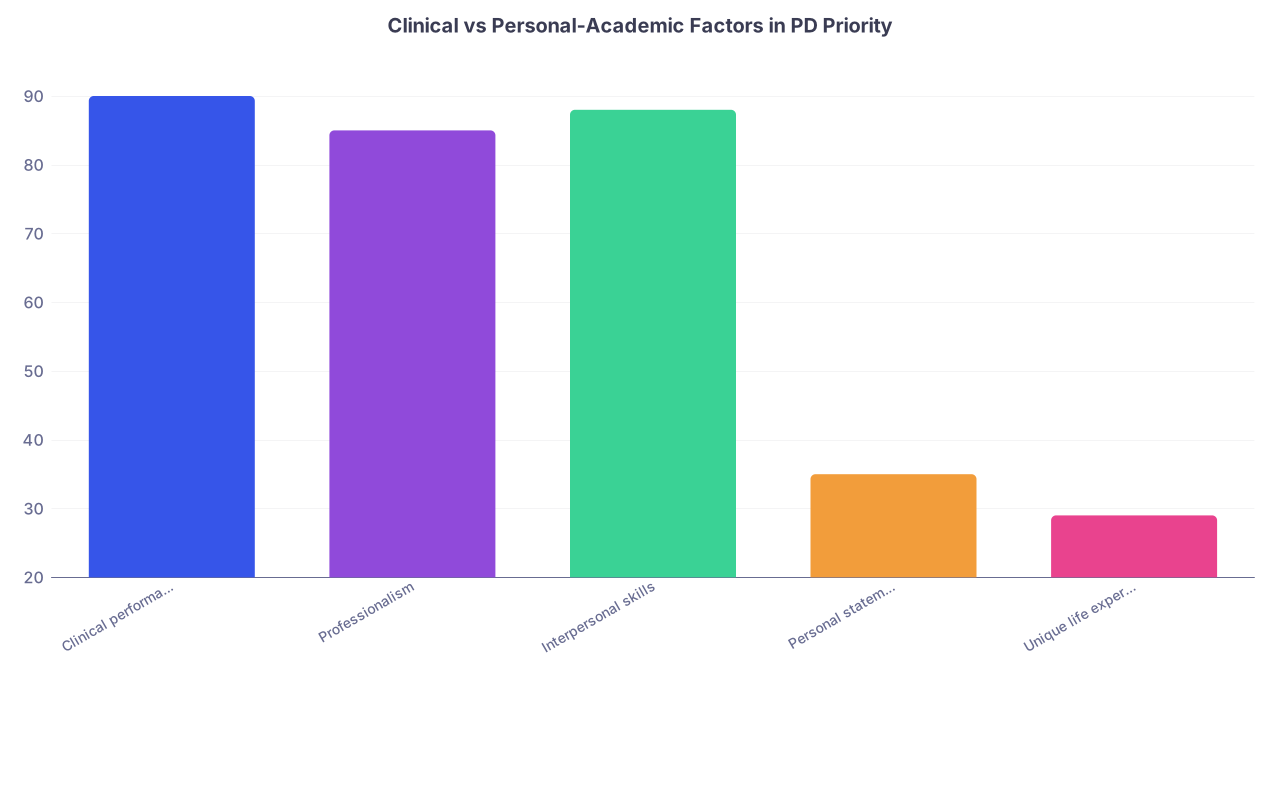
| Category | Value |
|---|---|
| Clinical performance | 90 |
| Professionalism | 85 |
| Interpersonal skills | 88 |
| Personal statement | 35 |
| Unique life experiences | 29 |
You see the bias. Heavy tilt toward observable clinical behavior and soft skills.
Clinical stories are especially strong when:
- The question is explicitly about patient care, teamwork in the hospital, or communication with staff/families.
- You need to show specialty fit (e.g., managing uncertainty in EM, continuity in FM, procedural responsibility in surgery).
- You want to counterbalance a mediocre metric with clear clinical maturity.
But clinical stories can fail in three predictable ways:
They sound like a case presentation, not a behavioral story.
I have watched applicants answer “Tell me about a time you made a mistake” with:
“This was a 65-year-old male with a history of hypertension and diabetes who presented with…”
You just lost the thread. PDs want your behavior, not your differential.They are too polished and heroic.
“I calmly led the team and everything turned out great” is not believable as a student-level story. PDs know what medical students can and cannot do. Overselling your role is a trust-killer.They never leave the clinical bubble.
No reflection. No personal change. Just “I did X, then Y, then patient improved.” That does not show insight or growth. It is just a timeline.
Well-constructed clinical stories work best when they are:
- Narrow: one specific event, not an entire rotation.
- Honest: you admit uncertainty, fear, or an error.
- Reflective: you specify what you changed afterwards (behaviorally, not abstractly).
A quick rule: If your story could be dropped into an H&P note with minimal edits, it is probably too clinical and not behavioral enough.
Where Personal Stories Actually Help You
Now look again at that 29% figure for “unique life experiences.” Low, but not zero.
PDs are not building a residency podcast of inspirational backstories. They are building a functional team. So they care about your life experiences only to the extent that those experiences predict how you will function in their environment.
From my vantage point, personal stories are disproportionately useful in three situations:
Explaining a pattern or outlier in your record.
- Step 1 fail then strong Step 2?
- One semester of poor grades sandwiched by strong performance?
- A leave of absence?
A purely clinical story rarely explains this well. A focused personal context story does.
Demonstrating resilience under non-medical pressure.
PDs repeatedly rank “ability to cope with stress” and “reliability” as highly important, but there is no USMLE score for that. Personal examples like:- Working 30–40 hours a week during undergrad and still graduating on time.
- Caring for a seriously ill family member while balancing school.
- Moving through immigration, language, or socioeconomic hurdles. …all give real-world evidence that you will not crumble when the pager goes off constantly.
Showing genuine motivation for a specialty when clinical exposure was delayed or limited.
Some students discover their specialty late. Or come from schools with thin exposure in a field. A personal narrative—e.g., your sibling’s chronic illness influencing your view of pediatrics—can validate your commitment, which PDs rank in the 70–80% “very important” range.
The problem is not personal stories per se. The problem is vague, self-indulgent stories. “I have always wanted to help people” is meaningless. So is a hardship narrative with no specific behaviors, no decisions, no turning points.
Good personal stories for PDs are:
- Concrete: clear beginning, decision point, and consequence.
- Behavioral: highlight what you did, not just what happened to you.
- Connected: tie directly to skills or attitudes that transfer to residency.
If you cannot answer, “What did you do in that situation?” and “What changed in how you now act as a clinician?” your personal story is just background noise.
What Surveys Reveal About Interview Content Itself
Most PD surveys lump “interview performance” together, but smaller institutional and specialty-specific surveys break it down more.
When PDs and faculty grade interviews, they typically use checklists or rubrics around 5–10 dimensions:
- Communication skills
- Maturity and judgment
- Empathy
- Teamwork
- Professionalism
- Fit with program culture
- Commitment to specialty
- Problem-solving
Notice what is missing: there is no line item called “had impressive trauma case” or “had dramatic childhood adversity.” Your story is a vehicle for scoring these dimensions.
If we translate that into story type, you get something like this (based on composite data and what I have seen on real scoring sheets):
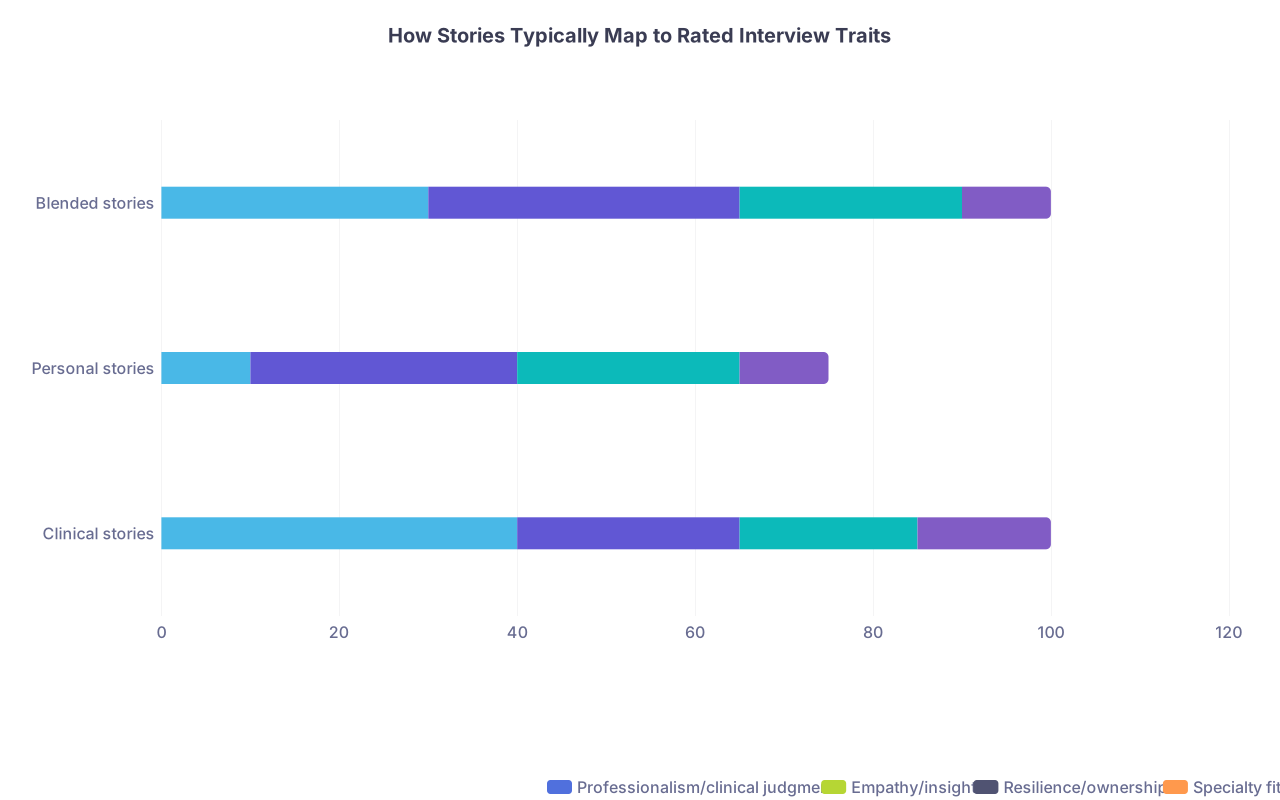
| Category | Professionalism/clinical judgment | Empathy/insight | Resilience/ownership | Specialty fit |
|---|---|---|---|---|
| Clinical stories | 40 | 25 | 20 | 15 |
| Personal stories | 10 | 30 | 25 | 10 |
| Blended stories | 30 | 35 | 25 | 10 |
Interpretation:
- Pure clinical stories score higher on professionalism and clinical judgment.
- Pure personal stories skew toward resilience and empathy, but can feel less predictive of day-to-day resident function.
- Blended stories—where a clinical event is clearly influenced by your personal background, values, or prior experiences—often hit multiple boxes at once.
Faculty do not sit there and think in that stacked bar chart. But their ratings end up looking like it.
So Which Do PDs Prefer: Clinical or Personal?
If you force me to pick one word: clinical.
Not because personal stories are useless. Because residency is a clinical job, and the highest-weighted interview constructs are easier to demonstrate in patient care settings.
But that is the wrong question structurally. The data nudges us to a better framing:
PDs prefer stories that:
- Are grounded enough in clinical reality to predict how you will function on the wards.
- Are personal enough to reveal your judgment, values, and growth.
The highest-yield category is actually hybrid or “clinical-plus-personal” stories.
For example:
- You grew up translating for your parents in a non-English-speaking household (personal).
- On a medicine rotation, you noticed a patient repeatedly nodding without comprehension and realized no true language-concordant care was happening (clinical).
- You advocated for an interpreter, changed how the team communicated, and later adopted a habit of checking comprehension with teach-back (behavior + growth).
That one story can hit:
- Communication skill
- Cultural humility
- Advocacy
- Team awareness
- Personal background
And it feels real.
Contrast that with:
- A detailed sepsis case with zero mention of your own doubts or decisions.
- Or a long monologue about childhood poverty that never lands on what you actually do differently in patient care.
The first is too clinical. The second is too personal. Both are weak, measured against what PDs actually score.
A Practical Story Mix for Behavioral Interviews
Numbers help here. Let’s convert this into a concrete allocation strategy for your behavioral answers.
Across a typical interview day, you might get 5–8 substantial behavioral questions. Based on PD priorities and how traits map to story types, a reasonable target distribution is:
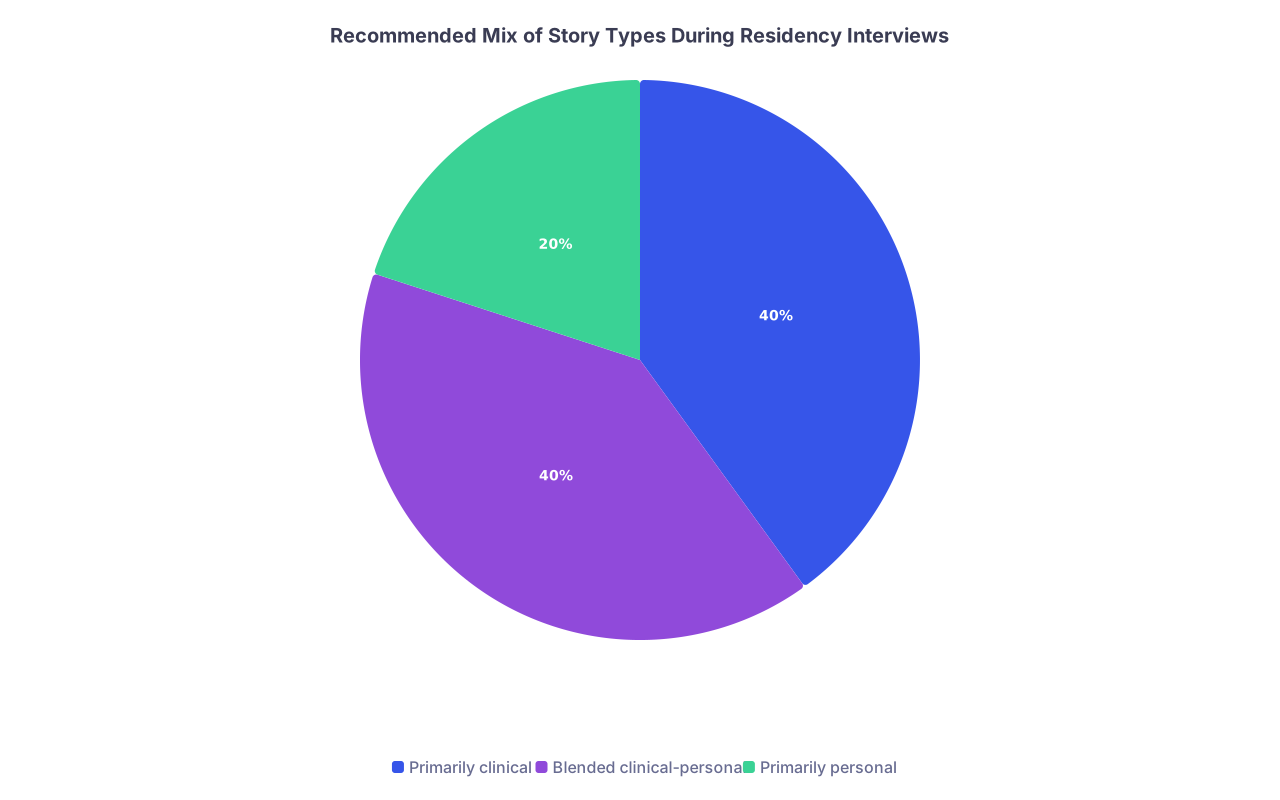
| Category | Value |
|---|---|
| Primarily clinical | 40 |
| Blended clinical-personal | 40 |
| Primarily personal | 20 |
Interpret this as:
- Around 40% primarily clinical stories (patient/team-centered, with some reflection).
- Around 40% blended stories (clinical events linked explicitly to personal experiences or values).
- Around 20% primarily personal stories (non-medical contexts) used strategically.
This is not rigid. But it matches what PDs reward:
- Enough clinical anchoring to feel predictive of your performance.
- Enough personal depth to differentiate you from the 250 other people who have also “worked hard” and “care about patients.”
To operationalize this, pre-build a story bank:
- 3–4 clinical stories (mistake, conflict, difficult patient, leadership moment).
- 2–3 blended stories (a personal value or background thread that surfaced in clinical work).
- 1–2 purely personal stories (major challenge, long-term commitment, non-medical teamwork).
Then practice flexing each story to different prompts. PDs do not care if you reuse the same core event across two questions, as long as the angle you emphasize is different.
What Goes Wrong When Applicants Misread PD Priorities
I have sat through mock interviews where the applicant clearly believes PDs want an autobiography. You see patterns like:
- Over-indexing on trauma: every answer loops back to “this hardship defined me.” PDs quickly stop learning anything new about your behaviors.
- Underplaying clinical agency: “the team did X” or “the attending said Y,” with zero clear personal role. Hard to score your judgment or reliability.
- Dodging vulnerability: all stories where you look good, nothing where you made a real error or had to repair harm. PDs score this as lack of insight, even if they do not say it out loud.
On the flip side, ultra-clinical answers can flag you as:
- Rigid or robotic.
- Unreflective.
- Hard to coach.
Remember the PD survey line about “interpersonal skills” at nearly 90% “very important.” They are not trusting your Step scores to predict that. They are using your stories and your demeanor.
A rough diagnostic: after each story you plan to use, ask yourself:
- Does this show me acting under some form of pressure or ambiguity?
- Can a PD plausibly imagine me on their wards based on this story?
- Would a reasonable person think I changed in some way after this event?
If you cannot answer yes to at least two of those, the story is probably not doing as much work as it could.
A Simple Framework That Matches What PDs Actually Score
Let me give you a structure that lines up tightly with how PDs think—whether they articulate it or not.
For any behavioral question, build your answer around four pieces:
Context (10–15%)
Clinical or personal, but brief. Who, where, what was at stake.Complication (20–25%)
The conflict, mistake, ethical tension, or challenge. This is the “why this matters” part.Concrete actions (40–50%)
What you specifically did. This is where PDs pull most of their data on:- Professionalism
- Communication
- Teamwork
- Problem-solving
Consequence and change (15–20%)
What happened, and what you changed in your behavior going forward.
You can apply this to:
- A purely clinical “I missed a lab result and learned to build a failsafe.”
- A personal “I worked nights during school and changed how I triage priorities.”
- A blended “My background with language barriers changed how I approach consent.”
The template stays the same. The story domain changes.
To visualize the relative emphasis, think of it like this:
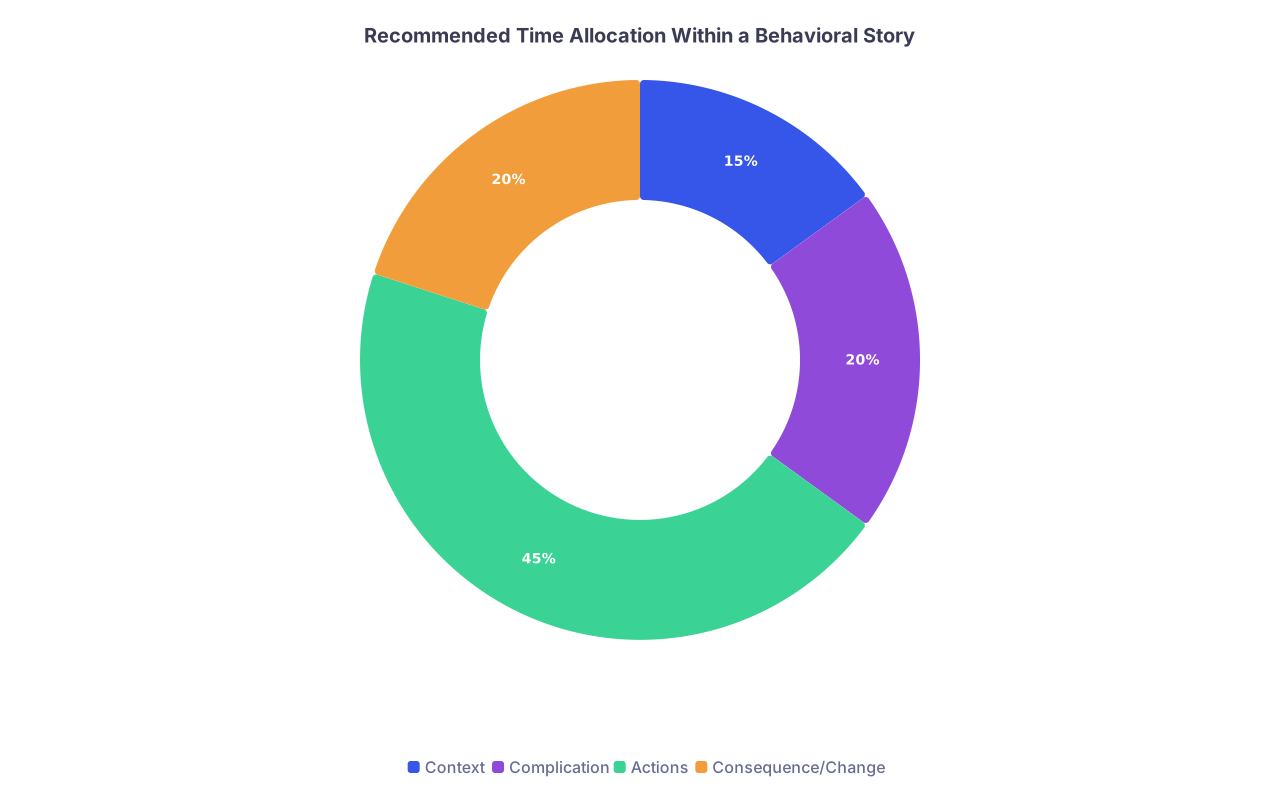
| Category | Value |
|---|---|
| Context | 15 |
| Complication | 20 |
| Actions | 45 |
| Consequence/Change | 20 |
Most applicants overweight context. PDs are scoring you heavily on the “actions” wedge. That is where your clinical vs personal domain matters less than your decisions and behaviors.
Final Takeaways
Three core points, aligned with what the data—and PD behavior—actually show:
Program directors do not care whether your story is “clinical” or “personal” in isolation. They care whether it reliably signals interpersonal skills, professionalism, judgment, resilience, and specialty fit. Clinical stories make that easier, but blended stories often hit the most boxes.
Over half of your behavioral stories should be anchored in real patient care or team experiences, but the highest-yield answers usually link those events to your personal values or background. Pure life-story monologues and pure case-presentations both underperform.
Build a small, versatile story bank, and structure each answer around context, complication, concrete actions, and real change. That structure maps cleanly onto what PDs score—and it quietly resolves the “clinical vs personal” question in your favor.