
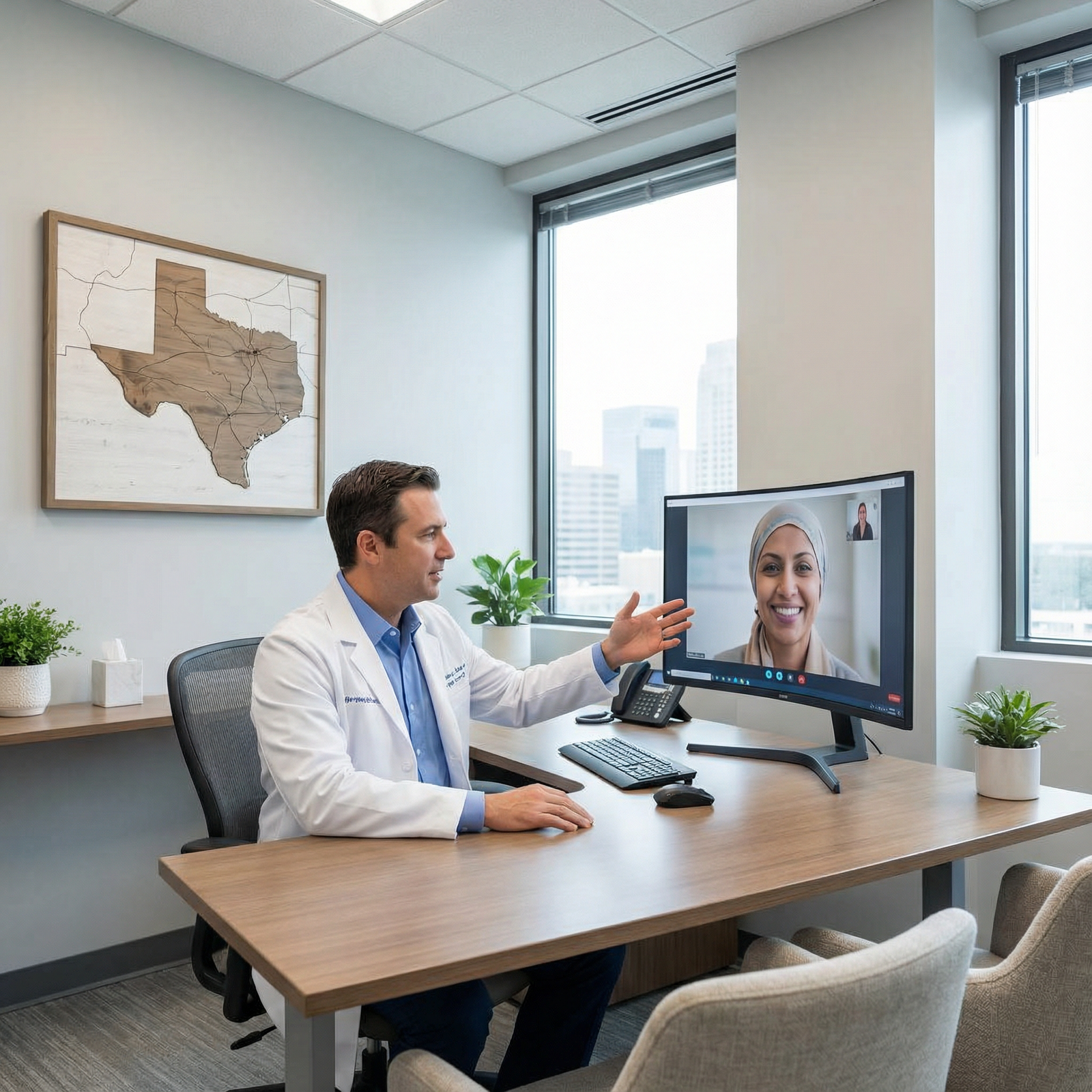
You're on a video call at 9:47 p.m. Patient's in Colorado. You're licensed in Texas. She's anxious, short of breath, wants a refill on her anxiety meds, and the platform pinged you as "available." You're tired. You tell yourself telehealth changed everything, laws are looser now, right? One click. One e-script. Done.
That's the mistake.
I've watched good doctors wreck careers on that exact assumption. Telehealth did not dissolve state lines. It just made crossing them quieter, and the fallout louder when someone finally notices.
This article is for educational purposes only. It is not legal, financial, or malpractice advice. Licensing rules, enforcement, and outcomes vary by state and situation. Talk to a healthcare attorney and your board before you practice across borders.
The Myth That Keeps Getting Doctors Burned
Somewhere between pandemic emergency waivers and slick telehealth marketing, a dangerous story took hold: if the patient can see you on a screen, you're good. License? "It's digital healthcare now." Jurisdiction? "The platform handles that." Controlled substances? "Everyone's doing it."
No.
Your medical license is a state-issued permission slip. It is not a national passport. It is not tied to your Wi-Fi. When you diagnose, treat, or prescribe, you are practicing medicine in the state where the patient is located at the time of the encounter. Full stop. Courts and boards have repeated this until they're hoarse. Doctors still miss it.
I've seen the pattern. A physician picks up a side gig on a national platform. Volume feels great. Then a complaint lands, or a pharmacy flags an out-of-state controlled script, or a malpractice carrier asks for proof of licensure in the patient's state. Suddenly the "flexible remote work" fantasy becomes a board investigation, a DEA letter, or a claim with no coverage.
Don't make this mistake because the interface looked seamless. Seamless is a design choice. Law is not.
Your License Lives in a State, Not on a Server
Here's the core rule people keep trying to wish away:
- The location of the patient generally determines where you are practicing.
- Being licensed in your home state does not authorize care for a patient sitting in another state.
- Platform terms of service do not override medical practice acts.
- "I was just consulting" rarely saves you if you crossed into diagnosis, treatment planning, or prescribing.
Emergency waivers during COVID created temporary exceptions in many places. Most of those sunsets happened. Some states kept limited flexibilities. Many did not. Relying on "what we did in 2020" in 2025 is how you walk into a disciplinary hearing with a shrug and no defense.
If you want multi-state work, you need multi-state authority, full licenses, compact privileges where available, or whatever that specific state actually allows. Hoping HR or the app "checked it" is not a strategy. You are the licensee. The board comes for you.
Practical red flags I want you to treat as stop signs:
- A platform that cannot clearly state which states you are credentialed and licensed to cover.
- Any workflow that auto-assigns you patients without showing patient location up front.
- Pressure to "just help this one" outside your licensed geography.
- Vague answers from leadership about who holds the liability when a cross-border complaint hits.
If it feels fuzzy, it is. Fuzzy gets people suspended.
Good Samaritan Laws Will Not Save Your Telehealth Case
This one shows up in break-room mythology constantly. Someone says, "If anything goes sideways, Good Samaritan covers me, I was just trying to help."
Wrong context. Wrong statute. Wrong fantasy.
Good Samaritan protections are generally built for true emergencies, often in-person, often for unpaid voluntary aid, with statutes that vary wildly by state. A scheduled or on-demand telehealth visit inside a commercial platform is not a roadside rescue. You are in a professional relationship. You are getting paid or building a panel. You have time to refuse the encounter. That is not the scenario those laws were written to shield.
I've watched physicians learn this the expensive way: malpractice suit filed, carrier asks hard questions about licensure and standard of care, and the "but Good Samaritan" argument dies in the first motion practice. You're left explaining why you practiced without proper authority and why your documentation looks like a rushed chat.
Malpractice risk in telehealth is not abstract. Incomplete history. No vital signs you can trust. Patient minimizing symptoms. You prescribing into a vacuum. Add an unlicensed-state problem on top and you've handed the plaintiff's attorney a gift.
Protect yourself like this:
- Confirm patient location every encounter. People travel. People lie. People forget to update the app.
- If they're outside your licensed states, do not proceed to treatment. Refer. Redirect. End the visit cleanly.
- Document location confirmation. If it isn't in the chart, it didn't happen.
- Know your carrier's telehealth and multi-state requirements before you need them. Some policies get thorny when licensure is defective.
Good intentions are not a defense. Authority is.
The Interstate Medical Licensure Compact Is a Privilege, Not a Participation Trophy
The Interstate Medical Licensure Compact (IMLC) is useful. It is not magic. It does not mean "you're automatically legal in 30-something states because you heard of the Compact."
Reality check:
- You must be eligible.
- You must apply through the proper pathway.
- You receive privileges to practice in selected Compact states, you don't absorb the whole map by vibes.
- You still answer to each state's laws, rules, and standards while practicing there.
- Fees, renewals, and reporting obligations still exist.
- Not every state is in the Compact, and membership can change.
I've seen doctors list "Compact" on a CV like it's a national license. Boards are not impressed. Employers who push volume sometimes oversell how fast or automatic the process is. You own the compliance. If your privilege lapses or you never secured it for State X, State X does not care that the onboarding checklist had a green checkmark.
Use the Compact the right way:
- Verify your eligibility with primary state of licensure requirements.
- Apply deliberately for the states you will actually serve.
- Track expiration and renewal like your career depends on it, because it does.
- Still learn local controlled-substance rules, telehealth consent rules, and standard-of-care expectations for each state you enter.
- Do not practice ahead of approval because a recruiter said it's "basically done."
Faster pathway ≠ no pathway. Don't confuse administrative efficiency with universal permission.
Controlled Substances Across State Lines: Where Careers Go to Die
If the license issue is a cliff, controlled-substance prescribing across state lines is the cliff with a federal agency at the bottom.
Prescribing controlled medications generally requires careful alignment of:
- Your state licensure where the patient is located
- DEA registration realities and state-controlled substance authority
- Federal rules (including Ryan Haight-related telemedicine requirements and whatever the current federal flexibilities or final rules actually allow at the time you prescribe)
- State-specific PDMP checks, quantity limits, telehealth prescribing bans or conditions, and medical marijuana / opioid / stimulant nuances
"Everyone on the platform does it" is not a legal opinion. It is how patterns of illegal distribution get described in indictments.
I am not exaggerating for drama. Out-of-state controlled prescribing without proper authority is one of the fastest ways to turn a side hustle into a DEA problem, a board emergency suspension, and a CV scar that never fully fades. Stimulants, benzos, and opioids get special scrutiny. So do high-volume telehealth models that look like prescription mills from 30,000 feet.
Hard rules I want burned into your decision-making:
- If you are not clearly authorized to practice in the patient's state, do not prescribe controlled substances there. Do not "just this once."
- Confirm current federal telemedicine prescribing requirements for controlled substances before you write. Guidance has shifted; your memory of 2021 is not a protocol.
- Check the PDMP as required, and understand which state's PDMP obligations apply.
- Watch for patients who shop platforms, request specific drugs early, or resist identity/location verification.
- If your employer's business model depends on frictionless controlled scripts across dozens of states with thin licensure coverage, that is not innovation. That is your risk wearing their logo.
Non-controlled meds can still get you in trouble for unlicensed practice. Controlled meds can get you in federal trouble. Know the difference in severity.
What "Practicing Everywhere" Actually Requires
If you truly want geographic flexibility, build it on purpose. Do not reverse-engineer compliance after a complaint.
A sane approach looks like this:
- Pick your states intentionally. Where do your patients actually live? Where does your employer send volume?
- Get real authority. Full license or Compact privilege, confirmed active, before the first visit.
- Map the extras. Telehealth consent, modality rules, prescribing limits, reporting, malpractice coverage territory, hospital/platform credentialing.
- Build a location gate. No patient location confirmed = no clinical care.
- Audit yourself. Quarterly check: licenses active, DEA/state CS registrations aligned, platform assignments match your map.
- Walk away from sloppy systems. If a company punishes you for declining out-of-license patients, they are asking you to rent them your license until it breaks.
Best places to work as a doctor in a telehealth-heavy world are not the ones dangling unlimited remote freedom with a wink. They're the ones that treat licensure like oxygen, non-negotiable, monitored, and resourced.
Myth vs Reality, Side by Side
| Myth | Reality |
|---|---|
| "Telehealth means my license works everywhere." | You practice where the patient is. License follows state law, not Zoom. |
| "Good Samaritan will cover a bad outcome." | Commercial telehealth is not a Good Samaritan scenario. |
| "I'm in the Compact, so I'm fine in all Compact states." | Only where you've obtained privileges, and only while they remain valid. |
| "It's just a refill on a controlled med." | Cross-border controlled prescribing can be a career-ending federal and state violation. |
| "The platform credentialed me, so I'm covered." | You remain personally responsible to each medical board and to federal law. |
If you remember nothing else, remember that table when you're tired and the queue is long.
Key Takeaways
- Your medical license is tethered to a specific state, not a server.
- Good Samaritan laws do not protect you in a telehealth malpractice suit.
- The Interstate Medical Licensure Compact is a privilege, not an automatic right.
- Prescribing controlled substances across state lines is a federal crime waiting to happen.
Don't Learn This From a Board Letter
Telehealth is real medicine. It can be excellent medicine. It can also be a quiet factory for jurisdictional mistakes because the geography feels imaginary when everyone fits inside a laptop.
It isn't imaginary.
Before your next multi-state shift, do three things tonight:
- List every state you might touch in the next 90 days.
- Verify active licensure or Compact privilege in each, yourself, in the primary sources, not from a dashboard screenshot someone Slack'd you.
- Write your personal rule in one sentence: No license in the patient's state, no treatment. Then follow it when it's inconvenient.
If your current setup can't survive that rule, fix the setup or leave it. The market will always offer another platform. Your clean license is harder to replace.
Protect your name. Protect your DEA. Protect the version of you that still gets to practice in five years. The myth says telehealth made borders optional. Reality says borders got quieter, and enforcement got more patient.
Choose reality.