

It’s 10:30 p.m. on a Sunday.
You’ve just landed in a small airport for your new locum tenens assignment. The recruiter said it was a “quaint community with great support.”
Your phone shows one bar of service.
The hospital shuttle? Not here.
The “hotel near the hospital”? Turns out to be a roadside motel with flickering lights and a “no refunds” sign badly taped to the front desk.
Welcome to one of the classic locum tenens location traps.
Let me be blunt: most locums horror stories are not about pay. They’re about place. Where you sleep. Where you work. What you’re actually walking into when you say yes to “rural Midwest” or “coastal community hospital.”
If you get the location wrong, everything else gets heavy. Fast.
This is your crash course in avoiding those mistakes.
1. The “Great Pay, Anywhere USA” Mirage
The biggest trap with locum locations? Getting hypnotized by the rate.
“$300/hour, 7-on/7-off, easy census.”
You see that and your brain stops asking questions. Bad idea.
The hard truth: high pay is often hazard pay in disguise. Sometimes it’s legit (short notice, true rural need, seasonal surge). Too often, it’s a screaming red flag about the location or conditions.
, Remote isolation, EMR chaos](https://cdn.residencyadvisor.com/images/articles_svg/chart-common-red-flags-behind-very-high-locums-rates-1705.svg "Common Red Flags Behind Very High Locums Rates")
| Category | Value |
|---|---|
| Chronic understaffing | 85 |
| Toxic leadership | 70 |
| [Unsafe call load](https://residencyadvisor.com/resources/best-places-to-work-doctor/how-new-attendings-misjudge-call-burden-in-dream-practice-locations) | 60 |
| Remote isolation | 55 |
| EMR chaos | 40 |
What physicians learn the hard way
I’ve watched people take these “too good to be true” gigs and then discover:
- The nearest tertiary center is 3–4 hours away in snow-prone territory.
- They’re the only doc on for the entire hospital at night.
- The “average census” number was pulled from fantasy land.
- The community is hostile to outsiders or burned out on revolving-door locums.
- There’s no reliable backup, no in-house specialists, and you’re expected to MacGyver your way through disasters.
They come home with money but also insomnia and a firm “never again.”
How to avoid this mistake
Before you let the hourly rate impress you, force yourself to ask:
- Why is this rate so high?
- Is it seasonal volume? A specific project? Or chronic dysfunction nobody wants to fix?
- How long has this job been open?
- A role that’s been “open for years” is almost always a location or culture problem.
- How many locums have cycled through?
- If they can’t or won’t answer, that’s your answer.
- What happened to the last full-time doc?
- Burnout, sudden resignation, or “we’re not sure” is a giant blinking sign.
If the recruiter downplays everything and only repeats the rate and “great team”? You’re being sold, not informed.
2. The Isolation Trap: “Just a Quiet Rural Town”
Rural can be wonderful. Or it can grind you down.
“Quiet rural town” is recruiter code that ranges from “charming+boring” to “you will be the only human awake after 9 p.m. and the Walmart is 40 minutes away.”
The problem isn’t just boredom. It’s functional isolation.
You discover on day two:
- No Uber, no Lyft, no public transit.
- The “airport” is a single-gate regional field that cancels for fog, rain, or moods.
- There’s one grocery store. It closes early on Sundays.
- Cell service is patchy. Your spouse can’t reliably reach you.
- If your car dies, you’re begging the night nurse for a ride.

The psychological trap
The first week, you tell yourself: “It’s just a short assignment, I’ll focus, save money.”
By week three:
- You’re eating gas-station food because everything decent is closed post-shift.
- Weather keeps you from flying out on time.
- You wake up, work, go back to a room, and stare at beige walls.
Then the extension offer comes. You’re tired, they’re desperate, and you say yes because “I already know the system.”
That’s how people end up doing 6–12 months in a place they hated after 2 weeks.
How to vet isolation before you accept
Ask questions that force details, not adjectives.
- “How far is the nearest:
- Major airport (actual major, not just ‘regional with two flights a day’)?
- Walmart/Target/Costco?
- Tertiary/trauma center?”
- “Is there:
- Uber/Lyft?
- Public transit?
- Any actual restaurants open after 8 p.m.?”
- “What do most physicians there do on their days off?”
Then cross-check everything:
- Drop the hospital’s address into Google Maps.
- Use Street View to walk the area virtually.
- Look up weather patterns. Ask yourself if you actually want to be in that location in January.
If being snowed in 3 days past your contract end would wreck you, don’t gamble on “we usually don’t have storms.”
3. The Housing Disaster: “We Provide Lodging” (You Won’t Like It)
This one blindsides a lot of people. You’re tired, you don’t want to coordinate housing, and the agency says: “Don’t worry, we provide it.”
Sometimes that’s great. A clean hotel near the hospital. Extended stay with a kitchen. Easy.
Other times?
- Old motel by the highway with paper-thin walls and sketchy guests.
- Converted “call room” that smells like 1995 and burnt coffee.
- Hospital-owned “apartment” that’s actually a basement with no windows and questionable internet.
| Housing Type | Typical Risks |
|---|---|
| Budget motel | Noise, safety, hygiene problems |
| Hospital-owned apartment | Dated, poor maintenance, no privacy |
| Extended stay hotel | Variable cleanliness, thin walls |
| Airbnb-style rental | Inconsistent quality, host issues |
| On-call room | Noisy, no separation from work |
What this does to you
You underestimate how much housing affects your sanity.
- You’re post-call and can’t sleep because of noise or safety concerns.
- There’s no place to cook, so you bleed money on food or eat trash.
- You can’t decompress because your “living space” feels like a storage closet with a bed.
Over a few weeks, that turns into irritability, worse decision-making, and a much, much higher chance of you saying “never doing locums again” when the real problem was: you accepted garbage housing.
Non‑negotiable housing questions
Before you sign:
- “Exactly where is the housing located?”
Ask for:- Name and address of hotel/apartment
- Distance and commute time to hospital
- “Do I get:
- My own private room/apartment?
- Private bathroom?
- Kitchen or kitchenette?”
- “Is internet included and reliable?”
- “Can I see photos or a virtual tour?”
Then verify it yourself:
- Look up hotel reviews by date, not overall score.
Anything with repeated mentions of bedbugs, odors, noise, or safety? Walk away. - If it’s an apartment: ask if other staff or locums currently live there and if you can speak to one of them.
If they refuse details and just repeat “We provide comfortable housing,” assume you won’t like what you find at midnight after a travel day.
4. The “Supportive Staff” Myth: Toxic Culture in Disguise
Recruiters rarely say: “The nurses are furious, primary care hates the hospitalist group, and the surgeons haven’t spoken to administration in six months.”
They’ll tell you: “Great team, very supportive environment.”
I have watched physicians walk into:
- Places where nursing is so understaffed that you’re basically your own ward clerk, social worker, and discharge planner.
- ERs where the “collaborative environment” means the ED doc calls you for every stubbed toe and “just to be safe” admission.
- Units where everyone is burned out and the locum is treated like a disposable buffer for bad patient satisfaction scores.
Once you’re there, you’re stuck for the duration of your contract unless conditions are truly unsafe and you’re willing to walk (which gets complicated).

| Step | Description |
|---|---|
| Step 1 | Chronic understaffing |
| Step 2 | Staff burnout |
| Step 3 | Hostility toward administration |
| Step 4 | High turnover |
| Step 5 | Dependence on locums |
| Step 6 | Locum blamed for system issues |
How to smell toxicity before you arrive
You won’t get honesty from leadership. You might from rank-and-file staff and previous locums.
Do this:
- Ask to speak to another physician currently working there
Specifically:- “Can I speak to a current locum or recent locum who did my exact role?”
- Ask targeted questions:
- “How many patients do you personally carry on a typical day?”
- “Who handles admissions and cross-cover overnight?”
- “How does the team handle difficult patients or families?”
- “Have many docs left recently?”
- Google the hospital and read between the lines:
- Look at staff reviews on Glassdoor/Indeed.
- Repeated mentions of “culture,” “turnover,” “disorganized,” “unsafe staffing” are not noise.
If administration or the agency blocks you from talking to current staff, that alone is a major warning.
5. Scope Creep by Zip Code: You vs. Local Reality
The job posting says:
“Hospitalist. 15 patients/day. Minimal procedures. No ICU management.”
You arrive and discover:
- The intensivist left 3 months ago.
- “Minimal procedures” means: you and YouTube.
- 15 patients becomes 20–25 because “we don’t have anyone else.”
Location matters here because rural or semi-rural hospitals often have no backup plan. And the locum becomes the backup plan.
This can blow up your license, your confidence, or your willingness to ever take a small-town assignment again.
Protecting yourself from scope creep
Be specific. In writing.
Before accepting:
- Get a written description of:
- Average daily census (day and night)
- Expected admissions per shift
- Procedures expected (central lines, intubations, chest tubes, paracentesis, lumbar punctures, etc.)
- Codes – who runs them?
- Ask directly:
- “Who is on-site overnight?”
- “If I’m uncomfortable with a procedure, what’s the escalation route?”
- “Is there a current intensivist, or will I be asked to manage vented patients?”
If the answers are vague or full of “usually” and “typically,” push harder. If they won’t commit, assume reality is worse than what they’re saying.
6. Licensing, Malpractice, and the Legal Landmines of Certain States
Some locations come with invisible baggage: state boards, malpractice climate, and patient-suing culture.
Not all states are equally friendly to physicians—especially temporary ones.
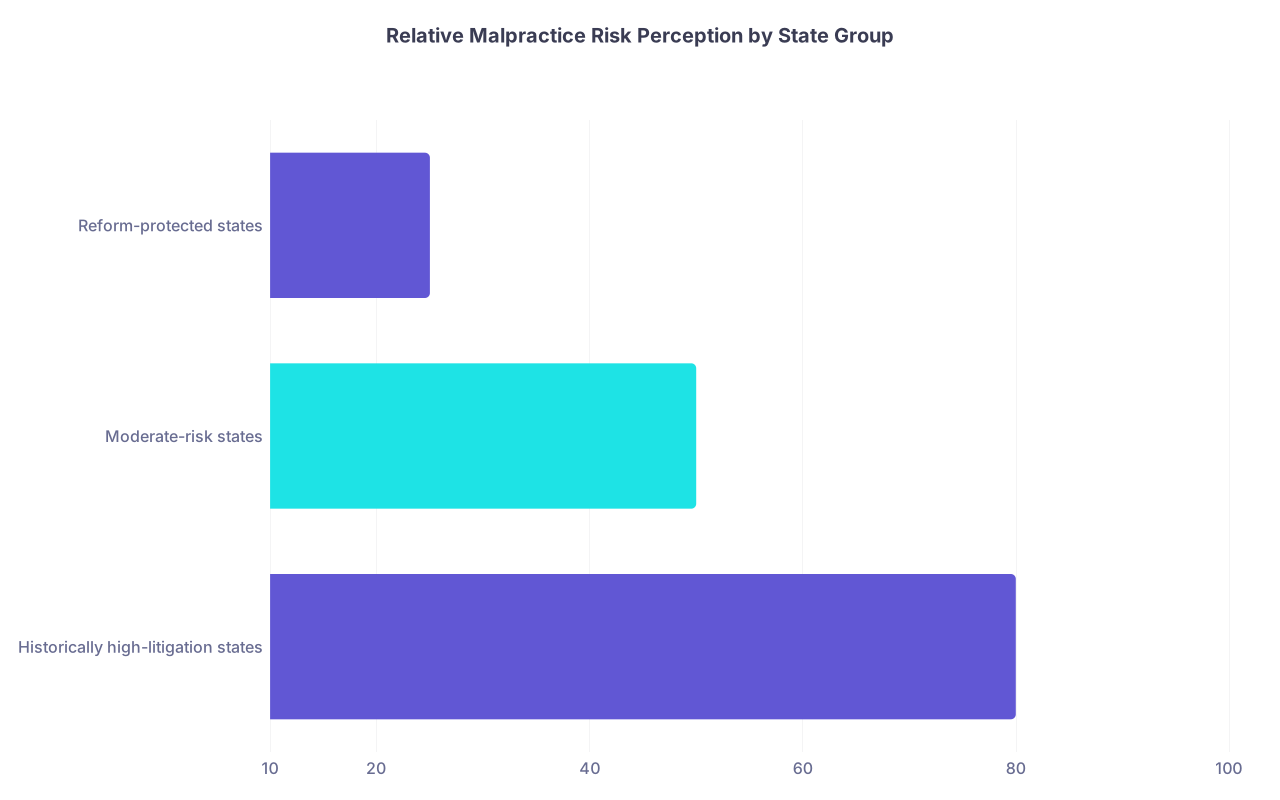
| Category | Value |
|---|---|
| Historically high-litigation states | 80 |
| Moderate-risk states | 50 |
| Reform-protected states | 25 |
I’ve seen docs do back-to-back assignments in:
- States with aggressive malpractice attorneys and billboards on every highway
- Places where the medical board is known for harsh discipline
- Hospitals that love to use locums as a shield and scapegoat when things go sideways
The problem isn’t just getting sued. It’s being far away when things arise, dealing with records from a hospital you hated, and trying to respond to a board inquiry from another time zone while you’ve already moved on.
How to avoid legal-location traps
- Ask the agency:
- “Who is covering my malpractice? Tail included?”
- “Has this site had locums involved in recent claims?”
- Know the state board’s reputation:
- Quick search: “[State] medical board discipline statistics”
If the pattern looks aggressive and punitive, you should care.
- Quick search: “[State] medical board discipline statistics”
- Avoid:
- Places with chronically bad press, frequent news about patient harm, or big public scandals. That culture doesn’t magically skip the locums.
If you’re early in your locums career, maybe don’t start in the most litigious states or notorious hospital systems. Build experience somewhere more stable first.
7. Lifestyle Mismatch: “I Can Do Anything for Two Weeks” (You Actually Can’t)
Another common lie physicians tell themselves:
“It’s just a short assignment, I can tolerate anything.”
No, you probably can’t. Not repeatedly. Not without it catching up.
Location mismatch shows up in small ways that accumulate:
- You’re a city person dropped into deep rural with nothing to do.
- You’re used to hiking and outdoors, but your assignment is in a strip-mall suburb with soul-crushing traffic and no nature.
- You’re introverted and end up stuck in a social, gossipy department that never lets you breathe.
- You’re bringing a partner/kids, but the location has nothing for them. Your stress doubles.

You can grind through a lot for a paycheck. But you pay somewhere else—sleep, mood, relationships, health.
Be honest about your own non‑negotiables
Write these down. Literally.
- Population range you can tolerate (5k vs 50k vs 500k+)
- Climate you absolutely do not want (blizzards, heat, humidity)
- Access needs (gym, certain faith community, specific schools if bringing family)
- Must-haves:
- Reliable internet
- Walkable area or safe running routes
- Decent grocery options
Then only let recruiters pitch you jobs that fit those basics. Saying “I’m flexible” guarantees they’ll send you the hardest-to-fill slots in locations no one else wants.
8. Time Zone, Travel, and the “Stuck There Longer Than You Planned” Problem
You think in dates. You should think in travel reality.
Location traps aren’t just about the town. They’re about how hard it is to leave the town.
You learn this the hard way when:
- Your flight out is canceled and the next option is 24–48 hours later.
- You need to get back for a wedding, but the only route involves 2 layovers and a 6-hour drive.
- You finish a night shift, then face a miserable all-day travel gauntlet across multiple time zones.

| Step | Description |
|---|---|
| Step 1 | Remote hospital |
| Step 2 | Regional airport |
| Step 3 | Limited flight options |
| Step 4 | Weather or maintenance delays |
| Step 5 | Missed connections |
| Step 6 | Extended stay in assignment town |
How to protect yourself from travel hell
For every potential assignment, do this before signing:
- Plug exact dates and times into Google Flights:
- From your home to the assignment.
- From the assignment back home.
- Check:
- Number of connections
- Airlines (are they cancel-prone budget fleets?)
- Weather patterns for that season
If “getting there” or “getting back” consistently looks like 10–15 hours of travel for a 7-day block, ask if the pay actually compensates for that lost time and exhaustion.
If you have anchor responsibilities (kids, elderly parents, clinic days), choose locations that are easy to exit, not just easy to enter on day one.


