

It’s a Tuesday night. You’re in the residents’ lounge, scrolling through job postings between admissions. Every hospital HR page looks the same: “collegial environment,” “competitive compensation,” “robust support staff.” But then you keep hearing this weird pattern from people a few years ahead of you:
“Honestly, everyone’s trying to get to Nashville right now.” “Dude, half my class is moving to Austin.” “Our cardiologists keep leaving for Charlotte.” “If I could redo it, I’d go to Madison / Raleigh / Denver.”
You go look at salary reports, Doximity “Best Cities for Doctors” lists, MGMA compensation data. Those cities don’t look that special. Sometimes they’re not even top 10. But people you trust keep clustering there. Almost like the data is late to the party.
Let me tell you what’s actually happening.
The formal data always lags reality by 3–7 years. Program directors, large groups, and health system execs spot talent flows long before anything shows up in Medscape surveys or Doximity rankings. By the time a city shows up as a “top market” in a glossy PDF, the real insiders are already on to the next place.
You’re either early to these physician-magnet cities or you’re fighting for scraps once everyone has “discovered” them.
The Hidden Life Cycle Of A Physician-Magnet City
Cities don’t suddenly become hot markets because some analyst in an office published a report. On the ground, it looks like a slow, messy human process.
Here’s how it actually plays out.
Phase 1: Under-the-Radar Build (Nobody’s Ranking It Yet)
On paper, the city looks average. Mid-tier cost of living, mid-tier salaries, no huge academic brand. Recruiters are still selling “lifestyle” and “your money goes further here” to people in coastal training programs.
Behind the scenes, a few key things are brewing:
A quiet anchor institution is ascending.
Not always a famous name. Think: a regional health system or a non-elite academic center that suddenly got serious about being a referral hub.
They start poaching solid subspecialists, building out service lines, and investing in infrastructure—cath labs, cancer centers, surgical robots, transplant programs.Leadership actually likes doctors.
I know, radical. A CEO or CMO who still sees physicians as the core product, not just “expensive labor.”
They cut some of the dumbest admin nonsense, build physician advisory councils, actually listen to feedback about call schedules and staffing, and move quickly on “this is unsafe” complaints.A couple of high-impact hires change the tone.
One famous surgeon. One well-liked program director. One big-name cardiologist who brings their research infrastructure. You rarely see this in public news, but internally everybody knows: “Oh, we landed that person? Things are changing.”
You won’t see any of this in salary tables. But attendings who rotate there as locums, fellows who moonlight there, and residents on away rotations notice. Word starts to spread: “Hey, [X city] is actually pretty decent. They’re growing. People seem happy.”
That’s the spark. Not the final phase. Just the spark.
Phase 2: Network Buzz (The Group Text Knows Before MGMA Does)
Next, you get the whisper phase.
A graduating fellow says in conference:
“I’m looking at jobs in Columbus and Raleigh.”
Someone else pipes up: “I heard a lot of people are going to Columbus now.”
Nobody can point to a chart. They just have stories.
What’s really happening is this:
- Residents follow older co-residents.
- Fellows follow their mentors.
- Program directors quietly steer people: “If you’re looking for a reasonable schedule and decent pay, you should talk to my friend in Charlotte. They treat people well there.”
That “you should talk to my friend” sentence is the hidden engine of physician migration.
Here’s the part no survey ever captures in real time: the informal backchannel reviews.
Attendings do not trust glossy recruitment packets. They trust:
- Texts from people they trained with
- What someone says after a second drink at a conference reception
- The tone in a mentor’s voice when you ask, “Be honest, would you work there?”
At faculty dinners I’ve heard things like:
“Data says Phoenix looks great, but burnout there is through the roof right now.”
or
“Pittsburgh is underrated. People who go there don’t leave. That tells you something.”
That off-the-record commentary is usually 3–5 years ahead of Doximity’s rankings.
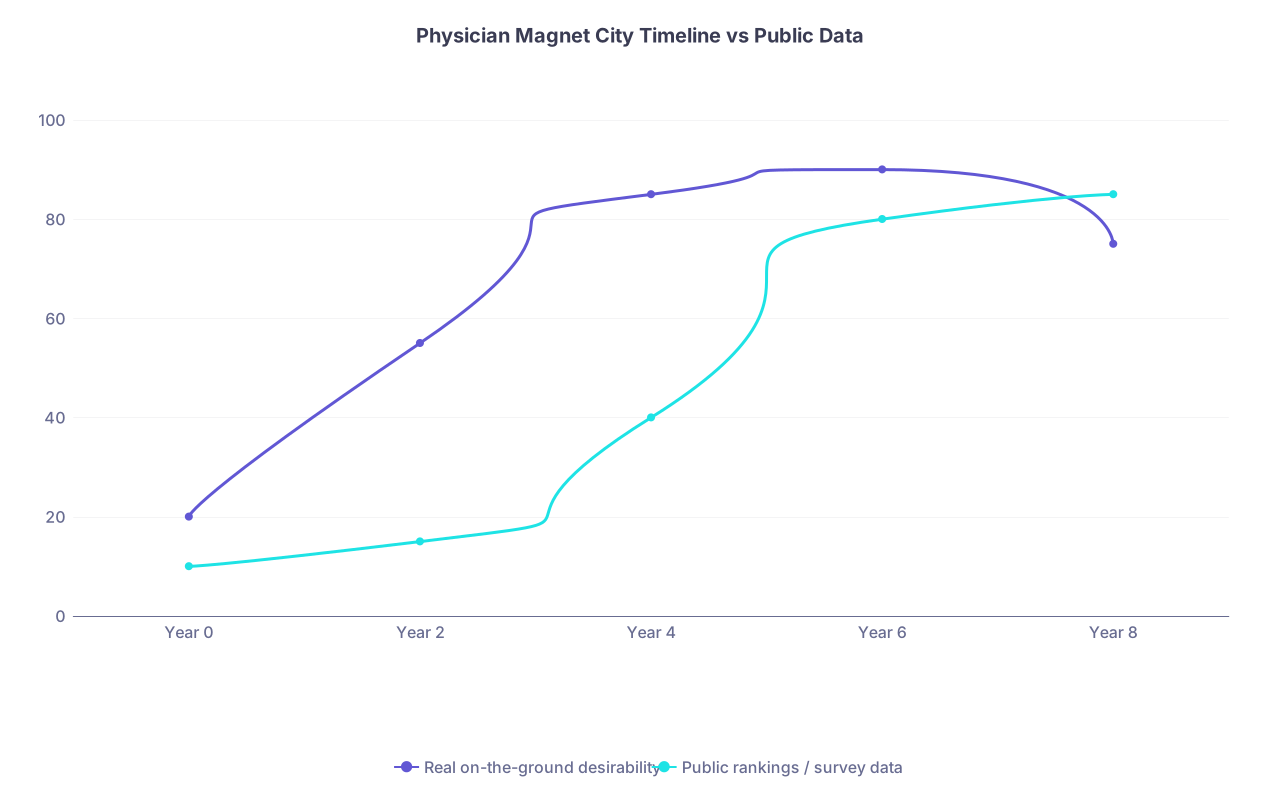
| Category | Real on-the-ground desirability | Public rankings / survey data |
|---|---|---|
| Year 0 | 20 | 10 |
| Year 2 | 55 | 15 |
| Year 4 | 85 | 40 |
| Year 6 | 90 | 80 |
| Year 8 | 75 | 85 |
Notice that gap in the middle? That’s where your decision either looks brilliant or late.
The Real Reasons Cities Become Magnets (Not The Ones In Brochures)
Let’s go under the hood. You’ve seen the usual talking points: “cost of living,” “salary,” “schools,” “airport access.” Those matter, but they’re table stakes.
When you listen to off-record conversations among attendings deciding where to go, different themes come up.
1. Leadership Culture That Actually Protects Clinicians
Smart doctors can smell administrative rot within two shifts. It’s in how nursing is staffed. It’s how fast they fix broken systems. It’s whether schedule changes are done to physicians or with them.
Some cities become magnets because one or two health systems decide to stop being adversarial. You’ll hear things like:
- “I called the CMO about the unsafe overnight cross-coverage, and it changed within a month.”
- “When our group pushed back on RVU creep, they actually negotiated—not threatened.”
- “They staffed up APPs instead of just dumping everything on residents.”
I watched one Midwest city go from “hard no” to “hidden gem” in under five years. The only visible external changes were a cancer center expansion and some recruitment. But behind the scenes, they replaced a catastrophically bad CMO with someone who actually practiced medicine recently. That single leadership change pulled in three strong subspecialty groups and then their friends.
You want a test question to ask during interviews? Try this:
“Tell me about a time physician feedback led to a concrete system change in the last year.”
If they can’t give you a specific story, that city’s “magnet” phase is not here yet.
2. Critical Mass Of Young-ish Physicians
This one never makes it into data sets, but it is huge. The more 30–45-year-old physicians in a city with decent schedules, the more that city snowballs as a destination. Because these are the people you:
- Join for dinner after a rough shift
- Text to swap call days
- Ask, “How’s the ortho group to work with?” and get an honest, recent answer
Residents do not want to be the only young attending in a department of 60-year-olds coasting to retirement. They want peers. They want people who still remember Medscape being in print.
I’ve seen the Lehman Brothers version of this too: one “destination” city where an entire call group was >55, grinding younger hires into oblivion with unbalanced call. On paper the money looked good and city amenities were fine. Over five years, they had near-total turnover of every new hire under 40. Residents talk. Word spreads. Suddenly, fewer people rank that city high, even if the generic “livability index” still looks great.
3. Couples And Clusters
Another quiet engine: two-doctor households and professional clusters.
Cities that can comfortably employ:
- A cardiologist and a rheumatologist
- A pediatrician and a software engineer spouse
- An academic surgeon and a biotech / med device spouse
…tend to get multiple physicians for every one job filled. Because once you bring in one half of a dual-career couple, you often lock in two highly educated professionals, both with networks.
Austin is a classic example. It didn’t become a “doctor magnet” because of medicine. Tech and culture drew in the first wave. Docs followed spouses and then told their friends: “The hospital is fine, lifestyle is great, and my partner loves their job.”
By the time the healthcare data “caught up,” those jobs were already competitive.

4. Reasonable But Not “Maximalist” Compensation
This part is counterintuitive: the cities with the absolutely highest compensation often are not the best long-term bets. Programs directors know this. They warn residents privately.
The pattern looks like this:
- Very high salary + brutal call + opaque admin + “we’ll fix it once we recruit more” = churn factory
- Solid salary + predictable schedule + rational expectations + stable leadership = retention magnet
Some of the earliest “magnet” cities on the physician grapevine actually pay a bit less than the most desperate markets. But they offer a sane workweek, decent benefits, and a non-toxic environment. Guess what? Those doctors don’t leave. That’s more powerful than a short-lived signing bonus.
When MGMA releases data, it will show a city with slightly-above-median pay and average cost of living. It won’t (and can’t) show that:
- Half the hospitalist group has been there 10+ years
- The cardiology group has had 1 departure in a decade
- The surgical teams share call fairly without constant drama
But the residency grapevine knows. Program directors track where their graduates are still happy five years out. That’s why if you corner a PD after grand rounds and ask, “Where are your graduates happiest?” you’ll often hear the same few “under-hyped” cities repeated.
5. Lifestyle That Actually Aligns With Physician Reality
Ignore the glossy “lifestyle city” rankings. They’re built for remote tech workers, not for people who:
- Work nights and weekends
- Need to get to the hospital in 20 minutes
- Have to live within real call radius
A city can have insane nightlife, trendy restaurants, and coastal charm and still be a nightmare for call logistics, childcare, or commuting. The places that quietly become physician magnets tend to have:
- Reasonable commutes from good neighborhoods to the main hospital
- Not-insane housing markets for a resident-to-attending transition
- Schools that are “good enough” without private-school-or-bust costs
- Enough culture and outdoors to keep families and non-medical partners sane
You’re not picking a vacation spot. You’re picking where you’ll drag yourself home post-call and still need life to work.
Residents compare: “Yeah, Denver is beautiful, but housing near the hospital is now absurd.” or “Madison is cold as hell but everything works, and people are weirdly happy.”
Guess which cities quietly fill positions early each year.
How Insider Circles Spot The Next Wave Cities
Here’s the real question you care about: how do you tell which cities are on their way to becoming physician magnets before the rest of your class wakes up?
There’s no single formula, but there are patterns. This is how attending-level insiders sniff it out.
Pay More Attention To Where Senior Residents Go Than To Surveys
At your institution, track:
- Where the top performing residents and fellows are signing
- Which cities keep showing up in farewell slides and going-away party speeches
- Where the faculty’s favorite former residents ended up and stayed
If in one graduating year, you see three strong people heading to, say, Raleigh or Tampa or Columbus, that’s not random. That means:
- There are enough good jobs there to absorb multiple hires
- Someone they trusted said, “This is a solid spot”
- Those groups are willing to pay and treat people well enough to attract quality, not just the desperate
Surveys can’t tell you that. Your own department gossip can.
Watch Where Your Attendings Are Moonlighting Or Doing Locums
Locums doctors see the underbelly. They know which places are imploding and which feel weirdly functional. When you see patterns like:
- Multiple attendings doing occasional weekends in the same mid-size city
- People who “go there for the money” but then say, “honestly it’s not bad at all”
You’re catching the ground-floor chatter.
Ask casually: “How’s it there?” If you get, “Admin is decent, nurses are strong, and they’re investing in growth,” that’s a subtle green flag.
If you hear, “The money is good for now but I wouldn’t work there full-time,” that’s a city you’ll see on the “Top Paying Markets” list later—right before the churn stories hit Reddit.
Red-Flag The “Hot” Cities That Everyone Else Already Discovered
By the time Doximity, Medscape, and random blog posts are all shouting about the same “Top 10 Cities for Doctors,” two things have usually happened:
- Oversupply has started. More docs applying. Groups get choosier, less generous.
- Admin realizes they no longer have to work as hard to keep you.
I’ve seen this arc in places like Seattle, Portland, and parts of coastal California over the last decade. They were incredible physician markets for a while. Then:
- Cost of living shot up
- Health systems consolidated
- Admin leverage increased
- Lifestyle stayed great, but job leverage dropped
They’re still good places to live, but they’re not the slam-dunk career plays they once were.

| Step | Description |
|---|---|
| Step 1 | Under the radar |
| Step 2 | Whisper buzz |
| Step 3 | Early mover advantage |
| Step 4 | Data finally shows it |
| Step 5 | Oversubscribed market |
| Step 6 | Next under the radar city |
You want to live in stage B or C. Not D and certainly not E.
The Cities You Hear About Before You See Them In Rankings
I’m not going to give you some definitive list. It will be wrong in two years. But I can tell you the types of places that historically move from “meh” to “magnet” while the official numbers are still yawning.
Look for cities that:
- Are home to 1–2 growing health systems actively building regional referral hubs
- Have non-healthcare economic drivers: tech, universities, manufacturing, military
- Consistently show up in “my co-residents went there and seem happy” anecdotes
Examples over the last 10–15 years that followed this arc (at different times and speeds):
- Nashville
- Raleigh-Durham
- Charlotte
- Madison
- Columbus
- Tampa / St. Pete
- Salt Lake City
- Des Moines (yes, really—for a certain slice of specialties)
Some of those are now already in the “data caught up” phase. The next wave will look similar: robust regional economies, not insanely expensive yet, big enough for two-career households, and at least one health system run by people who haven’t completely given up on physicians as professionals.
| Signal Type | Early-Green-Flag Example |
|---|---|
| Graduate patterns | 3+ residents in 2 years sign to same metro |
| Leadership behavior | Fast response to safety / staffing complaints |
| Market structure | Growing regional referral center, not oversaturated |
| Lifestyle reality | 20–25 min commutes from safe, affordable areas |
| Retention signal | Groups with many 5–10 year attendings, low churn |
Those are the levers PDs, chairs, and senior faculty watch. Not whatever Doximity sends out in a pretty infographic.
How To Play This Wisely As A Trainee Or Early Attending
Here’s how you use all this without trying to “game the matrix.”
Talk to three groups of people:
Your program director / fellowship director
Ask directly: “Where have our graduates been happiest in the last 5–10 years?”
They’ll name cities that do not line up perfectly with salary tables. Pay attention.Graduates 3–7 years out
That cohort is perfect. Far enough out to know if a job is sustainable, not so far that they’re locked into golden handcuffs. Ask: “What cities came up a lot when you were looking that people didn’t talk much about publicly?”Locums docs and traveling subspecialists
These people see dozens of systems. Over coffee, ask: “If you were forced to settle in one of the places you’ve worked, where would you pick?” The answers are rarely the headline cities.
Watch for recurring mentions. Not the one-off “I liked Boise.” The patterns. “We’ve had a bunch of people happy in Columbus.” “Our hospitalist grads keep heading to Charlotte.” “A surprising number of cardiology folks are ending up in Tampa and staying put.”
That’s your map.
Boiling It Down
Three things you should walk away with:
- By the time a city looks great in public data, you’ve already missed the easy phase. The real action is in the whisper networks years earlier.
- Physician magnets are built on leadership culture, peer clusters, and retention—not just raw salary. Follow where good people go and stay.
- Use your local insider network, not national rankings, to spot the next wave cities. Track where your program’s best graduates end up happy, and treat that as your early signal.
You can’t control the macro trends. But you can absolutely choose whether you’re the last one into a crowded market—or one of the first into a quietly rising one.


