

What if that $550,000 “dream job” in Texas, Florida, or Nevada quietly locks you into a toxic schedule, traps you with a brutal non‑compete, and costs you more in the long run than your current, lower‑paying position?
Most doctors do not lose money because they chose the “wrong” high‑pay state. They lose money — and sanity — because they signed the wrong contract there.
You think you’re being smart: no state income tax, high RVU rates, aggressive recruitment bonuses. Perfect. But the contract is where people get crushed. I’ve watched physicians move to “better” states and end up:
- Working 1.5 FTE for 1.0 FTE pay
- Owing back six‑figure bonuses after a bad fit
- Stuck with 50‑mile non‑competes in metro areas
- Paying for tail coverage that wipes out a year of savings
The state isn’t the risk. The paper is.
Let’s walk through the contract landmines that especially matter when you move to a so‑called “best place to work as a doctor.”
1. Chasing Headline Salary and Ignoring the Fine Print
The classic mistake: you see $450k in Florida or $600k in Texas and stop thinking critically. You’re comparing that number to your current $320k in a high‑tax state and your brain screams, “Done.”
That’s how people get trapped.
Here’s what they fail to check.
RVU traps and “phantom” productivity
In high‑pay states, a lot of that income is “productivity based.” That sounds fair. It often isn’t.
Common landmines:
- High RVU thresholds that assume
- Maximal throughput,
- No-show rates that don’t reflect reality,
- And zero admin drag.
- Credit only for personally performed services, while APP work “supports” you but doesn’t count toward your RVUs.
- Collections‑based compensation in markets with mediocre payer mix.
| State/Job Type | Base Salary | RVU Threshold | Rate per RVU |
|---|---|---|---|
| Current job (midwest) | $320,000 | 4,500 | $45 |
| Offer 1 (Texas) | $350,000 | 8,000 | $50 |
| Offer 2 (Florida) | $300,000 | 6,000 | $60 |
| Offer 3 (Nevada, 1099) | $0 | 0 (pure RVU) | $75 |
If your current volume is 5,000 RVUs, moving to Texas Offer 1 with an 8,000 RVU threshold means:
- You’ll likely never see that “$50 per RVU above threshold” kicker.
- Your “high‑pay” job is actually a disguised pay cut unless your volume explodes.
Mistake to avoid: Believing marketing phrases like “top quartile earning potential” without seeing real numbers: historical average RVUs for that position, collection data, and how many current physicians actually hit the threshold.
What to do instead:
- Ask directly: “What were the RVUs billed and wRVUs credited for the last three physicians in this exact role, year by year?”
- Require the formula in writing, with examples. Not verbal promises.
- If they dodge specifics? Huge red flag. Walk.
2. Non‑Competes That Make You a Prisoner in a “Great” State
Moving to a high‑pay state often means you’re moving for the state as much as the job. Family, schools, weather, taxes. That’s why non‑competes become especially dangerous.
You’re not just changing jobs. You’re potentially having to change ZIP codes — or states — again if things go bad.
The ugly non‑compete patterns in hot states
I keep seeing the same nonsense in contracts from “destination” states like Texas, Florida, Arizona, Nevada:
- 25–50 mile radii that cover the entire metro area
- 1–2 year duration
- Restrictions written as “any practice of medicine” rather than your specialty
- Non‑solicit clauses so broad you basically can’t talk to anyone you once worked with

| Category | Value |
|---|---|
| Northeast Metro | 10 |
| California Metro | 0 |
| Texas Metro | 35 |
| Florida Metro | 30 |
| Rural Midwest | 50 |
(Remember: CA effectively bans most physician non‑competes. Texas and Florida do not.)
Why this is worse when you’re relocating
If you’ve uprooted your entire life to a no‑income‑tax state, a harsh non‑compete means:
- If the job is toxic, you can’t just switch groups across town.
- You may have to leave the metro — or the state — to keep practicing.
- Now your kids, partner, and home are collateral damage.
Mistakes to avoid:
- Assuming “everyone just ignores non‑competes.” That bravado comes from people who haven’t been sued yet. I’ve watched groups go after departing docs just to make a point.
- Accepting language like “any facility owned, operated, managed or affiliated with Employer within 50 miles.” That’s not a non‑compete. That’s a career cage.
What to push for:
- 5–10 mile radius from your primary practice site only
- 12 months or less
- Specialty‑limited (e.g., “invasive cardiology,” not “any practice of medicine”)
- Explicit carve‑outs for telemedicine, academic work, VA, and pure administrative roles
If they say, “Our non‑compete isn’t enforceable anyway,” your response should be, “Then you won’t mind narrowing it in writing.”
3. The Relocation and Bonus Clawback Timebomb
The $30,000 relocation package and $75,000 sign‑on bonus look generous. Until you realize they’re booby‑trapped.
In high‑pay states with physician shortages, systems dangle massive “incentives” — then weaponize clawbacks.
How clawbacks really get you
Common structures:
- Relocation: “Repay 100% if you leave before 2 years; 50% before 3 years”
- Sign‑on: “Forgiven over 3–5 years, but immediately due in full if you leave without cause or are terminated for cause”
- Student loan assistance: Not forgiven until the end of a long service period (5+ years) — leave at year 4 and you still owe.
Now mix in:
- Vague “for cause” language the employer can twist
- A toxic work environment that makes staying 3–5 years miserable
I’ve literally seen physicians stuck in jobs they hated because they couldn’t stomach writing a $120k check to get out.
Mistakes to avoid:
- Focusing on the gross number instead of the terms
- Not asking: “What happens if the group changes ownership?” or “What if my hours are cut drastically?”
- Assuming you’ll definitely stay the full forgiveness period. New city, new colleagues, new admin. You do not know yet.
What to negotiate up front:
- Shorter forgiveness periods (1–2 years, not 3–5)
- Pro‑rated payback (e.g., 1/24 forgiven monthly) instead of cliffs
- No clawback if they terminate you without cause or materially change your duties/location
- Cap total repayment at net amount you actually received after taxes (or less)
And do not move your entire life based on money you haven’t really “earned” yet. Those dollars are on a leash.
4. Malpractice Coverage and Tail: The Silent Wallet Killer
People moving to higher‑pay states get distracted by salary and forget that malpractice structure is often where financial disaster hides.
You must know: claims‑made vs occurrence and who pays tail.
The tail coverage trap
In a lot of hospital-employed or large group jobs in high‑pay states, you’ll see language like:
“Employer provides claims‑made malpractice coverage at no cost to Physician. Upon termination, Physician is responsible for obtaining tail coverage.”
Translation: when you leave, you may owe $30k–$120k for tail.
If you:
- Stay 2 years,
- Hate the job,
- Can’t tolerate the non‑compete,
you now face a choice:
- Pay a huge tail bill to leave, or
- Stay and suffer until a vesting date or new policy year.
Pattern I’ve seen repeatedly: Moving physicians assume malpractice is “standard” and don’t even ask the cost of tail until they’re planning their escape.
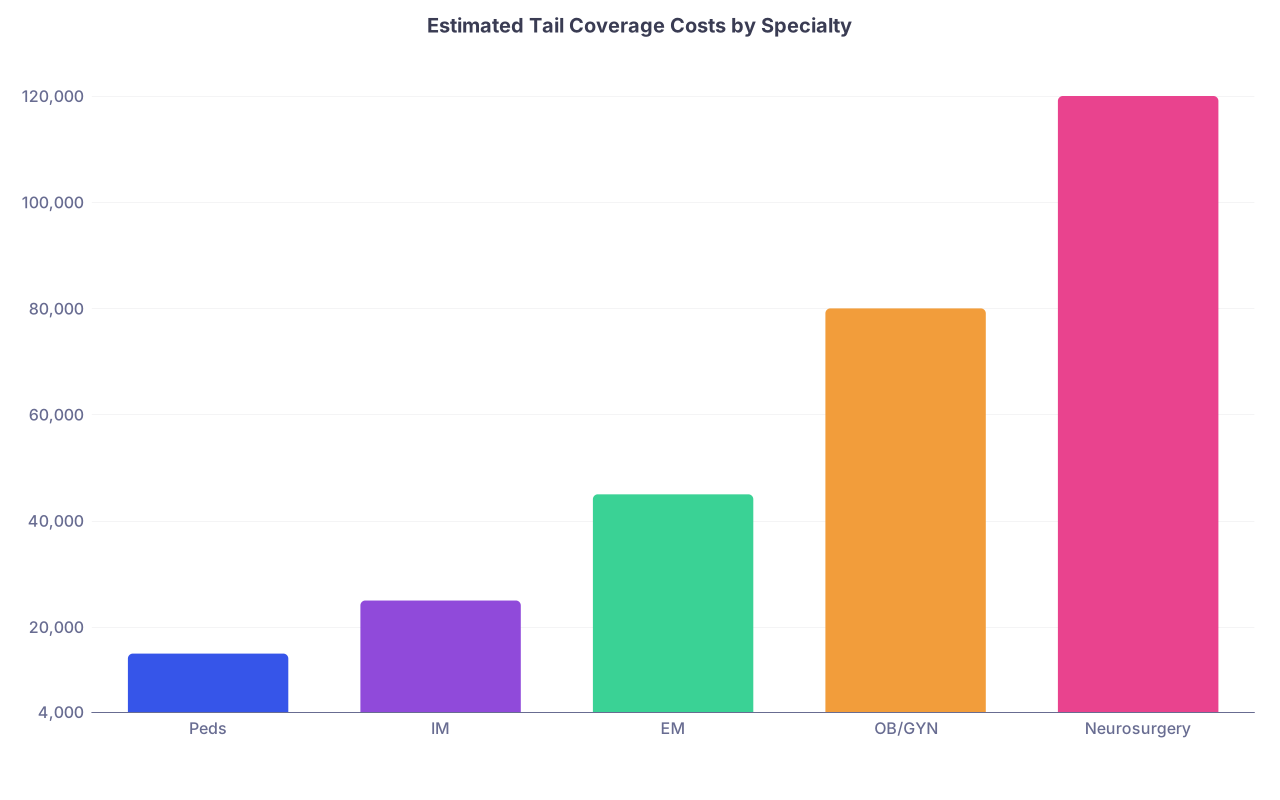
| Category | Value |
|---|---|
| Peds | 15000 |
| IM | 25000 |
| EM | 45000 |
| OB/GYN | 80000 |
| Neurosurgery | 120000 |
Mistakes to avoid:
- Ignoring this line because “everyone has malpractice”
- Not understanding that your years in practice, claims history, and specialty can explode that tail cost
- Moving to a new state, buying a house, and then realizing you’d need to drain savings to leave the job
What to do instead:
- Aim for occurrence coverage or employer‑paid tail on any move where you’re relocating states
- If they insist on claims‑made with physician‑paid tail, negotiate:
- Employer pays tail if they terminate without cause
- Employer pays tail after X years of service
- Shared tail cost formula (not all or nothing)
If an employer in a supposedly “great” state won’t budge at all on tail for a relocating physician, that’s a data point about how they value you.
5. “Flexible” Schedules That Aren’t Actually Flexible
High‑pay states love to sell lifestyle: “Sunshine, low taxes, and a 4‑day workweek.” Then you read the contract and find out what they really mean.
What the contract usually hides
Look for language like:
- “Additional call as reasonably required by Employer”
- “Physician shall provide services at such locations as Employer may designate”
- “Standard workweek is 40 hours of patient‑facing time, plus administrative duties as necessary”
Translation in practice:
- Your “4‑day week” becomes 4.5 or 5 days once you stack charting and mandatory meetings.
- You can be bounced between clinics or hospitals across a large metro with no say.
- Your “1:6 call” quietly shifts to 1:4 when an FTE leaves — and the contract doesn’t lock ratios.
I’ve watched this play out: A doc moves to Arizona for “no call hospitalist work, 7‑on/7‑off,” and six months in, administration starts assigning clinic shifts on “off” weeks because the contract said “as reasonably required.”
Mistakes to avoid:
- Relying on recruiter promises about schedule instead of written specifics
- Accepting vague language around hours, call, and site assignment
- Not asking: “What is the written policy for changing call burden or clinic locations?”
What to lock down in writing:
- Specific FTE definition (e.g., 36 scheduled patient‑facing hours per week)
- Explicit call frequency and compensation, plus how it can be changed
- Primary work site listed, with clear limits on additional sites (miles, number, and frequency)
- Maximum weekends/holidays per year
If the job sells lifestyle but the contract reads like a blank check for your time, believe the contract.
6. Cost of Living and Hidden Expenses You Didn’t Price In
High salary in a low‑tax state does not automatically mean more money in your pocket. This is where physicians routinely fool themselves.
You’re smart enough to compare state income tax rates. That’s kindergarten math. The real problems are:
- Housing bubbles in “desirable” metros
- Childcare, private school, and property tax surprises
- Commuting and call‑related costs in sprawling cities
- Health insurance structure if you move to 1099 work for that big rate bump
You know what I rarely see doctors do? Lay out a side‑by‑side after‑tax, after‑major‑expense comparison before signing.
7. Partnership Promises That Never Materialize
Private groups in high‑pay states love the word “partnership.” It’s the candy coating on a bitter pill.
Typical pattern:
- Year 1–2: “Associate” with lower pay, heavy work
- Year 3: “Eligibility for partnership, subject to approval”
- Buy‑in: high six figures, based on “valuation” you’re not allowed to see
Then year 3 comes and…
- “We’re revising the partnership track.”
- “We need another year to evaluate fit.”
- Or they simply never bring it up, and you’re too busy or intimidated to push.
Mistakes to avoid:
- Accepting verbal timelines for partnership without specifics
- Not demanding: criteria, buy‑in formula, and voting rights outlined in writing
- Moving states primarily because of a partnership promise that isn’t contractual
What a real partnership track should include in the employment contract or separate written agreement:
- Clear timeline (e.g., eligible after 24 months of full‑time employment)
- Objective criteria (RVUs, professionalism, citizenship requirements)
- Ballot process and required vote threshold
- Buy‑in range and how it’s calculated, plus what you’re buying (building, ASC, AR, goodwill)
If they say “trust us” but won’t document anything, what they’re really saying is “we’d like optionality; you don’t get any.”
8. Visas, Licensing, and “We’ll Take Care of It” Lies
For IMGs or anyone with visa issues, moving to a high‑pay state can be amazing — or a disaster. The difference is usually in the contract’s immigration and licensing language.
Landmines:
- No clear responsibility for visa costs, renewals, or legal fees
- Vague promises about green card sponsorship with no timelines
- No backup plan if credentialing or state licensing is delayed
In some hot‑recruitment states, I’ve seen groups say, “We sponsor,” but push all legal risk and cost to the physician and retain full control over timing. If your contract doesn’t spell this out, you’re one admin decision away from being stuck.
Even for non‑visa docs, there’s licensing:
- Some states are slow and painful (looking at you, certain southern boards).
- If the contract doesn’t address start‑date protections or relocation timing, you could be sitting unpaid for months while they “work on it.”
9. The “At-Will” + “For-Cause” Double Trap
Almost every contract has “without cause” termination with 60–180 days’ notice. That’s normal. But the combination of at‑will terms, broad for‑cause clauses, and relocation/bonus/tail obligations is where people get screwed.
Watch for:
- “For cause” including vague things like “failure to comply with employer policies” or “conduct deemed detrimental to the reputation of the employer”
- Relocation and bonus clawbacks triggered by any termination other than employee disability/death
- No separation protection if your program shuts down, merges, or loses a key contract (e.g., hospitalist group losing the hospital contract)
Picture this scenario:
- You move to a high‑pay state, take a big relocation and sign‑on
- New CMO comes in, wants to cut costs by cycling out higher-paid senior docs
- They build a flimsy “for cause” case from chart audits and “behavior concerns”
- You’re out — but still owing clawbacks and tail
I’ve seen versions of this story. It’s ugly.
What you should insist on:
- Narrow, specific “for cause” definitions (fraud, loss of license, felony, etc.)
- No bonus/relocation/tail repayment if they terminate you without cause
- Protection if the practice loses a major contract or closes (at minimum, no clawbacks)
If they refuse all of that, internalize the message: you’re disposable to them.
10. How to Actually Review and Negotiate — Without Getting Steamrolled
One last mistake: treating contract review as an annoying formality and rushing it because “recruiting season is almost over” or “they need an answer by Friday.”
The employer has lawyers and HR whose full-time job is protecting their interests. You have… what? A quick skim after call?
Stop doing this.
Bare minimum steps:
- Get the full contract in writing. No offer letters or recruiter emails as your main reference.
- Hire a physician‑side contract attorney or experienced consultant who knows that state. Not your cousin who does divorces.
- Mark up the contract with every concern — non‑compete, tail, clawbacks, schedule, partnership, for‑cause definitions.
- Prioritize your must‑haves vs nice‑to‑haves. Non‑compete, tail, clawbacks, and schedule terms are usually must‑haves.
- Make them explain anything vague. Then get the clarification in actual contract language, not “we’ll send you an email.”
If an employer in a “best state to work” pressures you to skip review or says “no one else has asked these questions,” that’s not a compliment. That’s a red flag.
Your Next Step (Do This Today)
Pull up the last offer letter or contract you received — or the one you’re expecting soon for that job in Texas, Florida, Arizona, or wherever you think life will be better.
Now, do one concrete thing:
Print the contract and highlight every clause that:
- Mentions “non‑compete,” “restrictive covenant,” or “non‑solicitation”
- References “tail coverage” or “claims‑made malpractice”
- Describes “relocation,” “sign‑on bonus,” or “loan repayment”
Count how many of those sections you truly understand — not “sort of,” but could explain to another physician in detail.
If your honest answer is less than 80%, stop. Don’t sign anything else until you’ve had a real physician‑side expert walk through those clauses with you.
High‑pay states can absolutely be the best places to work as a doctor.
But only if you refuse to step on the contract landmines everyone else pretends not to see.


