

It’s 10:45 p.m. You’ve just finished another soul‑sucking call shift, your pager is finally quiet, and instead of sleep, you’re scrolling through job ads from three different continents. Professor track in Germany. Clinician‑scientist role in Singapore. Teaching hospital post in Toronto.
They all sound good on paper. Every country’s brochure promises “world‑class research,” “protected time,” and “work–life balance.”
You and I both know that’s marketing.
Here’s what actually happens behind closed doors when serious academic physicians—people with R01‑level ambitions, or at least a real appetite for teaching and scholarship—decide which country to build their careers in. It’s not the list you see on Reddit. And it’s not what HR tells you on those “Come work with us!” webinars.
Let me walk you through how insiders really evaluate countries for academic medicine—and why some places look glittering from the outside but are dead ends once you’re inside the system.
The Quiet Shortlist: Where Serious Academic Doctors Actually Look
First, the unvarnished truth: globally, the number of countries that truly support high‑level academic medicine is smaller than you think.
Behind the scenes, when program directors or senior PIs talk candidly about where they’d be willing to move for a serious academic post, the “shortlist” usually looks something like this:
- United States
- United Kingdom
- Canada
- Germany (and a few other German‑speaking systems)
- Netherlands / Scandinavia (for certain fields)
- Australia
- Singapore (for particular research‑heavy paths)
Sure, people mention Switzerland, France, Israel, Hong Kong, sometimes the Gulf states—but those are often niche plays, dependent on language, politics, or hyper‑specific opportunities.
Here’s what people never say publicly but talk about quietly in department offices: you’re not picking a country; you’re picking a structure of academic medicine. Funding culture, promotion rules, hidden expectations, politics of visas, and how they treat foreign‑trained physicians.
So let’s break down how the insiders actually compare these systems.
The Real Filters: How Insiders Judge a Country for Academic Medicine
Most residents and junior attendings get this backwards. They start with “where is life nice?” instead of “where can an academic career actually survive?”
The insiders flip it. They look at five brutal filters before worrying about beaches, cafés, or hiking trails.
1. Funding Culture: Who Actually Pays for Your Ideas?
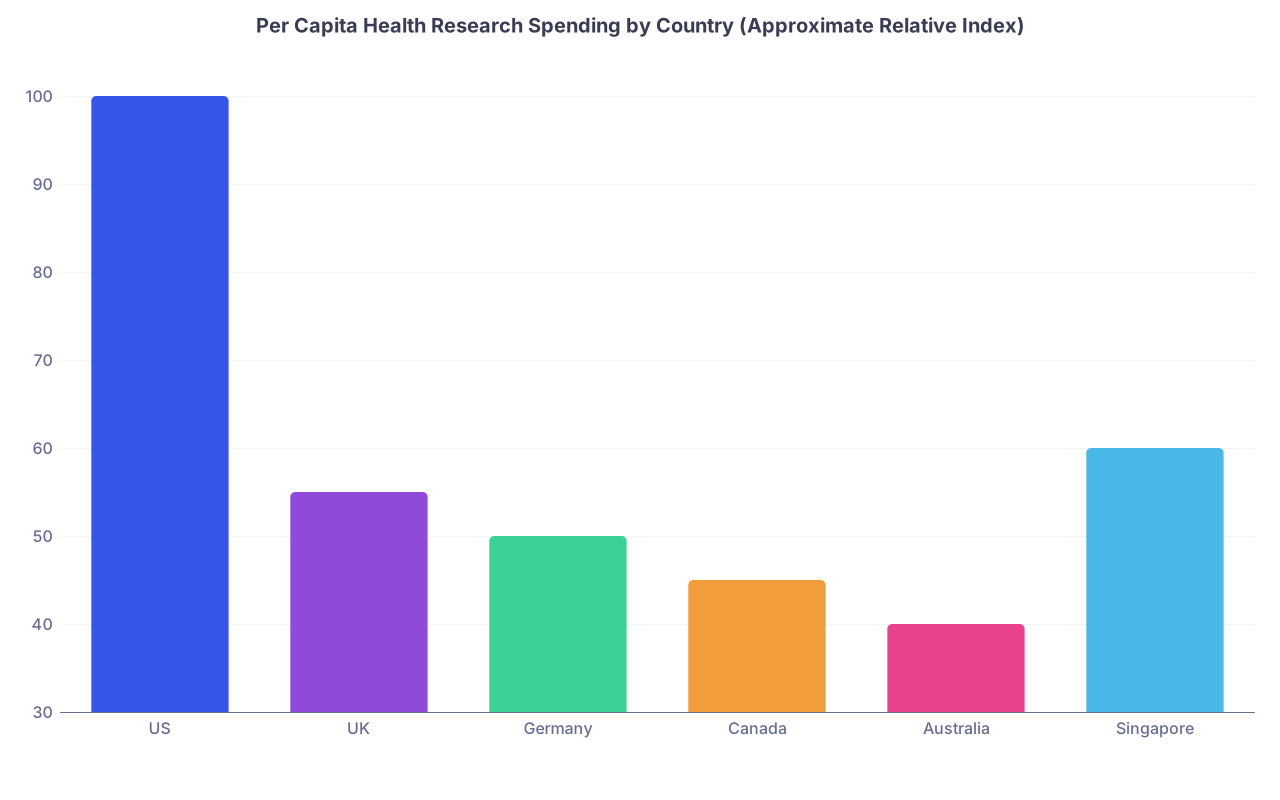
Forget slogans about “supportive research environments.” The quiet question everyone serious asks is: can I realistically get money here and keep it?
| Category | Value |
|---|---|
| US | 100 |
| UK | 55 |
| Germany | 50 |
| Canada | 45 |
| Australia | 40 |
| Singapore | 60 |
That chart isn’t exact dollars, but it reflects what faculty talk about in recruitment meetings. The U.S. is still the 800‑pound gorilla of biomedical funding. Everyone else plays a smaller game.
What insiders look at:
- Is there a strong national granting body with real money? (NIH in US, CIHR in Canada, MRC/NIHR in UK, DFG in Germany, NHMRC in Australia, NMRC in Singapore.)
- Are grants realistically obtainable for foreigners and IMGs, or is it a citizens‑first old boys’ network?
- Do hospital systems expect you to bring in your own salary via grants, or is research time partially hard‑funded?
Here’s what happens in real conversations.
In a U.S. department chairs’ meeting:
“Is this candidate fundable?” translates to: Can this person land an R01 or equivalent and pay for themselves?
In a Canadian department:
“Can we protect them 50%?” usually means: Is there enough internal money + CIHR potential to keep them afloat for 3–5 years while they get going?
Countries with weak or chaotic funding systems—many parts of Southern/Eastern Europe, a number of Asian and Latin American countries—may have brilliant scientists but terrible systems. Grants are politicized. Budgets arrive late. Lab infrastructure is patchy. If you’re building a serious academic career, insiders just quietly skip those.
2. Protected Time: Is It Real or a Lie?
On paper, nearly every job description says something like “40–50% protected time for research or teaching.”
What insiders do is ask the one question applicants are often too scared to ask bluntly: “How many people here actually have that much real protected time, and what happened to the last three people hired on this track?”
In the U.S., “protected time” is fragile. A division chief once told a new recruit in internal medicine: “Your 50% research time is guaranteed… unless clinical volume surges, someone quits, or the dean is mad. So, best‑case scenario: maybe 30%.”
In the UK, especially in proper academic contracts (Hon Consultant / University appointments), the 50:50 or 60:40 split is more real—but you will earn less clinically than your full‑time NHS counterparts. That’s the trade.
In Germany, the “Oberarzt with research” often means you do full‑tilt clinical work and somehow squeeze your research in. Unless you’re fully embedded in a true research institute or have a DFG‑funded group, your ‘protected’ time is usually evenings and weekends.
Singapore’s big academic centers (NUHS, SingHealth Duke‑NUS) can offer genuinely structured research time, but the bar for productivity is very explicit, and expats are under the microscope. You will be watched—output, grants, everything.
Insiders ask:
- Who covers your patients while you do research?
- What happens when a colleague leaves—do you inherit their clinics?
- Is your research time written in your contract, or is it just in the PowerPoint?
If the answers are vague, that country’s system is probably hostile to genuine academic practice.
3. Promotion Rules: Is There a Clear Path or a Black Box?
Here’s the dirty secret: in many countries, the title “Professor” is more politics than merit.

The U.S. is ruthlessly metric‑driven (publications, h‑index, grants, referrals), but the steps are at least written down. There are promotion guidelines. Criteria. You may not like them, but you can see them.
In contrast, I’ve heard junior faculty in Southern Europe say: “Unless you trained under Professor X or you’re politically aligned with Group Y, your odds of a chair are near zero, regardless of your CV.” That’s not paranoia; that’s how those systems actually run.
UK promotions can feel slower but clearer if you understand the system: clinical excellence + teaching + research output + “citizenship” roles. But many clinicians find they top out at Senior Lecturer / Reader unless they’re very strongly research‑heavy or plugged into national networks.
Germany is rigidly hierarchical. You move from Assistenzarzt → Facharzt → Oberarzt → maybe Professor, but the jump to Ordinarius (full chair) is rare and heavily network‑driven. If you’re not fluent in German and not trained in their system, your odds thin out.
Insiders quietly ask:
- How many foreign‑trained physicians have made full professor here in the last 10 years?
- How long did it take?
- Did they need citizenship? Language fluency? Certain fellowships?
If the answer is “almost none,” this is not a country you pick for a long academic arc, unless you’re unusually connected.
4. Visa and Citizenship: The Silent Career Breaker
There’s a painful conversation I’ve seen multiple times. A star IMG on a U.S. J‑1 who’s built a substantial research portfolio—but visa rules trap them. They either go home for two years, or scramble for a waiver job in some remote area that has zero research infrastructure. Career, meet wall.
Insiders think long‑term:
- In the U.S., if you’re not on a path to a green card, your entire academic future is sitting on a legal fault line. A single denied H‑1B or lost institutional sponsorship can erase five years of career momentum overnight.
- In Canada, permanent residency is more realistic for many, but positions are fewer, and provincial licensing adds another wrinkle.
- The UK’s Skilled Worker visa is more structured, but changing political winds keep people nervous about long‑term stability.
- Countries like Germany, Netherlands, and Scandinavia can offer more stable long‑term residency for those willing to master the language and integrate fully.
What senior people say off the record: “If a country cannot give you a stable, renewable, long‑term status, you don’t put your academic roots there. You do a fellowship, collect data, then move elsewhere for the permanent track.”
5. Clinical Load vs Academic Output: The Ratio That Actually Matters
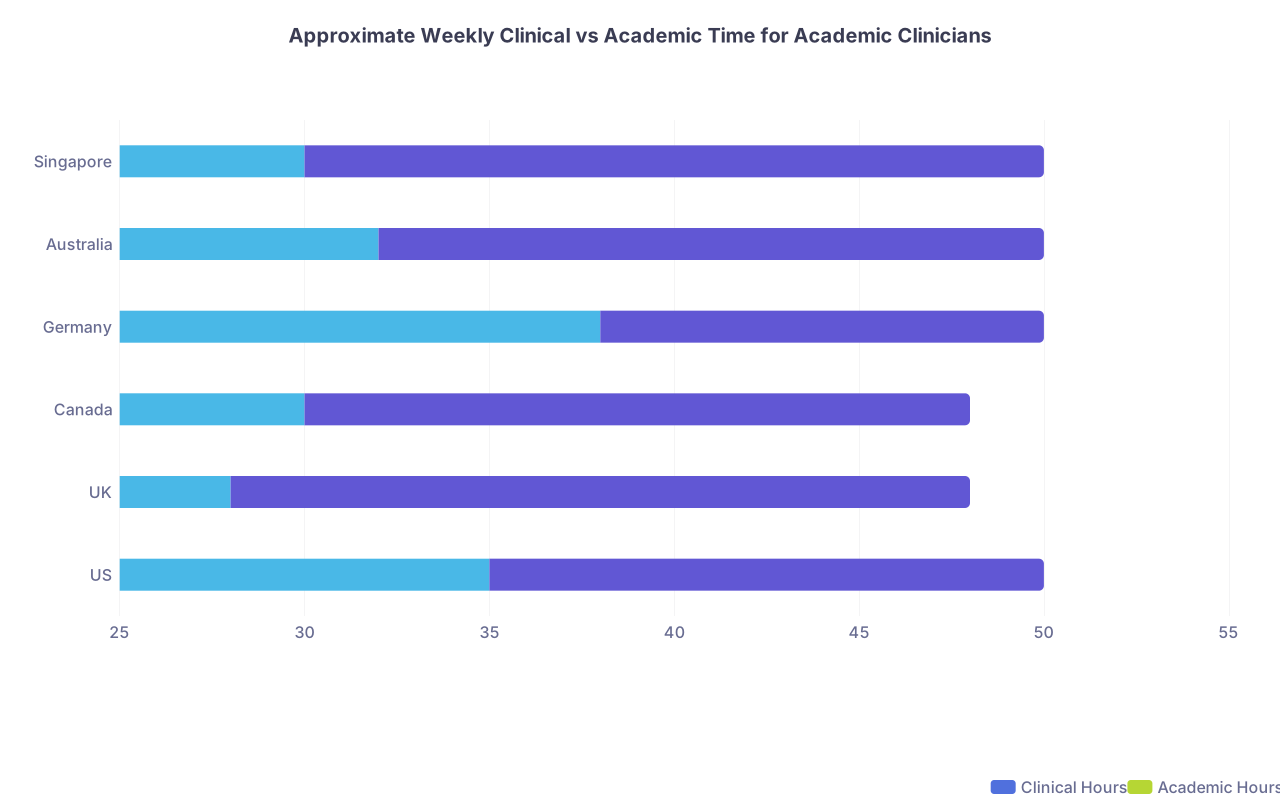
Academic medicine lives or dies by one ratio: clinical hours to academic output.
| Category | Clinical Hours | Academic Hours |
|---|---|---|
| US | 35 | 15 |
| UK | 28 | 20 |
| Canada | 30 | 18 |
| Germany | 38 | 12 |
| Australia | 32 | 18 |
| Singapore | 30 | 20 |
The numbers aren’t exact, but the pattern is. In Germany and many continental systems, clinicians are workhorses. Academic work is often an add‑on, unless you carefully carve a niche.
In the UK and Canada, well‑structured academic contracts can tilt that ratio in your favor—if you land the right post. Huge “if.”
In the U.S., extremes exist. At a community‑leaning “academic” center, your job is basically full‑time service with a grand rounds talk once a year. At a top‑tier research institution, you might be 80% research, 20% clinical—but you’re on a grant treadmill.
Insiders grill departments about:
- Actual clinic templates (how many patients per half day, how often)
- Call schedules (and who takes the brunt—junior faculty or senior?)
- Expectations for RVUs or billing relative value
- How teaching time is accounted for (or not)
If they hear “we all pitch in when needed” with no structure, they know what that means: research is done at night.
Country‑by‑Country: What Insiders Really Say in the Hallways
Let me cut through the myths and give you the hallway version you don’t get on recruitment calls.
United States: High Ceiling, High Burn
The U.S. is still the best country if your primary identity is “scientist who also practices medicine.” Top‑tier funding. Massive infrastructure. Endless subspecialization. But the cost is brutal pressure.
What insiders like:
- NIH and related funding ecosystems. If you’re good and relentless, you can actually build a lab that does big work.
- The density of academic centers. Boston, SF Bay, NYC, Houston, Philly—entire cities built around medicine and biotech.
- The possibility of carving extremely niche academic identities (e.g., “interventional cardiologist focused on structural heart device outcomes in geriatric diabetics”).
What they hate:
- The business model. You’re constantly balancing RVUs, billing, and “productivity” against academic goals.
- Visa fragility for IMGs.
- The creeping expectation that “protected time” is a luxury only for the hyper‑funded.
Insider rule: If you come to the U.S. for academic medicine, come with a plan: which grants, which mentors, which niche. Drifting here leads to burnout and mediocrity very fast.
United Kingdom: Structure, Stability, Slower Pace
The UK looks less glamorous than the U.S. on paper—smaller grants, lower salaries—but the academic–clinical integration can be cleaner.
You’ve got the NHS on one side and universities on the other, with formal academic consultant posts in the middle. NIHR, MRC, Wellcome—real funders, just not NIH‑scale.
What insiders like:
- Well‑defined academic tracks: academic clinical fellow, clinical lecturer, NIHR posts, then lecturer/senior lecturer/reader/professor. It’s bureaucratic, but traceable.
- True recognition of teaching and service in promotions. It’s not all about R01 equivalents.
- A bit more sanity in work–life balance compared to U.S. private‑heavy environments.
What they grumble about:
- Salaries. No, they’re not competitive with U.S. pay, especially given UK cost of living in London, Oxford, Cambridge.
- Funding being tighter and more political in some specialties.
- Slower decision‑making and heavy bureaucracy.
If you value a long, steady academic career where you’re not constantly hustling for private patients to pay your salary, the UK can be quietly excellent—especially if you plug into the right academic center early.
Canada: The Polite Middle Ground
Canada is what many burned‑out Americans fantasize about: decent research environment, public health system, polite culture, less manic commercialization. The fantasy isn’t entirely wrong—but insiders see the constraints.
What they appreciate:
- CIHR and provincial funding are competitive but not impossible.
- Reasonable chance at a balanced clinician‑scientist life in fields like internal medicine, pediatrics, psychiatry, family medicine, oncology.
- More humane attitudes toward parental leave, vacation, and sick time.
What they note quietly:
- Fewer academic slots overall. The system is smaller. Landing a real academic post in Toronto, Vancouver, or Montreal is not easy.
- Some institutions are very insular—heavy preference for “home‑grown” trainees.
- Immigration is more structured than the U.S., but licensing and provincial politics add friction.
The insiders’ move: use Canada as a long game. If you can align your training, licensing, and residency status early, you can build a very livable, solid academic life there. But you don’t “just move” to a Canadian academic center in your late 30s and walk into a professor track.
Germany and the German‑Speaking World: Titles, Hierarchies, and Hidden Strength
Germany, Austria, parts of Switzerland—they’re a different universe. People outside the system misunderstand it badly.
On one hand, they’re loaded with academic hospitals, strong basic science, a long tradition of medical scholarship. On the other, the career ladder is rigid, the hierarchy is intense, and the language barrier is not optional.
What insiders acknowledge:
- DFG funding and EU grants can be powerful.
- Certain fields—cardiology, oncology, neurology, surgery—have world‑class academic centers.
- Once you’re in the system, job security can be substantial.
What they warn about:
- You need German. For real, fluent German. Not “Duolingo level while on the ICU.”
- Promotion can be conservative and political. Foreigners rarely walk in at senior levels.
- The Oberarzt role often carries heavy clinical burdens; research is squeezed unless you’re very protected.
For someone already comfortable in German and aligned with the culture, this region can be strong academically. For most outsiders, it’s a niche rather than a primary target.
Netherlands / Scandinavia: High Quality, Low Volume

You hear this a lot in faculty circles: “The Dutch and the Scandinavians do very clean work.” That’s code for: small systems, good methodology, high standards.
The reality:
- Excellent for epidemiology, public health, health services research, and specific clinical research areas.
- Strong English use in academia, but clinical work still usually requires local language.
- Very limited number of academic posts. You’re competing with local trainees who started networking early.
People don’t move there randomly. They move for very specific labs, mentors, or niches. It’s a sniper shot, not a broad strategy.
Australia: Academic Light, Lifestyle Heavy (With Pockets of Serious Work)
Australia’s pitch is seductive: sun, beaches, solid public system, English‑speaking, decent academia. Insiders see the nuance.
What works:
- For teaching‑heavy and clinically oriented academic roles, it’s quite attractive.
- Certain universities (Melbourne, Sydney, Monash, Queensland) host serious research programs, especially in public health, infectious disease, critical care, oncology.
- The lifestyle baseline is higher than in many U.S. urban centers.
The constraints:
- Funding is thinner than in the U.S. and even UK in some respects. NHMRC is competitive, and philanthropy is limited compared to U.S. behemoths.
- The ecosystem is smaller; chairs and senior posts don’t open often.
- True protected clinician‑scientist posts exist, but they’re not widespread.
The insider move: Australia is a strong choice if you want balanced clinical‑academic work with good teaching and selective research, not if you’re chasing global‑top‑tier lab dominance.
Singapore: Small Place, Big Ambitions
Singapore is the classic “punches above its weight” example. NUHS, SingHealth Duke‑NUS, and NTU are actively recruiting global talent.
Insiders see:
- Aggressive investment in biomedical science, especially translational work and tech/bio interfaces.
- Real potential for protected research time, with explicit metrics.
- English as a working language in academia and medicine.
They also see:
- A small system where politics and alignment with institutional priorities matter a lot.
- Competitive pressure—if you underperform, you’re replaceable.
- A particular cultural environment—not for everyone.
For certain people—especially in basic/translational research or clinical fields aligned with national priorities—Singapore can be a power move. Not a casual choice.
The Hidden Criteria No One Tells You to Ask About
So you’ve heard the big picture. Let me give you the questions insiders quietly ask when they’re scouting a country and a specific institution.
| Dimension | Key Insider Question |
|---|---|
| Funding | How many new hires got major grants in 5 years? |
| Promotion | How many foreigners made full professor here? |
| Protected Time | Who covers your patients during 'research time'? |
| Visas | How many faculty lost positions due to visa issues? |
| Culture | What happens to people who say 'no' to extra clinics? |
You don’t ask these in exactly those words on your first Zoom call. But you find ways to probe:
- “Of the last few junior academic hires, how many are still on the academic track here?”
- “Can you walk me through what a typical week looks like for your most research‑active clinician in my field?”
- “Are there examples of IMGs who’ve reached leadership roles here?”
- “How is teaching evaluated and rewarded in promotions?”
- “What’s your process when clinical demands surge—whose time gets cut first?”
The answers will be far more revealing than any glossy recruitment slide deck.
So Where Should You Go? The Real Decision Tree
Let me give you the skeleton of how senior people actually think this through, when they’re being honest.

| Step | Description |
|---|---|
| Step 1 | Define your primary identity |
| Step 2 | US or UK top centers |
| Step 3 | Canada, Netherlands, Singapore, Australia |
| Step 4 | UK, Canada, Australia |
| Step 5 | Germany, Nordics, others |
| Step 6 | Plan 10+ year career |
| Step 7 | Use as fellowship or short term step |
| Step 8 | Research heavy or Teaching/Clinical heavy |
| Step 9 | Need top tier funding? |
| Step 10 | Need English system? |
| Step 11 | Visa stable? |
Bluntly:
- If you are truly research‑dominant and want maximal firepower, your first lens is still: U.S. or UK at the right centers, then maybe Singapore, Canada, Netherlands, parts of Germany.
- If you are education‑focused and clinically strong, Canada, UK, Australia, and some U.S. academic centers can give you a satisfying, stable academic life.
- If you’re an IMG without strong visa options, you either play the U.S. game very strategically, or you lean into countries with clearer immigration–professional pathways (Canada, UK, some EU countries—if you handle language).
And you never, ever pick based on lifestyle alone if you care about academic longevity. That’s how people end up bitter at 45, stuck in a job that’s 95% service with “Assistant Professor” stapled on the name badge as consolation.
What Comes Next in Your Journey
Right now, you’re probably somewhere between residency and early attending, staring at maps and job ads, trying not to make a career‑ending mistake.
You don’t need to decide everything tonight. The smarter move is to treat countries like stages, not soulmates.
You might do a research fellowship in the U.S. to build your CV, then pivot to a more stable academic consultant role in the UK or Canada. Or use a structured program in Singapore or the Netherlands as a launchpad for high‑impact work, then decide if you want to root there long‑term.
The point is this: insiders don’t ask, “Where is the nicest place to live as a doctor?” They ask, “Where can my academic identity actually survive and grow over the next 10–20 years, given who I am, what I want to study, and what passport I hold?”
Once you’ve answered that, the country question stops being overwhelming and starts being strategic.
You’ve seen how the game is really played. Next step is more focused: identifying specific institutions and mentors within those countries that match your ambitions—and learning how to approach them in a way that makes them see you as one of their own.
But that’s a different conversation. And we’ll get to that.


