

The fantasy of being a doctor abroad is wildly oversold.
You see glossy Instagram shots of doctors in London cafés and Australian beaches and think, “That could be me.” What you don’t see is the Excel spreadsheet of licensing exams, the 3 a.m. homesickness, or the quiet panic of realizing you just signed a contract in a country where you barely understand the healthcare system.
Let’s talk honestly about it. The good, the bad, and the “oh God, did I just ruin my career?”
The Big Fear: “What If I Move And It’s A Huge Mistake?”
This is the fear under everything, right? Not “Is the weather nice?” but “What if I blow up my entire life, move across the world, and end up trapped in a job I hate in a system I don’t understand?”
You’re not crazy for thinking like that. You’re realistic.
Here’s the uncomfortable truth: moving abroad as a doctor is high‑friction and high‑stakes. You’re not just changing jobs. You’re changing:
- Legal system
- Training structure
- Clinical culture
- Social network
- Language (sometimes)
- And yes, future career options
You can absolutely end up in a worse situation. I’ve seen people:
- Go to the UK, get stuck as a non‑training “trust grade” doctor for years and struggle to get into specialty training
- Move to the US, invest 2–3 years in USMLE and applications, and never match
- Head to Australia for “one year” and find it nearly impossible to get onto a training program they actually want
- Return home after 2–3 years abroad and realize their CV now looks confusing or “off track” to their home-country programs
So no, it’s not just in your head. There are real risks.
But here’s the other side: I’ve also seen people build fantastic lives and careers abroad. Better work‑life balance. Better pay. More autonomy. Less toxic culture.
The difference isn’t “bravery.” It’s strategy and brutally honest planning.
The Reality: No Country Is The Magical “Best Place To Work As A Doctor”
People love asking: “What’s the BEST country to work in as a doctor?”
That question makes me twitch.
Because what they really want is a simple answer that kills their anxiety: “Go to X country. It’s perfect. You’ll be happy there.” That country does not exist.
Let me be blunt: every system is broken. Just in different ways.
| Country/Region | Typical Trade-Off |
|---|---|
| UK | Structured but competitive training, heavy service load, Brexit visa mess |
| USA | High pay, high burnout, brutal USMLE + visa hurdles |
| Australia/NZ | Great lifestyle, but limited training spots and geographic constraints |
| Canada | Good pay, very tight residency spots for IMGs |
| Gulf States | Tax-free income, but variable working conditions and limited training value |
The real question isn’t “Where is best?” but “What problem am I trying to solve?”
Because if you don’t know your actual problem, you’ll pick the wrong solution.
Some examples:
If your problem is: “My home country has toxic hierarchy and no respect for work‑life balance.”
Then maybe Scandinavia or New Zealand make sense… but you’ll trade that for long language pathways and difficulty getting into your chosen specialty.If your problem is: “I want top-tier subspecialty training and academic opportunities.”
Then yes, the US or UK might be worth the pain. But you’ll live and breathe exams, applications, and bureaucracy for a while.If your problem is: “I just want to make more money.”
The US or Gulf might look appealing. But you’ll work harder than those beach photos suggest, and the lifestyle cost can be big.
The danger is moving for a vague vibe. “I just feel like I should go abroad.” That’s how people wake up three years later wondering what happened.
The Exam & Licensing Nightmare (You’re Not Overreacting)
Let’s talk about the part that makes you want to close all the tabs and take a nap: licensing, exams, and visa rules.
You know that chaotic feeling of having 19 browser tabs open: “PLAB vs USMLE vs AMC”, “GMC sponsorship route”, “residency pathways for IMGs”, “points-based visas”? That’s normal.
You’re not stupid. The system is genuinely convoluted.
Here’s what typically hits people harder than they expect:
Time cost
It’s not just “study for a test.” It’s months to years. USMLE alone can eat 1–2+ years between prep, scores, applications, and waiting. PLAB plus job hunting? Same thing.Money cost
Fees for exams. Travel. Courses. Application costs. Visa costs. And lost income while you’re in limbo or working below your training level.Career stall risk
The year you thought you’d spend “adventuring” can easily become a gap year of random locums, observer-ships, and “clinical experience” that doesn’t clearly progress your training.Withdrawal effect
Once you’ve sunk time and money in, it feels almost impossible to walk away—even if you realize this path is bad for you. You keep pushing because turning back feels like failure.
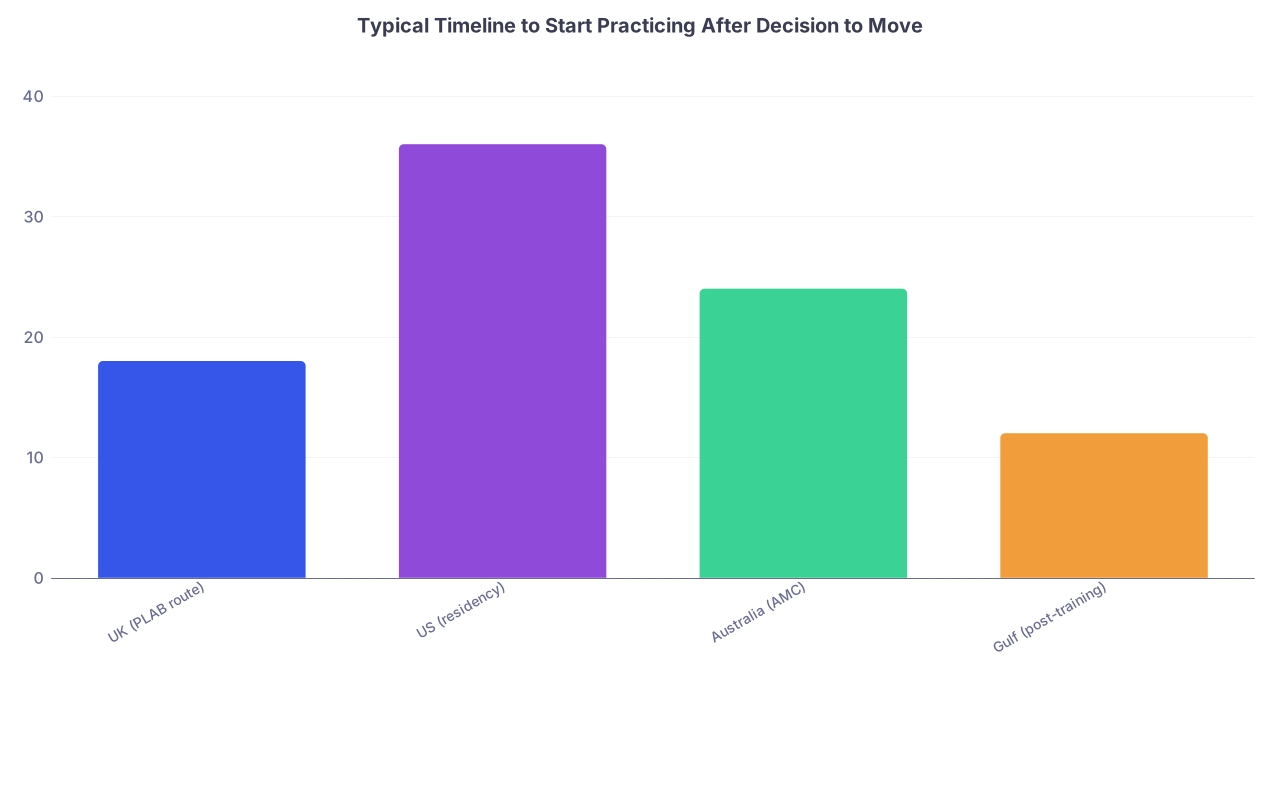
| Category | Value |
|---|---|
| UK (PLAB route) | 18 |
| US (residency) | 36 |
| Australia (AMC) | 24 |
| Gulf (post-training) | 12 |
Those numbers aren’t exact for every person, but the pattern holds: this isn’t a quick pivot.
If your brain is screaming, “What if I waste years and end up nowhere?” that’s a sane response to a real possibility. The fix isn’t pretending everything will magically line up. It’s planning for the worst‑case scenario so it doesn’t destroy you.
Worst-Case Scenarios (And How People Actually Survive Them)
Let’s spell out the nightmare situations your brain keeps replaying, because naming them helps you defuse them.
Nightmare 1: “I move, hate it, and get stuck”
You move to the UK/US/Australia. The work culture doesn’t fit you. You’re exhausted. The system feels alien. You miss home so much it physically hurts. But now you’ve:
- Signed a contract
- Uprooted your life
- Told everyone you were “moving abroad forever”
- Maybe burned some bridges at home
So you feel trapped. “If I go back, I’ll look like I failed.”
Here’s the messy truth I’ve watched play out: lots of people go back. Quietly. Some after a year, some after five. They don’t post about it on LinkedIn. But they exist. And most of them patch their careers back together.
Is it perfectly smooth? No. Do some have to explain odd training paths and gaps? Yes. But coming home isn’t career suicide. What wrecks people is staying in a miserable situation because they’re afraid of looking like they made a bad call.
Nightmare 2: “I never match / never get into training”
This one keeps a lot of people awake. You move, pass the exams, apply to training… and get rejection after rejection. You end up as a non‑training service doc forever.
I’ve seen this too. Especially in:
- US: good but not stellar scores, visa needs, average CV
- UK: IMGs stuck at trust-grade level, struggling to break into competitive specialties
- Australia: people doing “service registrar” roles over and over with no training number
Does this happen? Yes. Is it common? Common enough that you need to plan like it might happen to you.
What helps?
- Choosing destinations + specialties where your profile is actually competitive, not just desirable
- Getting brutally honest feedback early (from current IMGs there, not just official websites)
- Having a written backup path that isn’t purely theoretical (e.g., “If no training by X date, I will…”)
Nightmare 3: “I can’t come back home and I don’t fit there either”
This is the identity crisis one. You move. You half‑adapt. You’re never fully local. Then, if you go home, you’re not fully local there anymore either. You end up feeling permanently in‑between.
This isn’t talked about enough, especially among doctors who’ve moved multiple times (med school in one country, residency in another, work somewhere else). It’s a real emotional cost.
But again, it doesn’t mean you’re broken or that you made a catastrophic error. It means you’re living a complicated life, and your sense of belonging is going to be more complex than “born here, die here.”
That might sound terrifying now. Later, it can actually feel like strength. But while you’re in it, it’s disorienting.
The Boring But Crucial Part: Doing A Cold, Clinical Risk Assessment
You’re trained to do risk‑benefit analyses for patients. You almost never do it properly for your own life.
So do it. On paper. Like an actual consult.

| Step | Description |
|---|---|
| Step 1 | Unhappy or curious about abroad |
| Step 2 | Clarify problem first |
| Step 3 | Research 2-3 target countries |
| Step 4 | Talk to 3 real IMGs there |
| Step 5 | Adjust country or specialty |
| Step 6 | Define worst case and backup plan |
| Step 7 | Timeline and budget written |
| Step 8 | Start exams / paperwork |
| Step 9 | Clear main goal? |
| Step 10 | Pathway realistic for profile? |
Literally write:
- What exact problem am I trying to solve?
- What does success look like in 5–10 years (job, country, lifestyle, income, family)?
- What are the top 3 risks that could go wrong if I move?
- What would I actually do in each scenario? Not hypothetically—concretely.
Example:
“If I don’t get UK training after 2 application cycles, I will either:
A) Return home and apply to X residency programs with this experience framed as Y
B) Shift to less competitive specialties Z that still exist in both countries
C) Consider moving to [secondary destination] where this experience is valued”
Write it like you’re planning for a difficult patient who might deteriorate. You don’t assume they’ll do badly. You just don’t get blindsided if they do.
The Emotional Side: Loneliness, Culture Shock, And Silent Panic
People love talking about exam scores and job titles. They rarely talk about the part that actually breaks them: the emotional load.
You will likely feel:
- Inferior at first, even if you were top of your class back home
- Confused by unspoken cultural rules (“Why does that consultant call me by my first name but I can’t call them by theirs?”)
- Lonely. Crushingly so some nights.
- Guilty—especially if your parents or partner aren’t fully on board with you leaving
You’re already imagining the worst:
“What if I sit alone in a tiny apartment in some grey UK town crying because I miss my parents and I hate my job but I can’t quit because I need the visa and what if there’s no way out.”
That’s dark. But honestly, that exact scenario is not rare. I’ve heard versions of it at 2 a.m. on call rooms and WhatsApp calls across time zones.
Does everyone end up like that? No. Many don’t. Many build solid communities, adapt, and actually thrive.
But the ones who cope best:
- Don’t pretend moving abroad will magically fix their internal issues
- Start building support before they land (friends of friends, alumni groups, IMG forums that aren’t completely toxic)
- Allow themselves to say “this is hard” without assuming “this is a mistake” every time they struggle
And crucially: they don’t let pride trap them. They leave situations that are actively damaging them, even if they invested a lot to get there.
The Quiet Upside You’re Afraid To Believe In
I know you’re mostly here for reassurance that you’re not ruining your life. So here’s the uncomfortable positive reality:
Moving abroad as a doctor can absolutely be the best decision you ever make.
Not because your new country is amazing. It won’t be. It’ll be flawed in new and creative ways.
But because forcing yourself through that much change can:
- Break your perfectionism (nothing like feeling like a PGY‑0 all over again)
- Expose you to different ways of doing medicine, for real, not in textbook case studies
- Give you options—actual geographic and career flexibility that most people don’t have
- Show you that your identity is not tied to one exam system, one title, or one country’s approval
You don’t have to believe that right now. You’re allowed to be scared and skeptical. Honestly, I’d worry if you weren’t.
But both things can be true at once:
- Yes, this might be hard, slow, and sometimes humiliating.
- Yes, you might take a career hit or have to backtrack.
- And also, yes, it might open doors you can’t even see yet.
A Few Grounding Questions Before You Jump
Ask yourself these and don’t rush through them:
- If everything about my current life stayed the same for 5 years, would I be okay with that?
- If the move abroad is harder, slower, and less glamorous than I expect—do I still want it?
- If I end up back home in 3–4 years with a “messy” CV but a clearer sense of what I want, would that truly be a failure? Or just a detour I don’t want to admit might be fine?
You don’t need total certainty. You won’t get it. You just need a path where—even if things go badly—you’re not destroyed.
Years from now, you’re not going to remember every exam score or visa form. You’re going to remember whether you acted from fear or from a clear, honest assessment of what kind of life you were willing to fight for.
, Adventure/experience](https://cdn.residencyadvisor.com/images/articles_svg/chart-top-motivations-reported-by-doctors-moving-abroad-6934.svg "Top Motivations Reported by Doctors Moving Abroad")
| Category | Value |
|---|---|
| Better training | 20 |
| Higher income | 25 |
| Work-life balance | 18 |
| Escape toxic culture | 17 |
| [Family/partner](https://residencyadvisor.com/resources/best-places-to-work-doctor/what-if-my-partner-cant-work-where-i-train-options-for-physician-couples) | 10 |
| Adventure/experience | 10 |


FAQ: Anxious Doctor Thinking About Moving Abroad
1. How do I know if I’m running toward something vs just running away from my current situation?
Ask yourself this: if your current system suddenly became less toxic, paid you decently, and gave you a viable training path—would you still want to go abroad? If the answer is yes, you’re probably genuinely drawn to something there: a specific training style, lifestyle, or set of opportunities. If the honest answer is no, then right now you’re mostly trying to escape. That doesn’t mean you shouldn’t leave, but it means you need to fix the underlying burnout and resentment before assuming a new country will magically cure it.
2. Will going abroad hurt my chances if I decide to come back later?
It can complicate your path, but it doesn’t automatically kill it. Program directors are skeptical of chaos, not of experience. If your story looks like “left, bounced around random posts, unclear decisions,” that’s harder to sell. If it looks like “I went abroad for these specific goals, did X, Y, Z, and now I’m returning with skills A, B, C that fit your program,” that’s much more defensible. The trick is to move with a narrative in mind, not just vibes. Keep records, references, and a clear arc you can explain in 3 sentences.
3. What if I fail the exams (PLAB, USMLE, AMC, etc.)? Does that mean I’m not cut out for it?
No. It means you misjudged either timing, prep strategy, or personal bandwidth. Plenty of strong doctors fail one of these at least once. The key question isn’t “Did I fail?” but “Can I realistically improve my prep given my life circumstances?” If the honest answer is no—because of money, time, mental health—then persisting might be more damaging than rerouting. That’s not weakness; that’s triage. You don’t keep doing a procedure that’s bleeding you out just because you started it.
4. Is it worth moving if I’m not 100% sure about my specialty yet?
This is where people get stuck. You rarely get 100% certainty. But moving without any specialty direction can be risky because some countries basically funnel IMGs into specific fields (internal medicine, psychiatry, primary care) while making others a brick wall (derm, plastics, radiology). If you’re unsure, at least define what you definitely don’t want so you don’t lock yourself into a country where your likely future options are ones you already hate. Partial clarity is enough to start planning.
5. How do I deal with the fear of being lonely and unsupported in a new country?
You don’t wait until you land to think about it. You start building weak ties early: alumni in your target country, specialty IMG groups, doctors on Reddit or Discord who aren’t total catastrophes. You ask future colleagues honest questions about social life, not just on-call rota. And you give yourself permission to struggle without turning every bad day into a referendum on your entire life choice. Loneliness is brutal, but it’s less lethal when you expect it and have even 2–3 people you can message who actually get it.
6. What if I do all this planning, move abroad, and still regret it?
Then you’ll be a doctor who made a bold, imperfect decision and lived through the consequences. That’s it. Not a failure. Not a cautionary tale. You can course-correct. People switch countries, specialties, even careers much later than you’re probably imagining. Regret is real, but so is “what if I’d at least tried?” The question isn’t “How do I guarantee zero regret?” You can’t. The real question is: which version of regret could you live with more—trying and needing to pivot, or never trying and always wondering?
Years from now, you won’t remember the exact night you lay awake spiraling about PLAB vs USMLE vs staying put. You’ll remember whether you were honest with yourself about what you wanted—and whether you were brave enough to accept that no choice comes without a little fear.


