

The places that brag the loudest about “wellness” are often the ones burning people out the fastest.
I wish that line wasn’t true. But I’ve watched too many friends learn it the hard way.
You’re not crazy for being terrified of ending up in a toxic, burnout factory. You’re actually ahead of a lot of people who only realize it’s bad when they’re already crying in the call room at 3 a.m. wondering if medicine was a mistake.
Let’s walk through how to actually tell the difference between a place that just says the right things and a place where you can practice medicine without destroying yourself.
The brutal truth: most programs won’t admit they’re toxic
Every residency, hospital, or group says the same things:
- “We’re a family.”
- “We prioritize work–life balance.”
- “We take wellness very seriously.”
And then you talk to a resident who hasn’t had a real day off in three weeks and eats dinner standing up over a computer.
No program is going to advertise:
- Attendings who humiliate you on rounds
- Leadership that ignores duty hour violations
- A culture where asking for help = “not resilient enough”
So if you’re like me—your brain running constant worst‑case scenarios—you need some concrete levers you can pull. Things you can ask, data you can look at, red flags that actually mean something.
Let me break it into what you can see from a distance and what you can only see once you start talking to people.
From the outside: spotting burnout factories before you apply
You’re stuck stalking websites, Reddit, Doximity, AMA/FREIDA, maybe random whispers from upperclassmen. It feels like trying to diagnose sepsis through a keyhole. But you can pick up patterns.
1. Look at numbers that secretly scream “RUN”
I don’t just mean ACGME accreditation. Toxic places usually leak something somewhere:
| Signal | Green-ish Zone | Yellow Zone | Red Flag |
|---|---|---|---|
| Resident attrition | 0–1 per 5 years | 1 every 2–3 years | 1+ per year |
| Recent expansions | None or slow | Sudden +2–3 residents | Huge jump without new sites |
| Duty hour citations | None | One old citation | Recent or repeated |
| Unfilled spots in Match | Rare or never | Occasional | Frequent or SOAP-heavy |
You usually can’t get perfect data, but you can piece things together:
- Attrition: Ask your school’s recent grads: “Has anyone left that program in the last 5 years?” One person transferring because of family is normal. A trail of people bailing or “switching specialties” starts to smell.
- Unfilled spots: Repeated unfilled spots in an otherwise solid specialty often mean word got out: people don’t want to be there.
- Rapid expansion: “We’re adding more residents to decrease workload” sounds nice. But if they didn’t add faculty, clinics, or support staff, it just means more bodies to spread the same misery across.
2. Public reputation vs whispered reputation
Public reputation is glossy: Doximity, websites, fancy videos. Whispered reputation is what people say when there’s no attending in the room.
You already know where to look:
- Reddit threads about specific programs
- Specialty‑specific forums or Discords
- Alumni from your school who rotated there
One negative comment doesn’t mean much. But if you see the same themes repeating—“malignant attendings,” “gaslighting when you’re sick,” “they don’t care about education, just service”—that’s not noise.
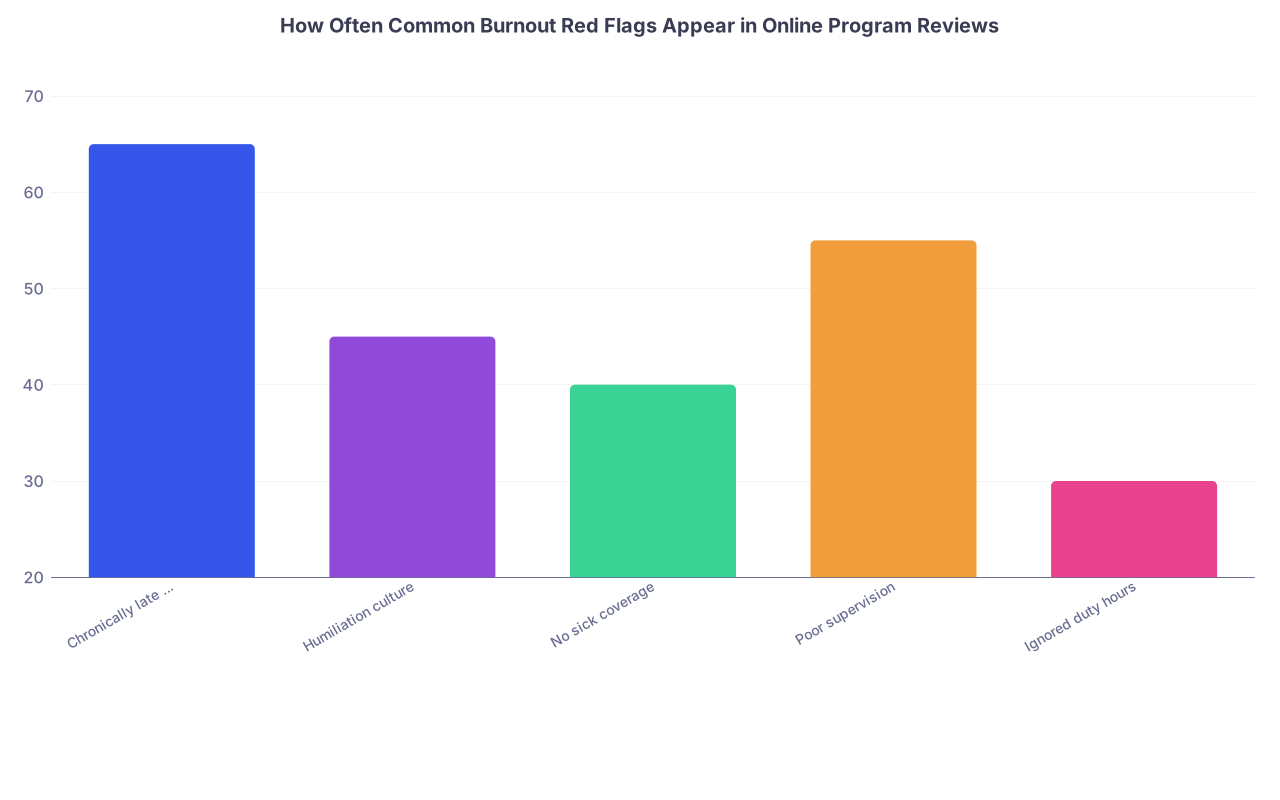
To keep your brain from spiraling, try this:
| Category | Value |
|---|---|
| Chronically late hours | 65 |
| Humiliation culture | 45 |
| No sick coverage | 40 |
| Poor supervision | 55 |
| Ignored duty hours | 30 |
Those numbers aren’t exact, but the pattern is real: if people consistently mention the same 2–3 things, pay attention.
On interview day: how to read between the lines
This is where your anxiety is actually a superpower. You’re already scanning for danger. You just need better sensors.
1. The questions that expose the culture
Ask these, almost word‑for‑word. And listen how they answer, not just what they say.
“When residents are overwhelmed or behind on notes, what actually happens?”
You want: “We help each other,” “We pull in float,” “We call upper levels.”
Red flag: “You just power through,” or jokes about “embracing the grind.”“In the last year, when a resident needed mental health support, how did leadership respond?”
You want a concrete story. “We adjusted their schedule,” “PD called to check in,” “We found coverage.”
Red flag: vague “We support wellness” without a single specific example.“How easy is it to call out sick?”
You want: “You call chief, they figure it out, no guilt.”
Red flag: long awkward pause, or “we try our best, but it’s hard,” or jokes about “we don’t get sick.”“What’s one thing current residents would change about this program if they could?”
You want something honest and bounded: “Better cafeteria food,” “Less weekend call,” “More elective time.”
Red flag: everyone gives the same scripted, safe answer. That usually means they don’t feel safe being honest.
2. Watch their faces, not their words
People can be forced to say the right thing. Their eyes give away the rest. On Zoom too.
Signals that people are actually drowning:
- Residents look exhausted in a flat way—not “tired but joking,” more “dead behind the eyes.”
- Everyone snaps to attention when the PD walks in. Jokes die instantly.
- No resident ever mentions hobbies in real, specific ways. Only “I like to hang out with friends… when I get the chance.”
Signals of a place that’s intense but not toxic:
- Residents openly admit, “Yeah, July is rough, ICU is brutal, but we lean on each other a lot.”
- They tease each other in front of leadership. That’s a sign of safety.
- They talk about interests outside medicine with real detail: “I still play in a band,” “We have a hiking group,” “We do board game nights on golden weekends.”
Hard red flags: “You won’t survive here long‑term”
There are dealbreakers. I know people try to rationalize them because of prestige or location or “it’ll just be three years.” But burnout doesn’t care about your logic. It just stacks days until you snap.
These are the ones I would personally not negotiate with:
1. Systematic disrespect
You see or hear about:
- Attending berating a resident in front of patients
- Nurses or techs constantly dumping on residents with no consequence
- Residents saying: “You just develop thick skin” as if that’s normal
A place that doesn’t protect its trainees from humiliation will not protect you when things get serious—like depression, a medical error, or a family emergency.
2. Open duty hour abuse + gaslighting
Every program violates duty hours sometimes. That’s reality. But it’s about the pattern and the response.
Hard no for me:
- Chiefs telling you to log false hours
- Residents all say, “We’re always over, but it’s just how it is here”
- No mechanism for anonymous reporting or feedback
A program that needs you to lie is a program that will sacrifice your mental health for their image.
3. No backup, ever
Ask: “Who covers if someone has an emergency?” If the answer is basically “we just absorb it” or “it hasn’t really come up,” walk away. Emergencies always come up. If they don’t have a plan, you are the plan.
Green flags: what safer, healthier programs actually look like
You will work hard everywhere. There is no magical low‑stress residency. But there is a massive difference between “hard but supported” and “hard and abandoned.”
Here’s what I’ve consistently seen in programs that don’t chew people up:
1. They are annoyingly transparent
Program directors who:
- Randomly drop into resident noon conference just to listen, not to lecture
- Share program data openly: board pass rates, survey results, what they’re changing this year
- Admit flaws: “Our ICU schedule was rough; we changed X, Y, Z based on your feedback”
That level of transparency is uncomfortable for leadership. If they do it anyway, it usually means they actually care.
2. They actually protect off time
Places that are serious about not burning you out:
- Have a real jeopardy or backup pool
- Enforce golden weekends and don’t casually take them away
- Don’t schedule mandatory “wellness” sessions on your only post‑call free afternoon
They treat your off time like it matters. Because it does. Without recovery, you’re just slowly marching toward collapse.
3. They talk about graduates like humans, not trophies
Ask: “What are your alumni doing now?”
Healthier places mention:
- People who went part‑time for family reasons
- Graduates in smaller community hospitals, not just big‑name fellowships
- Folks who changed paths and were still fully supported
Toxic places only brag about: “We send 2 people to top‑10 fellowships every year,” and that’s it. No humanity. Just outcomes.
How to protect yourself even if you do land somewhere rough
Here’s the part that really freaks me out: you can do everything right and still end up in a program that looked fine from the outside and feels very different from the inside.
So then what?
Step one: you are not trapped. People transfer. People switch specialties. People renegotiate schedules. It happens way more than programs acknowledge publicly.
Here’s the quiet playbook I’ve seen people use:

| Step | Description |
|---|---|
| Step 1 | Notice burnout and red flags |
| Step 2 | Meet PD and chiefs |
| Step 3 | Confide in trusted faculty |
| Step 4 | Request concrete changes or support |
| Step 5 | Stay and reassess in 3 months |
| Step 6 | Explore transfer options |
| Step 7 | Talk to mentors outside program |
| Step 8 | Apply to transfer or plan exit |
| Step 9 | Is leadership safe? |
| Step 10 | Any real change? |
Not everyone can or wants to leave. Family, visas, geography—life is messy. If you stay, you still have some levers:
- Find 1–2 attendings who see you as a person. Protect that relationship.
- Get a therapist outside your institution if you can. Confidential space matters.
- Set survival boundaries: protect sleep like a prescription, say no where you realistically can, refuse to log false hours.
It’s not weakness to need help. It’s survival strategy in a system that runs on pretending everyone’s fine.
How to keep your own burnout risk visible (even when everything pushes you to ignore it)
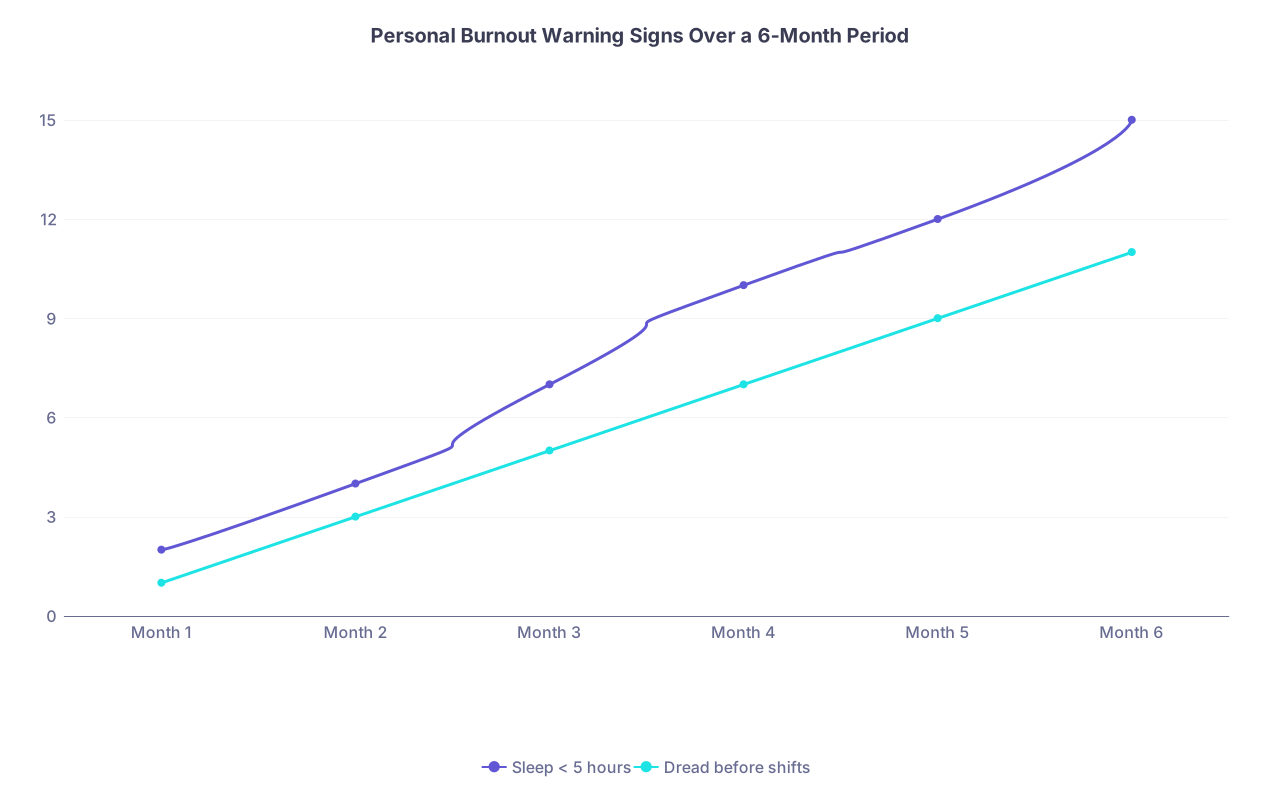
I worry a lot about this: you start residency promising yourself you’ll watch your limits. Then six months in, your “normal” has shifted so far that you forget what a red flag even looks like.
So make it concrete.
| Category | Sleep < 5 hours | Dread before shifts |
|---|---|---|
| Month 1 | 2 | 1 |
| Month 2 | 4 | 3 |
| Month 3 | 7 | 5 |
| Month 4 | 10 | 7 |
| Month 5 | 12 | 9 |
| Month 6 | 15 | 11 |
Again, not literal data—just the pattern. Things creeping up. Small at first, then suddenly your baseline is: exhausted, numb, irritable, fantasizing about quitting medicine entirely.
Every month, ask yourself:
- Am I still capable of enjoying anything outside work?
- Do I feel dread every single shift?
- Am I more cynical and detached with patients than I used to be?
- If I suddenly got offered an exit ramp from this program, would I take it immediately?
If the answers start stacking in the wrong direction, something has to change. Maybe not immediately switching programs, but at least more support, more honesty, more boundaries.
A quick comparison: healthy culture vs quiet toxicity
| Area | Healthier Program | Quietly Toxic Program |
|---|---|---|
| Feedback | Specific, bidirectional, regular | Vague, top-down, mostly criticism |
| Sick calls | Normalized, covered without guilt | Seen as weakness, no formal process |
| Wellness | Structural changes, not just yoga | Pizza, posters, no schedule adjustments |
| Leadership vibe | Approachable, visible, admits mistakes | Distant, defensive, uses fear to control |
| Resident group | Honest about struggles, still jokes | Fragmented, guarded, “just survive” talk |
If most of your impressions line up in the right column, it’s not your imagination. It’s the environment.
You’re not weak for wanting a place that won’t break you
There’s this awful undercurrent in medicine that if you care about burnout, you’re somehow “soft.”
That’s garbage.
Wanting to work in a place that doesn’t grind you into dust isn’t entitlement. It’s self‑preservation. And honestly, it’s patient safety. Burned‑out, sleep‑deprived, emotionally blunted doctors make more mistakes. They quit. They detach. Everybody loses.
You’re allowed to be picky. You’re allowed to say no to prestige if the price is your sanity. You’re allowed to walk away from a place that treats suffering as a personality test.
And no, you’re not the only one afraid of ending up somewhere toxic. Most people just don’t say it out loud.

FAQ (6 questions)
1. Am I being dramatic for worrying this much about burnout before I even start?
No. You’re doing what too many of us didn’t do: taking the risk seriously before it crushes you. Burnout is not rare, and it’s not just “a hard month.” It can wreck your health, your relationships, and your sense of self. Worrying now lets you make better choices while you still have leverage.
2. Should I avoid all high-volume or “intense” programs?
Not automatically. Some high-volume places are actually decent to work in because they pair intensity with strong teaching, backup, and honesty. The programs to avoid are the ones that combine high volume with chaos, disrespect, and zero support. Hard ≠ toxic. But hard + unsupported usually is.
3. How much weight should I give to one or two horror stories I hear about a program?
Single stories prove possibility, not patterns. I’d be cautious but not instantly out. If you hear the same kind of story from multiple independent people, over multiple years, then you should take it very seriously. One horror story: flag. Five similar ones: pattern.
4. What if the only programs that will take me are ones with some red flags?
This is a horrible spot, and people end up here. If that’s you, your job becomes: minimize harm and maximize your exit options. Get allies early (mentors, chiefs who are decent, mental health support). Document serious issues. Protect sleep when you can. Start planning next steps (fellowship, transfer, different practice setting) from day one. It’s not fair, but you’re not powerless.
5. Can I ask current residents directly, “Is your program toxic?” or is that too blunt?
It’s too blunt and puts them in a bad spot. Better: “What’s the hardest thing about this program that applicants don’t usually see?” or “If your best friend matched here, what would you warn them about?” Those questions invite honesty without forcing them to label the whole program as toxic.
6. How do I know if it’s the program that’s bad or if I’m just not cut out for medicine?
If you’re even asking this, I’m guessing the program is at least part of the problem. People blame themselves way too quickly. Look around: are most residents miserable, or is your experience very different from theirs? Are you anxious and sad only on service… or all the time, even away from work? A good therapist and a mentor outside your program can help you sort out what’s “this place is bad for me” vs “I need a different role in medicine” vs “I’m clinically depressed and need treatment.” You don’t have to untangle it alone.
Key points:
- Toxic programs almost never look toxic on paper—watch for patterns of disrespect, dishonesty around hours, and lack of support.
- Your anxiety about burnout is not weakness; it’s a survival tool that can guide better questions and better choices.
- Even if you land somewhere rough, you are never completely trapped—you still have options, allies, and exit ramps, even if the program pretends you don’t.


