

Do ‘No Income Tax’ States Really Favor Doctors? The Full Picture
Is moving to Texas or Florida actually going to make you richer as a physician—or are you just trading state income tax for quiet, slower, more painful money leaks you never notice on a paycheck stub?
Let me be blunt: “No state income tax” is one of the most overhyped, lazily analyzed talking points in physician career planning. I’ve watched attendings uproot their families for a 0% state income tax, only to realize three years later they’re not actually taking home more—sometimes less—once you factor in everything else.
Here’s what the data actually shows.
The Big Myth: “No Income Tax = Best for Doctors”
The story you’ve heard:
- Texas, Florida, Tennessee, etc. have no state income tax
- Doctors make high incomes
- Therefore, those states are automatically better financial choices
This is wrong. Not mildly off—fundamentally flawed.
States have to fund themselves somehow. If not through income tax, they do it with:
- Higher property taxes
- Higher sales taxes
- Fees, insurance rates, hidden costs
- Lower public investment (schools, infrastructure, safety nets) that you pay for in other ways—especially if you have kids
For physicians, the relevant question isn’t “What’s the state income tax rate?”
It’s: “How much of my total compensation do I actually keep after all state and local costs—and what quality of life do I get in return?”
Let’s put some numbers on it.
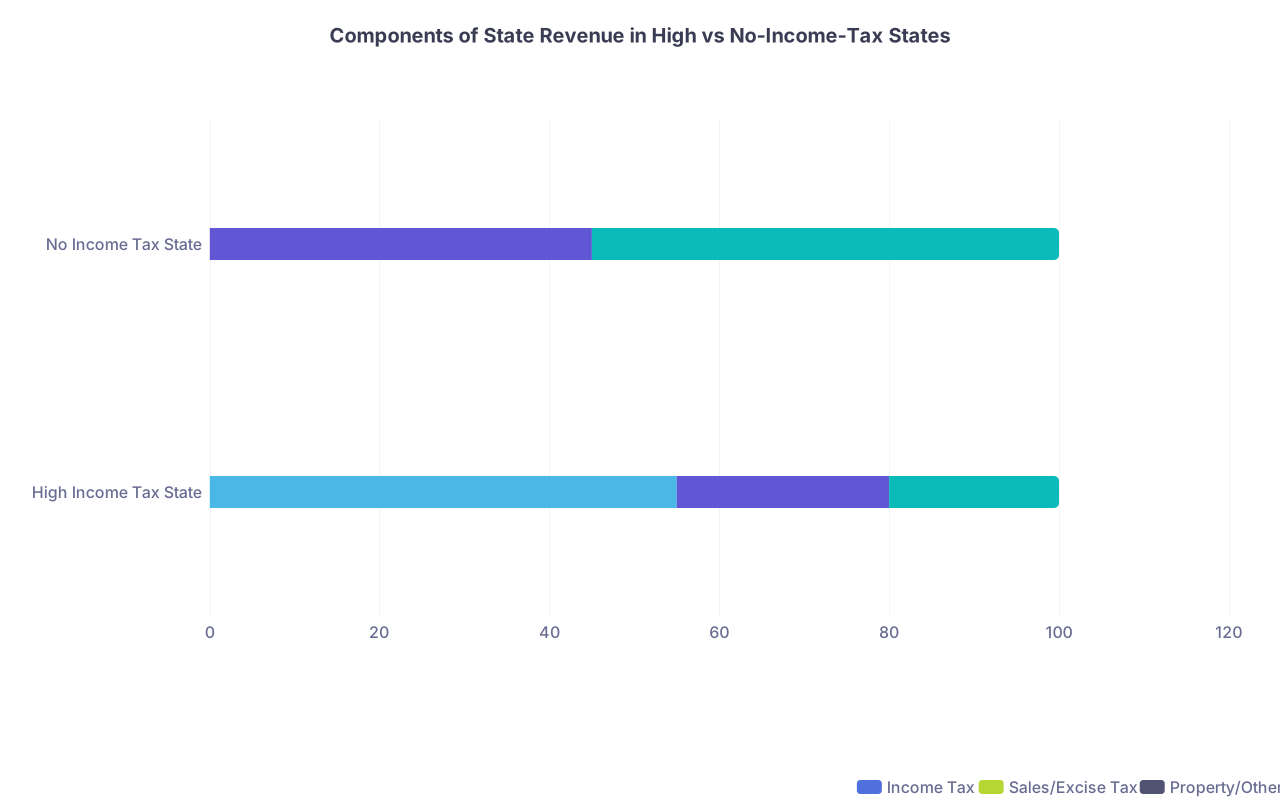
| Category | Income Tax | Sales/Excise Tax | Property/Other |
|---|---|---|---|
| High Income Tax State | 55 | 25 | 20 |
| No Income Tax State | 0 | 45 | 55 |
The headline “0% income tax” is simple. The reality is not.
What Actually Determines Your Take-Home as a Doctor
To compare states, you can’t fixate on one tax line. You need to look at:
- Effective state + local tax burden on a high-income household (e.g., $350–600k)
- Cost of living (housing, childcare, insurance, etc.)
- Compensation levels for your specialty in that region
- Workload and call burden tied to that pay
- Long-term upside: partnerships, equity, buy-ins, or just salary treadmill
Or, said differently:
- How much you gross
- How much you keep
- What you sacrifice for that number
Most doctors only do the first half of the math: “No income tax, $50k more saved!” Then they move and meet their new friends: $12k/year property tax on a modest house, sky-high homeowners insurance, and maybe $1–2k/month more in childcare.
A Tale of Two Attendings: Texas vs High-Tax State
Let’s make this less abstract.
You’re a hospitalist getting offers from:
- Houston, Texas (no income tax)
- Minneapolis, Minnesota (high income tax, but not a coastal outlier)
Assume:
- Base salary:
- Houston: $340k
- Minneapolis: $305k (yes, often slightly lower in high-tax states, but not always dramatically)
Household: you, partner, 2 kids.
Now compare real numbers. Rough ballpark estimates based on typical patterns:
| Category | Houston, TX | Minneapolis, MN |
|---|---|---|
| Base Salary | $340,000 | $305,000 |
| State Income Tax | $0 | ~$22,000 |
| Property Tax (median home) | ~$11,000 | ~$6,500 |
| Sales Tax & Fees (est.) | Higher | Moderate |
| Homeowners/Insurance | Higher (weather) | Lower |
| Childcare (2 kids) | Higher | Moderate |
On paper, Texas wins by $35k salary and $22k of “saved” income tax. That’s $57k. Except you’re bleeding more from:
- Property taxes
- Insurance (hurricanes, hail, etc.)
- Possibly higher childcare in many booming metros
- Longer commute or worse zoning leading to time costs that never show on a spreadsheet
By the time you add up everything, the “no-tax state” advantage shrinks—sometimes disappears.
And that’s before you look at something every physician quietly feels but rarely quantifies: workload and burnout.
In plenty of no-tax, high-growth states, hospitals run lean. Fewer physicians per population. That $35k salary bump might be your payment for more nights, higher patient volume, weaker staffing, and a perpetual sense of being a cog.
You are not “making more” if you’re trading your health and every free weekend for a slightly higher net number.
The Places That Quietly Treat Doctors Best Financially
Here’s the part no one on social media bothers to mention: some of the best states for physician net financial outcomes are not no-tax states. They’re:
- Moderate-to-high income tax states with
- High compensation relative to cost of living
- Reasonable housing prices
- Solid public services (schools, transport, safety)
- Physician-friendly practice climate
Think: parts of the Midwest, Mountain West, and smaller metros in “unsexy” states.
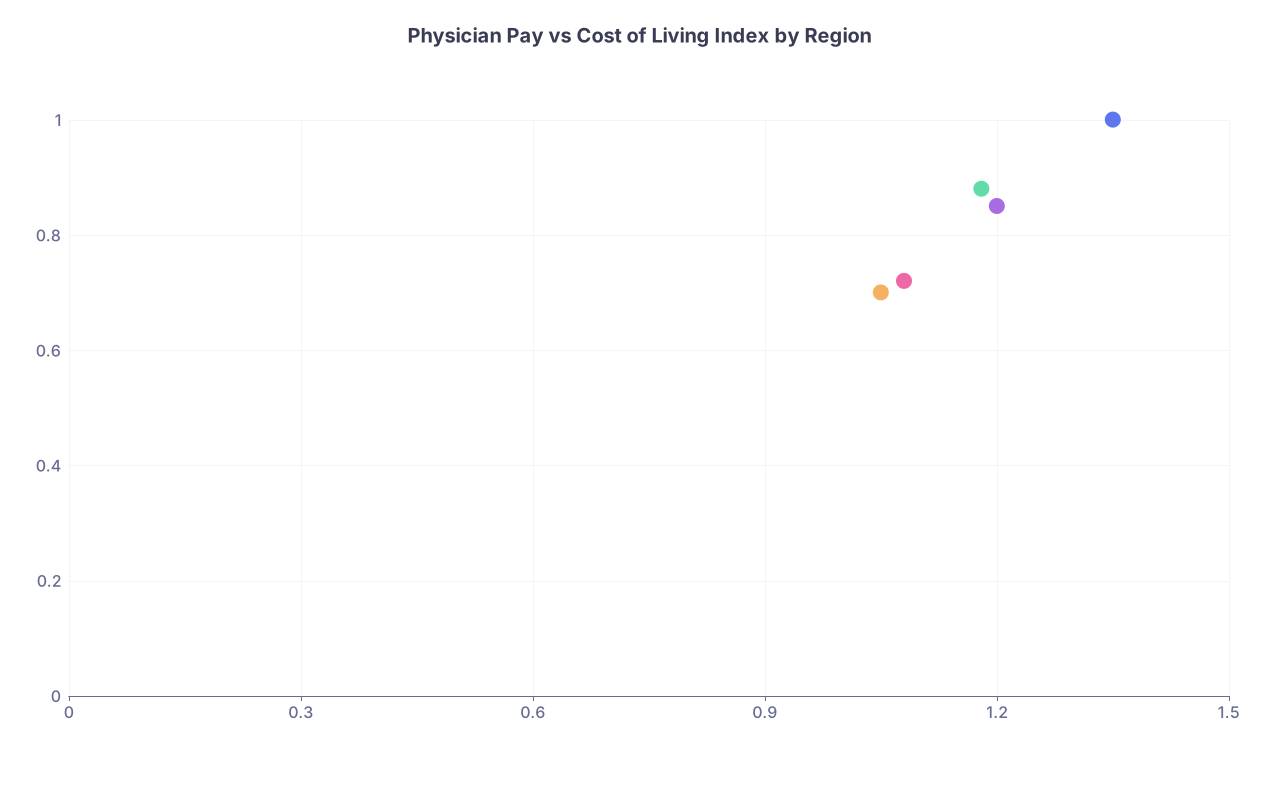
| Category | Value |
|---|---|
| Coastal Metro | 1.35,1 |
| Texas Metro | 1.2,0.85 |
| Florida Metro | 1.18,0.88 |
| Midwest Mid-Size | 1.05,0.7 |
| Mountain West City | 1.08,0.72 |
Interpretation:
- x-axis (first number) ~ cost of living index (1.00 = national average)
- y-axis (second number) ~ physician pay ratio vs national average
The sweet spot is high y, low x. That is not Manhattan. It’s not usually Miami either. It is often places you have never considered because they don’t have a tourism campaign targeting you on Instagram.
I’ve seen general surgeons in mid-size Midwestern cities with:
- Realistic call schedules
- $450–550k comp
- Solid schools without private tuition
- $500k 4-bed homes with reasonable tax bills
Run that math against a Texas metro where your house taxes alone can approach $15–20k/year, and your supposed “no income tax” advantage looks a lot flatter.
No-Income-Tax States: Where They Actually Help Doctors
I’m not saying Texas, Florida, Tennessee, etc. are bad choices. They’re not. They can be excellent—in specific scenarios.
They tend to favor you if:
You have truly high earned income and lower fixed local costs
- Example: You’re a single interventional cardiologist renting an apartment, making $700k in Florida, minimal dependents, not buying the big house yet. Yeah, the 0% income tax helps you a lot.
You’re stacking capital fast, intentionally
- Taking a few high-productivity years to pay off loans, max investments, and you’re willing to tolerate higher property or insurance costs temporarily.
You’re practicing in a rural or semi-rural area of a no-tax state
- Lower housing costs + no income tax + often high pay = real advantage.
- Very different math from an overcooked urban market like Miami or Austin.
Where physicians get burned is when they assume:
- “No income tax state” +
- “Major metro” +
- “Big house, kids in private school, two SUVs”
…and then wonder why their savings rate still sucks.
What No One Tells You About “High-Tax” States
A lot of doctors lump all high-tax states together as “bad for money.” That’s lazy thinking.
There’s a giant difference between:
- California / New York City-level cost + tax combos, and
- Minnesota, Wisconsin, Colorado, or even certain parts of New Jersey or Massachusetts outside the highest-cost metros.
High-tax states sometimes:
- Pay more in certain subspecialties
- Offer better benefits (pensions in some academic systems, better disability, strong union or physician-advocacy structures)
- Provide free or heavily subsidized public school systems that actually let you avoid $30–40k/year in private tuition per kid
I’ve seen attendings in “expensive” states whose effective overall position was better because:
- They weren’t bleeding on property taxes
- They didn’t need private school
- Commute was short
- Compensation was strong for their niche
- They had real job security and sane staffing
There’s a difference between tax rate and tax value. Physicians almost never talk about the second one.
The Hidden Cost: Burnout as an Unpaid Tax
Here’s the part that’s rarely in spreadsheets but shows up in cardiology consults: burnout.
Consider two options:
- Zero-income-tax state, high RVU job, $550k, brutal call, understaffed, high turnover
- Moderate-tax state, $450k, slower pace, better staffing, stable group, decent schools
Everyone loves to stare at the $100k income difference and the 0% vs 6% tax delta.
What they don’t compute:
- How many extra shifts you’re doing
- What that does to your health, marriage, and actual time with your kids
- The increased likelihood you’ll flame out early and cut your career short or go part-time involuntarily
If your “extra” $60–100k is buying antidepressants, takeout dinners, and a scratched-up Tesla you never actually drive outside your hospital commute, that’s not a win.
Burnout is a tax. It just doesn’t have a line on your pay stub.
A More Honest Framework: How to Actually Compare States
You want to know if a no-income-tax state really favors you? Walk through this—on paper.

| Step | Description |
|---|---|
| Step 1 | Job Offer |
| Step 2 | Calculate Net Pay After State and Local Taxes |
| Step 3 | Estimate Housing and Property Costs |
| Step 4 | Estimate Childcare and School Costs |
| Step 5 | Assess Workload and Call |
| Step 6 | Evaluate Long Term Growth or Partnership |
| Step 7 | Consider Move |
| Step 8 | Reassess State Options |
| Step 9 | Net Benefit Clear? |
Questions you should answer before you fall in love with “0% income tax”:
- What is the actual physician compensation data by specialty in that city/region? (MGMA, Doximity, talking to real people there)
- What will my property tax bill be on the kind of house I realistically want, near the schools I’d actually use?
- What are childcare costs and school quality? Do I feel forced into private school?
- What’s malpractice like? Non-competes? Payer mix? (Medicaid heavy vs commercial-heavy can dwarf tax differences over time)
- How brutal is call? Are they constantly recruiting because doctors keep bailing?
Then you line that up against a couple of “non-sexy” but stable, mid-tax options. Suddenly, the calculus changes.
Where This Really Matters: The Future of Physician Work
You’re not choosing a state for 2 years. You’re basically choosing a platform for:
- Pivoting to telemedicine
- Starting a side practice or niche cash-based service
- Doing locums
- Building equity in real estate or in a group practice
And the tax story changes a lot when you introduce:
- Business income vs W-2
- Pass-through deductions
- Capital gains and property treatment
- State laws around corporate practice of medicine
Some high-tax states are hostile to physician entrepreneurship. Some are surprisingly decent. Likewise, some no-income-tax states look great on W-2 but are more complicated for independent practice depending on hospital dominance and regulatory details.
The oversimplified “no income tax = best” narrative completely misses this.
Quick Reality Checks You Should Do
Before you sign a contract hyped by the “tax-free state” pitch, do three quick gut-checks:

Compare actual net after-state-tax and big-ticket living costs
- Run numbers on two or three real offers (not imaginary examples). Include: state income tax, property tax, homeowners + auto insurance, childcare, and expected housing cost.
Ask existing physicians there blunt questions
- “What’s your real take-home after everything?”
- “Would you move here again?”
- “How many people have left in the last 5 years, and why?”
Evaluate your 10-year life, not your 1-year paycheck
- Career trajectory, partnership vs salary, kids’ schooling, spouse job options, burnout risk.
If a no-income-tax state still looks obviously better after that, go. You’re not imagining it—sometimes the advantage is real and large.
Just don’t mistake “0% income tax” for automatic victory.
The Bottom Line: Who Really Wins in No-Income-Tax States?
Here’s the stripped-down truth.
- “No income tax” helps some doctors a lot—usually high earners with low fixed local costs and a short time horizon who are aggressively building wealth.
- Many physicians are barely better off there once you factor in property taxes, housing, insurance, childcare, and workload—and some are worse off.
- The best states for doctors financially are often boring, mid-tax, mid-cost places with strong comp, sane schedules, and stable communities, not the loudest “tax haven” states.
If you remember nothing else:
- Taxes are just one line on your personal P&L, and not the biggest for many physicians.
- Total net after all costs plus quality-of-life is what actually matters—not a big “0%” on a website.


