

Academic medical centers are not the promised land for every young doctor. For a lot of you, they’re actually the worst possible place to start.
That cuts against decades of cultural brainwashing in medicine. From day one of medical school you’re fed a story: the “best” people go to big-name academic centers, do fellowships there, build CVs there, and if you go anywhere else you’re… settling.
Here’s the problem: that story is only half-true. And for many early-career physicians, it is flat-out wrong.
Let’s pull this apart with data, not prestige worship.
How We Got the “Academic or Bust” Myth
You did not invent this bias. The system handed it to you.
Attendings in med school? Most were academic. The mentors you saw highlighted? Academic. The speakers who come talk about “career paths”? Academic leaders. The institutions that control your grades, letters, and research opportunities? Academic again.
So the hidden curriculum says:
- Real medicine = tertiary/quaternary care
- Real success = titles, grants, and PubMed citations
- Real prestige = academic brand name on your badge
Community hospitals, private groups, rural sites? Those were "away rotations," backup plans, or “good for lifestyle later.”
I’ve watched MS4s on the trail say things like, “I matched community but I’ll try to lateral into academic later once my CV is better,” as if community work is remedial training.
Yet if you look at where the majority of actual care in this country is delivered, the myth disintegrates fast.
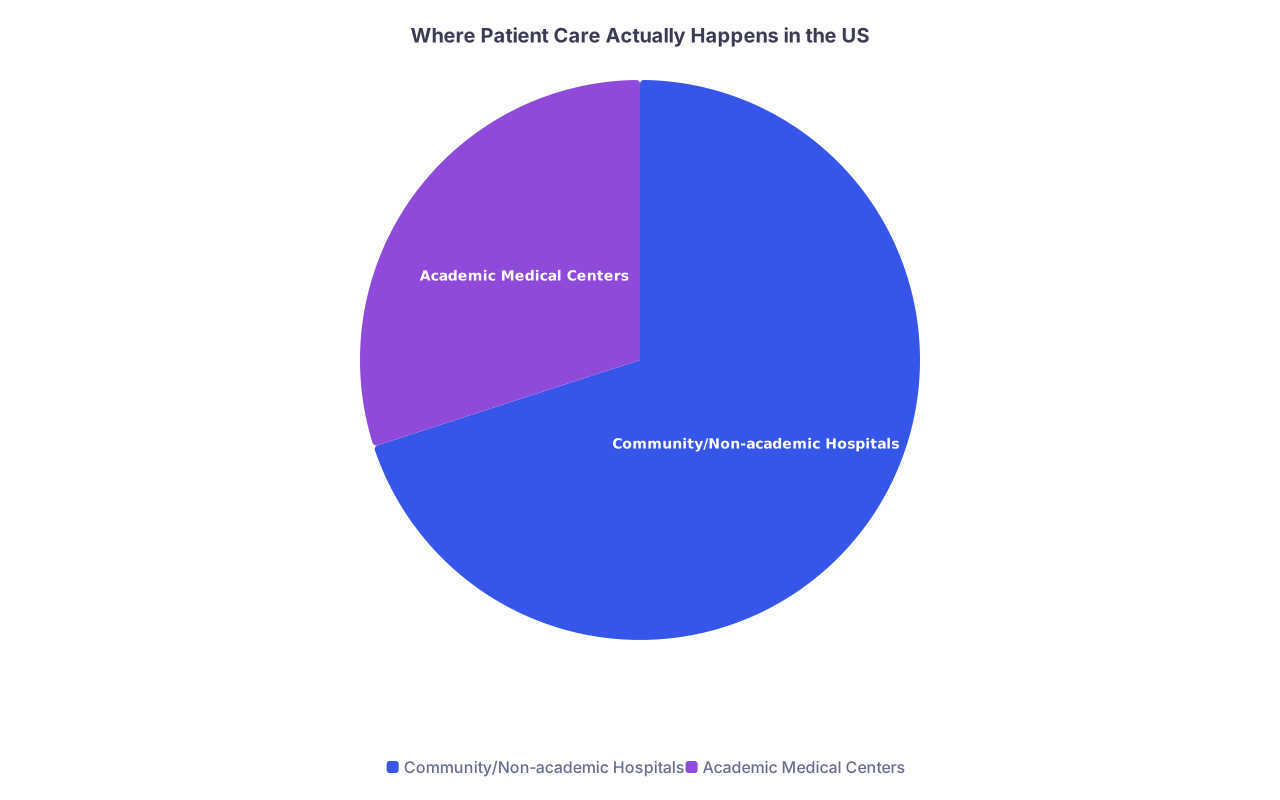
| Category | Value |
|---|---|
| Community/Non‑academic Hospitals | 70 |
| Academic Medical Centers | 30 |
About 70% of hospital care in the US is delivered outside academic medical centers. Most emergency care, most births, most primary care follow-up, most post-op management. If “real medicine” only happens in academic centers, someone forgot to tell reality.
The big academic logo on your ID badge is not a universal marker of a “better” job. It is a marker of a very specific type of job, with very specific tradeoffs.
What Academic Centers Actually Give You (and What They Take)
Let me be fair: academic centers do some things extraordinarily well. If you want a career in certain directions, they’re hard to beat.
Academic medicine is excellent for:
- Subspecialty training and ultra-rare pathology
- Structured research pipelines and protected time (sometimes)
- Exposure to complex tertiary and quaternary referrals
- Being around trainees if you love teaching and scaffolding careers
If you are dead-set on being a physician-scientist, a niche subspecialist, or a department chair, you’ll almost certainly need some time in that world.
But the sales pitch you hear as a resident or fellow usually leaves out the cost. Let’s be blunt.
The pay gap is real
On average, for the same specialty, academic jobs pay less than community jobs. Often a lot less.
| Specialty | Academic Starting ($) | Community Starting ($) |
|---|---|---|
| Hospitalist | 220,000–260,000 | 280,000–340,000 |
| General IM | 200,000–230,000 | 250,000–300,000 |
| General Surgery | 350,000–400,000 | 450,000–550,000 |
| EM | 250,000–300,000 | 350,000–450,000 |
| Cardiology | 450,000–550,000 | 600,000–750,000 |
You can argue around the edges, but large survey data (MGMA, Doximity) repeats the same finding year after year: academic pays below market, particularly for procedural and high-RVU specialties.
The standard academic defense: “But you get protected time and prestige.”
Sometimes you do. More often, what you get is:
- “0.2 FTE” research time that you end up doing at 10 p.m.
- Pressures to bill like a full-time clinician anyway
- A title instead of a meaningful raise
The workload and bureaucracy are not “better”
Ask a PGY-2 what they think academic life looks like: teaching rounds, cutting-edge cases, conferences, smart colleagues debating journal articles. Then ask a 5-year academic attending what their week actually looks like.
You hear the same complaints, over and over:
- “Endless meetings that accomplish nothing.”
- “Every new thing is a ‘pilot project’ dumped on frontline staff.”
- “I’m doing more documentation and quality busy-work than teaching.”
Many academic centers are bureaucratic juggernauts. Layers of leadership. Committees for every decision. Policy changes weekly. IT “improvements” that break your existing workflow.
Meanwhile, the thing that supposedly makes the academic tradeoff worth it—actual teaching and mentorship—often gets squeezed into whatever time is left after covering service, EMR nonsense, and productivity targets.
The prestige premium is mostly psychological
Let me say the quiet part directly: the emotional high of telling people you work at Big Famous University Hospital lasts maybe 6–12 months. The salary gap can last your entire career.
I’ve seen young cardiologists turn down $150–200K more per year in community jobs because they can’t let go of the academic brand. Five years later, they’re burned out, behind on loans, and quietly looking at the same community jobs again—just with more fatigue this time.
If you’re using academic work as a bridge to a very specific long-term goal (R01 funding, division chief, NIH track), fine. That’s a conscious strategic choice. If you’re doing it because “that’s what good residents do,” you’re following a script written by people with a very different life and financial situation than yours.
What Young Doctors Actually Want (When You Strip the Branding Off)
Forget labels for a second. When you sit across from residents in a workroom and ask what they actually want out of a first job, the answers are boringly consistent:
- Enough income to feel like the sacrifice was worth it
- Reasonable control over schedule and vacation
- A practice where you are not drowning every shift
- Colleagues you trust and don’t hate seeing
- Some sense of meaning, whether that’s complexity, continuity, or teaching
Let’s contrast what academic vs non-academic environments tend to offer on those fronts.
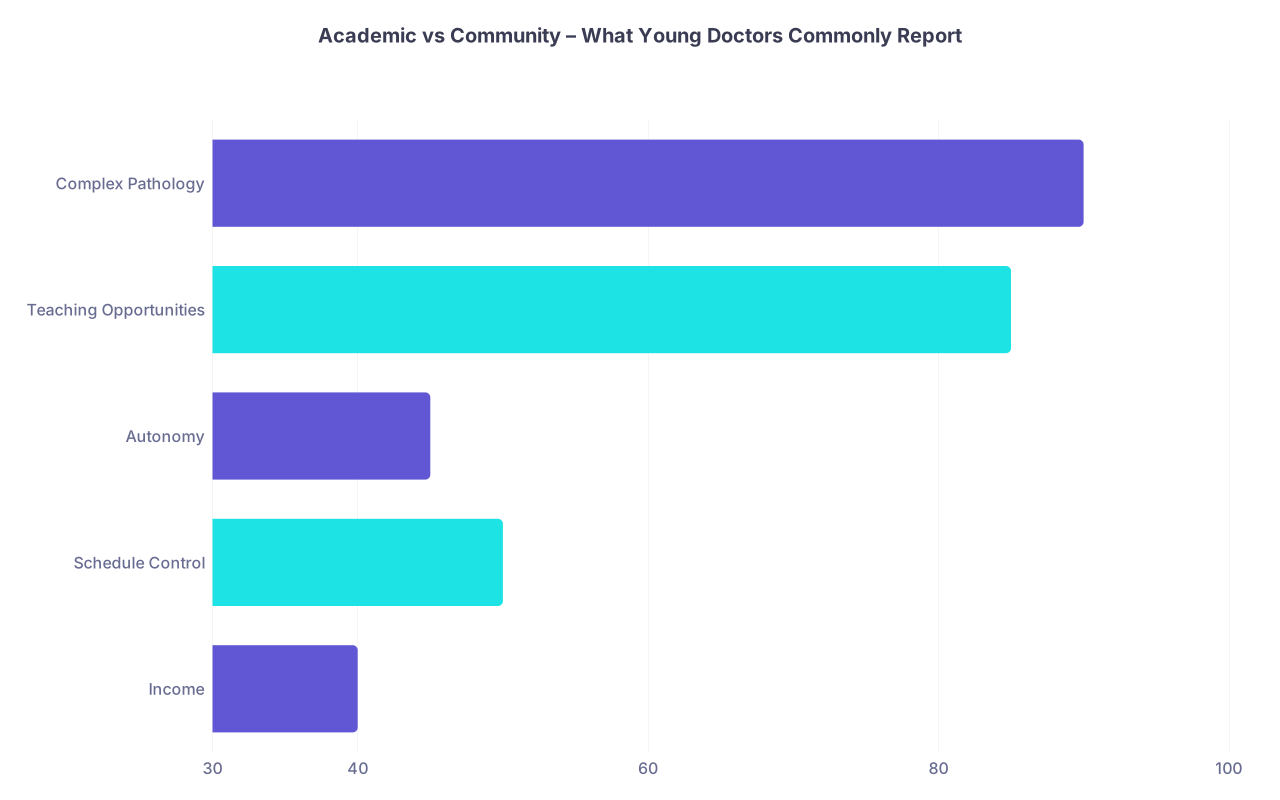
| Category | Value |
|---|---|
| Income | 40 |
| Schedule Control | 50 |
| Autonomy | 45 |
| Teaching Opportunities | 85 |
| Complex Pathology | 90 |
Call those values the rough “academic strength” out of 100 on each axis, based on surveys, salary data, and what people actually report. Now imagine a mirror-image bar chart for community settings: lower on ultra-rare pathology and formal teaching, higher on income, autonomy, and schedule control.
I’ve heard residents say this verbatim after a community elective: “The attendings actually leave on time and weren’t miserable. I didn’t know that was possible.”
They’re genuinely surprised, because the indoctrination is deep.
Why Community, Private, and Hybrid Jobs Deserve More Respect
The myth says non-academic = lower quality, less interesting, not for “top” people. The reality is more complicated and frankly more interesting.
Clinical skill does not magically disappear outside academia
Look at who staffs many high-functioning community ICUs, cath labs, and oncology services: often fellowship-trained academic refugees. Same training. Different ZIP code. Fewer committees.
You will see:
- Plenty of sepsis, ACS, GI bleeds, strokes, trauma
- Bread-and-butter pathology in massive volume (which actually makes you good)
- Enough complex pathology to stay sharp, especially in large community centers or regional referral hospitals
The idea that you only “keep your skills up” at an academic center is often an excuse academics tell themselves to justify staying in a system that’s underpaying and overworking them.
Work-life balance is not a meme; it’s a survival requirement
With physician burnout hovering around 50–60% in multiple large surveys, this is not a soft issue.
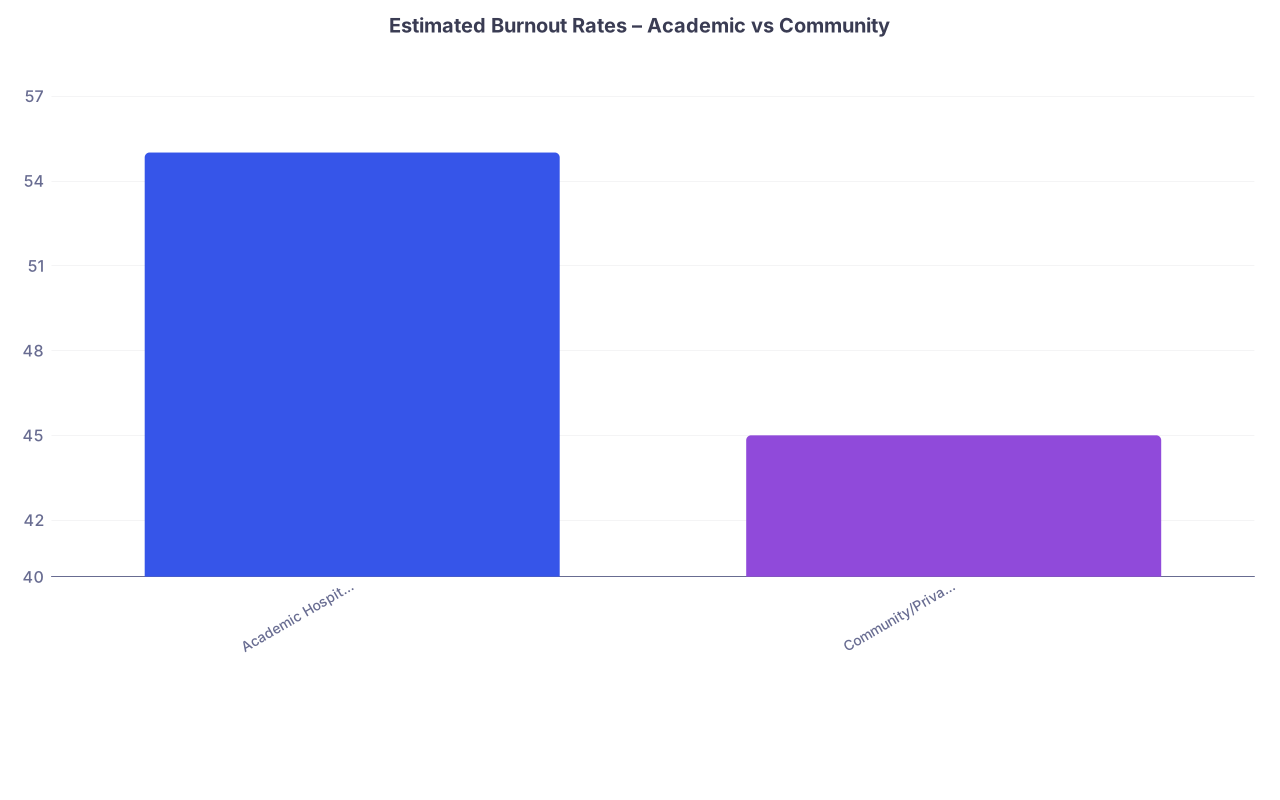
| Category | Value |
|---|---|
| Academic Hospital Physicians | 55 |
| Community/Private Physicians | 45 |
The numbers overlap and vary by specialty, but a consistent theme: rigid hierarchies, heavy trainee oversight obligations, + administrative bloat = higher burnout risks. A community setting is not a magical cure, but you often get:
- More predictable clinical expectations
- Less teaching/admin load unless you explicitly sign up for it
- Fewer layers between you and decisions that affect your day
And yes, more money for the same or fewer hours.
Autonomy and speed of change
Academic centers often move at the speed of a glacier, wrapped in red tape.
Want to change an order set? Add a new clinic template? Try a new scheduling model? That’s 6 meetings, 3 committees, 8 emails, and someone from compliance who has never seen a patient commenting on your workflow.
In many community or private settings, if you convince your group and your medical director, it happens. I’ve seen new grads build subspecialty clinics, launch community outreach programs, and redesign call schedules within a year or two at community jobs. That kind of agility is rare at the flagship university hospital, where you are doctor #837.
The Future of Medicine Is Not Purely Academic
If you’re thinking 10–20 years ahead, anchoring your career only around academic centers is a bad bet.
The healthcare landscape is shifting under your feet:
- Large systems are consolidating and swallowing smaller practices
- Telemedicine and distributed care are exploding
- Value-based and population health models are moving care out of the giant hospital and into smaller nodes
A lot of the real innovation in how care is delivered is happening outside of traditional academic towers:
- Hybrid models: academic-affiliated community hospitals where you can teach a bit, see solid pathology, and still have a life
- Physician-owned groups that are adding telehealth, urgent care satellites, or advanced practice provider teams intelligently
- Rural and semi-rural regional centers leveraging technology and referral networks to deliver high-end care locally
Here’s how the opportunity space is already looking for young doctors:

| Step | Description |
|---|---|
| Step 1 | Residency or Fellowship Finish |
| Step 2 | Traditional Academic Job |
| Step 3 | Community or Private Group |
| Step 4 | Hybrid Academic Affiliated |
| Step 5 | Locums, Telemed, Portfolio |
| Step 6 | Subspecialty Focus |
| Step 7 | High Volume Clinical |
| Step 8 | Moderate Teaching Load |
| Step 9 | Multiple Income Streams |
| Step 10 | Main Priority |
Academic centers will always matter. But they’ll be one node in a much more distributed, tech-enabled, system-level network. Betting your entire early career on one node because it has a nice crest on the letterhead is short-sighted.
How to Actually Choose a “Good” First Job (Without the Myth)
If you strip away words like “academic,” “community,” “private,” and just ask: “Is this a good job for me right now?” the criteria look surprisingly straightforward.
Start with three questions:
- Does the compensation and schedule let you realistically pay debt and live a non-miserable life?
- Are the people you’ll work with the kind of physicians you’d want to become?
- Does the practice environment match what you actually enjoy—teaching, procedures, continuity, fast-paced acute care, etc.?
Then layer the labels back in only as needed.
A few practical realities that rarely get said out loud:
- It’s easier to move from academic to community than the reverse, but it is not impossible to go from a strong community job to academic later, especially if you keep a toe in teaching or research.
- Your first job is not a life sentence. The average physician changes jobs in the first 3–5 years. Do not martyr yourself to “prestige” in those years; you’re just burning runway.
- The best “academic-adjacent” jobs now are often at community affiliates of academic centers: you get some teaching, some name recognition, but a much saner workload and paycheck.
And the most underused move of all: try them.
Electives at community sites. Locums stints after training. A telemedicine side gig. These give you more signal than another lunchtime talk from the Vice Chair of Research.

What the Data Actually Shows vs What the Culture Pretends
Let me distill the core mismatch.
The culture in training says:
- Academic = gold standard
- Community = consolation prize
- Leaving academic = “couldn’t hack it” or “sold out”
The data and real-world experience show:
- Most care happens outside academic centers
- Compensation and autonomy are often significantly better outside
- Burnout is at least as bad, if not worse, in big-name academic hospitals
- You can be an outstanding, respected, clinically sharp physician without ever holding an academic title
And here is the nasty little secret behind the myth: academic centers depend on a steady supply of young doctors who overvalue prestige and undervalue their own time and skills. The myth is not neutral; it serves someone. Usually not you.
So Where Are the Best Places to Work as a Young Doctor?
Not a single category. Not “academic” vs “community” as teams in a tribal war.
The best places to work are:
- Places that respect your time with fair pay and realistic workloads
- Places where your day-to-day clinical work matches what energizes you
- Places where leadership isn’t allergic to change and doesn’t treat clinicians as disposable labor
- Places with colleagues whose careers you’d be proud to mirror in 10 years
Some of those are academic. Many are not.

The Bottom Line
Three points, no fluff:
- Academic centers are one pathway, not the pinnacle. They’re great for specific goals, bad fits for many early-career needs.
- Community, private, and hybrid jobs often offer better money, more autonomy, and equal or better long-term quality of life—without making you a “lesser” physician.
- Ignore the prestige myth. Judge every opportunity by what it does to your actual life, not your CV header.


