

High Salary ≠ Best State: What Actually Predicts Physician Satisfaction
The states that brag the loudest about physician salaries are often the ones where doctors are the most miserable.
Let me be direct: using “average physician salary by state” to decide where to practice is lazy, misleading, and in some cases, downright harmful to your long‑term happiness. The glossy charts you see on blogs—“Top 10 Highest Paying States for Doctors”—are basically clickbait with an MD sticker on top.
If you care about your actual day‑to‑day life as a physician, you need to stop chasing raw income and start paying attention to the variables that predict whether you will hate your job, burn out, or quietly fantasize about early retirement at 42.
Let’s tear this apart properly.
The Salary Trap: Why High Pay States Often Feel Terrible
You’ve seen the headlines: “Radiologists make $X more in State Y,” “Move to the Midwest and earn 20% more.” They are not lying about the numbers. They’re just leaving out all the context that matters.
Two big problems:
- Salary is almost never adjusted for cost of living.
- Salary tells you nothing about how your workday actually feels.
Here’s what the data actually shows.
Medscape, Doximity, and multiple specialty societies publish annual compensation reports. Yes, some states in the Midwest and South routinely top the charts—Indiana, Alabama, Oklahoma, Kansas, etc. But if you compare net quality of life, the picture changes fast.
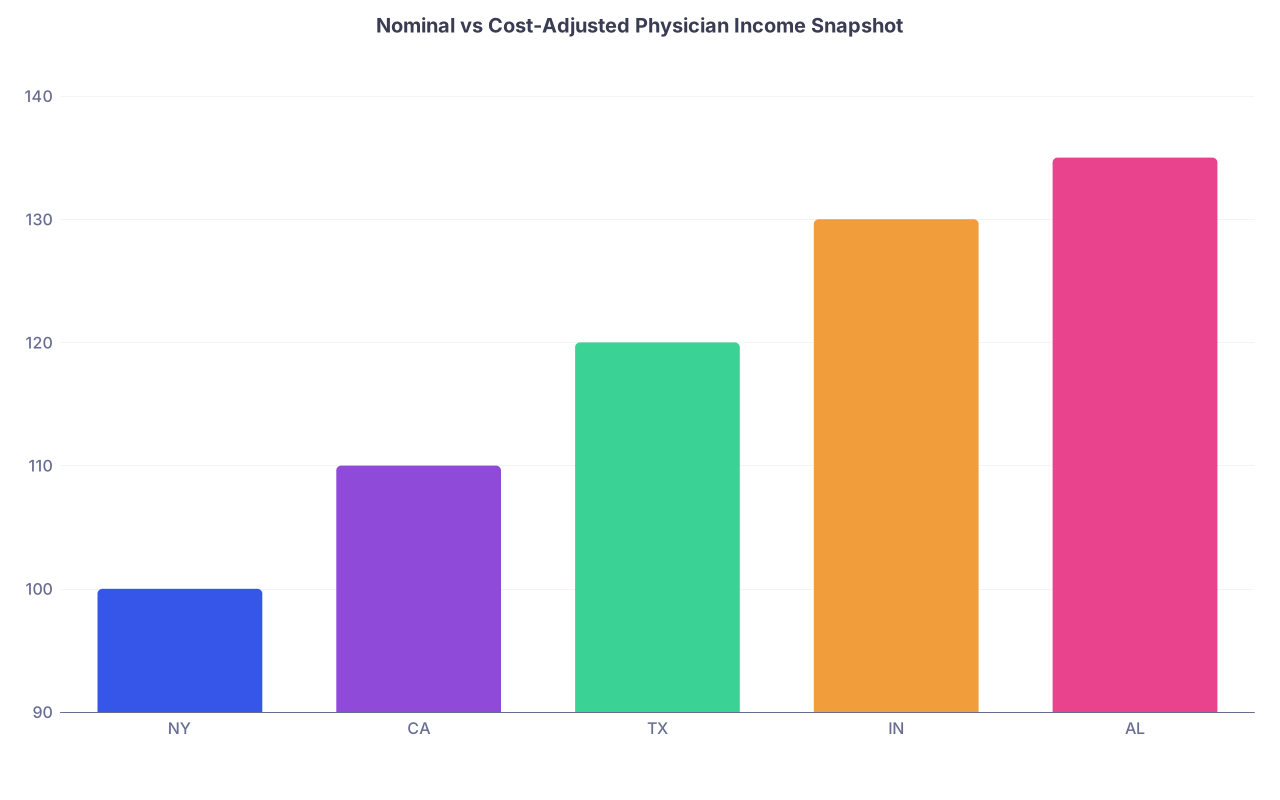
| Category | Value |
|---|---|
| NY | 100 |
| CA | 110 |
| TX | 120 |
| IN | 130 |
| AL | 135 |
On paper, Indiana and Alabama pay more than New York or California. But that simplistic view ignores:
- Housing costs
- Childcare
- Taxes
- Commuting time
- Malpractice premiums
- Call intensity
- Practice support
And more importantly, it ignores professional friction: how hard it is to do your actual job without fighting insurance companies, your own administration, or a broken EMR for 8 straight hours.
You can pay someone $450k, but if they’re seeing 30+ patients a day, doing their own prior auths, working in a medically underserved area with no subspecialty support, and covering hospital call every third weekend… they are not “well compensated.” They’re being paid off to tolerate dysfunction.
High salary is often hazard pay in disguise.
What Actually Predicts Physician Satisfaction (Across States)
Let’s skip the marketing fluff. When you look at multi‑year survey data and burnout research, the same variables keep coming up as strong predictors of physician satisfaction:
- Control over schedule and workload
- Administrative burden and EMR usability
- Practice environment and collegiality
- Regulatory and payer climate (how hostile the system feels)
- Community fit and support systems
- Legal/malpractice environment
- Cost of living relative to take‑home pay
Notice what’s missing: the raw number on your contract.
1. Control Over Schedule and Workload
This is the big one. It’s not glamorous, so recruiters do not lead with it.
There’s robust evidence that lack of control over work hours and scheduling is one of the strongest drivers of burnout. Mayo Clinic, Medscape, and AMA data all converge on the same point: autonomy matters more than compensation once you hit a certain income floor.
I’ve seen this play out again and again:
- A hospitalist in a high‑pay rural state working 7-on/7-off, 16–18 patients per day, constant cross-cover, and “just finish the notes at home.” Paid $350k+. Burned out in 3 years.
- Another hospitalist in a supposedly “lower‑pay” coastal state making $260k, capped census, strong nocturnist support, genuine 7-on/7-off with no post‑shift charting. Happy, stable, actually sees their family.
Who’s better off? Not the one with the larger 1040.

| Step | Description |
|---|---|
| Step 1 | High Salary Offer |
| Step 2 | High Satisfaction |
| Step 3 | Burnout Risk |
| Step 4 | Can Adjust Practice |
| Step 5 | Exit or Early Retirement |
| Step 6 | Workload Reasonable |
| Step 7 | Autonomy High |
State differences matter here. Some states and regions normalize brutal volumes and weekend expectations. Others are moving towards team-based care, scribes, and realistic RVU targets.
If you’re comparing states, you should be asking: What’s the average panel size, expected RVUs, and visit length? Not “What’s the MGMA 75th percentile salary?”
2. Administrative Burden and EMR Reality
Administrative burden has become the quiet killer of physician joy.
Studies repeatedly show that physicians spend 1.5–2 hours on documentation and desk work for every hour of direct patient care. This varies massively by system, not just specialty.
States where large, integrated systems or academic centers dominate often have:
- Somewhat lower salaries
- But better:
- EMR optimization
- Scribe programs
- Centralized prior auth teams
- Integrated ancillary staff
Meanwhile, high‑salary “doc factory” groups in some high‑pay states run skeleton crews, offload everything onto you, and call it “efficiency.”
You want to know which state is good to practice in? Ask:
- How many clicks per note is typical in the major EMRs used there?
- Do the dominant systems use scribes? Team-based MAs? Or one MA for three docs?
- Who handles prior auths—physician, or centralized staff?
If this sounds too granular, that’s exactly the point. The suffering is in the details, not in the line item labeled “base salary.”
Regulation, Payers, and the Hidden State‑Level Headwind
Not all states are equally hostile to the practice of medicine. Some make your life easier. Others treat you like a moderately dangerous criminal.
Key state‑level factors that actually change how your job feels:
Medicaid expansion & coverage rates
States that refused Medicaid expansion often have more uninsured/underinsured patients, worse collection rates, and more time spent navigating charity care and coverage issues.Insurer concentration
If one or two commercial payers dominate a state, they set the rules. Prior auth, denials, reimbursement hassles go up. Your practice may pass that headache straight to you.Scope of practice battles
States with constant legislative fights over independent NP/PA practice, corporate ownership of medical practices, and non-competes create a background stress level that does not show up in a salary survey.Telehealth and parity laws
Progressive telehealth regulations and payment parity can open up flexible practice models and hybrid schedules. That’s a huge quality-of-life factor.
| Factor | “Better” State Example | “Worse” State Example |
|---|---|---|
| Medicaid expansion | Yes | No |
| Dominant insurer count | 3–5 | 1–2 |
| Telehealth parity | Strong | Weak/none |
| Non-compete enforcement | Limited | Strong |
| Malpractice climate | Stable, capped | Volatile, plaintiff-friendly |
None of this shows up in the glossy “Top Paying States for Cardiologists” infographics.
Malpractice Climate and Legal Culture
This one’s not sexy, but ask any OB‑GYN or neurosurgeon: the malpractice climate of a state changes everything.
States with strong tort reform, damage caps, and predictable legal environments tend to:
- Reduce your background anxiety
- Lower malpractice premiums
- Reduce defensive medicine (and the associated wasted time and documentation bloat)
States with plaintiff‑friendly cultures and no meaningful reform:
- Increase unnecessary testing
- Increase note bloating for legal defense
- Make high‑risk specialties borderline untenable
That “extra” $40k you’re seeing in a higher‑pay state can disappear quickly in malpractice premiums, extra tail coverage, and your own mental tax of practicing in a lawsuit‑heavy environment.
Culture, Colleagues, and Community: The Squishy Stuff That Isn’t Actually Squishy
Most physicians underestimate this until they get burnt.
You can’t quantify this easily, but it’s predictably huge:
- Are you joining a culture where admin vs physician is adversarial, or where leadership is actually clinically active?
- Do physicians there stay for 10+ years, or is the average tenure 2–3 years with constant backfilling?
- Do you see genuine mentoring and shared governance, or a lot of “we value physician input” posters that mean nothing?
This varies by state because certain states are dominated by certain types of systems:
- Some states are health system–centric: a few big integrated groups, deliberate culture-building, more committees (yes, annoying) but also more guardrails.
- Other states are private equity and for‑profit dominated: more churn, intense pressure on productivity, and a “move fast, break people” mentality.
If I had to choose between:
- State A: $420k, known PE-heavy urgent care / hospitalist mills, short physician tenure
- State B: $320k, stable multispecialty groups, physicians staying 15–20 years
It’s not a hard decision if I care about actually liking my job in 10 years.
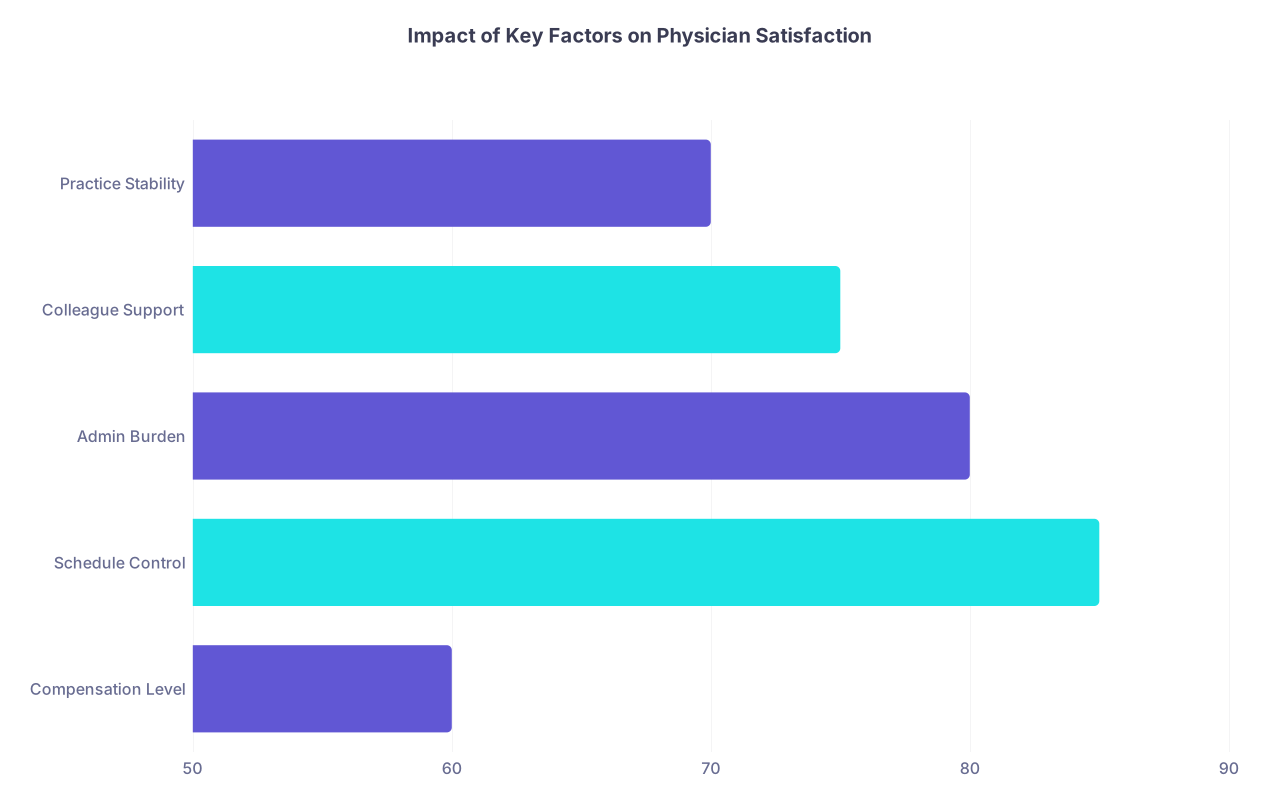
| Category | Value |
|---|---|
| Compensation Level | 60 |
| Schedule Control | 85 |
| Admin Burden | 80 |
| Colleague Support | 75 |
| Practice Stability | 70 |
(The exact percentages vary by study, but the general pattern—control > money—is very consistent.)
Cost of Living: The Boring Math That Beats Salary Headlines
Let’s get pragmatic. If you insist on looking at salary, at least do grown‑up arithmetic.
Two simplified scenarios:
| Scenario | Salary | State Type | Cost of Living Index* | Net Lifestyle Potential |
|---|---|---|---|---|
| Big‑City Coasts | $350k | High cost, prestigious | 140 | Moderate |
| High‑Pay Midwest/Rural | $450k | Lower cost, high volume | 90 | High (if tolerable) |
| Moderate Pay, Moderate Cost | $300k | Balanced metro/suburb | 100 | Solid |
| Low Pay, Low Cost, Low Support | $250k | Underserved, unstable | 80 | Miserable |
*Cost of living index: US average ≈ 100
The myth is that “more salary = more lifestyle.” The reality is “net time + net flexibility + net headspace = more lifestyle.”
I’ve seen physicians in a moderate‑pay, moderate‑cost state:
- Work 0.8 FTE
- Do some telehealth or urgent care on the side if they feel like it
- Save plenty for retirement
- Actually enjoy weekends
Meanwhile, their counterpart in a “high salary” state is locked into:
- Full‑time RVU grind
- Long commute
- High property tax
- School tuition costs that eat the raise
Who’s winning? Not the one whose number looks better on LinkedIn.
Red Flags and Green Flags When Comparing States
If you want a practical shortcut, here’s how you should be evaluating states as a physician—not with salary graphs, but with risk/benefit patterns.
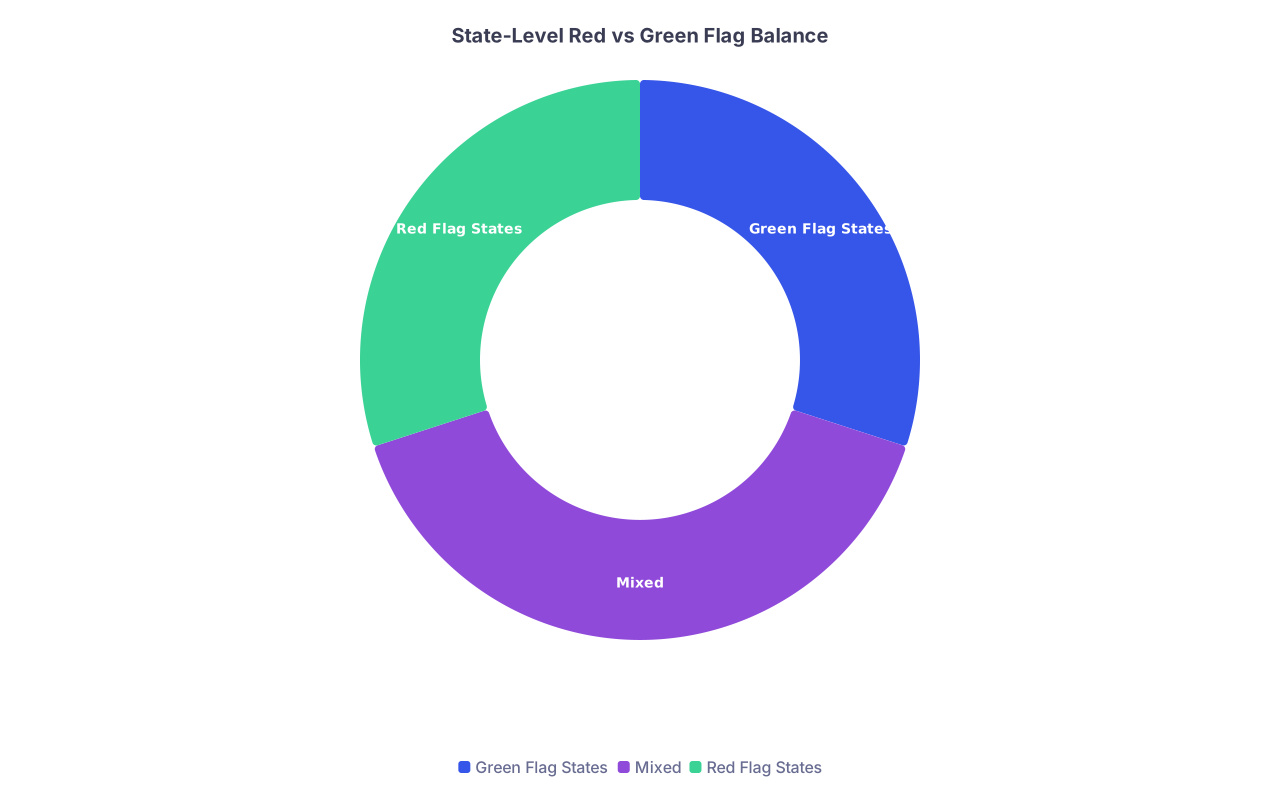
| Category | Value |
|---|---|
| Green Flag States | 30 |
| Mixed | 40 |
| Red Flag States | 30 |
State-Level Red Flags
- Dominance of one or two mega‑insurers with aggressive prior auth policies
- Rapid expansion of private equity–owned practices in your specialty
- High physician turnover in major systems; constant job postings for the same role
- No Medicaid expansion, high uninsured rates, and weak safety net funding
- Strong enforcement of non‑compete clauses and restrictive covenants
- Repeated stories (from actual local docs, not recruiters) about “burnout is bad here”
State-Level Green Flags
- Multiple competing systems so you’re not held hostage by one employer
- Documented investment in team-based care, scribes, or APP support
- Reasonable non-compete norms (or statutory limits)
- Medicaid expansion and better baseline access for patients
- Long physician tenure at major employers (pro tip: ask, “How long has your average physician been here?”)
States that look mediocre on salary lists can shine on these measures. And vice versa.
How to Actually Decide Where to Work as a Physician
If you remember nothing else, remember this: you are choosing a system and a lifestyle, not a number.
Use salary as a filter, not as your north star. Here’s a more honest hierarchy for deciding where to practice:
Eliminate states where:
- You’d be miserable living there, even with a great job
- The legal/insurance climate is actively hostile to your specialty
Among the remaining states, prioritize:
- Workload and schedule control
- Local system culture and physician tenure
- Administrative support and EMR reality
- Community fit for you and your family
Then—and only then—compare salary and benefits.

| Step | Description |
|---|---|
| Step 1 | Identify Potential States |
| Step 2 | Discard |
| Step 3 | Research Legal and Payer Climate |
| Step 4 | Evaluate System Culture and Workload |
| Step 5 | Assess Community and Lifestyle Fit |
| Step 6 | Compare Salary and Benefits |
| Step 7 | Choose Best Overall Package |
| Step 8 | Could I live there long term |
You’ll notice salary is at the very end, where it belongs. That’s not romanticism. That’s following what actual satisfaction and burnout data show.
Years from now, you won’t remember whether your starting salary was $280k or $320k. You’ll remember whether you dreaded opening your inbox each morning, whether your kids knew you as a real person or a blurry weekend visitor, and whether the place you chose treated you like a human being or a replaceable RVU machine.
Choose your state—and your job—the way you’d choose a treatment plan: by outcomes that matter, not by a single flashy number.


