

Rural America isn’t some guaranteed “purpose-filled, low-stress, grateful-patients” paradise for doctors. That narrative is half marketing, half guilt trip—and it regularly misleads physicians into career decisions they regret.
Let me be blunt: rural practice can be fantastic for some doctors. High autonomy, broad scope, real community impact. But there’s a parallel reality you rarely hear in recruiting dinners and glossy brochures—chronic understaffing, call every-other-night, financial instability, and burnout rates that rival any big-city tertiary center.
You deserve the actual numbers, not a Hallmark version of “serving the underserved.”
The Myth: “Rural = Underserved Heaven = Best Place to Work”
You’ve heard the script.
Program director: “If you want real medicine and appreciative patients, go rural. They need you more. You’ll have better work–life balance, lower cost of living, and actual autonomy.”
Recruiter: “We’re not corporate. We’re a tight-knit family. Our community really values their doctors.”
This plays perfectly into three things:
- Your guilt about privilege and access.
- Your fear of being a small cog in a massive academic center.
- Your student-loan anxiety.
But let’s stack this against data.
The access reality
Rural areas are, by many metrics, underserved. That’s true. HRSA designations for Health Professional Shortage Areas (HPSAs) are heavily rural.
Yet “they need you” doesn’t automatically translate into “this is a good job for you.”
What the rural shortage often means in practice:
- Fewer physicians covering huge catchment areas.
- Massive panel sizes and limited backup.
- You are the system. When you’re off, the system is half-closed.
You’re not stepping into an idealized “community medicine utopia.” In many places you’re plugging leaks in a ship that’s already taking on water.
What the Data Shows: Not All Rural Jobs Are Created Equal
Let’s lay out some harder numbers and patterns that actually matter when you’re deciding where to work.
Burnout and workload
There’s a common claim: “Rural doctors are happier and less burned out.” Sometimes true. Often not.
Studies are mixed, but here’s the pattern I keep seeing:
- When rural systems are well-supported (stable hospital, adequate staffing, decent call coverage), satisfaction can be very high.
- When they’re not, it’s a perfect recipe for burnout: emotional responsibility for an entire town’s health with minimal system backup.
Rural physicians frequently report:
- Higher on-call burden.
- More non-clinical scut: admin, quality metrics, informal care coordination.
- Being the de facto specialist because no one else is nearby.
That’s not inherently bad—if you want that. But it’s the opposite of “simple, slow-paced medicine.”
Income and cost of living: the half-true selling points
You’ll hear, “You’ll make more than city docs and spend less.” Sometimes. But the pattern is more nuanced.
| Setting | Base Pay Trend | Bonuses/Loan Repayment | Cost of Living |
|---|---|---|---|
| Large Urban Academic | Lower base | Lower | High |
| Urban Private/Group | Moderate–High base | Moderate | High–Moderate |
| Rural Independent | Variable, often high | High (to recruit) | Low–Moderate |
| Rural Hospital-Employed | Moderate–High base | Sign-on + some loan help | Low |
The reality:
- Yes, some rural jobs genuinely pay more. Especially for primary care, EM, anesthesia, and certain surgical fields.
- But “more” often comes with strings: heavier call, broader scope, weaker support, and higher risk of burnout.
- Also, many rural markets are sliding toward system consolidation, which brings RVU pressure and corporate oversight just like suburban settings—without the nearby backup.
Autonomy and income are there. But they’re purchased with responsibility and risk.
The Structural Problems You Inherit in Many Rural Jobs
This is the part the brochures skip. You can love rural patients and still be crushed by rural systems.
1. Unstable hospitals and closures
Rural hospital closures are not a theoretical concern. They are happening, repeatedly.
A recurring pattern:
- Small rural hospital runs thin margins for years.
- Payer mix is ugly: high Medicaid, Medicare, uninsured, underinsured.
- One major loss (a departing surgeon, OB group, or anesthesiology coverage) destabilizes the whole operation.
- Within a few years: service lines downsized or hospital closed.
You, the new young physician, might sign a three-year contract and then watch the OR volume collapse, OB shut down, or the hospital be acquired by a larger system and “restructured.”
That doesn’t mean “never go rural.” It means you should treat job stability as the central question, not an afterthought.
2. You’re covering more than just your “job”
I’ve seen this too many times:
A rural FP or IM doc thinking they’re signing up for clinic with some inpatient. They land in a reality where they’re:
- Rounding on inpatients.
- Covering ED shifts or “backup ED” call.
- Doing nursing home rounds across several facilities.
- Taking community calls because “you’re the only cardiologist within 90 miles” (even if you’re IM with an echo interest, not boarded cardiology).
Is that always bad? Not necessarily. If you like broad, old-school generalist work, this can be professionally fascinating.
But if your personal bandwidth, training, or risk tolerance doesn’t match that load, “meaningful” becomes “miserable” very quickly.
3. Specialty isolation and clinical risk
In many rural settings, you’re practicing far from other specialists. That means:
- Fewer people to bounce tricky cases off in real time.
- Limited options for urgent transfers when tertiary centers are full (which has become a real, chronic issue).
- Pressure to manage borderline cases locally because there’s nowhere else to send them.
Autonomy feels great—until the liability, clinical uncertainty, and moral stress start to stack.
The Good Side of Rural Work (Because It Isn’t All Doom)
Let me be clear: rural medicine can be deeply rewarding. I’ve seen physicians absolutely thrive in certain rural setups.
Where it tends to work well:
- Robust hospital or health system backing: not a shoestring operation constantly at risk of dying.
- Reasonable staffing levels: not “one doc covering everything for 40,000 people.”
- Realistic scope: you’re not being pushed to do procedures or care beyond your training because “no one else is here.”
- Strong local culture fit: you actually like living there, not just tolerating it for loan paydown.
When those align, you get real upsides:
- Longitudinal relationships over decades.
- The satisfaction of being the doctor for families, not one of dozens.
- Flexibility to shape your practice—OB or no OB? Procedures or not? Leadership roles if you want them.
But again: those good fits are specific and deliberate, not automatic just because the job is rural.
Who Actually Thrives in Rural Medicine?
Here’s where I’m going to be a little blunt.
Rural work tends to fit best for physicians who:
- Genuinely enjoy broad-spectrum practice and ambiguity.
- Have a decent tolerance for professional isolation and responsibility.
- Care more about autonomy and meaning than fancy restaurants, subspecialty peers, or big-city amenities.
- Are willing to be embedded in a community, not just commuting in and out like a locum mercenary.
The people who struggle most:
- Docs who picked rural purely for the money or loan forgiveness.
- Specialists who need frequent collaboration with peers and subspecialists.
- Those who dislike being “on” in public—because you will see your patients at the grocery store, church, and gas station.
- Physicians with partners who hate small town living. Spouse dissatisfaction is one of the most consistent drivers of early exits.
Rural America isn’t just a job site; it’s a social environment. If you or your family don’t like that environment, no bonus will fix it.
What You Should Actually Look At (Beyond the Brochure)
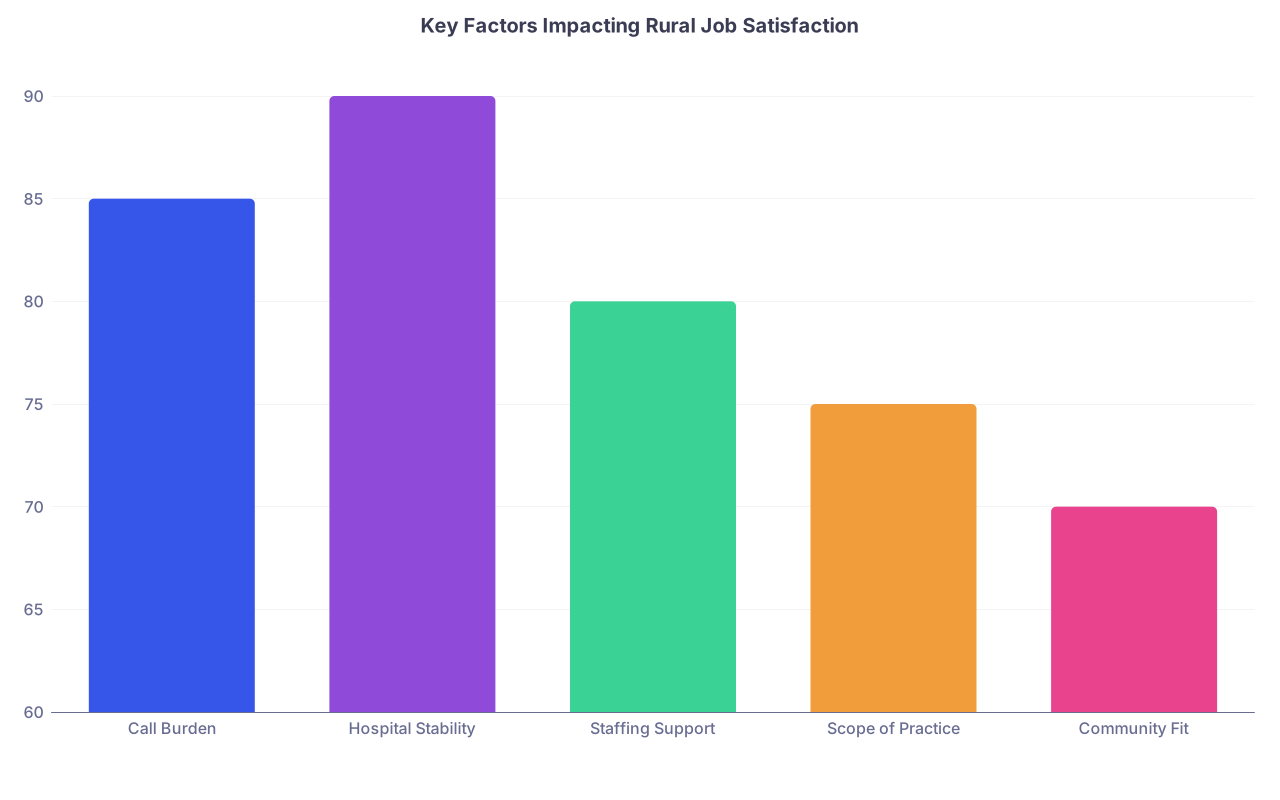
If you’re considering rural practice and want to maximize the chance it’s a good place to work, you need to interrogate the system, not just the salary.
| Category | Value |
|---|---|
| Call Burden | 85 |
| Hospital Stability | 90 |
| Staffing Support | 80 |
| Scope of Practice | 75 |
| Community Fit | 70 |
Those are not “my feelings.” They’re the things that repeatedly show up in retention, burnout, and satisfaction surveys among rural docs.
Here’s how you sanity-check a potential job:
- Ask about the last five years of physician turnover. Names, not just numbers.
- Ask which service lines have closed or opened in the last five years.
- Ask what happens if you get sick or need to be out unexpectedly. Who actually covers your patients?
- Ask to talk privately to a mid-career doc who has been there at least 5 years. If everyone is new or near retirement, that is not a coincidence.
- Look at call schedules. See them written. “Q3-4” can quietly become “effectively Q2” when colleagues leave.
You’re not just choosing “rural vs urban.” You’re choosing “how much system weight will be on my shoulders every day.”
Rural Isn’t Homogeneous: Know the Variants
People talk about “rural” like it’s a single category. It is not.
You have at least three very different beasts:
Frontier or critical access hospital towns
Population small. Hospital tiny. You’re very much the only game in town. Highest autonomy, highest responsibility, highest risk of overload.Regional hub towns
Population larger, draw from many surrounding counties. More specialists, some backup, but still substantial load. These can be reasonable compromises.Exurban or “edge” rural
Technically rural by HRSA or Census codes, but a short drive from a metro. Patients may flow to city hospitals; hospital may be a satellite in a larger system. Often less intense than true frontier work.
Each has a different risk–reward profile. Lumping them together is how people end up in situations that don’t fit what they actually wanted.
The Future of Rural Medicine: Don’t Bet on Nostalgia
A lot of “go rural” advice is built on a 1990s mental model: small independent hospitals, benevolent boards, a handful of docs running the show.
That world is disappearing.
What’s happening instead:
- System consolidation: many rural hospitals are now outposts of regional or national systems.
- Telemedicine creep: some cognitive specialties may end up more virtual, reducing the need for on-site presence but not necessarily reducing local workload for primary care.
- Service line pruning: OB, surgery, and ICU services are being cut in marginal hospitals, shifting rural docs into more outpatient and triage roles.

| Step | Description |
|---|---|
| Step 1 | Independent Rural Hospital |
| Step 2 | Financial Strain |
| Step 3 | System Acquisition |
| Step 4 | Service Cuts |
| Step 5 | Hospital Closure |
| Step 6 | Service Line Restructure |
| Step 7 | Outpatient Focus |
| Step 8 | Find Partner |
So if you’re thinking long-term career, don’t just ask, “What is this job now?” Ask, “What is this hospital and town likely to look like in 10 years?”
If OB is your passion and the hospital’s OB service line is barely hanging on, that’s not a “forever home,” no matter how warm the welcome.
So… Is Rural America a Great Place to Work as a Doctor?
It can be. It can also be a professional grinder dressed up as service and virtue.
The myth is that “rural + underserved” automatically equals meaningful, sustainable work. The data and lived experience say otherwise:
- Rural shortages often signal structural dysfunction, not just an opportunity.
- Compensation and cost of living can be excellent, but usually paired with heavier workload and higher responsibility.
- Job stability and hospital viability are the hidden levers that determine whether your “dream rural job” is still standing in 5–10 years.
If you go rural with clear eyes—about the system, not just the mission—you can absolutely build a rich, satisfying career there. But don’t let guilt, romanticism, or a recruiter’s script substitute for hard questions.


