

The biggest mistake doctors make when choosing a country to work in isn’t about salary. It’s about taxes and loans they barely understand until they’re already trapped.
You’re not just choosing a job in another country. You’re choosing an entire tax regime, a loan repayment reality, and sometimes a future where moving back home becomes financially impossible. Most physicians do not realize this until years in, when fixing it is brutally expensive.
Let’s walk through the worst errors I see over and over—and how to avoid becoming another “I wish someone told me” story.
1. Chasing Gross Salary and Ignoring After‑Tax Reality
If you compare jobs by “salary” alone, you’re already halfway to making a bad decision.
I constantly see this pattern:
- Doctor A: Offered £120k in the UK
- Doctor B: Offered €140k in Germany
- Doctor C: Offered 1,000,000 AED in Dubai
- Doctor D: Offered 450,000 SGD in Singapore
Everyone talks about who “won” based on the biggest gross number. That’s amateur hour.
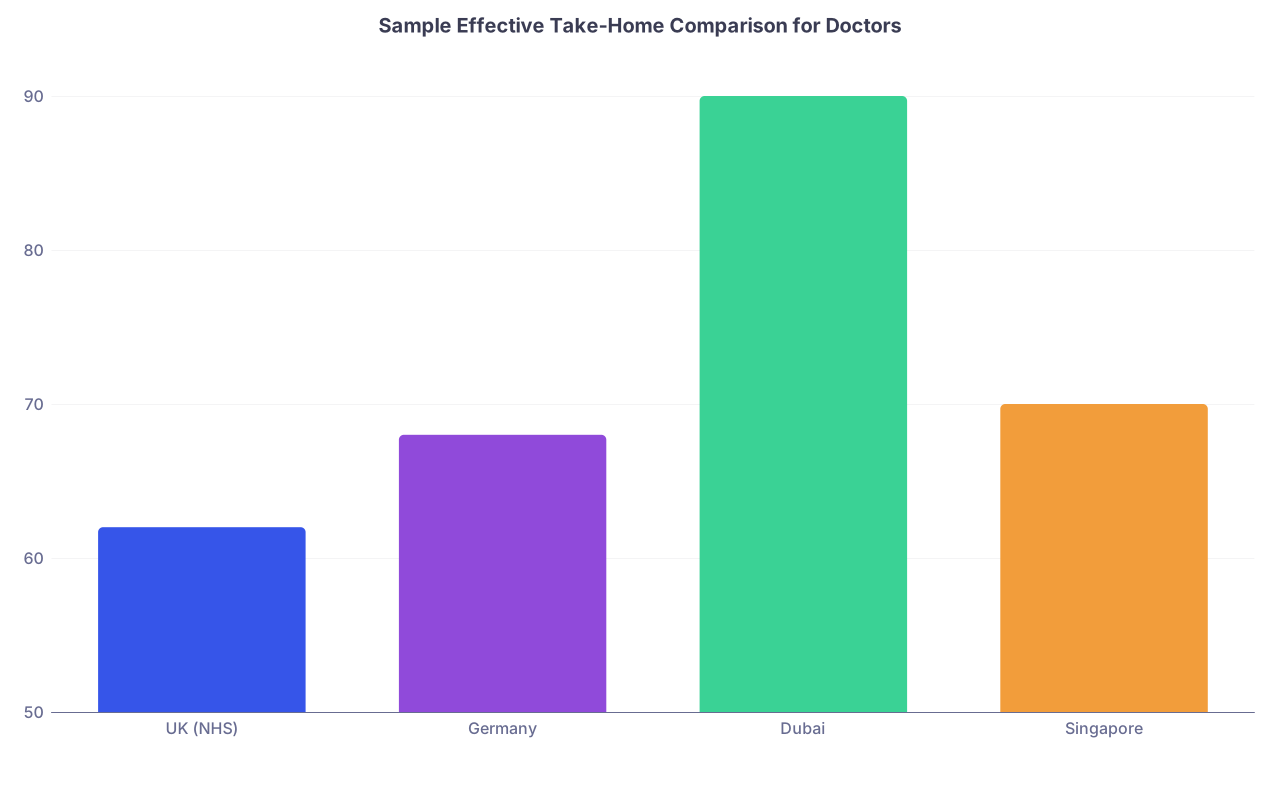
What actually matters is your take‑home after tax, mandatory social contributions, and cost of living. Miss that, and you get surprised by how little is left.
| Category | Value |
|---|---|
| UK (NHS) | 62 |
| Germany | 68 |
| Dubai | 90 |
| Singapore | 70 |
(Illustrative: approximate net as percentage of gross, assuming typical deductions and tax regimes; Dubai is tax-free but with other costs.)
Common mistakes:
- Ignoring progressive tax brackets
You see “marginal rate 45%” and panic—or “0% income tax” and celebrate. Both reactions are simplistic.
- High‑tax countries (UK, Sweden, Canada) can still leave you with reasonable net income if benefits are strong and effective average rate is lower than you think.
- Low‑tax or no‑tax countries (UAE, Qatar) can seem amazing—until you account for:
- Housing (often exorbitant)
- School fees for kids (easily $20–40k/year per child)
- Private health insurance
- Flights home
- Forgetting “hidden” wage cuts: social contributions
In many countries, your payslip will include:
- Pension contributions (mandatory or effectively mandatory)
- Social security, unemployment, long‑term care
- Health insurance shares
These aren’t trivia. They can be 15–25% of your pay.
- Not checking effective tax treaties with your home country
If you’re from the US, this is deadly important:
- The US taxes citizens and permanent residents globally.
- That “tax‑free” job in the UAE may still generate a US tax return, and possibly tax due, depending on:
- Foreign Earned Income Exclusion (FEIE)
- Foreign tax credits
- Your housing exclusion limits
If you’re from a non‑US country, many have residency‑based systems but still tax you in specific situations (e.g., if they deem you “tax resident” because of ties, home ownership, spouse, kids).
How to avoid this mistake:
- Use at least one expat tax calculator for each country (ideally from a firm that specializes in foreigners).
- Look up your country’s tax treaty (if any) with the new country.
- Get a one‑hour consult with a cross‑border tax advisor before you sign anything—especially if you’re American, British with UK property, Canadian, or from any country known for aggressive tax residence rules.
2. Forgetting That Your Student Loans Don’t Leave With You
You can fly across the world. Your debt does not care.
Doctors often assume:
- “If I leave the US, my federal loans pause or go away.”
- “If I move from the UK to Australia, my student loan won’t matter anymore.”
- “My home country can’t chase me abroad.”
Wrong. Wrong. And dangerously wrong in some cases.
US doctors: the PSLF / IDR / expat trap
If you have US federal loans and you’re considering:
- PSLF (Public Service Loan Forgiveness)
- Any income-driven repayment (IDR) plan
- Long‑term forgiveness planning
Then moving abroad can wreck the entire strategy if you don’t understand the rules.
Common disasters:
- Leaving before 120 PSLF payments are secured
I’ve actually heard: “I only had 72 PSLF‑qualifying payments left, but the tax‑free job in Dubai was too good to pass up.”
That person walked away from potentially hundreds of thousands in future forgiveness. For maybe $50–70k more per year. For a few years. The math is ugly.
- Not realizing foreign income can still count for IDR
- You still must file US taxes each year.
- You still must recertify income for IDR, even if abroad.
- FEIE can change how your “adjusted gross income” is calculated. This can reduce or raise your IDR payment unexpectedly.
- Consolidating or refinancing at the wrong time
People move abroad and then refinance federal loans to private lenders because the “rate is lower.” They don’t realize:
- They’re permanently giving up IDR and PSLF protections.
- If they ever want to move back to US academic or nonprofit work, they’ve killed their PSLF eligibility forever.
UK, Australia, Canada, and others: overseas collection is real
- UK (Student Loans Company): If you leave the UK, you’re required to submit overseas income forms. They’ll base your repayment on your foreign income, not on UK income.
- Australia (HELP/HECS): You must report your worldwide income to the ATO even if you live abroad. Repayments are assessed accordingly.
- Canada: Loans can go into default with serious credit and legal consequences, even if your salary is in another currency.
I’ve seen doctors return “home” for a consultant/attending job only to find:
- Wage garnishments waiting for them.
- Ruined credit history, impacting mortgage approvals.
- Accrued interest they didn’t bother tracking while abroad.
How to avoid this mistake:
- Make a loan map before you move:
- Type of loan (federal, private, government-backed, income‑based).
- Jurisdiction (US, UK, AU, etc.).
- Rules while living abroad.
- For US doctors: talk to a student loan specialist who understands expat issues before committing to a move.
- For UK/AU/CA: check official gov pages about overseas obligations and confirm with your loan servicer. Get email confirmation of any advice.
3. Misunderstanding Tax Residency and “Home Ties”
Another common error: thinking residency equals where you work physically. That’s not how most tax authorities think.
You can become tax resident in a country:
- By days spent there (commonly 183 days+).
- By your “center of vital interests” (family, property, business).
- By formal residency status (PR, green card, etc.).
And yes, you can be tax resident in more than one country at once. That’s a nightmare.

| Step | Description |
|---|---|
| Step 1 | Doctor Moves Abroad |
| Step 2 | Possible tax ties remain |
| Step 3 | Check other ties |
| Step 4 | High risk dual residency |
| Step 5 | Primary residency abroad likely |
| Step 6 | Own home in origin country |
| Step 7 | Family living there |
Classic dual‑residency trap:
- You keep your house in the UK “just in case.”
- Your spouse and kids stay there for schooling.
- You fly back frequently.
- You work full‑time in, say, the UAE.
UK HMRC might still consider you UK tax resident under the statutory residence test and ties rules. Meanwhile, UAE may treat you as tax resident there.
Then what?
- Both countries believe they can tax your income.
- Tax treaties may help—but not always cleanly or quickly.
- You’ll be paying for highly specialized accountants to unwind the mess.
“I’ll just not tell them” fantasy
I hear the whispered version of this all too often:
“Well, if I’m in Qatar and I’m paid there, how will [insert home tax authority] know?”
Here’s how they know:
- CRS / FATCA: Global information‑sharing agreements between banks and tax authorities.
- Your foreign bank reports that you, a resident/citizen of Country X, hold accounts and receive income.
- Your home tax authority gets that data automatically.
The days of simply not mentioning foreign income are basically over for any country that takes revenue seriously.
How to avoid this mistake:
- Before moving, do a tax residency assessment:
- Count your days in each country.
- List your ties: property, spouse, kids, business ownership, pensions.
- Use the official residency tests (e.g., UK’s Statutory Residence Test, Canada’s residency criteria).
- Ask a cross‑border tax advisor:
“If I structure my move like this, which country will likely claim me as tax resident and why?”
Then adjust:
- Sell or rent out property differently.
- Move your family fully (or accept the tax cost of not doing so).
- Change where you hold investments.
4. Ignoring Social Security, Pensions, and “Future You”
Doctors obsess over their paycheck and forget about retired‑you entirely.
If you move countries:
- Your pension schemes may not be portable.
- Your years of contributions might not count where you end up retiring.
- You can accidentally forfeit contributions because you didn’t hit vesting thresholds.
| Scenario | Likely Problem |
|---|---|
| Work 7 years in NHS, then leave | Reduced NHS pension compared to full career; may not meet thresholds for enhanced benefits |
| Move mid‑career to UAE | No state pension, must rely on own savings; lose future accrual in home system |
| Pay into US Social Security briefly | May not reach 40 quarters needed; benefits tiny or nonexistent |
| Multiple short stints in EU countries | Fragmented pensions that are hard to consolidate or track |
Totalization agreements: ignored by most, costly if you do
Many countries have totalization agreements (US–UK, US–Germany, etc.) to avoid double social security taxation and to combine service periods.
Doctors rarely know these exist. So they:
- Pay social charges in both countries unnecessarily.
- Miss chances to qualify for home country benefits by a small margin.
Employer pensions abroad
In some places, employer pensions are excellent. In others, they’re cosmetic.
- Gulf: tax‑free income but typically no robust state pension. Employer “end of service gratuity” may be the only structured benefit.
- Singapore: CPF for citizens/permanent residents, but foreigners are treated differently.
- Switzerland: Mandatory 2nd pillar pensions, but rules vary and cashing out when leaving can trigger taxes and penalties.
How to avoid this mistake:
- Ask every employer:
- Is there a state pension I’ll pay into?
- Is there an employer pension or retirement plan? Vesting rules?
- Can I withdraw or transfer benefits if I leave?
- For your home country:
- Check how leaving for X years impacts your future pension.
- Look specifically for “totalization agreement” between the two countries.
- Map your retirement strategy assuming:
- You may not retire in the country you’re moving to.
- You might want the option to return home.
5. Mispricing Cost of Living and Lifestyle Inflation
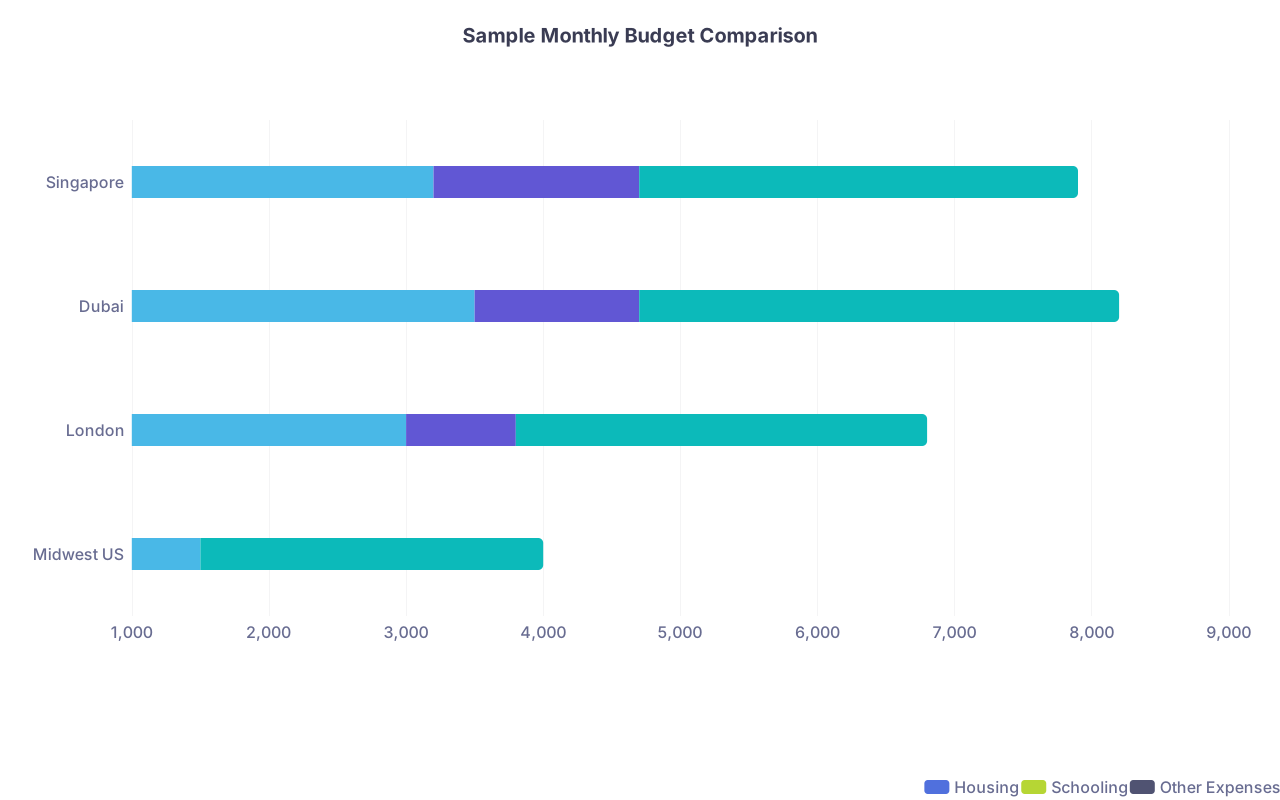
A high net income is useless if your local expenses explode.
The big trap countries:
- High‑gloss, high‑cost cities: Dubai, Singapore, Zurich, Sydney, London.
- Popular expat hubs with “expat pricing” on rent, schooling, and services.
| Category | Housing | Schooling | Other Expenses |
|---|---|---|---|
| Midwest US | 1500 | 0 | 2500 |
| London | 3000 | 800 | 3000 |
| Dubai | 3500 | 1200 | 3500 |
| Singapore | 3200 | 1500 | 3200 |
Common blind spots:
- School fees: In some expat locations, international schools are your only realistic choice:
- $20k–40k/year per child is not rare.
- Many hospital “education allowances” are capped and don’t cover full costs.
- Housing: Employer “housing allowances” can:
- Push you into more expensive areas.
- Be taxable in some systems.
- Disappear after a few years, leaving you stuck with a lifestyle you can’t sustain.
Then there’s lifestyle inflation:
- Colleagues driving luxury cars, taking frequent long‑haul holidays, staying in 5‑star hotels “because we work hard.”
- You copy them, assuming their finances look like yours. They usually don’t.
How to avoid this mistake:
- Build a mock monthly budget before accepting a job:
- Rent (based on actual neighborhood listings, not guesses).
- Utilities, food, transport.
- School or childcare.
- Health insurance / co‑pays.
- Flights home once or twice per year.
- Compare it to your after‑tax pay, not your gross.
- Decide in advance:
“What percentage of my income will I save or use to crush loans?” Then check whether that’s realistic in that city.
6. Overlooking Currency Risk and Repatriation Problems
You earn in one currency, owe in another, and plan to retire in maybe a third. Doctors underestimate how violent exchange rates can be over a decade.
Real scenario I’ve seen:
- UK doctor moves to Australia.
- Keeps a big UK mortgage.
- Earns and saves in AUD.
- GBP strengthens significantly just as they want to pay off or sell. Their AUD savings suddenly feel 20–30% smaller relative to their UK debt and house price.
Or:
- A US doctor earns in a weaker local currency, but federal loans are in USD.
- If local currency drops, their loan burden in local terms balloons.
You’re effectively speculating on FX markets without intending to.
On top of that, some countries make it painful to move money out:
- Withholding taxes on transfers.
- Reporting requirements.
- Limits or bureaucracy around foreign exchange.
How to avoid this mistake:
- If you have loans in a specific currency, prioritize:
- Earning in that currency, or
- Aggressively paying off those loans before fully committing to long‑term work in a different currency zone.
- Keep at least part of your savings in:
- The currency of your debt.
- The currency of where you plan to retire (if you have a strong plan).
- Ask your bank (and employer) about:
- Costs of international transfers.
- Any local rules on money leaving the country.
7. Assuming “The Hospital Will Handle It”
This is one of the most dangerous assumptions I see with migrating doctors.
Hospitals and recruiters will help you with:
- Visas.
- Licensing.
- Sometimes housing and a relocation stipend.
They do not reliably:
- Plan your tax residency.
- Optimize your loan repayment.
- Protect your long‑term pension and retirement structure.
Their job is to fill roles, not to function as your cross‑border financial advisor.
Red flags I’ve heard from HR/recruiters:
- “Most doctors don’t have any tax issues after moving here.”
- “We’re tax free, so it’s really simple.”
- “Your loans are between you and your home country; shouldn’t affect anything here.”
Translation: You’re on your own.
How to avoid this mistake:
- Treat HR information as partial and often biased toward making the move sound easy.
- Independently confirm:
- Tax details with a cross‑border accountant.
- Loan implications with a loan specialist.
- Pension and social security issues with someone who actually works in that domain.
If you’re not willing to spend a few hundred on real advice before committing to a multi‑year international move, you’re pretending this is smaller than it is.
8. Not Planning an Exit Strategy (Or a Return)
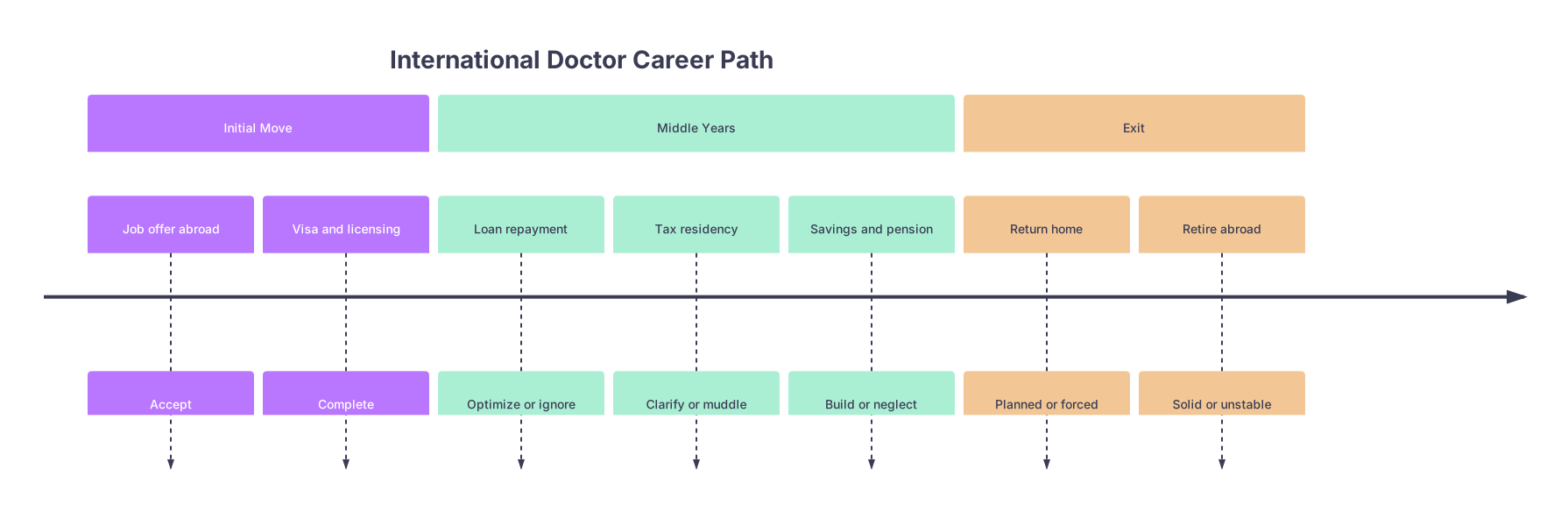
The last big error: doctors plan the move like it’s forever, then life happens.
- Relationship changes.
- Parents get sick.
- Kids struggle in local schools.
- Political or regulatory environment shifts.
Suddenly, you want—or need—to leave.
If you didn’t plan for that:
- You can’t afford to move back because of:
- Housing prices at home.
- Currency changes.
- Pension issues.
- New licensing or training requirements.
- Or you’re forced to take a terrible job just to satisfy visa/tax obligations.
| Period | Event |
|---|---|
| Initial Move - Job offer abroad | Accept |
| Initial Move - Visa and licensing | Complete |
| Middle Years - Loan repayment | Optimize or ignore |
| Middle Years - Tax residency | Clarify or muddle |
| Middle Years - Savings and pension | Build or neglect |
| Exit - Return home | Planned or forced |
| Exit - Retire abroad | Solid or unstable |
How to avoid this mistake:
Before you move, answer:
- If I had to return home in 3 years, could I:
- Qualify for the jobs I want?
- Afford housing?
- Transfer, preserve, or at least not lose the bulk of my pension?
- If I ended up staying abroad 20+ years, would:
- My loans be safely handled?
- My retirement be secure and portable?
- My tax structure still make sense?
Write down a simple exit plan:
- “If I return, I’ll need X cash buffer, Y housing plan, Z credential recognition.”
- “If I stay, I’ll need A retirement accounts in my home country, B in my host country, C loans paid off.”
Not elaborate. Just enough so future‑you isn’t cleaning up current‑you’s mess.
9. A Quick Pre‑Move Checklist (So You Don’t Blow This)
Use this as a minimum standard. If a country or job fails this checklist, slow down.

Before you sign any contract:
Tax
- Do I know which country (or countries) will treat me as tax resident?
- Did I use a realistic after‑tax income calculator for that specific country?
- Do I understand any tax treaty interaction with my home country?
Loans
- How will my exact loan types behave while I’m abroad?
- If I have US federal loans, how does my move affect PSLF/IDR or future forgiveness?
- If I have UK/AU/CA loans, what are my overseas reporting obligations?
Pensions & Social Security
- What am I giving up by leaving my home system?
- What am I gaining in the new system?
- Do the two countries have a totalization agreement?
Cost of Living
- Have I built a realistic monthly budget using local data?
- How much will I actually be able to save or put toward loans every month?
Currency & Repatriation
- In what currencies are my debts, income, and long‑term savings?
- Can I easily move money out of the new country?
Exit Strategy
- If I had to leave in 2–3 years, would this move still have been financially smart?
If you can’t answer these questions clearly, do not move yet. You’re not ready.
Your Next Step Today
Open a blank document and title it: “If I Move To ____: Money, Tax, and Loan Reality”.
Write three headings:
- Taxes
- Loans
- Pensions & Future
Under each, list what you actually know right now versus what’s just assumption or recruiter talk. Anywhere you see guesswork, highlight it.
Those highlights are where you’ll get burned if you move blind.
Then—before another recruiter call, before any signed offer—book a single session with a cross‑border tax/loan expert and walk through that document together.


