

The way most residents pick a state to train or practice in is financially reckless.
They look at prestige, weather, or vibes. They ignore tax codes, loan rules, and cost-of-living traps. Then they wonder why they feel poor on a “high-income” career path.
You are loan‑crushed. So your strategy has to be different. You are not choosing the “best” state in some abstract sense. You are choosing the state that maximizes take‑home pay after taxes, cost of living, and loan strategy.
Here is how to systematically do that.
Step 1: Define “Take‑Home Pay” Like an Adult, Not an MS1
Your real question is not “Where do doctors make the most?”
It is “Where will I, with my debt, my specialty, and my goals, keep the most money after everyone else takes their cut?”
That means you stop fixating on posted salary and start looking at this formula:
Effective Take‑Home = Base Salary
– Federal Taxes
– State + Local Taxes
– Cost of Living (housing + basic expenses)
– Required Loan Payment (given your plan)
You will not be able to compute this to the dollar for every state. You do not need to. You need a shortlist of financially smart states that are friendly to:
- Your training phase: residency + early attending years
- Your loan plan: PSLF, long‑term IDR forgiveness, or aggressive private payoff
- Your specialty reality: primary care vs ortho vs derm vs psych, etc.
Let me break the financial levers you can actually control.
Step 2: Know the Three Main Levers That Actually Move the Needle
Most residents obsess over the wrong variables. Here are the ones that matter.
1. State Income Tax and Local Tax
This is the obvious one. But people misunderstand it.
There are 9 states with no state income tax on wages (as of 2024):
Alaska, Florida, Nevada, New Hampshire (wages), South Dakota, Tennessee, Texas, Washington, Wyoming.
That does not automatically make them “best.” You have to compare:
- State tax rate where you live
- Local / city income tax (e.g., NYC, Philly, some Ohio cities)
- Property and sales tax, but those usually matter less for a resident in a small rental
Bottom line: State and local income taxes are a direct haircut off your gross pay. In a $70k resident salary, a 6% state tax is over $4,000 a year. On a $350k attending salary, the haircut can easily exceed $20k–25k annually.
2. Cost of Living, Especially Housing
There is a tragic pattern I see every year:
Residents choose high‑prestige, high‑COL cities (NYC, SF, LA, Boston) and then drown in rent.
Housing will be your largest controllable cost. You care about:
- Rent for a safe 1–2 BR apartment within 30–40 minutes of the hospital
- Parking / commuting costs
- Childcare if you have or plan to have children
Your “take‑home pay” dies not just from taxes, but from $2,800/month rent on a $65–70k resident salary.
3. How the State Interacts With Your Loan Plan
Different states change how smart your loan strategy is:
For PSLF & IDR forgiveness
High-debt residents often benefit from:- Hospitals that qualify as nonprofits (most academic centers, VA)
- Lower cost-of-living areas where you can live cheaply while keeping IDR payments under control
- States that do not tax forgiven student loans if federal rules change later (this is more forward-looking, but worth tracking)
For aggressive payoff / private refinancing
You want:- High salary
- Low taxes
- Low cost of living
So that you can throw $5–10k/month at loans as an attending.
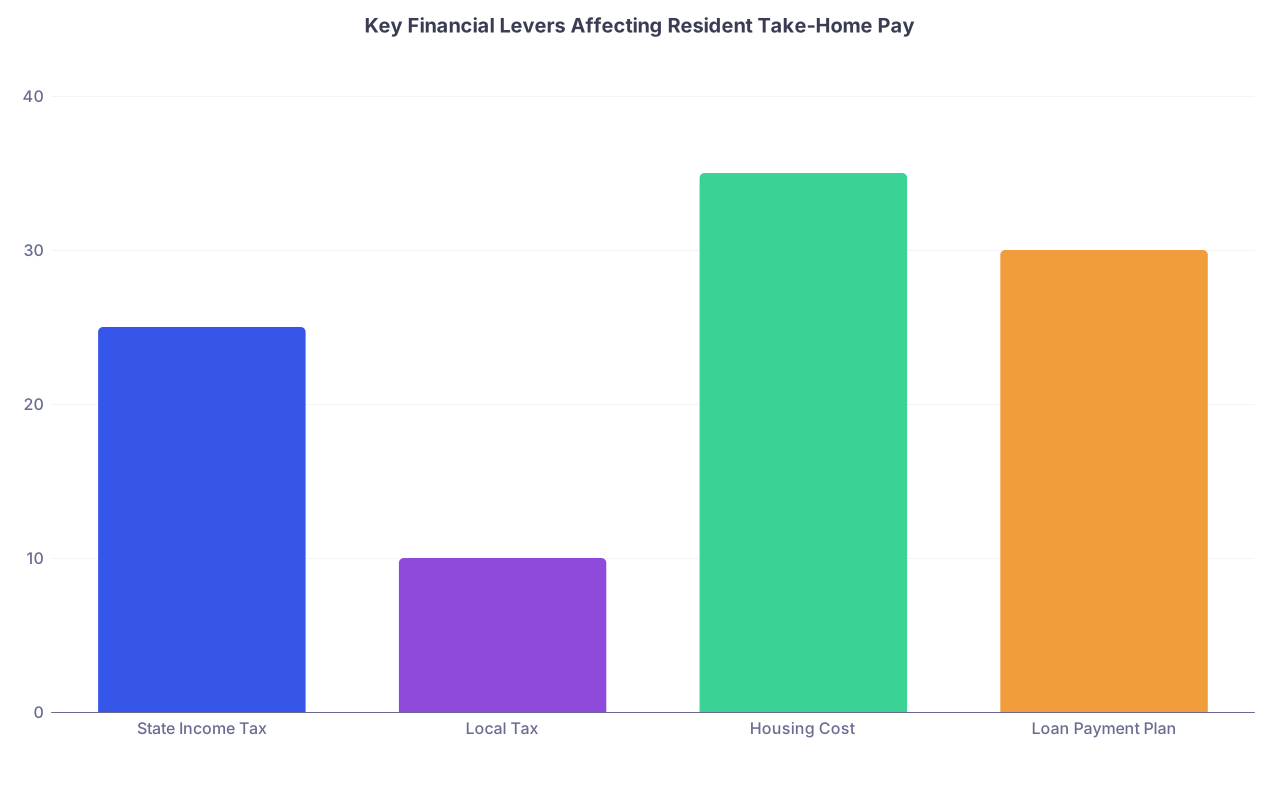
| Category | Value |
|---|---|
| State Income Tax | 25 |
| Local Tax | 10 |
| Housing Cost | 35 |
| Loan Payment Plan | 30 |
Step 3: Decide Your Loan Strategy First, Then Pick the State
Backwards is normal: people pick the residency, then try to make loan strategy fit. That is how you end up a hospitalist in Manhattan with $300k loans and PSLF confusion.
You will do it in the correct order:
Inventory your numbers
- Total med school debt: federal vs private
- Interest rates
- Household income (spouse or partner?)
- Desired specialty and realistic income range as an attending
Decide which of these camps you are in:
Camp A: PSLF or Long‑Term IDR Is Your Best Shot
You are here if:
- You have > $250k federal debt
- You plan to work at nonprofit / academic / VA / county institutions long‑term
- You want some career flexibility and are not obsessed with paying everything off in 3 years
Your goals:
- Complete 120 qualifying PSLF payments as efficiently as possible
- Keep payments manageable as a resident
- Position yourself in a state where nonprofit/academic jobs are plentiful
For you, the right states:
- Should have robust nonprofit hospital systems
- Do not need the absolute highest salaries, but solid academic job markets
- Have reasonable cost of living so you are not buried in day‑to‑day stress while chasing PSLF
Camp B: Aggressive Payoff as an Attending
You are here if:
- You have ≤ $200k–250k in loans and/or
- You are entering a high‑income specialty (ortho, derm, rads, gas, cards, GI, etc.)
- You are very motivated to live lean for 3–5 years and destroy your debt
Your goals:
- Keep resident payments reasonable (usually on IDR)
- As attending, maximize spread between take‑home income and lifestyle cost
- Possibly refinance privately once PSLF is clearly not your path
For you, the right states:
- Pay very well in your specialty
- Have no or low state income tax
- Have moderate‑to‑low cost of living
- Ideally not in the highest‑prestige mega‑metro where lifestyle creep will eat you alive
Camp C: You Genuinely Do Not Know Yet
Then you need flexibility.
Pick states with:
- Strong mix of academic and private practice opportunities
- Medium taxes or no tax
- Reasonable cost of living so it is not catastrophic whichever way you go

| Step | Description |
|---|---|
| Step 1 | Assess Debt and Specialty |
| Step 2 | Consider PSLF or Long IDR |
| Step 3 | Aggressive Payoff Strategy |
| Step 4 | Flexible Strategy |
| Step 5 | Target States with Strong Nonprofit Systems |
| Step 6 | Target States with High Pay and Low Tax |
| Step 7 | Target States with Moderate Tax and COL |
| Step 8 | High Debt > 250k? |
| Step 9 | High Income Specialty? |
Step 4: Build a Shortlist of States That Actually Help You
Now to what you probably came for: where should you actually look?
I will group states by financial profile, not vibes.
Tier 1: No Income Tax AND Reasonable Cost of Living
These are the states that often give residents and attendings the best shot at maximizing take‑home pay, especially for aggressive payoff.
Texas
- Pros:
- No state income tax
- Multiple large academic centers (UT system, Baylor, MD Anderson) → PSLF‑friendly
- Big private practice markets in DFW, Houston, Austin, San Antonio
- Plenty of mid‑priced housing outside central downtowns
- Watch out:
- Property taxes are high (more relevant when you buy)
- Austin and some Houston/DFW neighborhoods are getting pricey
- Pros:
Tennessee
- Pros:
- No state tax on wages
- Big academic centers: Vanderbilt, UT, others
- Nashville, Knoxville, Chattanooga: moderate COL compared to coastal cities
- Watch out:
- Some competition for plum attending jobs in Nashville
- No PSLF‑style tax angle, but still very solid payoff environment
- Pros:
Florida
- Pros:
- No state income tax
- Expanding healthcare market, multiple academic centers (UF, UM, USF, UCF)
- Many mid‑tier cities (Jacksonville, Orlando, Tampa, Gainesville) with manageable COL
- Watch out:
- Miami and parts of coastal South Florida can be crazy expensive
- Insurance and climate risk if you are thinking home ownership later
- Pros:
Nevada
- Pros:
- No state income tax
- Growing healthcare demand
- Lower COL outside key tourist zones
- Watch out:
- Fewer big academic systems compared with Texas/Florida
- Market can be smaller and more concentrated
- Pros:
These states are incredibly attractive for aggressive payoff attendings and still fine for PSLF‑oriented residents if you latch onto a nonprofit system.
Tier 2: Low/Moderate Tax, Strong Hospital Systems, Decent COL
These states give you flexibility. Good for people who might want PSLF but also want reasonable take‑home.
North Carolina
- Moderate flat state tax, growing physician demand
- Strong academic centers: Duke, UNC, Wake Forest
- Triangle and Charlotte are not dirt cheap but more reasonable than NYC/Boston/SF
Georgia
- Atlanta has Emory, Grady, big systems
- Outside Atlanta, cost of living drops significantly
- Tax is moderate, not insane
Ohio
- Solid academic heavyweights: Cleveland Clinic, OSU, UC, others
- Cost of living in Cleveland, Columbus, Cincinnati is often very manageable
- Some city income taxes, but base COL is low enough to compensate
Indiana
- Reasonable tax structure
- IU Health, other hospital systems
- Low housing costs, especially outside core Indy hotspots
These are good “I want options” states. Reasonable environment for PSLF or for aggressive payoff if you eventually choose private practice.
Tier 3: High Nominal Salary but High Tax and High Cost of Living
Here is where many residents get burned.
Yes, posted salaries in places like California and the Northeast can be higher. But so are taxes and rent. For a loan‑crushed resident, those regions are a mixed bag.
California
- Pros:
- High salaries for many specialties
- Massive healthcare market, lots of academic and private opportunities
- Cons:
- Brutal state income tax
- Sky‑high housing in SF Bay, LA, San Diego, some coastal regions
- Even “cheaper” inland areas are not cheap compared to Midwest/South
- Pros:
New York / Massachusetts / New Jersey
- Pros:
- Big academic centers (Harvard affiliates, Columbia, Cornell, NYU, etc.)
- Strong PSLF‑eligible institutional presence
- Cons:
- High state and sometimes city income taxes
- Extremely high rent in Boston, NYC metro
- Resident salaries often do not keep pace with living costs
- Pros:
You might still choose one of these states for PSLF if:
- You lock into a nonprofit system for 10 years
- You are committed to an academic/teaching career
- You accept that your day‑to‑day lifestyle will be tighter
Otherwise, these states are usually terrible for aggressive payoff. You are working too hard just to keep the lights on and pay rent.
| State | Approx Resident Salary | Est. State + Local Tax Hit | Typical 1BR Rent Near Major Center | Overall Financial Fit |
|---|---|---|---|---|
| Texas | $62–68k | Low (no state income tax) | $1,200–1,800 | Strong |
| Tennessee | $58–65k | Very Low | $1,000–1,600 | Strong |
| Florida | $58–65k | Very Low | $1,200–1,900 | Strong/Moderate |
| California | $65–75k | High | $2,000–3,000+ | Weak for payoff |
| New York | $65–75k | High (plus city in NYC) | $2,200–3,200+ | Weak for payoff |
(Numbers are rough ballparks for illustration. You will look up exact program data when you shortlist.)
Step 5: How to Actually Research States and Programs Like a Professional
You do not guess. You build a mini‑spreadsheet and force the data to talk.
Here is a practical 5‑step approach you can do over a weekend.
Pick 5–8 target states
- At least 2 no‑income‑tax states (e.g., Texas, Tennessee, Florida)
- 2–3 moderate‑tax, strong‑hospital states (e.g., NC, GA, OH)
- 1 or 2 “prestige” states you are emotionally attached to (so you see the contrast)
For each state, pull:
- Average PGY‑1 salary for programs you are realistically interested in (most program websites list this)
- Tax rate on that income level (use a state tax calculator)
- Median rent for a safe neighborhood within commuting distance (Zillow / Apartments.com / local forums)
Estimate monthly net pay:
- Start from gross monthly salary
- Subtract federal + state + local tax estimates
- Subtract your best‑guess IDR payment as a resident (use the federal loan simulator)
- Subtract rough rent
- What is left is your true monthly maneuvering room
Do the same exercise for attending level:
- Use realistic salary ranges for your specialty in that state (MGMA, Doximity, or talking to attendings)
- Apply tax differences
- Assume a life standard that is comfortable but not insane (mortgage or rent, childcare, etc.)
- See how much you could throw at loans monthly if you stayed lean for 3–5 years
Rank states by:
- Resident sanity (do you have a positive margin each month?)
- Attending payoff power (how much could you realistically send to loans?)
- Career fit (availability of nonprofit jobs if PSLF, or strong private practice groups if payoff)
You will be shocked how quickly some “dream” states fall to the bottom of your list once you run numbers.
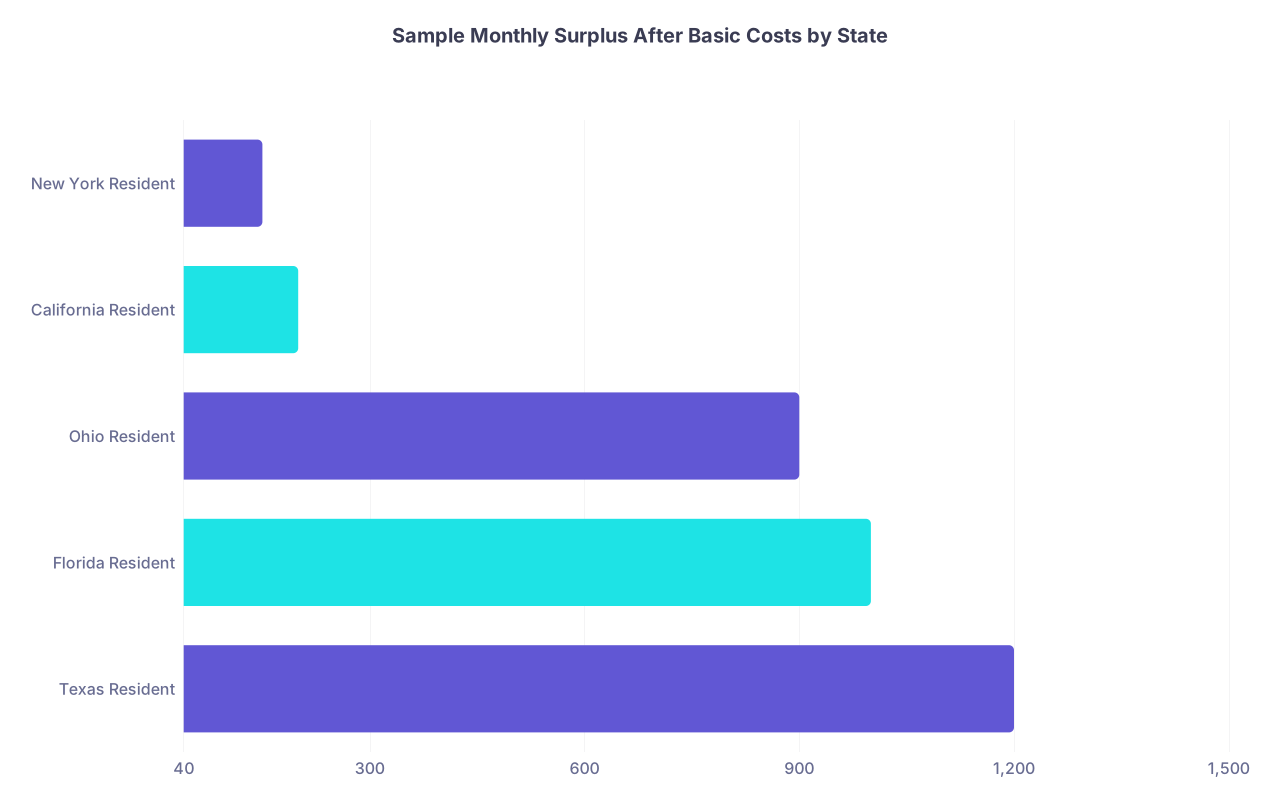
| Category | Value |
|---|---|
| Texas Resident | 1200 |
| Florida Resident | 1000 |
| Ohio Resident | 900 |
| California Resident | 200 |
| New York Resident | 150 |
(Again, illustrative. Your exact numbers will differ, but the pattern is real.)
Step 6: State-Specific Angles People Miss
There are a few under‑the‑radar details that matter if you are serious about optimizing.
1. Community Property States and Married Borrowers
If you are married or might be soon, community property states (like Texas) can change how your IDR payment is calculated if you file taxes a certain way. This can lower payments without tanking PSLF eligibility.
This is nuanced and you should eventually speak with a student loan–savvy CPA or advisor, but do not ignore it.
2. State Tax on Future Forgiven Debt
Right now, federal tax on forgiven student loans under IDR is suspended through 2025, and there are complex rules in motion. Long‑term, there is always risk that forgiveness becomes taxable at either federal or state level (outside PSLF).
Some states have historically taxed forgiven debt, some have not. If you are betting heavily on 25‑year IDR forgiveness, you want to pay attention to whether your state tends to conform to federal rules or not.
For PSLF, this matters less, because PSLF forgiveness is federally tax‑free.
3. Local Loan Repayment Programs
Many states and regions have:
State‑based loan repayment programs
Hospital or health system bonuses for committing to underserved areas
Rural programs that will throw $50k–$200k at your debt over several years
States like Texas, North Carolina, and others have county / rural programs that quietly stack with your loan strategy. These are often easier to access outside the mega‑metro.
4. “Hidden” Local Income Taxes
Some Midwest states have city‑level taxes (e.g., parts of Ohio, Pennsylvania).
Residents forget this, then get their first paycheck and realize there is another 1–3% haircut.
Always check:
- State income tax
- City income tax (if present)
- Mandatory “occupational” taxes in some regions

Step 7: How to Align This With Specialty Reality
All of this is useless if you pretend dermatology in rural Ohio is the same as hospitalist work in Houston.
A few specialty‑specific angles:
Primary care / hospitalist / psych
- Your income will be solid but not ortho‑grade
- PSLF in a nonprofit system + moderate‑COL, moderate‑tax state can be a fantastic combo
- Alternatively, no‑tax states with reasonable salaries and low COL (Texas, Tennessee) let you crush loans if you live below your means
Highly paid procedural specialties (ortho, ENT, GI, cards, anesthesia, rads)
- You need to be ruthless. High tax, high COL environments can easily rob you of $50k–$100k per year in potential loan payoff
- States with no tax + solid private practice pay are absurdly powerful for you (Texas, Florida, Tennessee, Nevada, some others)
Academic‑only specialties or strong academic leaning
- You are more PSLF‑sensitive
- Look for states with strong academic ecosystems and tolerable living costs: North Carolina, Ohio, parts of the Midwest and South
- You are not required to chain yourself to Boston or Manhattan to have a serious academic career
Step 8: Build a Concrete Application Strategy Around This
You are not just “keeping it in mind.” You change how you apply.
For residency applications
- Deliberately overweight programs in states that:
- Are no‑tax or low‑tax
- Have a reasonable cost of living
- Have nonprofit affiliation if you care about PSLF
- Still apply to a few prestige coastal programs if you want, but treat them as luxury options, not the default.
- Deliberately overweight programs in states that:
For fellowships
- If you did residency in a high‑cost state, use fellowship to pivot to better states
- Pick fellowship locations that either:
- Continue PSLF trajectory in a lower COL state
- Or set you up for attending work where payoff will be powerful
For attending job search
- Decide before job hunting: Are you PSLF‑bound or payoff‑bound?
- If PSLF‑bound:
- Filter job listings by nonprofit status and state tax
- If payoff‑bound:
- Filter by salary + no/low state tax + lower COL cities
- Be willing to give up “name brand city” for 3–5 golden years of debt destruction

The Brutal Truth and the Upside
Here is the truth many attendings wish someone had told them earlier:
- If you pick state and city badly, your six‑figure income will not feel like a win for many years.
- If you pick them well, you can:
- Live decently as a resident
- Have margin for emergencies
- Either wipe out your loans 3x faster or glide to PSLF with a lot less stress
You cannot control tuition that you already paid. You cannot undo your debt.
You absolutely can control the financial environment you practice in.
So stop thinking in terms of “where I have always dreamed of living” and start thinking in terms of “where does the math treat me best while I am owing six figures?”
Because later, after the loans are gone and you have savings, you can move to your dream coastal city if you still want it. It is much more enjoyable to move to San Diego or Boston with no student loans and a strong balance sheet.
Right now, you are loan‑crushed. You need leverage. States are one of the most powerful levers you have.
FAQ
1. Should I ever choose a high‑tax, high‑cost state for residency if I am drowning in loans?
Yes, but only if you are getting something very specific in return: a clearly superior training program for your specialty or a unique career opportunity that realistically boosts your long‑term earning potential or academic trajectory. If it is just “Boston seems nice” or “NYC is exciting,” that is a poor trade for an extra $10k–$20k per year of lost take‑home and higher living costs. If you do go to a costly state, be intentional: live with roommates, keep expenses lean, and use that time to position yourself for a better financial state as a fellow or attending.
2. How early in training should I start factoring state tax and cost of living into my plan?
Right now. MS3, MS4, intern year—it does not matter. The longer you ignore geography, the tighter your finances will feel. Start this week: pick three states you are considering, look up average resident pay, estimate taxes, and pull rents for realistic neighborhoods. Then compare your projected monthly surplus in each. Let that number influence where you apply and how you rank programs. Open your residency or job list today and write the after‑tax, after‑rent surplus next to each city; if you cannot stomach that number, you have your marching orders.


