

You just finished another evening clinic. It is dark when you walk out, daycare is about to charge another “late pickup” fee, and your partner just texted: “We cannot keep doing this here.”
Your residency or first job city made sense on paper. Good program. Decent salary. But now you have a toddler, maybe a second kid on the way, and the city that worked for single-you is beating up family-you.
Commute is brutal. Housing is insane. The call schedule plus traffic means you miss bedtime more than you make it. Your hospital talks about “wellness,” but the city you live in is actively hostile to having a life outside work.
You are not just looking for “nice places to live.” You are looking for doctor‑friendly cities for young families specifically. Where your career and your kids can both do well.
Here is how you actually find them—step by step—without relying on fluffy listicles or hospital recruiters who swear “this is such a great family town” while they live two suburbs away with a nanny and a private school budget.
Step 1: Get Ruthlessly Clear on What “Doctor-Friendly” Means for You
“Doctor-friendly” is not universal. An anesthesiologist with heavy call and a dermatologist with clinic hours only need different things from a city.
Define it before you start Googling cities. Otherwise, you will get seduced by skylines and “Top 10” lists that do not fit your life.
I usually break “doctor-friendly for young families” into 5 domains:
- Schedule + Commute Reality
- Cost of Living vs Physician Compensation
- Family Infrastructure
- Professional Ecosystem
- Lifestyle + Safety
Build a quick scoring sheet
Open a spreadsheet. Make columns for:
- Commute / Proximity to hospital
- Cost of living vs expected salary
- Childcare + schools
- Support services (pediatrics, OB, therapists, etc.)
- Spouse/partner job opportunities
- Safety + family-friendly amenities
- Call burden / schedule culture
- Professional growth + backup hospitals in town
Rate each from 1–5 for every city you research. You are not looking for perfection. You are looking for balance that works for your constraints.
Here is a practical way to think about priorities if you have a young family and practice medicine:
Non-negotiables (deal breakers)
- Unreasonably long commute (>40–45 minutes one way regularly)
- Unaffordable childcare relative to income
- Safety issues in the neighborhoods you can realistically afford
- Only one hospital employer in the entire metro (for most people, that is a big risk)
Strong preferences (nice but flexible)
- Walkable or short-drive access to good parks, grocery, daycare
- Nearby grandparents or extended family
- Reasonable on-call coverage (i.e., not one person covering three hospitals)
Write these down before you start chasing specific cities. This becomes your filter.
Step 2: Shortlist Candidate Cities Using Real Data, Not Vibes
Now you need names on a list. Not 50. Start with 5–10 candidate metros.
You are aiming for places where:
- Physician salaries are at least in line with national averages
- Cost of living is not insane
- Healthcare infrastructure is dense enough to give you options
Start broad, then narrow.
Use macro tools to get a first pass
Physician compensation + practice environment data
- Medscape Physician Compensation Reports
- Doximity Physician Compensation Dashboard
- MGMA regional salary reports (if you have access)
- State medical society workforce reports
Look for regions where salaries are strong and not crushed by coastal cost of living.
Cost of living comparison
- NerdWallet Cost of Living Calculator
- Numbeo cost of living + rent indices
- MIT Living Wage Calculator (for overall baseline)
Family-friendliness baseline
- Cities with:
- Multiple hospital systems
- At least one children’s hospital or strong pediatrics presence
- Population roughly 200k–2 million (sweet spot: enough services without mega-city chaos)
- Cities with:
Then combine.
You are looking for cities that hit a rough sweet spot: decent physician comp, moderate cost, and enough medical density.
To give you a sense of how trade-offs look (numbers illustrative, not exact):
| City Type | Example Region | Relative MD Pay | Cost of Living | Net Take-home Feel |
|---|---|---|---|---|
| Coastal Big City | SF / NYC / Boston | Very High | Extremely High | Often Mediocre |
| Large Non-coastal Metro | Dallas / Atlanta | High | Moderate | Strong |
| Mid-size Metro | Raleigh / Omaha | High | Lower | Very Strong |
| Rural | Small Town Midwest | Very High | Very Low | Strong but Isolated |
You do not need to pick a specific city yet. Just build a shortlist of 5–10 that look promising on paper.
Step 3: Pressure-Test Each City on Commute and Schedule Reality
The best daycare on Earth is useless if you are stuck on a freeway at 5:30 p.m. while they are closing.
Doctor-friendly for a young family usually means: you can get from hospital to home, daycare, and back in under 20–25 minutes in normal traffic. That is the thing that protects your evenings, your call nights, and your sanity.
Map your actual life radius
Pick one candidate city. Then:
- Identify the main hospitals you might realistically work at.
- Plug each one into Google Maps.
- Draw a 20–25 minute drive-time ring around each during:
- 7:30–8:30 a.m. (probable start times)
- 4:30–6:00 p.m. (daycare pickup chaos)
You are looking for overlapping zones where:
- Commute stays under ~25 minutes in both directions.
- There are residential neighborhoods with:
- Single-family homes or townhomes you can afford.
- Decent schools or at least solid elementary options.
- Access to grocery stores and basic services.
You can approximate this with crime and commute overlays or just brute-force housing websites (Zillow, Redfin, Realtor.com) + Google Maps.
Watch for these red flags
If you see any of the following, downgrade the city:
- Most physicians live 45 minutes away from the main hospital “because schools are better there.”
- “Everybody just lives out in X suburb and deals with the commute. It is not that bad.” (It is. For a parent on call, it is bad.)
- Only one practical neighborhood near the hospital, with housing prices completely detached from your starting compensation.
You do not want a life where every day depends on perfect traffic.
Step 4: Run the Numbers: Salary, Housing, Childcare, Support
Now you move from “nice idea” to “can we actually live here with children and a physician schedule without constantly drowning?”
Build a rough family budget per city
For each candidate city:
Estimate your likely salary
- Use:
- Doximity / Medscape / MGMA regional data
- Try to get specialty-specific data, not generic “physician”
- Apply a conservative haircut (take 10–15% off what recruiters throw at you).
- Use:
Estimate core fixed costs
- Housing (rent or mortgage for a 3-bedroom suitable for kids)
- Childcare:
- Full-time daycare for 1–2 kids
- Or nanny share rates if daycare hours do not match your schedule
- Health insurance (if not entirely employer-covered)
- Student loans (if you have them)
Check what percentage of your net pay these fixed costs eat
- If housing + childcare + loans start hitting 50–60% of take-home, you will feel squeezed even on a “good” physician salary.
Here is a rough comparison scenario that I have seen play out:
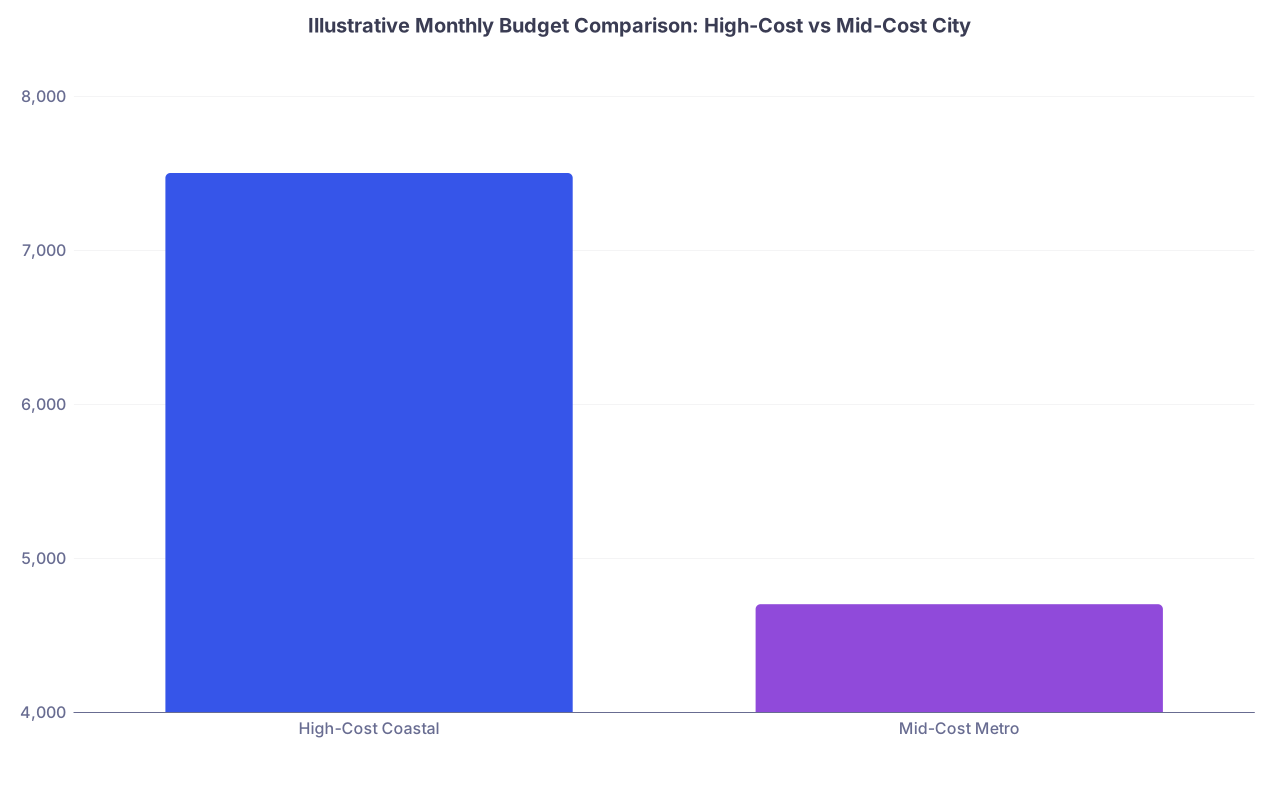
| Category | Value |
|---|---|
| High-Cost Coastal | 7500 |
| Mid-Cost Metro | 4700 |
Where that bar represents combined housing + childcare for the same family.
Same specialty, similar gross pay. One city gives you margin. The other eats it.
Sanity check with real people
Internet calculators are fine. But they lie by omission. They do not account for:
- Extra babysitting you will need when you are on call.
- Parking costs at hospitals.
- Paying for backup care when your daycare closes or your child is sick.
Find 2–3 physicians already living there (group Facebooks, Doximity, alumni). Ask them bluntly:
- “What do you actually pay for daycare / preschool per month?”
- “What is your mortgage/rent, and how far are you from the hospital?”
- “If you could rewind, would you still choose this city with young kids?”
If their voice gets tight when they talk about money or time, pay attention.
Step 5: Audit Childcare, Schools, and Kid Infrastructure
You practice medicine. Your workday is not 9–5, and it is rarely predictable. That makes childcare and school options absolutely central.
Doctor-friendly cities for families have multiple viable childcare paths that work with non-standard schedules.
Childcare filters
For each city, check:
- Are there multiple daycares within that 20–25 minute radius?
- Do any open early (6:30–7:00 a.m.) or close late (6:00–6:30 p.m.)?
- Are there home-based providers with good reputations that might offer more flexible hours?
- What are nanny rates, and is there an active nanny market?
Call 3 daycares in the area. Literally call. Ask:
- Current waitlist length for under-2s
- Earliest and latest pickup times
- Policies on late pickup fees
- Sick policies (how fast they send kids home)
If every daycare closes at 5:30 p.m. and your clinic ends at 5, that city just became substantially less doctor-friendly.
Schools and long-term runway
You are not just picking for preschool. You are picking where your 8-year-old will bike around.
Look at:
- Public school ratings (yes, Niche/GreatSchools are imperfect—but they are a starting point).
- How many neighborhoods with decent elementary schools are close to your potential hospitals.
- Presence of:
- Pediatricians you would actually trust.
- Children’s hospitals or strong peds services.
- Kid activities: libraries, parks, community centers, low-traffic neighborhoods.
You want redundancy. Not “there is one good school, but it is across the city.”
Step 6: Evaluate the Professional Ecosystem and Backup Plans
Being a doctor with a family in a one-hospital town can work. But it is fragile. If leadership changes or your group implodes, you might have to uproot the entire family.
Doctor-friendly cities usually give you:
- Multiple hospitals or large groups in reasonable commuting distance.
- A functional locums market nearby.
- Academic + community mix (if you like the flexibility).
Check the local medical landscape
For each city on your list:
- How many hospital systems?
- Are there large multispecialty groups?
- Is there a strong independent practice ecosystem or is it all hospital-employed?
- Are there fellowship programs or academic centers that might support your career growth?
If the answer to all of that is: “One nonprofit system, that is it”… just recognize you are putting a lot of eggs in one administrative basket. Some people are ok with that. Many with kids are not.
Look at culture proxies
You cannot see “wellness culture” in a job posting. But you can infer some things if you dig.
Red flags in a city’s hospital environment:
- Constant physician recruitment for the same department year after year.
- Residents talking about “everyone leaves after training because the lifestyle is brutal.”
- ER or hospitalist turnover that is clearly chronic.
Positive signs:
- Multiple physicians who have stayed in the same city for 10–15 years and do not look dead inside when they talk about it.
- Part-time or 0.8 FTE options that are actually used, not just lip service.
- Strong NP/PA support where it makes sense, so you are not doing scut someone else should be doing.
You want a city where medicine is sustainable enough that older physicians are not wrecks.
Step 7: Deep-Dive Research: Use Tools Like a Professional
At this point you should have maybe 3–6 candidate cities that look promising. Now you shift from “reading stuff” to “investigative work.”
Use structured tools, not random Googling
Crime and safety
- City crime maps (police department websites)
- Neighborhood Scout (grain of salt, but useful)
- Local Reddit threads combined with actual data
Walkability and daily-life mapping
- Google Street View: look at the actual walk from potential home areas to parks, schools, daycare.
- Look for sidewalks, speeding traffic, street lighting.
Medical density and colleagues
- Use Doximity or state licensing databases to see how many people in your specialty actually practice there.
- If you are pediatrics, is there a freestanding children’s hospital?
- If you are surgical, are there enough ORs and support staff?
Future growth
- Is the city growing in population and jobs or stagnating?
- A city that is adding young families usually builds better infrastructure over time (parks, schools, clinics).
Here is a simple framework that helps keep this organized:

| Step | Description |
|---|---|
| Step 1 | Shortlist Cities |
| Step 2 | Map Commute Radius |
| Step 3 | Run Budget Numbers |
| Step 4 | Evaluate Childcare and Schools |
| Step 5 | Assess Medical Job Market |
| Step 6 | Talk to Local Physicians |
| Step 7 | Test Visit with Family |
| Step 8 | Rank and Decide |
You do not need to treat this like a formal study. But you should not rely on some blog that says “Top 10 cities for doctors 2026” either.
Step 8: Talk to People Actually Living Your Future
This is the part almost everyone skips. They pay for it later.
You should aim to talk with:
- 2–3 physicians in your specialty in that city.
- 1–2 physicians with young kids in that city (any specialty).
- If possible, a non-physician spouse who lives there with a physician partner.
What to ask them:
- “Walk me through a normal weekday for you, from wake-up to bedtime.”
- “How far do you live from your main hospital? How long does it actually take with traffic?”
- “Who picks up your kids when you are on call or stuck late?”
- “Do you feel like this city works for you as a family with your schedule?”
- “If you had to rank this city for career only vs family only, what would you give each out of 10?”
Listen more to tone and hesitation than to the exact words.
If you keep hearing:
- “It is fine, we make it work” with a flat voice.
- “The schools are good… if you can afford to live in X and Y neighborhoods.”
- “We are thinking about moving in a few years once the kids are older.”
That tells you plenty.
On the other hand, when someone says:
- “We are 12 minutes from the hospital; I see my kids every night unless I am on call.”
- “The daycare is 5 minutes from my clinic, and they know my schedule.”
- “If my group implodes, I have at least three other hospitals I could apply to within 30 minutes.”
That is doctor-friendly living.
Step 9: Do a Targeted Test Visit (Not a Tourist Trip)
If a city survives all of this on paper and in conversation, you do not fly in for a weekend of restaurants and downtown attractions. You simulate your actual life.
Here is how to run a proper test visit:
Stay in the area you would realistically live, not the trendy downtown hotel zone.
Drive your potential commute at real hours.
Visit:
- 2–3 daycare centers
- 1 grocery store you would frequent
- 1 neighborhood park in the evening
- The main hospital campus
If possible, bring your partner and kids. See:
- How your kids respond to the environment (noise, parks, space).
- How your partner feels walking around during the day.
Pay attention to:
- Traffic flow at school drop-off times.
- Who is actually in the neighborhood (families? retirees? students?).
- How far everything feels when you are exhausted (because you will be, often).
This is optional if you are still in early training, but if you are moving a family, it is not optional. And if a potential employer balks at you taking a day or two for this, that is free data about their priorities.
Step 10: Build a Ranked Shortlist and Make a Deliberate Choice
At this point, you should have:
- A spreadsheet with scores and notes for each city.
- Budget scenarios.
- Firsthand reports from physicians there.
- Maybe one or two test visits.
Now you compress all that into something simple:
Rank your top 3 cities.
For each, answer:
- “What do I gain, professionally and personally, by living here?”
- “What does my family gain?”
- “What is the single biggest risk in choosing this city?”
If two cities are close, use tiebreakers like:
- Proximity to grandparents / family.
- School quality in the exact neighborhoods you can afford.
- Backup hospital options within a 30-minute radius.
Here is a compact view of what a final comparison might look like:
| Factor | City A (Big Metro) | City B (Mid Metro) | City C (Smaller City) |
|---|---|---|---|
| Commute Time | 35–45 min | 15–20 min | 10–15 min |
| MD Compensation | High | High | Very High |
| Cost of Living | Very High | Moderate | Low |
| Childcare Options | Many, pricey | Solid, affordable | Few but affordable |
| Hospital Options | 4+ systems | 3 systems | 1–2 systems |
| Family Vibe | Urban, hectic | Balanced suburban | Quiet, limited options |
Sometimes the “perfect” city on paper is not the best fit for your actual family and risk tolerance. That is fine. You are choosing constraints either way. The goal is to choose them on purpose.
A Quick Word on the Future of Medicine and Why This Matters More Now
The structure of medical work is shifting:
- More hospital-employed positions.
- Increasing burnout.
- Telehealth and hybrid models expanding.
- Consolidation of hospital systems.
What that means for you:
- City choice has become even more critical. If your employer merges or your group dissolves, having multiple options in the same region is insurance for your family.
- Hybrid and part-time work are becoming realistic for more specialties. Cities that are wired for remote work and have good internet, coworking spaces, and a professional spouse job market will age better.
- Burnout is heavily mediated by environment. It is not just your hospital. It is whether you can see your kids on weekdays, afford help, walk outside without fearing for safety, and feel like your life is not just working and collapsing.
Doctor-friendly cities for young families are not an abstract “nice to have.” They are one of the biggest levers you control to avoid hating this profession ten years from now.
Core Takeaways
- Define “doctor-friendly for your family” before you chase cities. Clarify non-negotiables: commute radius, childcare reality, safety, and multiple hospital options.
- Use a structured process, not vibes. Map commutes, build budgets, audit childcare and schools, talk to real physicians there, and run a test visit that mimics actual daily life.
- Prioritize flexibility and redundancy. Cities with multiple hospital systems, reasonable cost of living, and strong family infrastructure protect both your career and your kids as medicine continues to change.


