

The way most burned‑out doctors pick a new state is backwards. They chase salaries and Instagram scenery, then wonder why they are just as exhausted three years later—only now with mountains in the background.
You do not need another dreamy “top 10 states for doctors” list. You need a system. A filter. A way to translate your actual daily misery into concrete criteria and then sort the map accordingly.
That is what we will do here.
Step 1: Diagnose why your current city is killing you
Before you open Zillow in Montana, you need a blunt diagnosis. “I’m burned out” is too vague. You must break it into measurable problems, because that is what you will be solving for in your next state.
Sit down for 30–45 minutes. Pen and paper. No phone.
Make four short lists:
Workload and schedule
- Average patients per day
- Average hours per week
- Number of nights/weekends per month
- Charting time outside work (estimate honestly)
- Call burden + how often you come in
Workplace climate
- Leadership: supportive, indifferent, hostile?
- Staffing: chronic shortages? decent? terrible?
- Autonomy: can you say “no” to unsafe volume?
- EMR: tolerable vs soul‑crushing
- How often you feel rushed to the point of unsafe care
Money and security
- Actual take‑home pay after taxes and loan payments
- Housing cost (percent of income)
- Childcare cost (if relevant)
- Commute time and cost
- Sense of financial progress vs treading water
Life outside work
- Commute length
- Green space / nature access
- Community support (family or friends nearby)
- School quality (if you have kids)
- Crime / safety feelings
- Time and energy for hobbies, exercise, relationships
Then answer these questions, in one sentence each:
- “If I could fix three things about my current situation, what would they be?”
- “What do I absolutely not want to repeat in my next job?”
- “What parts of my current job/life are actually good that I would like to preserve?”
You are building your decision criteria. Not vague wishes.
Most burned‑out urban physicians end up with patterns like:
- I need fewer patients/day or more visit time.
- I want a shorter commute and more daylight.
- I am tired of $3,000 rent for a one‑bedroom.
- I want leadership that actually practices medicine or at least respects it.
Hold onto this list. We will use it to filter states.
Step 2: Translate burnout causes into measurable state-level filters
You are not picking a state for vibes. You are picking inputs that reliably predict a better daily life.
Turn your problems into state-level variables you can actually research.
Core variables that matter more than you think
Physician density and demand
- Lower physician density = more demand = usually more leverage and better pay.
- Too low density = unsafe coverage, insane call.
- You want healthy scarcity, not “you are the only intensivist in 200 miles.”
Cost of living and taxation
- Income tax rates, property tax, housing price‑to‑income ratio.
- Some “high salary” states are fake wins once taxes and housing eat half your paycheck.
-
- Caps on non‑economic damages?
- Average malpractice premiums by specialty?
- Frequency of suits?
- This affects your stress, not just your wallet.
Payer mix and reimbursement
- Medicaid expansion status
- Medicaid reimbursement rates relative to Medicare
- Commercial insurance penetration vs uninsured rates
Regulatory and scope environment
- How aggressive is prior auth and utilization review?
- State rules on telehealth, non‑competes, NPs/PAs, etc.
- For some physicians, collaborative vs independent NP rules matter a lot.
Lifestyle and environment
- City size options: do you want mid‑size, small city, or rural?
- Access to outdoors: mountains, water, trails, seasons.
- Climate: be honest about your tolerance for winter or humidity.
Family and social realities
- Proximity to support network (or at least reasonable flights)
- School quality index if you have or plan kids
- Cultural or religious community if that matters to you
Build your personal “state filter template”
Write down a simple table, literally on paper or in a spreadsheet:
| Factor | Weight (1-5) | Target/Threshold |
|---|---|---|
| Income tax burden | 4 | Low or no income tax |
| Cost of housing | 5 | Affordable vs income |
| Physician density | 3 | Moderate-low |
| Malpractice environment | 3 | Favorable |
| Average physician salary | 4 | Above national median |
| Climate | 2 | Mild winters |
You will adjust this with your own numbers and priorities, but this is the structure.
Step 3: Use data, not hearsay, to shortlist 5–8 states
Physicians love swapping anecdotes at conferences. “I heard Texas pays great.” “I heard Oregon is very lifestyle‑friendly.” Half of it is outdated or heavily specialty‑specific.
You can do better with four categories of data:
1. Compensation and cost of living
Use these to identify where your income actually stretches:
- Salary: MGMA data (if you have access), Doximity Physician Compensation Report, Medscape Compensation Report.
- Cost of living:
- MIT Living Wage Calculator
- Numbeo cost of living index
- Zillow for rental/house price medians
Look for salary-to-cost-of-living ratio, not just raw salary.
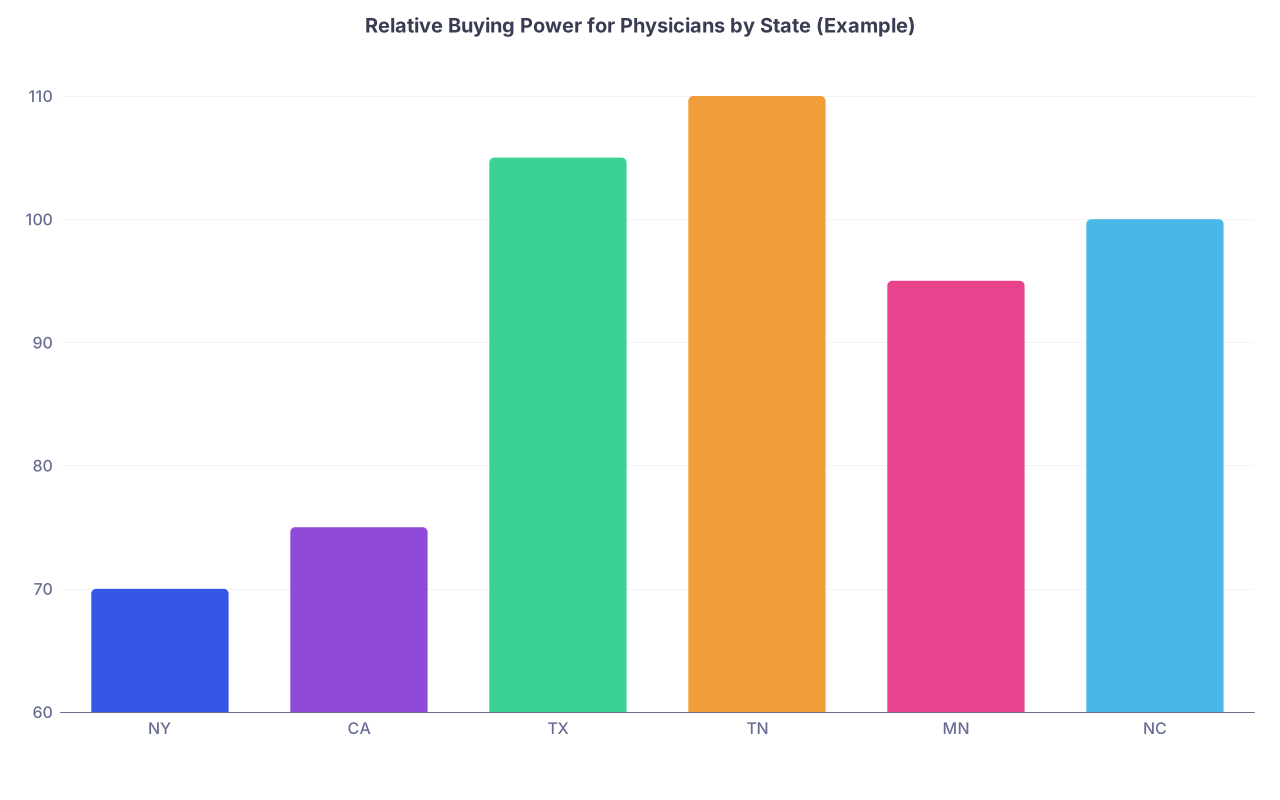
| Category | Value |
|---|---|
| NY | 70 |
| CA | 75 |
| TX | 105 |
| TN | 110 |
| MN | 95 |
| NC | 100 |
(Assume 100 = national average buying power. NYC and coastal CA often sit far below, even at high nominal pay.)
2. Tax and malpractice climate
Look up:
- State income tax (including states with none: TX, FL, TN, NV, WA, SD, WY).
- Property tax rates if you plan to buy a home.
- Malpractice premiums: AMA reports, specialty society data, or talking to a specialty recruiter.
3. Payer mix and practice environment
Key questions:
- Has the state expanded Medicaid?
- What is the uninsured rate?
- How aggressive are dominant payers (e.g., BCBS, United, etc.)?
For primary care and pediatrics, Medicaid rates matter more. For high‑procedure specialties, commercial payer mix matters more.
4. Lifestyle and safety
Avoid romanticizing. You are not moving for a postcard; you are moving for a life.
Check:
- City crime stats (FBI data, local stats)
- Air quality (big for asthma/allergy folks)
- School rankings if relevant
- Climate data (average temps, extreme weather risks)
Step 4: Match state profiles to your burnout drivers
Now you have:
- Your personal burnout diagnosis and priorities.
- A data framework for evaluating states.
Time to build actual profiles for a handful of states.
Let us take a few illustrative examples that I have seen work well for burned‑out big city physicians. Not universal. But recurring.
| State | Big Pros | Big Cons |
|---|---|---|
| Texas | No state income tax, high pay | Malpractice risk, hot climate |
| Tennessee | No wage tax, good COL | Some rural isolation, politics |
| North Carolina | Balanced lifestyle | Growing traffic in metros |
| Minnesota | Strong systems (Mayo, etc.) | Harsh winters |
| Colorado | Outdoor lifestyle | High housing costs near Denver |
Now, overlay your situation.
Example: Burned‑out NYC hospitalist
- Current pain: high cost of living, brutal commute, unsafe patient/physician ratio, parking nightmares, constant nights.
- Priorities:
- Work a manageable census
- Lower housing costs
- Keep a mid‑size or large city feel
- Avoid extreme rural isolation
This person will probably weight:
- Cost of living: 5
- Income tax/total tax: 4
- Physician demand: 4
- Malpractice climate: 3
- Weather: 2
They might shortlist:
- Texas (San Antonio, Austin fringe, or Dallas suburbs)
- North Carolina (Raleigh‑Durham, Winston‑Salem, Greensboro)
- Tennessee (Nashville periphery, Knoxville, Chattanooga)
- Minnesota (Minneapolis–St. Paul, Rochester)
- Maybe Colorado, if willing to trade some cost for outdoors
You will build a similar shortlist tailored to yourself.
Step 5: Create a scoring system instead of going on vibes
You are a physician. Use a scoring rubric like you would for risk stratification.
Make a simple spreadsheet. Columns are:
- States (and maybe specific metro areas)
- Factors that matter to you (each with a weight)
Give each state a 1–5 score for each factor. Then multiply by weight.
Example structure:
| Factor | Weight (1–5) | State A Score | State B Score |
|---|---|---|---|
| Cost of living | 5 | 4 | 2 |
| Income tax burden | 4 | 5 | 2 |
| Physician demand | 4 | 3 | 4 |
| Lifestyle fit | 3 | 3 | 5 |
| Malpractice climate | 3 | 4 | 3 |
Total each state. You will quickly see which states are obviously wrong for you, despite their reputation.
This does not need to be mathematically perfect. It needs to be structured enough to stop you from being seduced by mountains and ocean views while ignoring that your rent will be $4,000 again.
Step 6: Narrow to 2–3 metro areas per top state
States are not monoliths. Texas is not just Houston. North Carolina is not just Charlotte. Your burnout experience will live or die at the metro and employer level, not the map outline.
For each of your top 3–5 states, pick 2–3 metro areas that fit your preferences:
- Prefer mid‑size city with academic presence?
- Think: Chapel Hill/Durham, Rochester (MN), Madison, Omaha.
- Prefer community hospitals with solid systems?
- Think: Greenville (SC), Winston‑Salem, Boise, Spokane.
- Want genuine rural with strong referral networks?
- Think: many options in the Plains, Mountain West, and South—but you must evaluate call burden very carefully.
Then dig into employer types in each metro:
- Large non‑profit health systems
- Academic centers
- Independent physician groups
- FQHCs or large multispecialty clinics
- VA / government systems
Each has a distinct pattern of:
- RVU pressure vs salary
- Teaching vs service burden
- EMR quality
- Coverage depth (so that you can actually take vacation)
Step 7: Vet employers with a structured “burnout risk” checklist
This is where most doctors blow it. They do all the thinking at the state level, then accept the first decent‑looking position in that state.
You will not do that.
Here is a burnout risk checklist to use on every potential employer, no exceptions:
Workload and staffing
- Average patient volume per day (clinic) or census (hospital).
- Support staff per provider (MAs, RNs, scribes).
- Expected charting outside scheduled hours.
- Turnover rate for physicians and nurses in the last 2–3 years.
Call and schedule
- Frequency and nature of call (phone only vs in‑person).
- Nights, weekends, and holiday expectations.
- Flexibility on FTE (e.g., 0.8–0.9 FTE options).
- Protected time for admin, teaching, or leadership.
Culture and leadership
- Physician leadership representation in decision‑making.
- Response to recent crises (staffing shortages, COVID surges).
- History of layoffs or abrupt contract changes.
- How they treat people who say “no” to unsafe volume.
Compensation and contract risk
- Base vs RVU vs quality bonus mix.
- Non‑compete radius and duration.
- Termination clauses (with or without cause, notice periods).
- Tail coverage for malpractice.
Ask these questions explicitly in late‑stage interviews and site visits. If they dodge, that is information.
Step 8: Do a “test drive” visit the right way
Do not rely on virtual tours and polished recruiter talk. You need to walk the streets, stand in the clinic, feel the commute.
Plan 1–2 day visits for your top 2–3 metro areas. When you go:
Drive the commute at realistic times.
- Morning rush, evening rush.
- Check where you would likely live vs where you would work.
- If the recruiter is driving you on some scenic back route mid‑day, you are not seeing reality.
Walk the hospital/clinic without the filter
- Watch how nurses talk to each other.
- See how full the waiting room is.
- Peek at provider workrooms. Cramped chaos vs organized stations?
Talk to front‑line staff alone
- Ask a nurse or MA: “How long have you been here?” “Have many people left recently?”
You will learn a lot in two honest minutes.
- Ask a nurse or MA: “How long have you been here?” “Have many people left recently?”
Sample actual living areas
- Spend an hour in likely neighborhoods.
- Look at grocery stores, parks, gyms, and schools.
- Check rental and house listings on your phone while physically there.
Check your body’s reaction
- Do you feel your shoulders drop a bit?
- Do you find yourself thinking “I could breathe here”?
- Or are you already rationalizing problems?
Trust that data, but cross‑check with your scoring rubric. Do not throw your system out because you liked one coffee shop.
Step 9: Plan your exit like a project, not a fantasy
Once you have a target state and metro, you are not done. You need a stepwise exit plan.
Use a simple timeline:
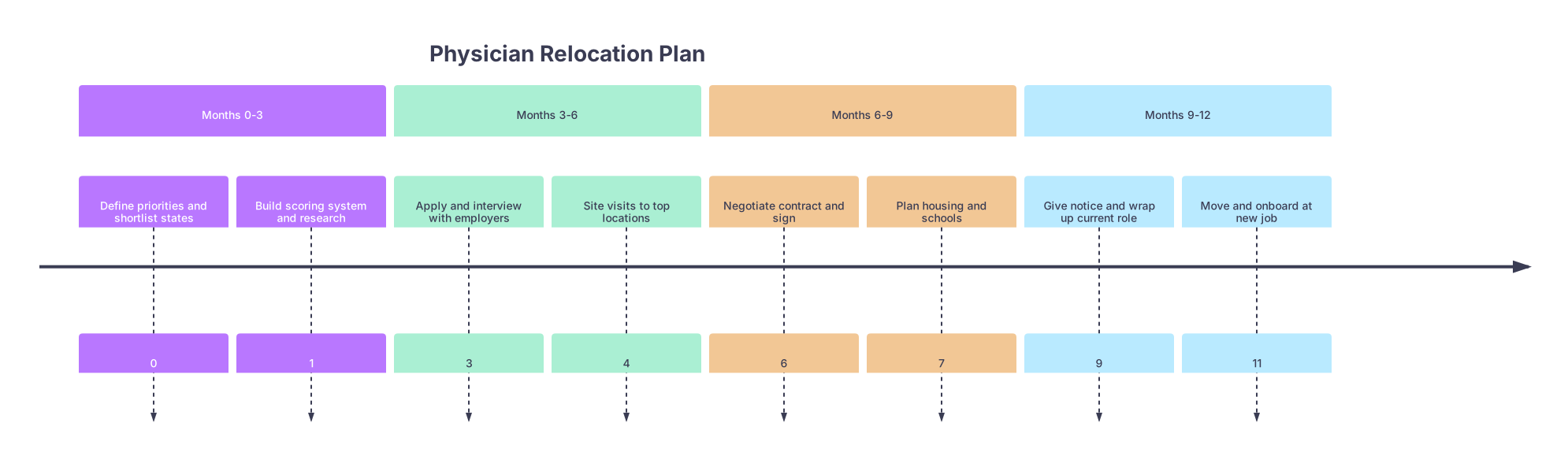
| Period | Event |
|---|---|
| Months 0-3 - Define priorities and shortlist states | 0 |
| Months 0-3 - Build scoring system and research | 1 |
| Months 3-6 - Apply and interview with employers | 3 |
| Months 3-6 - Site visits to top locations | 4 |
| Months 6-9 - Negotiate contract and sign | 6 |
| Months 6-9 - Plan housing and schools | 7 |
| Months 9-12 - Give notice and wrap up current role | 9 |
| Months 9-12 - Move and onboard at new job | 11 |
Key steps:
Financial buffer
- Aim for 3–6 months of expenses in cash.
- Account for moving costs, overlap of rents/mortgages, licensing fees.
Licensing and credentialing
- Start state medical license applications early (can take 3–9 months).
- Check if your target state participates in the Interstate Medical Licensure Compact; if so, use it.
Exit strategy from current job
- Review your contract for:
- Notice period
- Repayment clauses (signing/relocation bonuses, loan repayment)
- Non‑compete scope and radius
- Time your resignation to minimize penalties.
- Review your contract for:
Family logistics
- School transition for children.
- Job hunt for partner if needed.
- Staging the move: does someone go first, or do you all move together?
Step 10: Manage expectations once you arrive
Here is the part people skip. A new state will not magically fix internal burnout drivers: perfectionism, boundary problems, inability to say no. You are just installing them in a prettier setting.
You must actively protect yourself this time.
On day one in the new job:
- Set a firm maximum on:
- Patients per day.
- Extra committees.
- Extra shifts.
- Decide in advance:
- How often you will bring charts home (goal: as little as possible).
- What you will say the first time leadership tries to quietly raise volume.
Three concrete guardrails:
Boundary script
- Example: “I can safely manage X patients a day. Above that, I am concerned about quality and safety. If that is the expectation, we need to talk about more staffing or adjusting templates.”
- Practice it. Use it early.
Non‑hero rule
- No routinely covering chronic staffing failures “just this once.”
- If you take extra call, it must be:
- Paid appropriately.
- Clearly time‑limited.
- Not quietly normalized.
Quarterly self‑audit Every 3 months, answer:
- How many hours did I work last week?
- How much time did I spend charting at home?
- How often did I feel rushed to the point of unsafe care?
If the numbers look like your old big‑city job, you make changes immediately. Not after another two years of rationalizing.
Visual snapshot: Where your time should shift
The entire point of this exercise is to change your daily time allocation. From reactive fatigue to more protected, meaningful time.
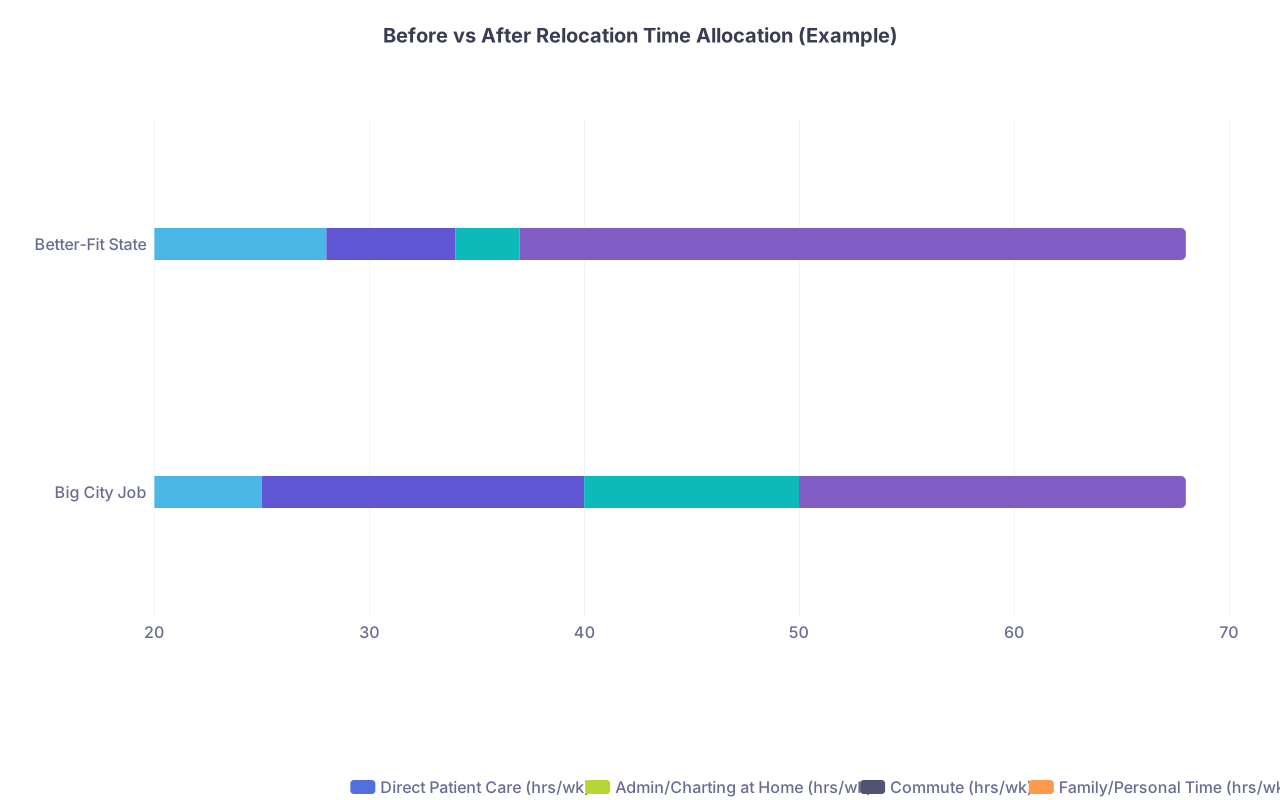
| Category | Direct Patient Care (hrs/wk) | Admin/Charting at Home (hrs/wk) | Commute (hrs/wk) | Family/Personal Time (hrs/wk) |
|---|---|---|---|---|
| Big City Job | 25 | 15 | 10 | 18 |
| Better-Fit State | 28 | 6 | 3 | 31 |
If that shift does not materialize in the first year, something in your plan or boundaries is off.
Common traps to avoid when picking a new state
I have seen these mistakes repeatedly. Do not repeat them.
Chasing scenery instead of structure
- “But the mountains are amazing.”
You know what is not amazing? 24‑patient clinic days with 10‑minute visits in a tourist town with no backup coverage.
- “But the mountains are amazing.”
Ignoring spouse/partner reality
- You love the idea of a small Idaho town. Your partner is a software engineer or artist who needs a bigger market. Resentment will build fast.
Underestimating cultural mismatch
- Politics, religion, social norms. If you are wildly out of sync with the local culture, that bleeds into daily life more than you expect.
Believing “we are like a family”
- Red flag. Families do not write each other up for productivity. Ask specific, structural questions, not vibes.
Assuming academic = humane
- Some academic centers are great. Others are just RVU factories with a residency program attached. Do not assume. Verify.
Adding one more tool: a mindmap of your decision
If you are more visual, build a quick decision mindmap. It forces clarity on tradeoffs.

Everything you are considering should plug into one of these branches. If it does not help one of them, it is probably noise.
Key takeaways
- Burnout in a big city is not solved by scenery. It is solved by systematically changing the structural inputs: workload, cost of living, payer mix, and workplace culture.
- You must treat state selection like a clinical decision: define your problem precisely, convert it into measurable criteria, score your options, and verify on the ground.
- A new state buys you a reset. Protect it with stronger boundaries and ongoing self‑audit, or you will rebuild the same burnout in a different zip code.


