

The way most doctors pick small towns is backwards. They chase signing bonuses and “lifestyle” promises, then discover six months later they hate the call structure, their spouse is miserable, and the local hospital is half‑functional.
You can do better than that. You need a method, not vibes.
This is a practical, step‑by‑step system to evaluate small‑town job options so you can move from traffic and burnout to something close to tranquil—without torching your career, your income, or your family life.
Step 1: Get Clear on What You Are Actually Optimizing For
If you skip this, everything else is noise. “I want a better lifestyle” is useless. You need numbers and thresholds.
Break it into five buckets and assign each a weight (0–10). This is your personal “tranquility profile.”
Clinical Load & Autonomy
- Max clinic patients per day?
- Max in-house call per month?
- Need ICU backup? Surgical backup?
- Tolerance for being “the only” in your specialty?
Family & Social Reality
- Partner’s job options?
- School quality for kids?
- Distance to grandparents or support network?
- Tolerance for social isolation?
Financial Security
- Minimum base salary you need to feel safe.
- Loan burden and payoff timeline.
- Retirement and benefits expectations (401k match, pension, health, malpractice tail).
Professional Growth
- Do you need research, teaching, or academic title?
- Need subspecialty colleagues?
- Procedural volume requirements to keep skills current?
Location & Lifestyle
- Climate non‑negotiables (no snow, or you love snow).
- Airport access (max drive time).
- Hobbies: hiking, skiing, water, arts, restaurants.
- Political/cultural fit, if that matters to you (for most people, it does).
Now, force rank the buckets:
- 10 = “I will not accept a job that fails here.”
- 7–9 = “Strongly preferred.”
- 4–6 = “Nice to have.”
- 0–3 = “I can live without it for a few years.”
If you actually put numbers on these, the rest of this process gets brutally clear. Example:
- Clinical load & autonomy – 10
- Family & social – 9
- Financial – 8
- Professional growth – 6
- Location & lifestyle – 5
You just decided: you are willing to live somewhere not perfect if the work and family structure are solid.
Step 2: Build a Shortlist Using Hard Filters, Not Hope
Most doctors window‑shop on Doximity, PracticeLink, or a recruiter’s email blast and call that “research.” That is how you end up three hours from an airport in a one‑hospital town that is about to lose its anesthesia group.
You will use hard filters to create a shortlist instead.
Hard Filters to Apply Up Front
Set these before you look:
- Population range: e.g., 10,000–150,000 (small town vs micropolitan vs small city).
- Hospital type:
- Critical access (≤25 beds)
- Community (25–150 beds)
- Regional referral center (150+ beds)
- Distance to major airport: e.g., ≤90 minutes.
- Distance to tertiary/academic center: e.g., ≤2–3 hours.
- Call expectation: e.g., no more than 1:4 in-house, no Q2 home call ever.
- Visa issues (if applicable): J‑1/H‑1B friendly or not.
Use those to screen postings and conversations. If a job fails multiple hard filters, do not “just see what they offer.” You are not that desperate.
Step 3: Use a Scoring Matrix – Stop Relying on Gut Feel
You need a way to compare “Nice midwest town with 4‑day workweek” versus “Mountain town with light call but lower pay.”
Create a simple scoring matrix. Rate each town 1–5 in each category, then weight it by your priority from Step 1.
| Factor | Weight (0-10) | Town A Score (1-5) | Town B Score (1-5) |
|---|---|---|---|
| Clinical load & autonomy | 10 | 4 | 3 |
| Family & social | 9 | 3 | 5 |
| Financial | 8 | 5 | 3 |
| Professional growth | 6 | 3 | 4 |
| Location & lifestyle | 5 | 2 | 5 |
Weighted score for each factor = Weight × Score. Sum for each town.
Run this for every serious option. Yes, it takes an hour. That hour saves you from a two‑year contract mistake.
To keep yourself honest, do the scoring immediately after site visits—before nostalgia or signing‑bonus brain kicks in.
Step 4: Clinical Reality Check – How “Tranquil” Is the Actual Work?
Small town does not automatically mean low stress. I have seen:
- A rural hospitalist job that was Q2 nights with no in‑house ICU coverage.
- A small‑town OB job where one physician was covering L&D, clinic, and ED consults simultaneously.
- A “low volume” EM job where you are the only doc in a 10‑bed ED plus floor codes.
You will do a clinical stress audit of each option.
Questions You Must Ask (And Get in Writing if Possible)
Patient volume and mix
- Average daily patients (clinic, inpatient, ED).
- Visit complexity: mostly bread‑and‑butter, or lots of transfers?
- No‑show rates and panel size if outpatient.
Call and backup
- Call schedule: in‑house vs home, weekdays vs weekends, holidays.
- Who is backup? For real. Names, not vague “coverage.”
- What happens if you are sick or on vacation?
Transfers and support
- Time to nearest higher‑level center.
- How often transfers are delayed by weather or bed availability.
- Availability of:
- Surgery
- Anesthesia
- ICU
- Interventional cardiology
- OB coverage at all hours
Staffing stability
- Turnover in:
- Physicians
- NPs/PAs
- Nursing
- Any service lines recently closed? (OB, surgery, psych are common canaries in the coal mine.)
- Turnover in:
Documentation and admin load
- EMR used (Epic vs some Frankenstein system from 1998).
- In‑basket expectations.
- Productivity expectations (RVUs, panel size, average visit lengths).
You are trying to answer one central question:
“On a bad week—flu season, staff short, weather blocking transfers—would I still be able to practice safely without hating my life?”
If the answer is “probably not,” that town does not score high on the tranquility scale, whatever the realtor’s brochure says.
Step 5: Financial Sanity Check – Understand the Full Package, Not Just Base Pay
Small towns often dangle golden handcuffs: big signing bonuses, loan repayment, “income guarantees.” There is always a catch.
Break the offer into four parts:
- Base + expected total comp
- Loan repayment / bonuses
- Benefits & retirement
- Malpractice (especially tail coverage)
Build a Simple Offer Comparison
| Component | Town A (Midwest) | Town B (Mountain) |
|---|---|---|
| Base salary | $320,000 | $260,000 |
| Expected total comp | $380,000 | $310,000 |
| Signing bonus | $40,000 | $20,000 |
| Loan repayment | $100,000/4 years | $50,000/3 years |
| 401k match | 6% | 3% |
| Tail coverage | Employer pays | You pay |
Now adjust for cost of living, not just raw dollars.
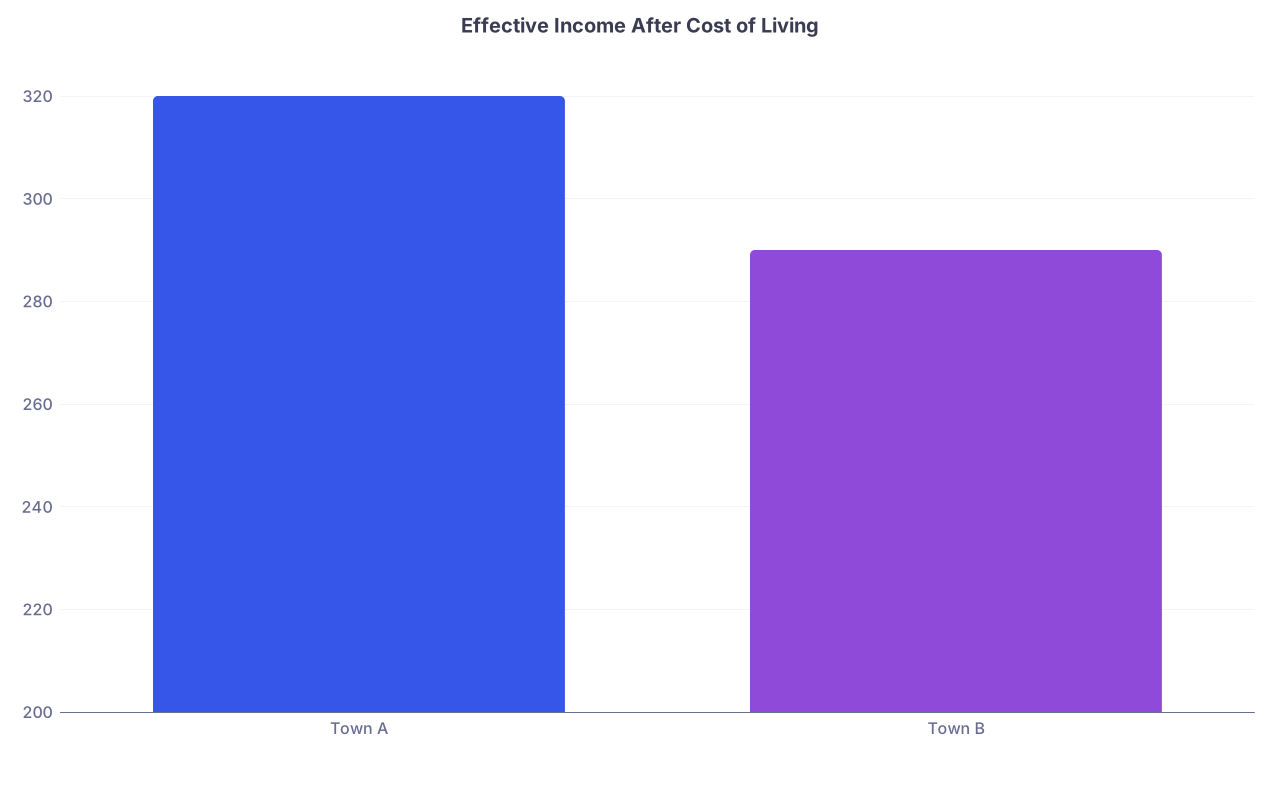
| Category | Value |
|---|---|
| Town A | 320 |
| Town B | 290 |
Hypothetical: Town A pays more but has higher housing costs and terrible property taxes. Town B pays less but your mortgage is half and schools are better. On a “what hits your bank after life expenses” basis, B might win.
Non‑negotiables to clarify:
- Who pays tail if you leave?
- Is loan repayment forgivable yearly or only at the end of the commitment?
- Are RVU thresholds realistic given local volume?
- Is comp transparent or “trust us, everyone does fine”?
Step 6: Family and Social Fit – The Silent Career Killer
Most failed small‑town moves are not about the job. They are about:
- A spouse with no meaningful work.
- Kids hating the school.
- No community connection beyond the hospital.
You evaluate this as seriously as your call schedule.
On Your Site Visit, You Will Do More Than Tour the Hospital
Do this, in order:
Schools (if you have or want kids)
- Visit at least one elementary and one high school.
- Ask about:
- AP/IB availability
- Special needs services
- Extracurriculars (sports, music, clubs)
- Look up state report cards and graduation rates.
Work options for partner
- Meet a local realtor or community development person, not just the recruiter.
- Ask what professionals do here: engineers, IT, teachers, remote workers.
- Check local job boards realistically.
Community and culture
- Walk the main street on a weekend.
- Sit in a coffee shop or diner and just listen.
- Ask younger staff (nurses, therapists, residents) what they do for fun.
- If you are a racial, religious, or LGBTQ minority, ask explicitly about local demographics and support networks. Do not guess.
Distance and travel reality
- Have them drive you to the nearest airport—do not just take their “45 minutes” at face value. In winter. At rush hour.
- Ask how often roads close for weather.
Your question here:
“Can my family build a life here that does not depend entirely on my job and the hospital?”
If the answer is no, tranquility will not last. You will be dealing with resentment at home regardless of how good your clinic days are.
Step 7: Professional Growth – Is This a Cul‑de‑sac or a Launchpad?
Some small towns are professional dead ends. Others are surprisingly powerful career accelerators if you handle them right.
You need to evaluate:
Skill Maintenance
- Will you see enough volume to keep procedures and complex decision making sharp?
- Any chance to keep up with your subspecialty interests?
- Access to CME funding and dedicated time?
Academic or teaching links
- Affiliated with a residency or medical school?
- Tele‑conference access to M&M, tumor board, journal club?
- Opportunities to precept students or residents a few weeks a year?
Future exit options
- Where did previous physicians go next?
- Any alumni in academic centers or large groups?
- Do large systems consider this a feeder site?

Do not accept “you can always leave later” as a strategy. Ask yourself:
- “If I stay 3–5 years, will I look more or less marketable than I am now?”
If the job cuts your procedure log in half and isolates you academically, that is a problem if you want options later.
Step 8: Stress‑Testing the Offer – Worst‑Case Scenarios
Before you sign anything, you run each town/job through a worst‑case filter. Assume:
- The nicest colleague leaves.
- Volumes go up 20%.
- They do not hire that “second recruit” they promised.
- Your kid struggles in school.
- There is a regional economic dip.
Now ask:
Workload ceiling
- Does the contract prevent them from doubling your call?
- Are there caps on panel size?
- Any language about “other duties as assigned” with no limit?
Exit ramp
- Length of notice required to leave.
- Restrictive covenants (non‑compete radius and duration).
- Financial clawbacks on signing bonus or loan repayment if you leave early.
Institutional risk
- Hospital financial health (bond ratings, recent layoffs, service line closures).
- Dependency on one major employer in town (if it goes under, the whole town suffers).
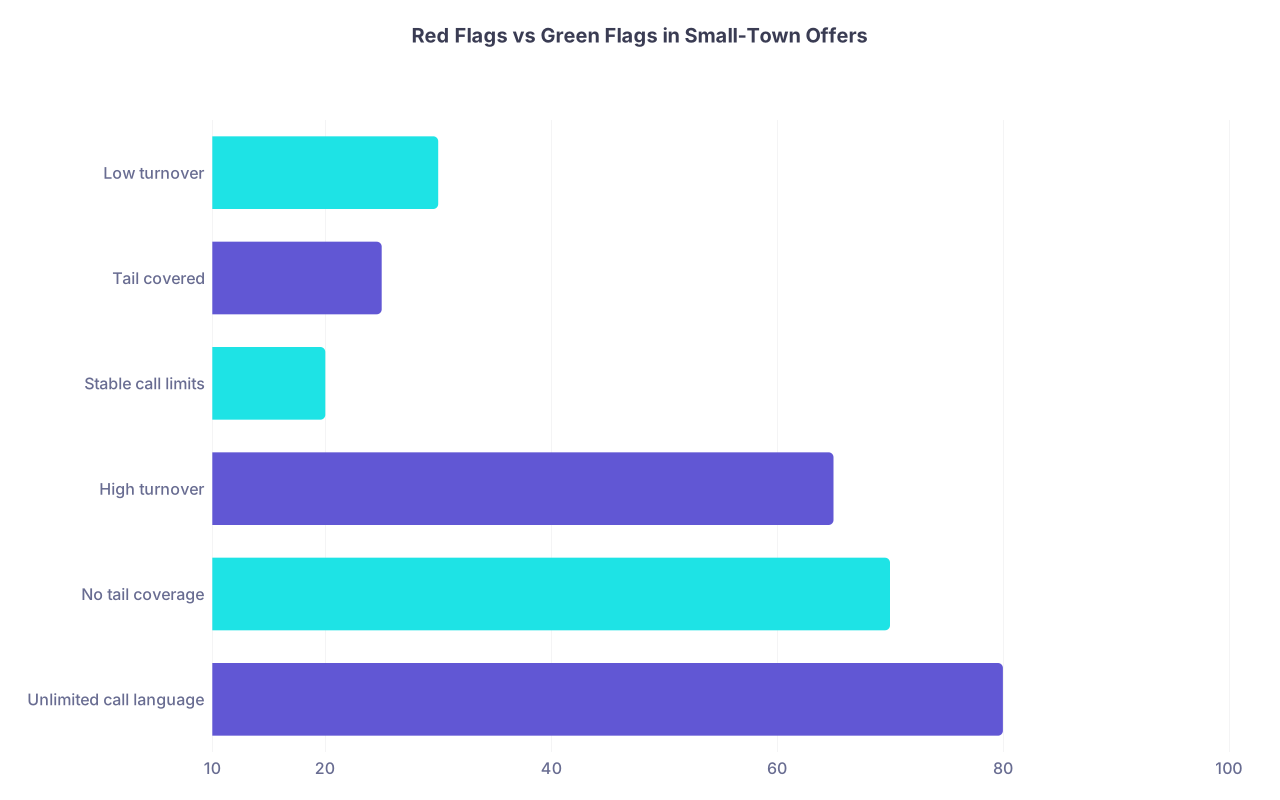
| Category | Value |
|---|---|
| Unlimited call language | 80 |
| No tail coverage | 70 |
| High turnover | 65 |
| Stable call limits | 20 |
| Tail covered | 25 |
| Low turnover | 30 |
The point is not to find a risk‑free situation. That does not exist. The point is to avoid fragile situations where small shocks break everything.
Step 9: The Site Visit Protocol – How to See the Real Town, Not the Sales Pitch
Most site visits are tightly choreographed. You meet the “happy” doctors, see the new wing, eat at the best restaurant, and fly out.
You need to break their script (politely) and create your own.
Before the Visit
Send a list of must‑meet people:
- At least one physician who joined in the last 2 years.
- At least one who has been there 10+ years.
- At least one mid‑level or nurse you would work with.
- Ideally someone who left and is willing to talk by phone.
Ask for full call schedules for the last 6 months (de‑identified) and average RVU or panel data.
During the Visit
You ask direct questions. No fluff.
To newer physicians:
- “What surprised you in the first 6 months?”
- “If you had to do it again, would you still come?”
- “Who has left in the last few years, and why?”
To senior physicians:
- “How has your workload changed recently?”
- “Any recent conflicts with admin? How were they handled?”
- “Has the hospital ever renegotiated contracts in a way people did not like?”
To nurses and front‑line staff:
- “Are you usually fully staffed?”
- “What frustrates doctors here the most?”
- “Who is the easiest and hardest doctor to work with, and why?”
To admin:
- “What keeps you up at night about the hospital?”
- “What are the last three major changes you made, and how did clinicians respond?”
- “What would you change about this practice if money were no object?”

| Step | Description |
|---|---|
| Step 1 | Pre-visit research |
| Step 2 | Request data and contacts |
| Step 3 | Travel to town |
| Step 4 | Hospital tour |
| Step 5 | Meet physicians |
| Step 6 | Meet staff and nurses |
| Step 7 | Community and school visits |
| Step 8 | Independent time in town |
| Step 9 | Score matrix same day |
After the Visit
Same day, before nostalgia kicks in:
- Fill out your scoring matrix.
- Write a brutally honest one‑page “pros / cons / unknowns” summary.
- Call your spouse or a trusted colleague and talk through it out loud. If you hear yourself making excuses for red flags, that is data.
Step 10: Put It All Together – A Repeatable Decision Method
By now, for each small‑town option you should have:
- A scoring matrix with weighted categories.
- A clinical stress audit.
- A financial breakdown.
- A family/social fit assessment.
- A worst‑case stress test.
- Detailed site visit notes.
Now the method is straightforward:
- Eliminate any option failing your non‑negotiables (weight = 10 items).
- Rank the remaining by total weighted score.
- Re‑read your own notes for the top 2–3 and highlight:
- Red flags you might be downplaying.
- Green flags you might be undervaluing.
If you are torn between two:
- Imagine both jobs went badly. Which failure scenario do you tolerate better?
- Imagine both went well. Which success scenario actually feels like the life you want?
Your brain is much better at comparing concrete futures than trying to evaluate vague “opportunities.”
Quick Example: Two Hypothetical Offers
You are a general internist in a congested metro, burnt out, looking for small‑town work.
Town A: Plainsville
- Pop 25,000, 60‑bed hospital.
- Base $320k, 1:4 call, clinic 18–20/day.
- 90 minutes to small airport, 3.5 hours to major city.
- Good public schools, limited partner jobs.
- No residents, minimal teaching.
Town B: Ridgeview
- Pop 45,000, 120‑bed regional center.
- Base $280k, 4‑day week, 1:6 call.
- 45 minutes to major airport, 1.5 hours to academic center.
- Excellent schools, robust remote‑work community.
- Family med residency, some teaching.
Your priorities: Clinical load 10, Family 9, Financial 8, Growth 6, Lifestyle 5.
You score them (1–5) based on real data from visits:
- Clinical: A=3, B=4
- Family: A=3, B=5
- Financial: A=5, B=4
- Growth: A=2, B=4
- Lifestyle: A=3, B=5
Weighted totals (Weight × Score):
- A: (10×3) + (9×3) + (8×5) + (6×2) + (5×3) = 30 + 27 + 40 + 12 + 15 = 124
- B: (10×4) + (9×5) + (8×4) + (6×4) + (5×5) = 40 + 45 + 32 + 24 + 25 = 166
On paper, B clearly wins, even though raw money is higher in A. And notice: B is more likely to keep you in medicine long‑term because call and support are better.
That is the kind of clarity this method gives you.
FAQs
1. How many small‑town options should I seriously evaluate before deciding?
Three to five is ideal. Fewer than three and you have no comparison points; more than five and you will drown in details and start rationalizing. Use your hard filters to narrow the field quickly, then do deep dives on 3–5 real contenders using the scoring method.
2. What if my partner hates every small town we visit but I cannot stay in my current big‑city job?
Then you have a joint problem, not a solo one. Expand your search to micropolitan or “edge of city” communities that cut your commute and clinical chaos without forcing a fully rural lifestyle. Also look at structural fixes: job sharing, 0.8 FTE, switching to hospitalist or telemedicine work in your current region. Do not drag a resentful partner to a town they dislike; that destroys tranquility fast.
3. How long should I plan to stay in a first small‑town job?
Aim mentally for 3–5 years. Less than 2 years looks unstable on a CV unless the situation was truly unsafe. Three years gives you time to integrate into the community, pay down some debt, and decide if this lifestyle is for you. If you do the due diligence I outlined, you will reduce the odds of needing an early escape dramatically.


