

Last winter, a hospital CEO pulled me aside after a medical staff meeting and said, “If I don’t land two more cardiologists this year, my board will start talking about ‘strategic alternatives.’ That’s code for: replace me.”
You think CEOs care most about length-of-stay or Leapfrog grades. They do. But right now, their real knife fight is over you and your colleagues.
Let me walk you through what they actually do to compete for physicians—and what that means for where you should (and should not) work.
The New Arms Race: Physicians as the Core Asset
A decade ago, hospital CEOs were obsessed with buildings and technology. New towers. Hybrid ORs. Da Vinci robots. Bragging rights in glossy annual reports.
Now, in closed sessions with boards and consultants, the PowerPoint slide that matters is blunt: “Provider FTEs by Specialty – Filled vs Open.”
They know the truth: no doctors, no revenue. No surgeons, no downstream imaging. No primary care, no referral base. They can dress it up as “access to care” and “mission,” but behind doors it’s pure survival math.
Here’s the unspoken hierarchy in many boardrooms today:
- Cash flow risk → directly tied to physician supply
- Market share → directly tied to physician loyalty and alignment
- Reputation → directly tied to a few star names who anchor service lines
So CEOs have quietly shifted into recruitment mode. Aggressive, sometimes desperate recruitment mode. And they’re competing with each other harder than you realize.
How CEOs Actually Track the Physician “Scoreboard”
Most physicians think recruitment is handled by HR or some random “provider relations” office. That’s the surface layer.
Behind that, smart CEOs get a monthly (sometimes weekly) dashboard summarizing physician workforce data. I’ve seen these dashboards. They’re blunt.

| Category | Value |
|---|---|
| Open FTEs | 18 |
| Time-to-Fill (months) | 11 |
| Locums Spend | 4200000 |
| Turnover Rate % | 12 |
| Referral Leakage % | 27 |
Those numbers aren’t made up. They’re close to what I’ve seen at regional systems:
- Open FTEs in key specialties
- Average time-to-fill for cardiology, ortho, GI, hospitalist
- Annual locums spend (this number horrifies boards)
- Turnover rate in the last 12–24 months
- Referral “leakage”—patients leaving the system because they cannot get in
When the board sees “11 months to hire a general surgeon” and “$4.2M in locums,” they clamp down on the CEO: Fix this. Now.
That pressure drives behavior. Which leads to…
The Quiet Market-Share War Over You
You probably think of “jobs” at individual hospitals. CEOs think in terms of territory and capture.
A blunt reality: in many regions, they’re not just trying to recruit a cardiologist. They’re trying to prevent the hospital across town from recruiting you.
I’ve seen systems do the following:
Fast-track offers: Candidate has interviews at three systems. One CEO tells the recruiter: “Offer by Friday, no committee delays, sign-on maxed.” They’re beating the other systems to the punch, not just courting you.
Preemptive block-hiring: A practice of five ortho surgeons is unhappy with call coverage at Hospital A. Hospital B’s CEO quietly meets with the group and offers to move all five at once—new block time, guaranteed support staff, capital commitments. This is a market play, not a “we just love ortho” play.
Geographic lock-in: Systems will aggressively recruit in specific zip codes just to prevent another hospital from establishing a foothold. They may offer above-market terms for a seemingly “random” clinic site. It’s not random; it’s defensive territory.
You’re not just a candidate. You’re a chess piece in a regional strategy. Many CEOs won’t admit that in public, but I’ve sat in rooms where your specialty is literally mapped as dots on a competitive map.
The Real Levers CEOs Pull to Lure Physicians
Let’s go past the brochure talk. Here’s what CEOs actually do to compete, and how you should read it.
1. Manipulating Compensation Structures
Comp plans are the biggest weapon. But it’s not just “higher salary.” It’s how they bake it.
Front-loaded offers: Huge sign-on bonus, housing stipend, relocation, loan repayment. They’re betting you’ll be too entrenched after 3–5 years to leave once the golden handcuffs kick in.
“Guarantee then RVU” traps: A luscious 2-year guarantee and then—boom—straight productivity. If the practice isn’t mature enough, your income falls off a cliff in year three. I’ve seen surgeons go from $600k in year two to $350k in year three. The CEO still looks good to the board: short-term recruitment win, long-term reduced fixed cost.
Complex “quality” add-ons: Quality metric bonuses that are deliberately vague or constantly shifting. It lets them advertise “up to $X00k in quality incentives” while knowing damn well most people will never hit it.
Here’s roughly how three different hospital types typically compete on money:
| Hospital Type | Base Pay Strategy | Extras Emphasized |
|---|---|---|
| Academic Medical Ctr | Lower base, prestige | Teaching, research, titles |
| Large Community Sys | Market+ base, RVU heavy | Sign-on, bonuses, call pay |
| Rural/Frontier Hosp | Above-market base | Loan repayment, housing, visas |
When you see a big number, ask: How long is it guaranteed? What happens in year three? What happens if volumes drop or they “re-evaluate the compensation model”?
If they dodge, that’s your answer.
2. Infrastructure Promises (Some Real, Some Vapor)
CEOs know physicians want two things: support and tools. So they dangle infrastructure.
I’ve been in closed recruitment dinners where the CEO promises:
- “We’ll build you a new cath lab.”
- “We’ll add another robot.”
- “We’ll hire three more NPs to support you.”
- “We’re committed to expanding your service line.”
Sometimes that’s genuine. Other times, it’s theater.
The test: ask for specifics and timelines. Capital projects go through boards and committees and budget cycles. If the CEO can’t articulate where in the process that new lab/clinic/robot actually sits—approved, requested, still a dream—then it’s leverage, not commitment.
I watched one hospital recruit a spine surgeon on the promise of a dedicated spine OR and dedicated navigation system “within 18 months.” Three years later, he still didn’t have either. The CEO had moved on. The new leadership shrugged and said, “We’re re-evaluating priorities.”
You know who was stuck renegotiating? The surgeon. With no leverage now that he’d built his panel there.
3. Playing the Culture Card (Sometimes Honestly, Sometimes As Spin)
“Culture” has become another recruitment weapon. Every CEO leads with it now.
Tours are staged. The happiest physicians are trotted out for your meet-and-greet. The disgruntled ones are mysteriously on vacation.
Behind the scenes, CEOs watch these culture metrics:
- Physician engagement scores
- Burnout survey data
- Turnover among mid-career physicians
- Number of physicians in conflict with administration
If those numbers are ugly, the CEO leans harder on scripted culture messaging. Buzzwords like “Wellness,” “Physician Leadership Council,” “Clinician Voice.” Many of those councils exist mostly on paper.
If you want the real read on culture, ignore the CEO. Ask:
- Mid-career docs: “How has this place changed in the last 5 years?”
- Departed docs: “What finally made you leave?”
- Nursing and ancillary staff: “What do physicians complain about here?”
The CEO knows this. That’s why they try so hard to control which people you meet during a site visit.
4. Weaponizing Flexibility and Work-Life Branding
Post-COVID, CEOs realized one painful fact: their older recruitment playbook is dead. Younger physicians are not as impressed by prestige, tower expansions, or “this is how we’ve always done it.”
So they compete with flexibility narratives.
Hybrid schedules. 7-on/7-off. Four-day clinic weeks. Remote telehealth sessions. Part-time leadership roles. “We support your side projects.”
Some CEOs mean it. Others just added those phrases to their recruitment scripts because the consulting firm told them to.
You can tell which is which by asking for names:
Who here actually works 0.8 FTE long term?
Who reduced call and kept their pay within a reasonable range?
Who has a protected day for admin or research work every week?
If they keep talking conceptually instead of giving specifics, you’ve got your answer.
CEOs Competing in the Shadows: The Back-Channel Games
Here’s where it gets interesting. Most of the competition between CEOs never appears in contracts or brochures. It’s played quietly.
Back-Channel Intel Sharing (and Smear Campaigns)
Executives talk. Physician recruiters talk. They move from system to system and carry stories.
I’ve listened to CEOs say things like:
- “We heard Dr. X left your system… behavioral issues, right?”
- “We’ve been warned Dr. Y is ‘challenging to work with.’”
Translation: “Should we poison the well before the other guy recruits them?”
On the flip side, some CEOs will quietly nudge recruiters to hype departures from competitor systems:
- “A lot of our incoming docs are leaving Hospital Z because they’re imploding.”
- “They’re hemorrhaging cardiologists; what does that tell you?”
You’re rarely hearing a neutral version of reality. You’re hearing a sales pitch shaped by competitive insecurity.
Non-Compete Maneuvering and Legal Chess
Another quiet competitive tool: non-competes and restrictive covenants.
Some CEOs push aggressively for harsh non-competes—not just to protect their own turf, but to make it harder for you to jump to the hospital across the street. If they can’t recruit you away, they’ll at least make it painful for you to leave them.
Others are dropping non-competes strategically to attract physicians who are sick of being boxed in. I’ve seen CEOs pitch:
“Come here, and your contract will have no non-compete. If you ever leave, you stay in the community.”
That’s not generosity. That’s a recruitment tactic against systems still clinging to old restrictive models.
If a CEO is serious about physician-friendly policies, they’ll be proud to say: “No non-compete” or “Limited to 5–10 miles, 12 months” and won’t dance around the question.
Where Are the Best Places to Work—From a CEO’s Playbook?
You asked about best places to work as a doctor. Here’s the part no glossy “Top Hospitals” list will tell you:
The best places to work tend to be systems where:
The CEO doesn’t treat recruitment like a one-time war, but like a long game. Retention actually matters. They know churning through physicians destroys reputation and morale.
The recruitment story matches reality. Offers aren’t dramatically better than what existing docs are getting. If you’re offered way above-market pay and insane perks while the current docs are bitter and burned out, you’re walking into a political mess.
The CEO is visible and not just for photo ops. If you ask ten physicians, “When’s the last time you saw the CEO on your unit or in clinic?” and they all shrug, that says something.
They are honestly transparent about financials and strategy. If they’re willing to show you strategic plans, volumes, and how they see your specialty growing, they’re less likely to pull the rug out later.
The worst places? They share a few patterns:
Constant “restructuring” and leadership turnover. Every 18–24 months, new COO, new CMO, new service line VP. That chaos is not an accident; it’s a symptom of a CEO flailing under board pressure.
Serial recruitment with serial failures. Look at how many physicians in your specialty have come and gone in the last 5–7 years. That is the single most predictive metric I’ve seen for whether you’ll be happy.
Perpetual crisis language. “We just need to get through this year.” I’ve heard that for four straight years at some systems. That’s not a rough patch; that’s the culture.
How To Read Between the Lines When a CEO Courts You
When a CEO meets with you, it’s not just a meet-and-greet. It’s a high-stakes sales call. They will be measured on your yes or no.
Use that.
Here’s how their world really looks over the next few years:
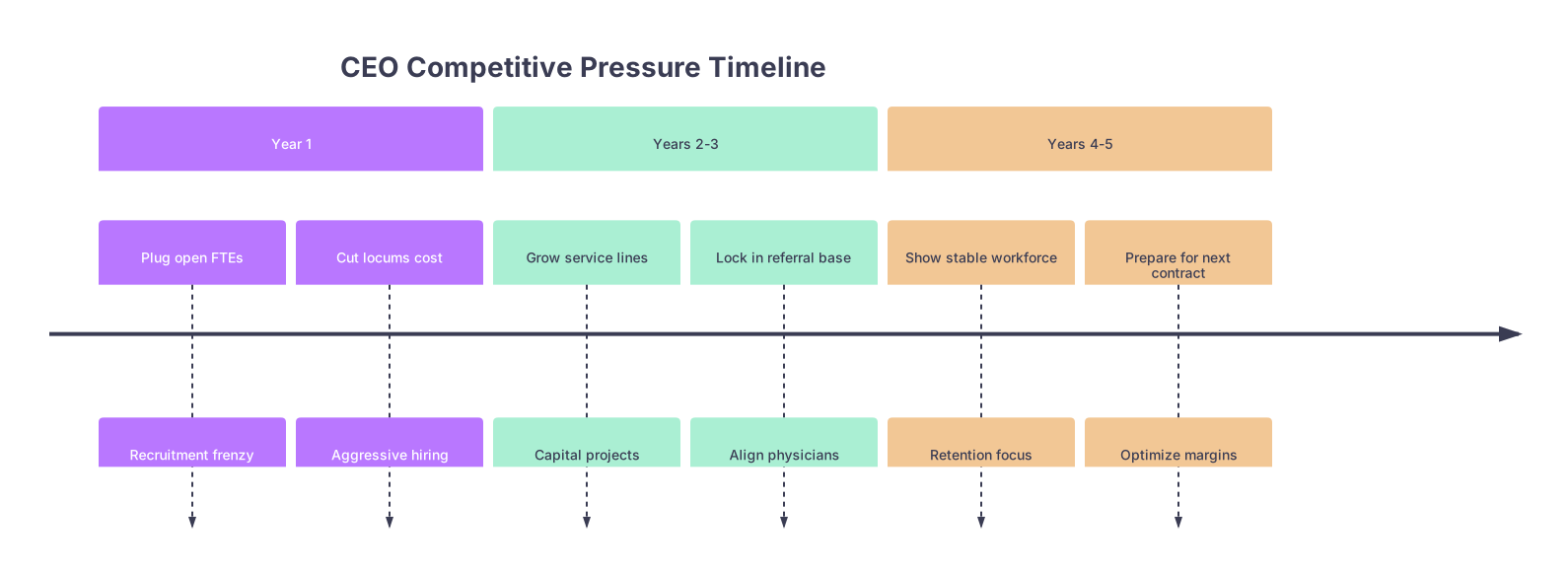
| Period | Event |
|---|---|
| Year 1 - Plug open FTEs | Recruitment frenzy |
| Year 1 - Cut locums cost | Aggressive hiring |
| Years 2-3 - Grow service lines | Capital projects |
| Years 2-3 - Lock in referral base | Align physicians |
| Years 4-5 - Show stable workforce | Retention focus |
| Years 4-5 - Prepare for next contract | Optimize margins |
They’re in a rush to show short-term wins. But you’re playing a 5–10 year game.
So when you’re across from a CEO, ask questions that force them into the long-term:
- “Where do you see this specialty in five years here?”
- “What’s one hard lesson you’ve learned from losing physicians?”
- “What’s the biggest physician complaint about this place right now?”
- “Which initiatives have failed in the last few years, and why?”
Pay more attention to their willingness to answer than the polish of the answer. A CEO who can’t admit a single mistake or failed project is not someone who will back you when things inevitably get messy.
And one more thing: ask to speak to at least one physician who left leadership (CMO, service line director) and returned to full-time clinical. Their perspective on how the system treats its own will be brutally clarifying.
What This Means For Your Future
The physician labor market is shifting in your favor long-term. Demographics and burnout are on your side. CEOs know this, even if they pretend otherwise.
They’re competing more fiercely and more quietly for you than at any time in recent history. That competition can work for you—or chew you up—depending on how clearly you see what’s actually happening.
Remember:
- You are not just filling a job; you’re shifting leverage in a local market.
- CEOs deploy money, promises, policy, and narrative as weapons to win you.
- The smartest move you can make is picking a place where the CEO’s need for short-term wins is aligned with your long-term stability and autonomy.
Don’t get dazzled by the sign-on or the scripted culture speech. Watch what they do to the physicians who are already there—and what they admit about the physicians who left.
That’s where the real story is.
FAQs
1. Are non-profit hospitals really better places to work for physicians than for-profit systems?
Not automatically. I’ve seen non-profits that behave like ruthless corporations and for-profits that treat physicians reasonably well. The real differences are in transparency and governance. Non-profits sometimes give physicians a bit more voice in strategic planning and quality decisions, but they can also hide behind “mission” while overworking you. Look at turnover, compensation fairness, and how they respond to safety concerns—not the tax status.
2. How much can I realistically negotiate with a hospital CEO or system?
More than you think on structure; less than you think on raw dollars. Most systems have fairly tight compensation ranges set by “fair market value” opinions. But you can often negotiate non-compete terms, call burden, support staff, clinic templates, protected time, leadership roles, and capital commitments with actual timelines. That stuff usually matters more to your quality of life than squeezing out another $20k in base pay.
3. Is it safer to join an employed model or stay independent with hospital privileges?
Employed models give you short-term security and scale but can erode your leverage if leadership changes or compensation models shift. Independent practice gives you more control but exposes you to payer and overhead risk. What’s changing is that many CEOs now target independent groups for acquisition specifically to lock in referral streams. If you stay independent, be very clear-eyed about contract terms with each hospital and how easily they can redirect patients elsewhere.
4. How do I spot a hospital or system that’s about to implode?
Look for a rapid cascade: frequent C-suite turnover, heavy reliance on locums, sudden changes to compensation models, hiring freezes combined with growing volumes, and aggressive spin in internal communications about “transformation” and “right-sizing.” Talk to people in revenue cycle and nursing. If both groups say, “We’re drowning,” and several mid-career docs have left in the past year, you’re staring at the early stages of an implosion, no matter how confident the CEO sounds.


