

The worst place to launch a clinic or health startup is “where you happen to live.”
Physician-entrepreneurs who treat location as an afterthought pay for it in reimbursement cuts, impossible hiring, and suffocating regulation. The ones who treat geography as a strategic lever win.
Let me break this down specifically.
This is not a generic “top 10 cities” fluff piece. Different kinds of physician-entrepreneurs need different ecosystems:
- The doctor building a high-touch, cash-pay cardiometabolic clinic.
- The anesthesiologist spinning up a multi-site ASC platform.
- The internist creating a virtual-first chronic care startup.
- The radiologist writing AI tooling for imaging groups.
Each of these has very different “best places to work as a doctor” if the metric is entrepreneurial upside, not just salary or lifestyle.
We will walk through the real levers that matter: payer mix, regulation, talent, capital, and growth runway. Then we will map those to concrete geographies and specific use-cases.
The 7 Location Levers Physician-Entrepreneurs Ignore (and Should Not)
If you remember nothing else, remember this: “good” places for employed doctors and “good” places for physician-founders are not the same list.
Here are the levers that matter for entrepreneurs.
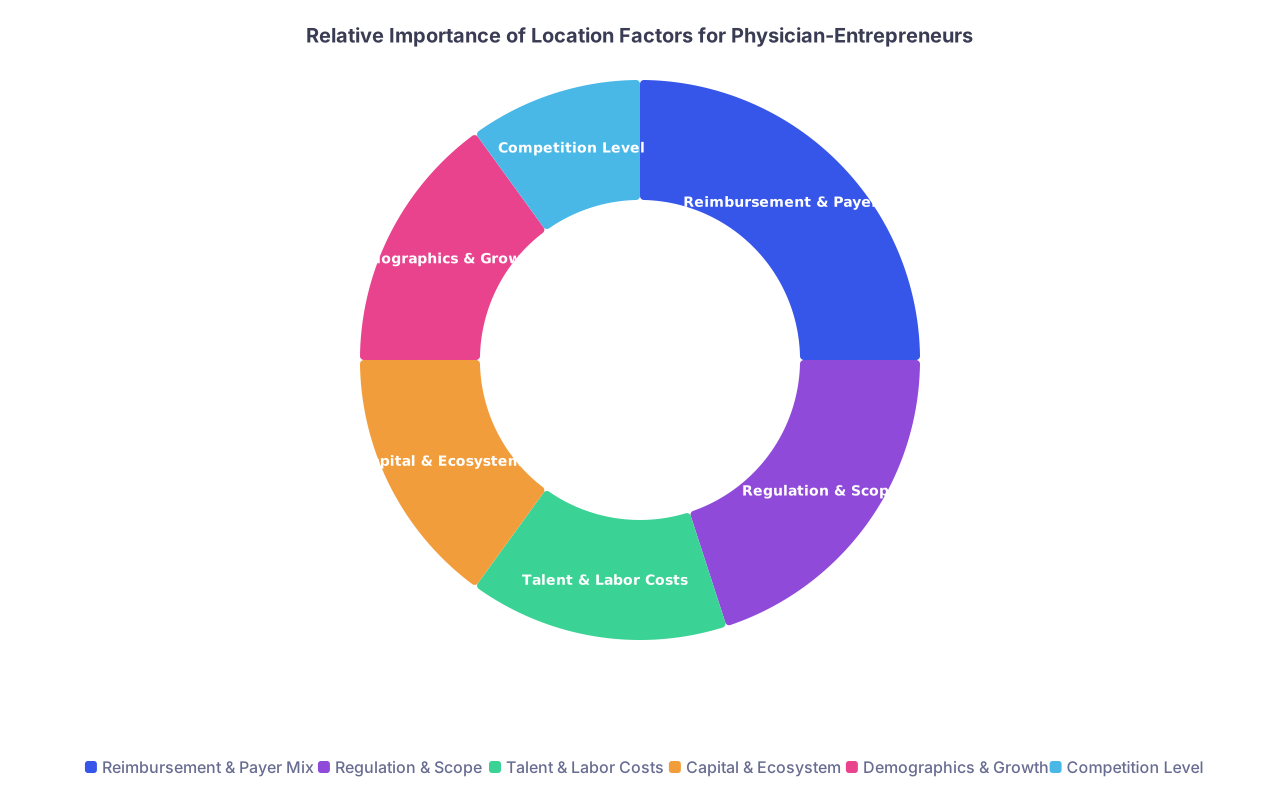
| Category | Value |
|---|---|
| Reimbursement & Payer Mix | 25 |
| Regulation & Scope | 20 |
| Talent & Labor Costs | 15 |
| Capital & Ecosystem | 15 |
| Demographics & Growth | 15 |
| Competition Level | 10 |
1. Reimbursement and payer mix
You want:
- High commercial payer penetration
- Large employer base with good benefits
- Reasonable Medicaid rates (or the ability to structure around them)
Texas, for example, has a strong commercial base and is generally friendlier to commercial plans than many coastal states. Nevada has brutal Medicaid but decent self-pay and tourism-driven commercial. Florida has heavy Medicare but an insane volume of high-acuity, procedure-heavy patients.
If your model is procedure-heavy, fee-for-service, or ASC-based, this matters more than anything.
2. Regulatory climate and scope
This includes:
- Certificate of Need (CON) laws for ASCs, imaging, cardiac services
- Corporate Practice of Medicine (CPOM) restrictions
- Telehealth regulations and parity laws
- Prior auth and network adequacy constraints
North Carolina versus Texas for a multi-specialty ASC platform? Night and day. One is CON-heavy and protects incumbents. The other lets you build if you can find capital and staff.
For virtual-first or multi-state plays, you care more about where your entity is domiciled and where you get early licensure and compacts (e.g., IMLC states) than where your office physically sits.
3. Talent access and labor costs
You cannot scale a clinic or startup without:
- Reasonably priced RNs, MAs, and front-desk staff
- Access to midlevels (NPs, PAs) where they fit your model
- Tech, data, and product talent if you’re building software or a hybrid model
San Francisco has great tech talent and horrible clinical staff costs. Phoenix or Dallas have decent tech talent (not top tier, but plenty) and much better clinical staffing economics.
4. Capital and ecosystem
If you are building:
- A tech-enabled services company
- A venture-scale digital health platform
- A multi-site roll-up with private equity ambitions
Then you pay close attention to:
- Direct flights to SF, NYC, Boston, Chicago
- Active healthcare investors and PE funds
- Local accelerators and payers willing to pilot
Boston-Cambridge for biotech and deep clinical-science. SF Bay Area for software + healthcare. Nashville for provider platforms and PE-backed roll-ups. Austin and Miami as the new money magnets.
5. Demographics, growth, and disease burden
You want:
- Population growth (new patients instead of zero-sum poaching)
- Clear demographic pattern that matches your niche
- Chronic disease burden if you are doing longitudinal or value-based care
Arizona, Texas, Florida: aging, moving-in, cardiometabolic heavy. Colorado and Utah: younger, fast-growing, active, good for sports medicine, MSK, and wellness-adjacent models. The Rust Belt: slower growth, but heavy chronic disease — great for risk-bearing primary care if you do it well.
6. Competition and incumbents
Is there:
- A dominant academic medical center that owns every referral?
- A single integrated system (e.g., Kaiser) that walls off patients?
- Or a fragmented market with lots of independent PCPs and small groups?
For outpatient specialties and ASCs, you want fragmentation and at least moderate out-of-network tolerance. For referral-dependent specialties, you either align with the 800-pound gorillas or intentionally stay away from their core markets.
7. Lifestyle and retention
Founders ignore this; then their key NP quits because child care is impossible or their tech lead will not move to a city they hate.
You do not need “best city overall.” You need “good enough that high-performers will stay for 5–7 years.” Phoenix, Raleigh-Durham, Salt Lake City, and Tampa quietly win here.
Best Places to Build Brick-and-Mortar Clinics and ASC Platforms
Let’s start with physician-entrepreneurs whose businesses have real walls and real parking lots: primary care, specialty clinics, surgery centers, imaging, urgent care, and niche programs.
1. Texas Triangle: Dallas–Fort Worth, Houston, Austin, San Antonio
Texas is the default answer for a reason, but you have to be specific about where and what.

Why the Texas Triangle works:
- Huge, fast-growing populations with strong commercial insurance
- No state income tax; relatively business-friendly regulatory climate
- Flexible CON (or absence) for many outpatient services and ASCs
- Deep healthcare labor pool, especially around large hospital systems
What works extremely well here:
- Multi-site urgent care and primary care with extended hours
- Orthopedics, pain management, GI, cardiology — anything procedure-heavy and ASC-amenable
- Direct primary care (DPC) and concierge models in higher-income suburbs (Plano, The Woodlands, West Austin)
- Hybrid clinic + telehealth behavioral health and weight management, especially in suburban sprawls
DFW and Houston are more traditional medical markets: system-heavy but fragmented enough to let good operators win. Austin and San Antonio offer slightly less mature competition but a more tech-savvy patient base.
Where founders get burned:
- Underestimating competition in affluent suburbs (everyone had the same idea)
- Misjudging staff wage inflation and assuming “Texas is cheap” across the board
- Ignoring language and cultural nuances in Houston and San Antonio — you need bilingual staff and thoughtful engagement to truly scale
2. Phoenix Metro (Arizona): The Quiet Goldmine for Clinics
Phoenix is one of the most underappreciated clinic markets in the United States for physician-entrepreneurs.
You get:
- Explosive population growth (retirees + families moving from California and the Midwest)
- High burden of chronic cardiometabolic disease, orthopedic issues, and cancer
- A state that is relatively friendly to independent practice and ASCs
- Good airports and flight access for capital and multi-state oversight
Models that thrive in Phoenix:
- High-efficiency specialty clinics: cardiology, GI, ortho, rheumatology
- Imaging centers (if you can secure equipment financing and payer contracts)
- Medically supervised weight loss and obesity medicine — especially if you stitch in virtual follow-up for the snowbird population
- DPC / concierge primary care in the East Valley and North Scottsdale; the demand is there
Real constraint: summer heat is brutal; recruiting from coastal cities sometimes requires higher effort. But retention can be excellent once people settle in.
3. Florida’s Fast-Growing Corridors: Tampa, Orlando, Jacksonville
Do not treat “Florida” as a single market. Miami is different from Jacksonville is different from Tampa.
But a few things are consistent:
- Massive Medicare population (great for cardiology, vascular, GI, oncology, nephrology)
- Rapid in-migration from the Northeast and Midwest
- Favorable tax environment and significant PE interest in provider platforms
Tampa and Orlando are particularly good for:
- Multi-site specialty clinics feeding into ASCs (ortho, pain, ENT, GI)
- High-volume, efficiency-focused primary care (including risk-bearing groups if you know what you are doing with Medicare Advantage)
- Niche subspecialties: retina, interventional pain, electrophysiology, structural heart — if you can secure block time and contracts
Miami/Fort Lauderdale is more saturated and more competitive on staff wages and commercial contracts. It is better if you are building something premium or global-facing (e.g., destination plastic surgery, fertility, or executive health).
4. Carolinas and Georgia: Regional Platforms and “Good Enough” Everything
Charlotte, Raleigh-Durham, Greenville-Spartanburg, and suburban Atlanta (north of the city especially) are very attractive for physician-led platforms.
Why:
- Strong employer base and commercial insurance
- Mix of urban, suburban, and rural catchment areas in reasonable driving distance
- Reasonable real estate costs (for now) and relatively stable staff availability
Be careful with CON laws here; some states in this region are still protectionist toward hospitals for imaging and certain surgical services. But for:
- Outpatient clinics
- Pain, behavioral, women’s health, pediatrics
- Functional medicine, lifestyle clinics attached to standard practices
You can do very well. Raleigh-Durham adds the benefit of a sophisticated patient base and major university anchors, which is useful if you want to run research or pilot innovative care models.
Best Places to Build Virtual-First and Hybrid Startups
You do not necessarily need to sit in the same city as your patients. But your founding location still matters for:
- Recruiting engineers, product, data science
- Raising capital
- Being perceived as a “serious” health tech company

| Step | Description |
|---|---|
| Step 1 | Define care model |
| Step 2 | Choose payer friendly state |
| Step 3 | Choose tech hub |
| Step 4 | Focus on reimbursement and staffing |
| Step 5 | Focus on capital and engineering |
| Step 6 | Layer telehealth to other states |
| Step 7 | Clinic heavy or tech heavy |
1. San Francisco Bay Area: Still the Center of Gravity for Health Tech
I know, everyone loves to complain that SF is over. It is not.
For venture-scale digital health, the Bay Area still offers:
- Unmatched density of investors who understand software and healthcare
- Experienced health tech talent from companies like Teladoc Health (via Livongo), Omada, Kaiser’s innovation arms, Carbon Health, etc.
- A culture that tolerates experimentation and iteration in product
Use the Bay Area if:
- Your primary asset is software / data, not physical clinics
- You want to raise venture capital and scale quickly across states
- You are building AI-heavy workflows (imaging, documentation, triage, coding)
Common mistake I see: clinicians move there, rent a clinic in Palo Alto, and burn months building a boutique local patient base. That is not why you go to SF. If you are there, you are there to build product and raise funds — not to create one more concierge practice for tech workers.
2. Boston–Cambridge: For Deep Clinical and Biotech-Adjacent Plays
Boston is not just for bench science and pharma. It is a tremendous location if your startup:
- Needs tight integration with academic medicine
- Touches genomics, advanced diagnostics, or complex therapeutics
- Requires KOLs, clinical trials, or specialist involvement from day one
You have access to:
- Teaching hospitals, research institutes, and major payers
- A deep bench of physicians comfortable with technology and trials
- A surprisingly strong startup scene in digital health (not just molecules)
If I were building anything at the intersection of:
- Oncology + data
- Rare disease + virtual specialty networks
- Advanced imaging analytics integrated with hospital PACS
I would seriously consider Boston. The drawback: high cost of living and clinical staff wages; not ideal for building large, cost-sensitive call centers or low-margin care delivery.
3. New York City: Enterprise Health, Payers, and Employers
NYC is useful for a specific type of health startup:
- Selling into large employers, unions, or self-funded plans
- Working closely with big payers and benefit consultants
- Running multi-specialty virtual clinics tied to Wall Street or Fortune 500 benefits
Your clinic does not have to be in Midtown, but your business development often will be. Many employer-focused behavioral health, MSK, and virtual primary care companies keep a NYC or tri-state presence simply to be physically accessible to benefit leaders and brokers.
If your end-customer is HR and CFOs, not individual patients, NYC is one of the best places to operate from.
4. Newer Tech-Health Hubs: Austin, Miami, Seattle
Austin and Miami are not just “tax arbitrage for tech bros.” They are becoming legitimate secondary centers for health tech.
- Austin: mix of big tech (Apple, Google, Meta) and a growing healthcare base (Ascension, Baylor Scott & White, Dell Med). Strong engineering pool and more reasonable costs than SF.
- Miami: strong Latin American connectivity, increasing investor presence, often used as a beachhead for cross-border health offerings and concierge/destination medicine combined with tech layers.
- Seattle: anchored by Amazon, Microsoft, and strong cloud/AI talent. Solid if you are doing anything with large-scale data infrastructure tied to health systems.
These cities are ideal if you want a mix of:
- Reasonable cost of living relative to SF/NYC/Boston
- Access to modern tech talent
- A narrative that investors buy (“We’re building at the intersection of tech and healthcare in Austin…”)
Where to Base Multi-State Telehealth and Niche Virtual Clinics
If your business is:
- Telepsychiatry
- Virtual addiction treatment
- Remote dermatology, endocrinology, women’s health, or men’s health
- Remote patient monitoring and chronic disease bundles
Then your “best place to work as a doctor” is about:
- Entity domicile and regulatory flexibility
- Malpractice climate
- Ease of multi-state licensure and compacts
| State | Key Advantage | Drawback |
|---|---|---|
| Texas | Large patient pool, business-friendly | Some payer friction on parity |
| Arizona | Progressive telehealth laws | Smaller absolute population |
| Florida | Huge demand, snowbirds | Heavy regulatory and MA scrutiny |
| Colorado | Tech-savvy, compact-friendly | Smaller payer diversity |
| Washington | Telehealth parity history | High cost of living |
Arizona and Colorado stand out for sustained telehealth-friendliness and population growth. If you are building a virtual-first clinic with:
- A compact license strategy for physicians
- Midlevels practicing across several western states
- A hybrid in-person “flagship” in one metro area
Then basing administrative HQ and initial clinical operations in places like Phoenix, Denver, or Dallas makes a lot of sense. You get good internet connectivity, airports, and a workforce that is comfortable in hybrid remote/office roles.
Common error: founders set up shop in an ultra-high-cost hub for prestige, then realize their RPM nurses, health coaches, and patient navigators could have been 30–40 percent cheaper with better retention in a city like San Antonio or Nashville.
Physician-Entrepreneur Hotbeds That Are Not Obvious Yet
Let me call out a few markets I have seen quietly becoming excellent for physician-founders, especially those combining clinical operations with tech-enabled workflows.
1. Nashville, Tennessee: Provider Platforms and PE Gravity
Nashville is already PE-central for healthcare. It has:
- HCA and many major provider platforms headquartered there
- A deep bench of executives and operators for multi-site clinics and surgery centers
- Investors who understand clinic P&Ls, not just SaaS metrics
If you are a physician planning to:
- Roll up pain practices, GI, dermatology, or cardiology groups
- Build a multi-site ladder up to a PE recapitalization event
- Combine a tech layer with a traditional services revenue base
Then running corporate HQ out of greater Nashville (Brentwood, Franklin) with clinical sites across the Southeast is a rational play.
You do not have to love country music. You do have to love unit economics and network contracts.
2. Utah (Salt Lake City / Provo): Tech Talent, Family-Friendly, Growth
Utah is quietly producing strong tech companies in SaaS, analytics, and consumer internet. Layer that with:
- A young, fast-growing, family-centric population
- Reasonable reimbursement and improving commercial payer presence
- A culture that often values preventive care and family health
There is an emerging niche here for:
- Pediatric and family-focused digital health models with in-person anchors
- Women’s health platforms that combine OB/GYN with virtual longitudinal care
- Behavioral health and addiction services that use telehealth plus some in-person hubs
Engineering talent from the “Silicon Slopes” scene is not SF/Boston, but it is serious — and often more loyal.
3. Midwest Secondary Metros: Columbus, Indianapolis, Kansas City
These cities will not show up on “best city for doctors” clickbait lists. They should show up on entrepreneur shortlists.
Why?
- Lower clinical staff costs
- Solid commercial payer presence (large employers, insurers)
- Less local competition for innovative care models
Think:
- Value-based primary care for Medicare and duals
- Cardiometabolic clinics that include RPM and remote coaching
- Employer-focused on-site or near-site clinics for large manufacturing, logistics, or tech employers
If you want to make a margin on actual care delivery rather than arbitraging California PPO contracts, these markets are compelling.
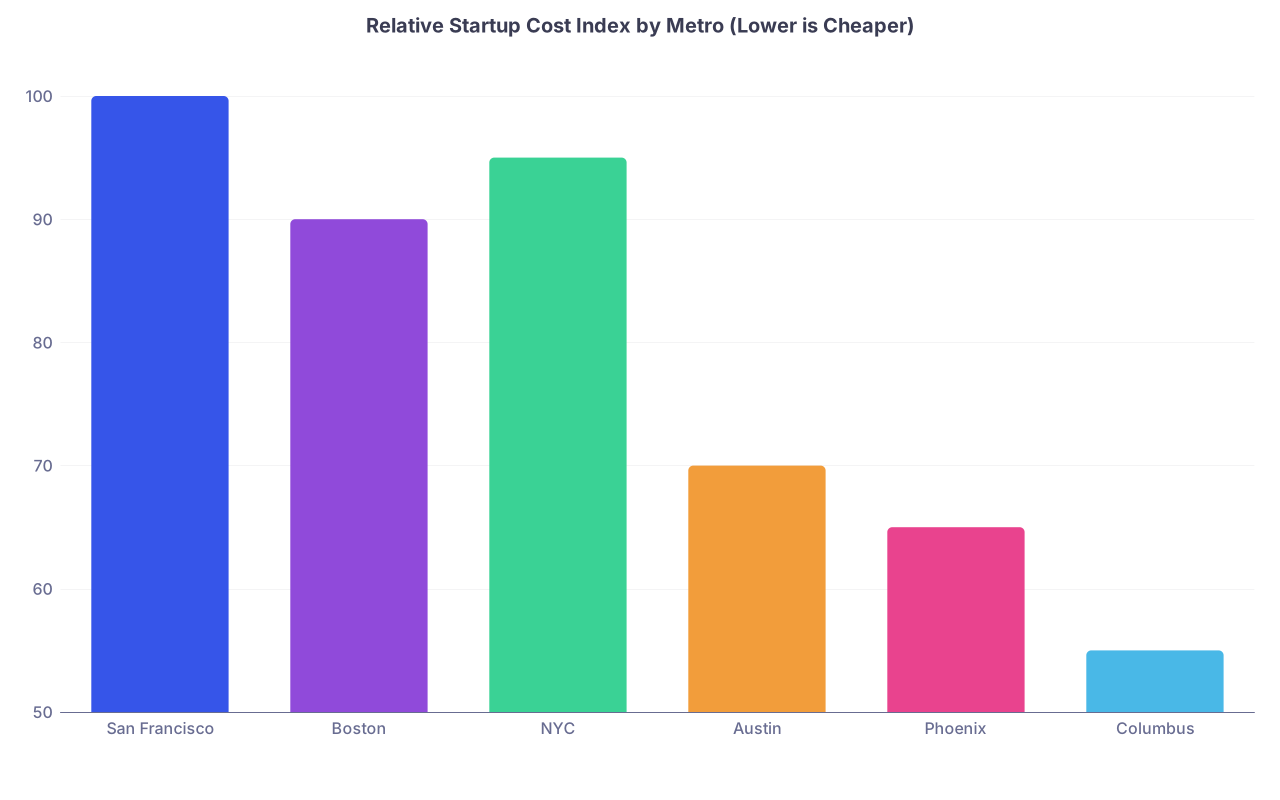
| Category | Value |
|---|---|
| San Francisco | 100 |
| Boston | 90 |
| NYC | 95 |
| Austin | 70 |
| Phoenix | 65 |
| Columbus | 55 |
Matching Your Physician-Entrepreneur Profile to the Right Place
Let’s tie this together. You are not picking a city. You are picking a business model, then picking a city that amplifies it.
Profile A: Proceduralist Building an ASC + Clinic Platform
Examples: orthopedic surgeon, pain specialist, GI physician, ENT.
You want:
- High commercial payer mix
- Weak or absent CON laws
- Reasonable facility and staff costs
- Population growth
Top choices:
- Dallas–Fort Worth, Houston suburbs, San Antonio
- Phoenix metro
- Tampa/Orlando/Jacksonville
- Nashville + satellite markets in neighboring states
Avoid:
- Heavy CON states with dominant academic centers unless you are explicitly partnering with them
- Ultra-high staff cost metros where ASC margins get eaten alive (San Francisco proper, Manhattan)
Profile B: Internist/Family Med Building DPC, Concierge, or Risk-Bearing Primary Care
You want:
- Affluent pockets for DPC/concierge OR
- High chronic disease burden + MA penetration for risk-based models
- Patients who are willing to switch away from health-system-owned primary care
Top choices for DPC/concierge:
- Austin, Dallas suburbs (Plano, Frisco), Houston suburbs
- Phoenix east/north, Scottsdale
- Raleigh-Durham, Charlotte suburbs, Denver-Boulder
Top choices for risk-bearing primary care (if you know what you’re doing):
- Florida (with heavy MA presence — but tread carefully)
- Texas metros
- Selected Midwest markets (Columbus, Indianapolis, Kansas City)
Critical nuance: DPC in a low-income town with poor employer coverage is masochism. Risk-bearing MA in a tech-heavy, young city is silly.
Profile C: Psych, Addiction, Behavioral Health Virtual-First
You want:
- Telehealth-friendly states and payers
- Multi-state licensure strategy
- Lower-cost HQ for clinical and non-clinical staff
Top choices:
- Phoenix, Denver, Dallas as operational hubs
- Entity domicile in a business-friendly state with good telehealth precedent (AZ, TX, CO, WA)
- Satellite clinicians recruited across compact states
You might raise money in SF/NYC/Boston while keeping almost all operations elsewhere.
Profile D: AI, Data, or Deep-Tech Health Startup
You want:
- Top AI / ML talent
- Proximity to large health systems and payers for pilots
- Venture ecosystem that understands frontier tech
Top choices:
- SF Bay Area for AI-heavy imaging, documentation, triage, coding
- Boston–Cambridge for data-intensive clinical integration, oncology, genomics
- Seattle for cloud-heavy, enterprise health data infrastructure
Physical clinics are optional and often unnecessary early-on.
Practical Steps: How to Actually Choose and Test a Location
Do not just pick a city because you liked the restaurant scene during a conference. Here is a simple, brutally practical approach.

| Step | Description |
|---|---|
| Step 1 | Define business model |
| Step 2 | Identify 3 key drivers |
| Step 3 | Shortlist 5 candidate metros |
| Step 4 | Collect payer and wage data |
| Step 5 | Talk to 5 local physicians per market |
| Step 6 | Run small pilot or telehealth-only launch |
| Step 7 | Pick 1-2 markets for deeper buildout |
Steps:
Define your primary revenue engine
Fee-for-service procedural? Capitated primary care? SaaS license? Cash-pay membership? Your location depends on this more than you think.Pull basic market data
For each candidate metro, look up:- Commercial vs Medicare vs Medicaid mix
- Median MA and RN wages
- Payer presence (which insurers, how concentrated)
- Population growth over the last 5–10 years
Talk to actual local physicians
Not hospital executives. Not chamber-of-commerce people. Working clinicians. Ask:- How hard is staff recruitment really?
- Which payers are nightmares?
- Who dominates referrals?
- Are independents thriving or selling?
Run your earliest MVP where regulatory friction is lowest
For virtual models, start in a telehealth-friendly state with simple licensing and reasonable malpractice. For clinics, target where you can open without months of CON battles.Be willing to be wrong once
Many very successful physician-entrepreneurs “wasted” their first city and then crushed it in the second. Picking wrong once is recoverable. Stubbornly staying in a bad fit market out of ego is not.

The Future: Where the Next Wave of Physician-Entrepreneurs Will Cluster
Two trends are going to matter more and more over the next decade.
1. Cross-border and global patient flows
Cities like Miami, Houston, Los Angeles, and New York will continue to dominate cross-border medicine:
- Latin American and Caribbean patients to Miami and Houston
- Middle Eastern patients to Houston and LA
- European and global wealthy patients to NYC and Boston
If you are building destination medicine, complex surgical programs, or second-opinion clinics with global intake, these cosmopolitan hubs hold a structural advantage.
Layer in telehealth triage and pre/post-op care across borders, and you have a powerful model.
2. Hybrid Tech + Clinics in Secondary Cities
As tech talent decentralizes, do not be surprised to see:
- Serious digital-health-plus-clinics companies headquartered in places like Raleigh-Durham, Salt Lake City, and Columbus
- Physician-led groups using remote engineering teams while maintaining strong local clinical hubs
- PE-backed platforms using these cities as operational hubs with spoke clinics nationwide
The myth that you must either be in SF/NYC/Boston or nowhere will continue to die. Physician-founders who understand both reimbursement and software will build serious companies out of “boring” places with superb economics.

Three Things to Remember
- “Best place to work as a doctor” is not “best place to build as a founder.” Optimize for business model, not lifestyle rankings.
- Your clinical revenue model — procedural vs primary care vs virtual vs SaaS — should dictate which metros even make your shortlist.
- You can always bolt on new states and new cities. Choose the first one or two markets ruthlessly for reimbursement, regulation, and talent — not for convenience.


