

The way most doctors pick cities is backwards if they actually care about raising kids.
They chase prestige hospitals, salary numbers, or “cool” metros. Then they complain later about 60‑minute commutes, lottery school systems, and never seeing their kids awake on call weeks. If you’re serious about being both a good physician and a present parent, you have to flip the script: start with your kids’ lives, then work backwards to the job.
Let’s walk through where that actually works in the U.S.—and how to think about schools, safety, and schedules in brutally practical terms.
Step One: Define Your Real Non‑Negotiables (Not the Fantasy List)
You cannot optimize for everything: top 10 academic center, six‑figure sign‑on, 10‑minute commute, elite schools, low crime, cheap housing, and year‑round sunshine. That city doesn’t exist.
So you start by choosing your top three non‑negotiables. For physician parents, the smart ones usually look like:
- Reasonable commute (20–30 minutes max)
- Predictable schedule (or at least predictable patches of time with your kids)
- Stable, decent public schools in the neighborhoods you can actually afford
Safety threads through all three.
Here’s how I’ve seen this play out:
The “big‑name hospital” trap: Attending signs with a marquee academic center in a huge coastal city. Commute is 45–60 minutes each way because they can’t afford housing in the good school zones near the hospital. They leave the house before kids wake, get home as they’re going to bed. They technically live in a great city. The kids barely know them.
The “cheap house, bad schools” trap: Physician couple buys a huge house 45 minutes out in an exurb with weak schools because it’s affordable. They plan on private school “later.” Later never comes. They’re backup Uber drivers to the city every time they’re on call.
The “I’ll fix this in fellowship” lie: Resident says, “We’ll just suffer now and fix it after fellowship.” Then they match into another prestige program in another expensive city. Now there are two moves with kids, zero community, and constant reset of childcare.
You avoid these traps by forcing this order of decisions:
- Decide what school quality and neighborhood safety level you will not go below.
- Decide maximum commute time from that neighborhood.
- Only then look at hospitals/clinics that fit inside that circle.
Backwards of how most doctors do it. Much better for your kids.
The Core Tradeoffs: Academic vs Community vs Private Practice
Before cities, be honest about job type. Your kids will feel your practice model more than they ever care about your hospital’s U.S. News ranking.
Here’s the rough reality:
| Job Type | Schedule Predictability | Nights/Weekends | Geographic Flexibility |
|---|---|---|---|
| Big Academic | Low–Medium | Frequent | Limited, clustered |
| Community Hospital | Medium | Moderate | Wide range of cities |
| Outpatient Only | High | Rare | Very wide |
| Hospitalist 7on7off | Medium–High | Intense blocks | Wide |
If you want strong schools + safe area + control of your kids’ schedule, you’re usually looking at one of these setups:
- Outpatient‑heavy (IM, FM, peds, some subspecialties)
- Community hospital employed with protected clinic days
- Hospitalist with strict boundaries on extra shifts
This matters because it opens up a different map of “best cities” than the med student fantasy list. You’re not hunting for Manhattan or San Francisco anymore. You’re hunting for medium metros and “boring” suburbs where:
- Median household income is solid
- Property taxes actually fund schools
- Violent crime is low
- There’s one tertiary center and several stable community systems
That’s exactly where a lot of physician parents thrive.
Best City Profiles for Physician Parents (And Concrete Examples)
Forget “top 10 cities” lists. Those are written for consultants and tech workers, not docs with toddlers and 1 in 4 call.
You want profiles that work: patterns of cities that consistently hit schools + safety + decent schedules.
1. Mid‑Sized Metro With One Dominant Health System
These are 500k–1.5M population metros with:
- One main academic/flagship hospital
- Several community satellites
- Reasonable cost of living
- Well‑rated suburban school districts ringing the city
Examples (not exhaustive, but real options):
Raleigh–Durham–Chapel Hill, NC
Triangle area, anchored by Duke and UNC but surrounded by community systems (WakeMed, Duke regional sites). Strong school districts in places like Cary, Chapel Hill, parts of Apex. Tech‑driven economy supports tax base. Traffic is growing but still manageable.Madison, WI
University hospital plus stable community networks. Consistently high public school rankings, bike‑able city, relatively low violent crime. Winters are brutal, but family life is solid. Commutes under 25 minutes are very doable.Ann Arbor, MI
University of Michigan plus regional hospitals. Top‑tier schools in Ann Arbor and some neighboring districts. Housing isn’t cheap, but compared to coastal academic cities, it’s survivable on a physician salary. It’s a classic “raise your kids here” town.
How this helps your schedule: dominant systems in these metros need bodies. That gives you leverage for sane clinic hours, part‑time options, or custom schedules—especially in primary care and hospitalist roles.
2. Suburbs of Major Medical Hubs (But Not the Hub Itself)
This is where a lot of physicians get it right or disastrously wrong. The magic is living in the suburb that combines:
- Top‑half or top‑quartile schools in the state
- Lower violent crime than the core city
- A reverse or off‑peak commute to your hospital
A few patterns:
Outside Boston:
Living in Boston with kids on a physician salary is a contact sport. But Lexington, Newton, Needham, and similar suburbs have elite public schools and safer streets. Commuting into MGH, Brigham, BIDMC is painful in rush hour but manageable if you structure your hours or take hospitalist week-on/week-off gigs and stay near the hospital for those weeks.Dallas–Fort Worth burbs:
Frisco, Plano, Southlake, Coppell—highly ranked schools, relatively low crime for a large metro, tons of health systems (Baylor Scott & White, Texas Health, UT Southwestern). The key is choosing a clinic or hospital in the same quadrant as your house. A Southlake doc working in Southlake is home for dinner. A Southlake doc commuting to downtown Dallas is miserable.Twin Cities suburbs (MN):
Edina, Eden Prairie, Minnetonka, Woodbury—excellent schools, strong safety metrics. Multiple major systems (Fairview, Allina, HealthPartners, Mayo satellite sites). Winter is real, but family life is structured and kid‑friendly.
This strategy shines when you’re willing to skip the most prestigious downtown academic job and instead work for a suburban affiliate or strong community system. You get shorter commute, more predictable hours, and your kids get top‑tier schools without private tuition.
3. Quiet College Towns With Attached Medical Systems
If you’re not obsessed with nightlife and Michelin stars, college towns are underrated goldmines for physician parents.
Features that matter:
- Higher education anchor -> stable economy
- Typically lower violent crime
- Often above‑average public schools
- Enough culture and sports to keep teens sane
Concrete examples:
- Iowa City, IA – University of Iowa Hospitals and Clinics
- Gainesville, FL – UF Health
- Columbia, MO – University of Missouri Health Care
- Charlottesville, VA – UVA Health
These are the places where you bike to work, your kids walk to decent schools, and you’re not fighting for OR block time with 20 fellows. You may trade prestige or pay, but your daily life is radically calmer.
4. Growing Second‑Tier Sunbelt Cities (Choose Carefully)
Some fast‑growing southern and mountain cities work very well for doctors with kids—if you pick the right neighborhoods and avoid the hype zones.
Examples:
- Raleigh–Durham, NC (already mentioned)
- Boise, ID
- Greenville, SC
- Colorado Springs, CO (not Denver; traffic and cost are rougher there)
Common pros:
- Lower cost of living than coasts
- Growing health systems hungry for docs
- Outdoor recreation for family life
- Mix of charter, magnet, and solid neighborhood schools
Common cons:
- Rapid growth can strain schools and traffic
- Some political/cultural climates may not fit every family
- Fewer subspecialty/niche academic roles
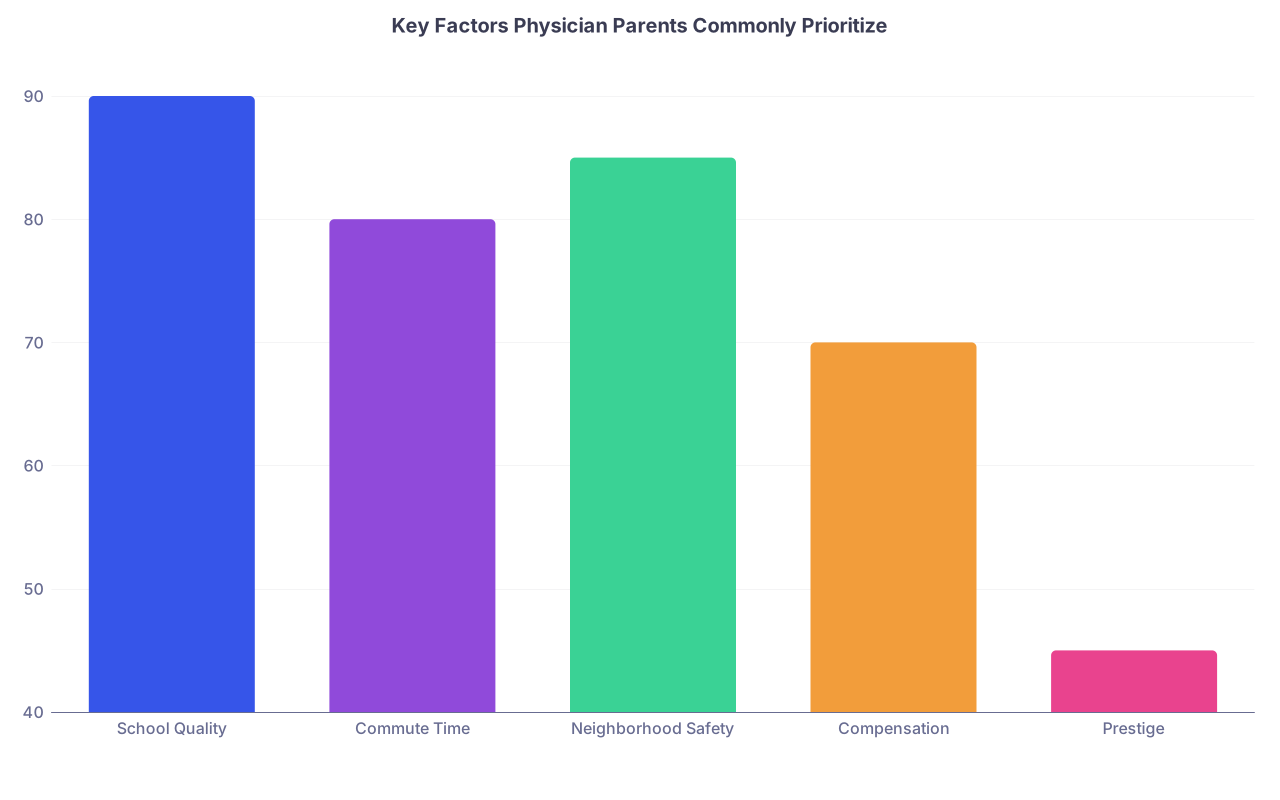
| Category | Value |
|---|---|
| School Quality | 90 |
| Commute Time | 80 |
| Neighborhood Safety | 85 |
| Compensation | 70 |
| Prestige | 45 |
School Quality: How to Check It Without Getting Lost in Rankings
You don’t need to produce an education PhD thesis. You do need to avoid the classic mistakes:
- Looking only at district reputation without checking zoned schools
- Assuming “everyone talks about this suburb” means your specific school is good
- Ignoring middle school and high school while your kids are still in diapers
Here’s the fast‑and‑dirty approach that actually works.
1. Check Real Boundaries, Not Marketing
A district can have some A+ schools and some C schools. Your kid goes where your address says, not where the brochure points.
- Pull the exact address of any house or apartment you’re considering.
- Use the district’s own boundary lookup (not a real estate site’s estimate).
- Identify the elementary, middle, and high school you’d be assigned to.
If those are consistently in the bottom half of the district or state, you’re buying a fight you don’t need.
2. Look Beyond One Composite Score
GreatSchools, Niche, state report cards—they all simplify things. Use them, but look under the hood:
- Check test score distribution, not just the rating
- Look at student–teacher ratio
- Check AP/IB offerings for the high school
- Look at graduation and college‑going rates
Red flag I see constantly: district is famous, high school is amazing, but the zoned middle school is mediocre and chaotic. Those are rough years to risk.
3. Factor Commute + School Start Times Into Your Call Life
This is where schedules bite.
Typical pattern I’ve seen:
- Elementary school starts at 7:45–8:00
- Middle/high school can be 7:20–7:30 in some districts
- Your OR cases or clinic start at 7:00 or 8:00
If your commute is 35 minutes, you aren’t doing morning drop‑off on OR days. Period.
What you want:
- Commute under 25 minutes
- At least one parent with some schedule flex for either drop‑off or pickup
- Backup plan for post‑call mornings when you’re useless
Smart physician parents will sometimes choose a slightly less elite school in exchange for 10–15 fewer commute minutes and daily presence. The kids remember time with you more than the difference between rank #4 and #14 district.

Safety: How to Avoid Overreacting and Being Naive
Doctors are great at catastrophizing about crime because we see the worst days of people’s lives. You don’t want to raise your kids in a panic bunker, but you also shouldn’t ignore glaring data.
Here’s how to approach it like a rational adult.
1. Look at Trend, Not Just Single Numbers
Check:
- City crime data (often on city or PD website)
- Neighborhood‑level data, not just whole metro
- Whether violent crime is trending up, down, or stable over 5–10 years
A neighborhood with slightly higher crime but stable or declining trend can be acceptable with good schools and community. A place with rapidly rising violent crime near your kids’ schools is a harder sell.
2. Walk It Like a Human, Not Just on Google Maps
If you’re serious about a job:
- Visit the neighborhood around 7–8 am (school and commute time)
- Visit again around 5–7 pm (when your kids would be outside)
- Notice: sidewalks, people out walking, parks actually being used, basic upkeep
If you don’t feel comfortable walking your kids around the block at dusk, keep looking.
3. Do the “Call Night” Test
Imagine this scenario:
- You’re on call at the hospital
- Your partner is home with the kids
- One kid spikes a fever at 11 pm and needs urgent care
Ask yourself: do you feel OK about your partner driving to urgent care or the hospital, parking, and walking in with 2 kids at that hour from where you live? If your answer is no, that neighborhood is not a good fit.
Schedules: Structuring a Life Your Kids Can Count On
This is the part no recruiter talks about. You need to design your actual life, not just your compensation package.
1. Choose Jobs by “Protected Family Time,” Not Just FTE
When you’re evaluating offers, ask:
- What does a typical week look like for attendings with school‑age kids?
- Are there physicians working 0.8 or 0.9 FTE, and is that stigmatized?
- What’s the real expectation for after‑hours charting?
There are departments where 1.0 FTE means 70 hours and constant inbox. There are others where 0.9 FTE means four 8–5 days, truly protected. Guess which one your kids prefer.
2. Decide Your “Anchor Times” With Your Kids
Pick 1–2 things you will protect most weeks:
- Breakfast with them 4 days a week
- Dinner 3 nights a week
- Always home for bedtime on non‑call days
- Always at Friday night games during season
You then work backward:
- Can your clinic block you out after 4:30 on those days?
- Can you cluster late OR days and protect others?
- Can you schedule telehealth half‑days when you’re home for sick kids?
Physician parents who survive aren’t more efficient. They’re more ruthless about these anchor points.

| Step | Description |
|---|---|
| Step 1 | Job Offer |
| Step 2 | Reject or renegotiate |
| Step 3 | Check clinic hours |
| Step 4 | Review call schedule |
| Step 5 | Accept and set anchor family times |
| Step 6 | Commute under 30 min |
| Step 7 | Home for dinner 3 days? |
| Step 8 | One free weekend monthly? |
3. Hospitalist and Shift Work: Dangerous or Perfect?
Hospitalist 7‑on/7‑off or ED shift work can be either a dream or a nightmare for kids.
Great when:
- You cluster shifts and are fully present on off weeks
- Your partner understands that on‑week you’re basically gone
- You live close enough that post‑shift drive isn’t a safety risk
Terrible when:
- You “voluntarily” add extra shifts for the money
- Your off weeks get eaten by committees and charting
- Your kids never know if you’ll be awake or asleep
If you choose a shift‑based specialty, you must set rules from day one: maximum shifts per month, non‑negotiable off‑week protection, and a commute that doesn’t kill you after nights.

How to Actually Pick Your City: A 3‑Visit Strategy
You’re not going to think your way into the perfect choice from a job posting. You need to see it.
Use this rough framework when you’re serious about a place.
Visit 1: Interview + Reality Check
During your job interview visit:
- Drive from the hospital to 2–3 recommended family neighborhoods at rush hour
- Stop at a grocery store and a park near each
- Ask every physician with kids where they live, how long it takes, what schools their kids attend
You’re not asking “Do you like it here?” (they’ll say yes). You ask, “If you could redo it, would you pick the same neighborhood and school?”
Visit 2: Bring Your Partner (and Even the Kids, If They’re Old Enough)
Second time:
- Tour the actual zoned schools if you can
- Drive the morning commute from a prospective house to school to hospital at 7:15 am
- Do a 7 pm walk around the block near your top 2–3 houses
If your partner hates the vibe, listen. You’re going to be at the hospital. They’ll be living there all day.
Visit 3: Stress‑Test the Plan
Before signing:
- Sit with the schedule: map next year’s school calendar against call schedule expectations
- Identify backup childcare for late cases and call nights
- Run the household budget with local taxes, property insurance, and realistic childcare costs
If it only works when everyone is healthy and no one is ever late, it doesn’t work. Real life has stomach bugs the night before your 7 am OR start and snow days during your 7‑on week.
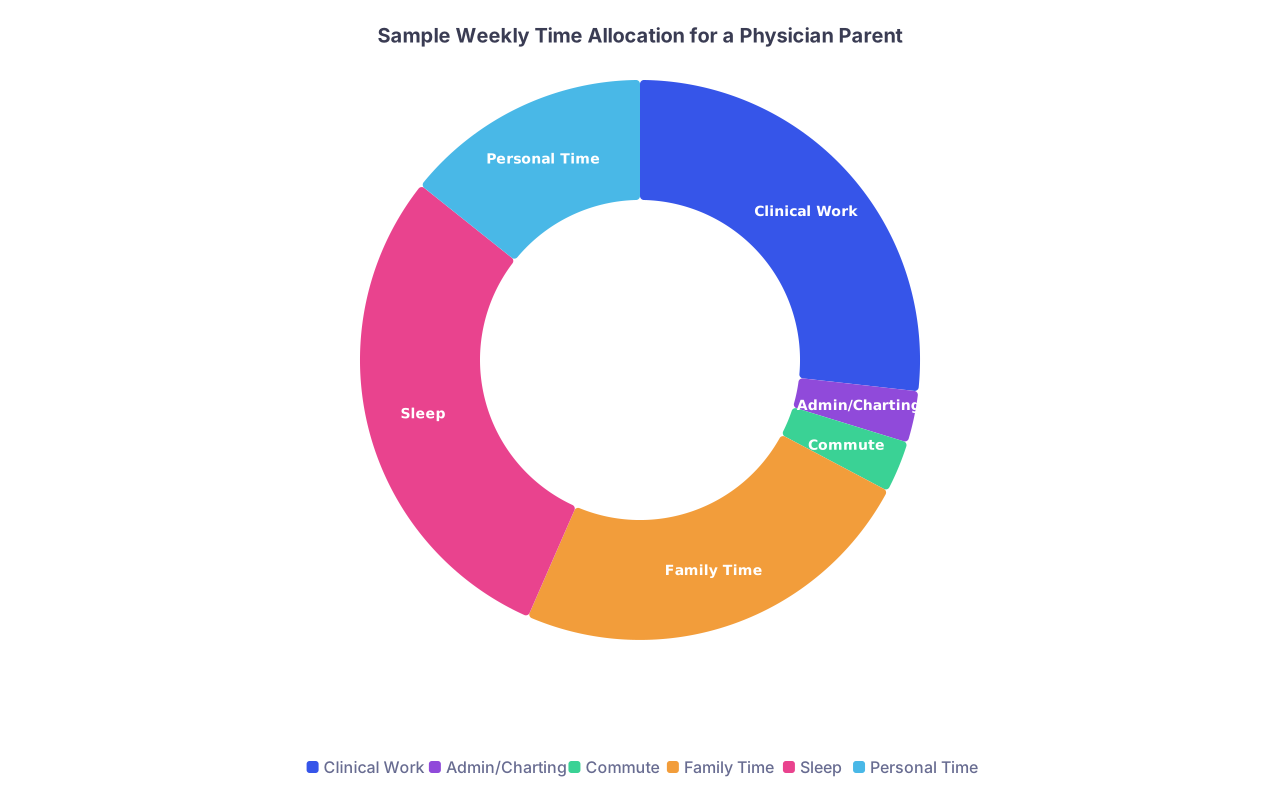
| Category | Value |
|---|---|
| Clinical Work | 45 |
| Admin/Charting | 5 |
| Commute | 5 |
| Family Time | 40 |
| Sleep | 49 |
| Personal Time | 24 |
Concrete City Shortlist Ideas by Priority
To make this less abstract, here’s how I’d build shortlists by what you care about most. This is directional, not gospel.
If your #1 is elite public schools + safety + medium cost
Look at: suburbs of Minneapolis, Raleigh‑Durham, Madison, Ann Arbor, some Dallas‑Fort Worth suburbs, parts of Denver area (with caution on cost).If your #1 is predictable outpatient schedule + kids walk to school
Look at: college towns with health systems (Iowa City, Charlottesville, Gainesville, Columbia MO), smaller metros like Boise or Greenville.If your #1 is maximum free chunks of time (hospitalist or ED)
Look at: second‑tier metros with multiple hospital systems—San Antonio, Kansas City, Richmond, Jacksonville, Oklahoma City—where your skill is in demand and you can negotiate hard on schedule and FTE.If your #1 is academic career but you still want kids to have a normal life
Look at: Ann Arbor, Madison, Chapel Hill/Durham, Charlottesville, Iowa City, Rochester MN (Mayo). Strong academics without coastal insanity.
The pattern you should see: very few of these are New York, LA, or San Francisco. Not because those are “bad,” but because when you factor in schools, safety, and schedules as a physician with kids, they’re often stacked against you unless you’re willing to sacrifice a lot.
Open a map of the U.S. right now and pick three cities that fit one thing: a 30‑minute triangle between hospital, likely neighborhood, and a decent public school. Then start checking real school assignments and crime data for those neighborhoods. Let the map—and your kids’ future Tuesday afternoons—guide your next move, not the hospital’s logo.


