

You are standing in the call room at 2:15 a.m., staring at the board. Nine holds in the ED, three admits with no beds, and one ICU transfer waiting on a miracle. You have done this in some version for years. Good salary, big-city hospital, academic logo you can put on your CV.
But you are cooked. You want out. Not out of medicine. Out of this.
You keep pulling up photos of lake towns, mountain towns, or that one rural place where your friend swears everyone knows his dog’s name and he is home for dinner by 6.
You are not ready to quit next month. You also are not willing to “see what happens” and drift. You want a structured transition: quarter by quarter, with real milestones.
That is what this guide is: a 12–18 month, quarter-by-quarter plan to move from an urban hospital job to practicing in a small town in a way that protects your income, your family, your license, and your sanity.
Big Picture Timeline (0–18 Months)
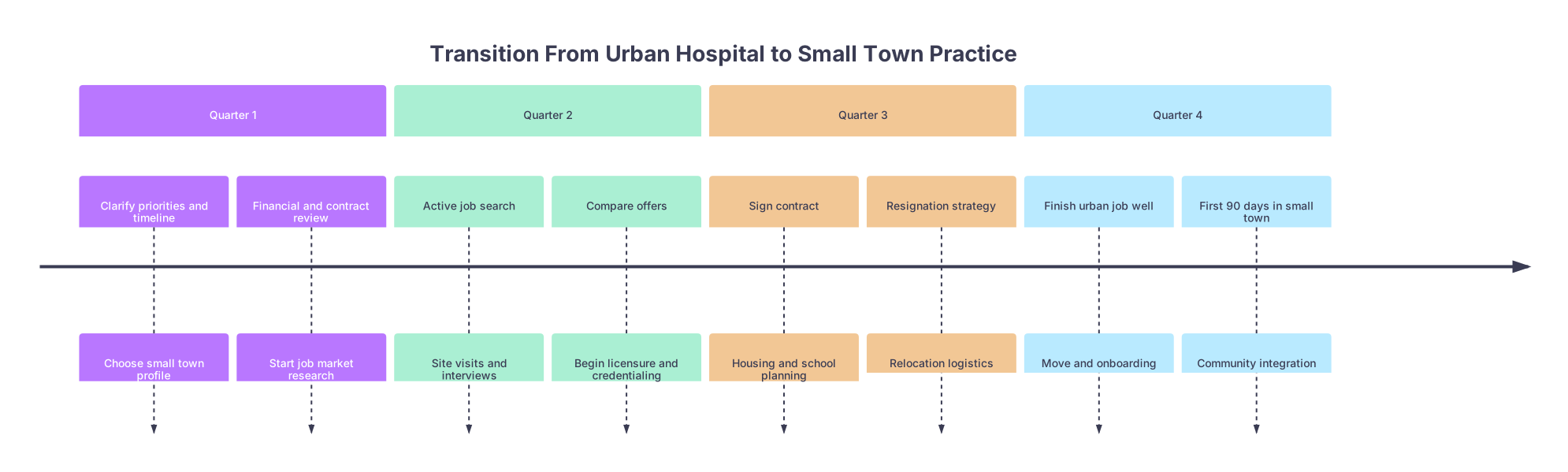
| Period | Event |
|---|---|
| Quarter 1 - Clarify priorities and timeline | Choose small town profile |
| Quarter 1 - Financial and contract review | Start job market research |
| Quarter 2 - Active job search | Site visits and interviews |
| Quarter 2 - Compare offers | Begin licensure and credentialing |
| Quarter 3 - Sign contract | Housing and school planning |
| Quarter 3 - Resignation strategy | Relocation logistics |
| Quarter 4 - Finish urban job well | Move and onboarding |
| Quarter 4 - First 90 days in small town | Community integration |
At this point, you are probably 9–18 months away from actually leaving.
- If you want to move in 12 months → compress each “quarter” into ~2 months.
- If you have kids in school and want to move on a summer cycle → stretch to 18 months.
The key is to treat each quarter like a project with specific outcomes, not vague “I should look into rural jobs someday” energy.
Quarter 1 (Months 0–3): Define the Target and Clean Up Your House
At this point you should not be firing off applications. You should be getting clear and getting ready.
Month 1: Decide What “Small Town” Actually Means For You
“Small town” is not one thing. Rural Minnesota critical access hospital is not the same as a 40k-person resort town with a Level III trauma center.
You need hard criteria.
Population range:
- 5–15k? 15–50k?
- How far are you willing to drive to an airport > daily?
Clinical setup:
- Hospital-employed vs independent group vs FQHC.
- Inpatient + outpatient combo vs pure outpatient vs hospitalist-only.
Scope of practice:
- Are you willing to broaden (e.g., more procedures, more peds, more OB, more ICU management)?
- Where is your true safety line? Put it in writing.
Lifestyle anchors:
- Outdoorsy? Mountain / lake / coast?
- Need certain schools, synagogues, mosques, churches, or cultural communities nearby?
Write this out. Literally one page. I have seen too many people “escape” to jobs that look rural-cute and then realize they signed up for ICU call they are not comfortable with.
Month 2: Financial and Life Inventory
At this point you should be brutally clear about your money and obligations. Rural jobs often pay well, but relocation, house changes, and partner job loss can wreck you if you are not prepared.
Do a quick financial map:
- Annual income now vs minimum acceptable in small town.
- Debt load (student loans, mortgage, credit cards).
- Contractual obligations:
- Current non-compete radius.
- Repayment clauses (sign-on bonus, relocation, loan repayment, retention bonuses).
| Item | Target Detail |
|---|---|
| Minimum annual salary | $___ |
| Student loan monthly payment | $___ |
| Current non-compete radius | ___ miles for ___ years |
| Bonus payback risk | $___ if leaving before ___ date |
| Emergency fund | ___ months of living expenses |
Loop in a financial planner who understands physician comp if you have one. If not, at least get a CPA to run rough numbers with tax differences (state income tax, property tax, potential 1099 income if locums).
Month 3: Contract + CV Cleanup
You cannot plan a clean exit without knowing your current shackles.
Have your contract reviewed (by someone who does physician employment contracts, not your cousin).
- Key items:
- Term and termination clause (how much notice required).
- Non-compete: radius, duration, what it actually forbids.
- Repayment obligations (bonuses, CME, relocation).
- Put key dates in a simple timeline:
- Earliest penalty-free departure date.
- Dates when payback amounts shrink or disappear.
- Key items:
Update your CV for rural relevance.
- Emphasize:
- Breadth of cases.
- Any procedural skills.
- Leadership / QI work.
- Flexibility with call and night coverage.
- Trim:
- Overly academic fluff that does not help (unless pursuing a rural academic hybrid).
- Emphasize:
You end Quarter 1 with:
- A one-page “ideal small town job” profile.
- A clear read on exit penalties and timing.
- A clean CV ready to send.
Quarter 2 (Months 4–6): Serious Job Search and Site Visits
Now you move from “thinking” to “acting.”
Month 4: Market Scan and Initial Conversations
At this point you should be scanning widely but applying selectively.
Channels to use:
Recruiters:
- Yes, most are annoying. Some are useful.
- Use 2–3 regional or rural-focused agencies, not 12 generalists.
Direct hospital systems:
- Check systems known for rural networks:
- Example: Mayo Clinic Health System (Midwest), Sanford (Dakotas), Banner (West), Providence (NW), large Catholic or regional systems.
- Check systems known for rural networks:
State and specialty societies:
- Many state medical societies and rural health associations maintain “hard to fill” rural job lists.
Make a simple tracking sheet (Google Sheet is fine):
- Town, state
- Population
- Hospital / clinic
- Compensation structure
- Call expectations
- Contact person
- Status (initial email, call done, site visit scheduled, offer received, etc.)
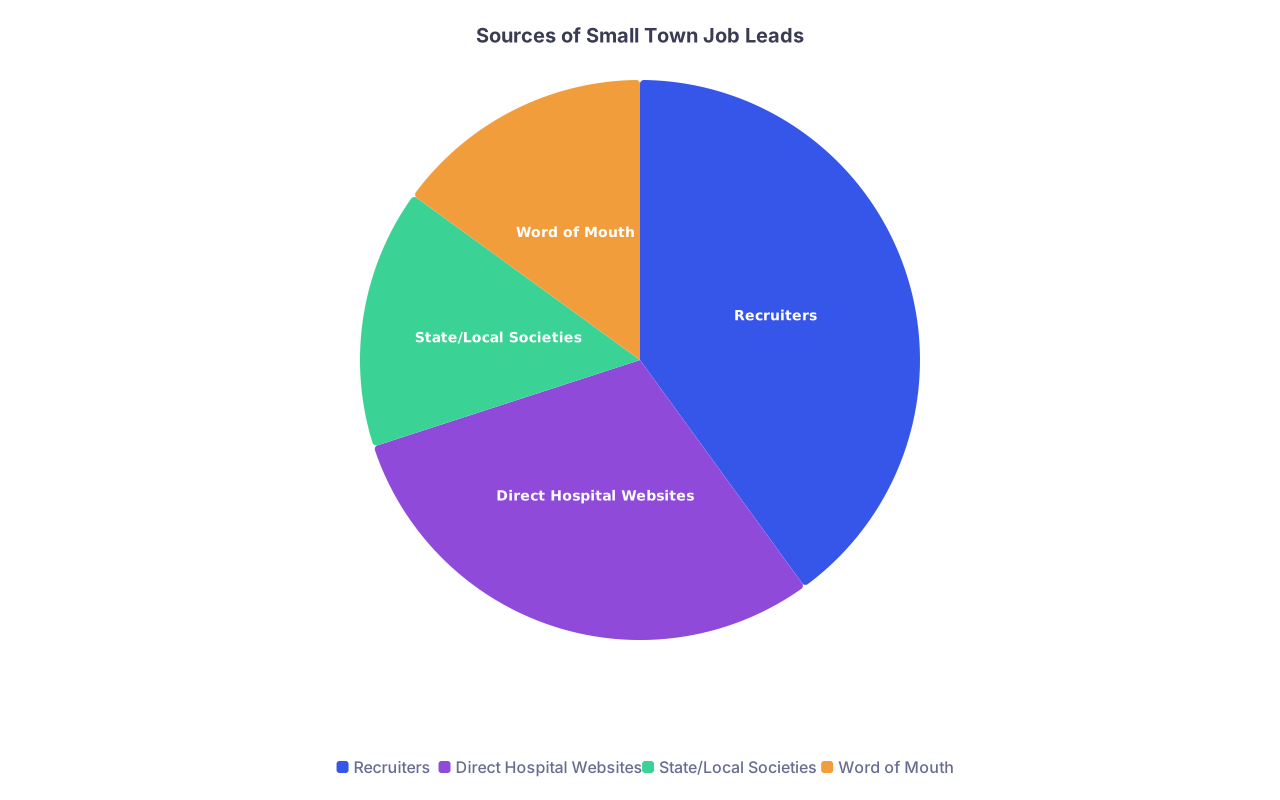
| Category | Value |
|---|---|
| Recruiters | 40 |
| Direct Hospital Websites | 30 |
| State/Local Societies | 15 |
| Word of Mouth | 15 |
Start with low-stakes conversations. You are not committing just by talking.
Script for that first call:
- “I am in [specialty] in [city], planning a transition in about [X] months. I am interested in [type of town] with [broad scope / specific boundaries]. What does your practice actually look like on a Tuesday? What do your physicians complain about?”
If they cannot answer that last question honestly, red flag.
Month 5: Site Visits (At Least 2, Preferably 3)
Paper jobs lie. Site visits tell the truth.
At this point you should schedule visits to your top 2–4 locations. Do not cram them all into one week if you can avoid it; you want some time to decompress and compare.
During each visit:
Workday reality:
- Sit in clinic / round with them if allowed.
- Look at the schedule templates.
- Ask to see actual call logs for the last 3 months.
Infrastructure:
- Imaging: CT? MRI? How often? Telerad coverage?
- Subspecialty backup: who takes STEMIs, strokes, complex trauma? How far away?
- Nursing and ancillary staff stability: “How many travelers do you have on a typical day?”
Town reality:
- Drive around without the recruiter.
- Check schools, grocery stores, housing stock.
- Eat where locals eat, not just the “showpiece” restaurant.

Bring your partner if applicable. If they hate it, you do not have a viable job. Simple as that.
Month 6: Compare Offers and Start Licensure / Credentialing
By now, you should have at least one serious option, probably more.
Break down each viable offer across a few non-negotiable dimensions:
| Factor | Offer A | Offer B | Offer C |
|---|---|---|---|
| Base salary (yr 1) | |||
| Call burden | |||
| Sign-on bonus | |||
| Loan repayment | |||
| Scope of practice | |||
| Town population |
Do not get hypnotized by a big sign-on bonus. I have seen $50k bonuses tied to brutal call schedules and toxic cultures. A small town that pays $30k less but respects your time is usually the better play over five years.
At the same time:
- Start any needed state medical license applications if you are moving states.
- Start DEA address changes planning.
- Ask about credentialing timeline:
- Hospital privileges can easily take 90–120 days. Back-time from your ideal start date.
You end Quarter 2 with:
- 1–2 offers you would actually take.
- Active licensure and credentialing in motion (if you intend to accept one of them).
Quarter 3 (Months 7–9): Commit, Plan Exit, Build Logistics
Here is where things become real. Your name on a contract. A date on the calendar.
Month 7: Negotiate and Sign
At this point you should have chosen your top job and be negotiating in detail.
Key items to negotiate in rural contracts:
Compensation and work:
- RVU thresholds that are realistic for volume.
- Professional expenses (CME, licensing, boards, dues).
- Productivity vs guarantee duration (guarantee for at least 1–2 years if volume is uncertain).
Call and backup:
- Clear maximum call frequency.
- Backup expectations (are you second call for surgical emergencies because there is no surgeon? Be explicit).
Exit flexibility:
- Reasonable termination clause (90–120 days, mutual).
- Non-compete radius that does not block the only other regional employer.
Once you sign:
- Get a written, approximate start date.
- Confirm with credentialing and onboarding teams.
Month 8: Resignation Strategy and Timing
Now you coordinate the messy middle: ending your urban job without burning bridges or detonating your finances.
At this point you should:
Match your resignation date to:
- Your contractual notice requirement.
- Your new start date + any wanted gap (for moving or a short break).
- Any bonus repayment cliff dates.
Decide how transparent to be and when:
- Boss gets told first (in person).
- HR second.
- Colleagues after the above.
Keep it simple in the resignation conversation:
- “I have accepted a position in a small town closer to [family / lifestyle reasons]. My last day will be [date] per my contract. I will do everything I can to help with the transition.”
Avoid long explanations. Avoid venting. That can wait for beers privately.
Month 9: Housing, Schools, Relocation Logistics
With dates fixed, you move into actual life logistics. This part swamps a lot of people.
Housing:
- Temporary vs permanent:
- Many rural employers will pay for 1–3 months of temporary housing. Use it if you can so you do not rush into buying the wrong house.
- Check call distance:
- If you are on call, confirm acceptable distance from hospital (often 20–30 minutes max).
- Temporary vs permanent:
School and family:
- Enroll kids.
- Get records transferred from current schools and pediatricians.
- If you or your partner need specific subspecialty care, identify where that will happen (small town vs nearest city).
Moving:
- Leverage relocation assistance.
- Schedule movers 2–3 months ahead.
- Plan overlap with last weeks of current job so you are not moving the day after your last shift.

| Category | Value |
|---|---|
| Negotiation | 20 |
| Resignation & Notice | 25 |
| Housing & Schools | 30 |
| Moving Logistics | 25 |
You end Quarter 3 with:
- A signed contract.
- A confirmed last day and start day.
- A concrete housing / moving plan.
Quarter 4 (Months 10–12): Exit Well, Land Softly, Integrate
This is the phase everyone underestimates. The part after you “got the job.”
Month 10: Finish Strong at the Urban Hospital
At this point you are on the clock. Everyone knows you are leaving.
You have two goals:
- Protect your reputation.
- Protect your sanity.
Practical moves:
- Do not coast clinically. Keep your standards.
- Avoid starting new big initiatives or committees.
- Help with transition:
- Clean notes, problem lists, med lists for your sickest patients.
- Write sign-out summaries for complex cases your group will inherit.
And emotionally? Start letting go. You will not fix the entire system in your last 60 days. Stop trying.
Month 11: Move and Start Onboarding
Now it is boxes, addresses, and HR checklists.
At this point you should:
Complete:
- Final paperwork for credentialing and payer enrollment.
- HR onboarding (benefits, retirement, malpractice tail, etc.).
- IT training for EMR (yes, again).
Arrange:
- New PCP for your own family if needed.
- Dental, vision, therapists if relevant.
For the physical move:
- Pack a dedicated “first week” box: scrubs, basic kitchen gear, medications, important documents, router, work laptop. Do not trust the moving truck to be on time.

If there is a 1–2 week gap between jobs, protect it. Rest, explore, do not fill it with locums unless you absolutely must for financial reasons.
Month 12: First 90 Days in the Small Town Practice
Your first three months will define how the town sees you and how tolerable your life feels.
At this point you should:
Clinically:
- Start with slightly lighter schedules if you can negotiate them.
- Learn your actual limits in this system:
- When to transfer.
- How to get subspecialist input quickly.
- Keep a running list of “process fixes” you want but do not try to fix everything now. Observe first.
Culturally:
- Say yes to some things:
- Hospital medical staff meetings.
- One community event (fair, school fundraiser, church picnic, whatever fits).
- Say no to becoming the town’s free 24/7 curbside doc within 2 weeks.
- Say yes to some things:
Socially:
- Join one non-medical group: running club, book club, church group, fishing group. You need a non-hospital identity fast, or burnout will follow you.

Expect the first month to be disorienting. Slower pace, less backup, more visibility. Everyone knows who you are and where you live. That is part of the deal.
Optional Quarter 5 (Months 13–18): Adjust, Optimize, Decide If You Stay
After 6–12 months, you will know if this small town is your long-term spot or a stepping stone.
At this point you should:
Do a one-year review with yourself and your partner:
- Work:
- Hours, call, stress vs urban job.
- Professional satisfaction.
- Life:
- Community fit.
- Family happiness.
- Financial trajectory.
- Work:
Decide what to tweak:
- Negotiate schedule adjustments (clinic template, call rotation).
- Add or drop certain procedures based on comfort and need.
- Consider leadership roles only if your personal life is stable.
If you realize this specific town is not your forever place, do not panic. You have proven the model: you can leave a big urban system and thrive in a smaller setting. Your next move will be easier and better informed.
A Quick Reality Check: What People Get Wrong About This Transition
Before closing, I want to be blunt about three mistakes I see repeatedly:
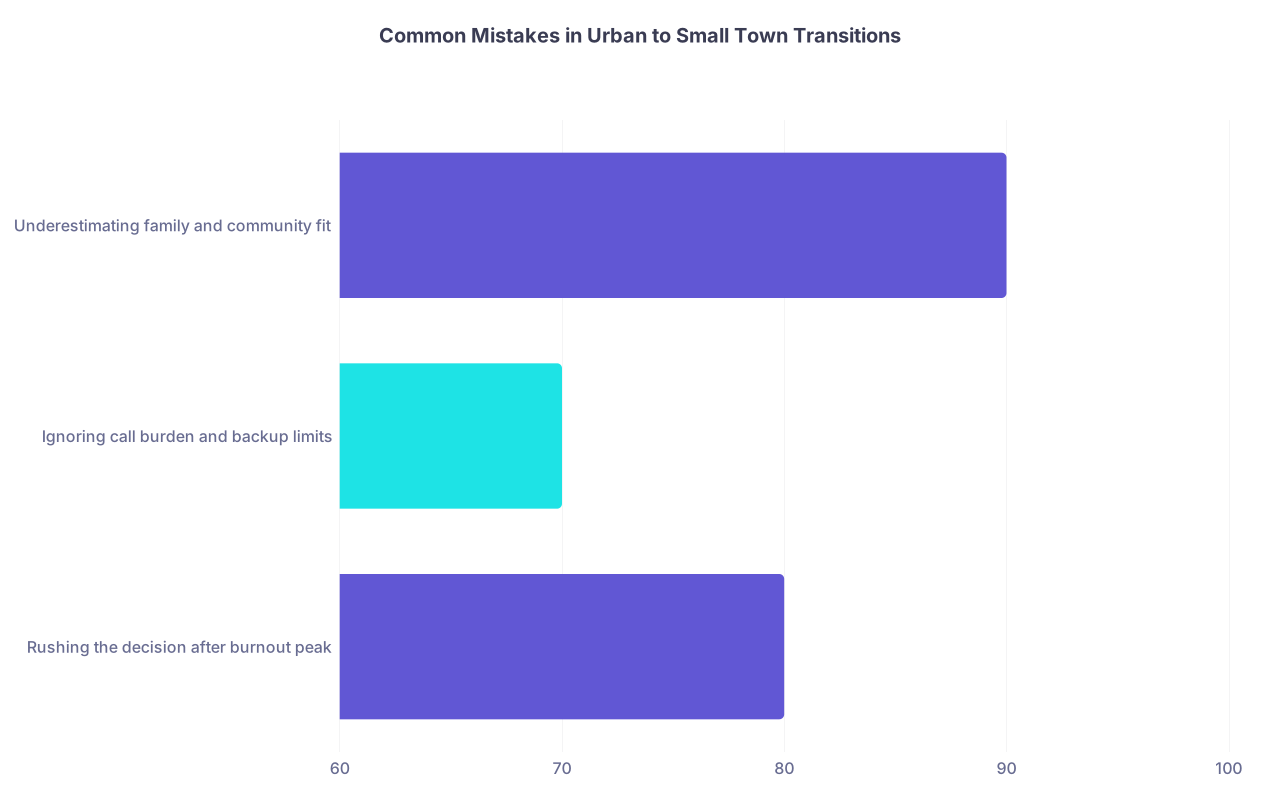
| Category | Value |
|---|---|
| Rushing the decision after burnout peak | 80 |
| Ignoring call burden and backup limits | 70 |
| Underestimating family and community fit | 90 |
Rushing from a bad week.
Quarter 1 should not be skipped. If you sign the first rural job that looks peaceful because you had a catastrophic stretch in your urban ED, you will miss deal-breakers hidden in the fine print.Underestimating scope and isolation.
In small towns, you are often it. ICU coverage without an intensivist. Or OB backup with no MFM anywhere near you. You must know your comfort zone and enforce it. If leadership cannot respect that, wrong job.Treating it like only a job move, not a life move.
You are not just changing hospitals. You are changing schools, grocery stores, friend networks, anonymity level. Planning that layer quarter by quarter is what keeps this from blowing up your family.
Final Takeaways
- Break the move into quarters: define, search, commit, then integrate. Each phase has concrete tasks; do not mash them together.
- Site visits and scope-of-practice clarity matter more than the sign-on bonus. Protect your future self, not just your bank account.
- Treat the first 90 days in the small town as your foundation. Pace yourself, set boundaries, and build a real life, not just a less chaotic job.


