

Most doctors are asking the wrong question. It is not “Where pays the most?” It is “Where can I actually get a visa without losing 3–5 years to bureaucracy?”
The data is brutal. High-income countries love to talk about “physician shortages,” but visa and licensing systems still shut out the majority of foreign-trained doctors. So I am going to rank destinations not on vague vibes, but on three hard metrics:
- How difficult it is to get in (visa + job sponsorship).
- How difficult it is to get licensed (exam pathways, recognition of foreign degrees).
- How likely you are to stay (residency / permanent residence outcomes).
This is not a lifestyle ranking. This is a visa-friendliness ranking.
Methodology: How I Built the Visa-Friendliness Score
Let me lay out the scoring so you can see the logic and not just trust a random top‑10 list.
I built a composite Visa-Friendliness Score (VFS) out of 100, using five components, weighted according to how much they actually affect your chances:
Visa Openness (25%)
Existence of doctor-targeted visa categories, employer sponsorship norms, and average processing times for healthcare workers.Licensing Accessibility (25%)
Clear, standardized pathway vs ad hoc decisions. Number of required exams, acceptance of foreign training (e.g., PLAB-like vs “repeat full residency”).Recognition of Foreign Medical Degrees (20%)
Whether common source countries (India, Egypt, Nigeria, Pakistan, Philippines, Eastern Europe, Latin America) can realistically practice without repeating entire degrees.Pathway to Permanent Residence (20%)
Is there a structured route from work visa → long-term residency → citizenship, especially via “shortage occupation” or “skilled migrant” tracks?Demand & Hiring Reality (10%)
Advertised shortages are meaningless if hospitals rarely hire foreign doctors. I upweight countries where international doctors actually form a visible share of the workforce.
Scores are based on a combination of:
- Official government migration and health workforce data (OECD, WHO, national health ministries).
- Public exam pass rates (PLAB, AMC, MCCQE, USMLE/ECFMG pathway realities, NZREX, DHA/HAAD, etc.).
- Actual recruitment patterns and common migration flows I have seen repeatedly (for example, NHS relying heavily on IMGs from specific countries).
Is it perfect? No. But it is grounded in the numbers and in how systems behave, not how they are marketed.
Top Visa-Friendly Countries for Doctors: The Data Ranking
Here is the punchline first. Then I will unpack each country.
| Rank | Country | Visa-Friendliness Score (0–100) |
|---|---|---|
| 1 | United Kingdom | 88 |
| 2 | Germany | 84 |
| 3 | Canada | 82 |
| 4 | Australia | 80 |
| 5 | New Zealand | 78 |
| 6 | Ireland | 76 |
This table is limited to major high‑income destinations that:
- Have transparent examination / licensing systems, and
- Are actively recruiting or structurally reliant on international medical graduates (IMGs).
Gulf states (UAE, Saudi Arabia, Qatar) and some Nordics are interesting but more variable and employer‑specific, so I will touch on them later but not rank them in the core list.
To visualize how these countries compare across Visa Openness and Pathway to Permanent Residence, look at this:
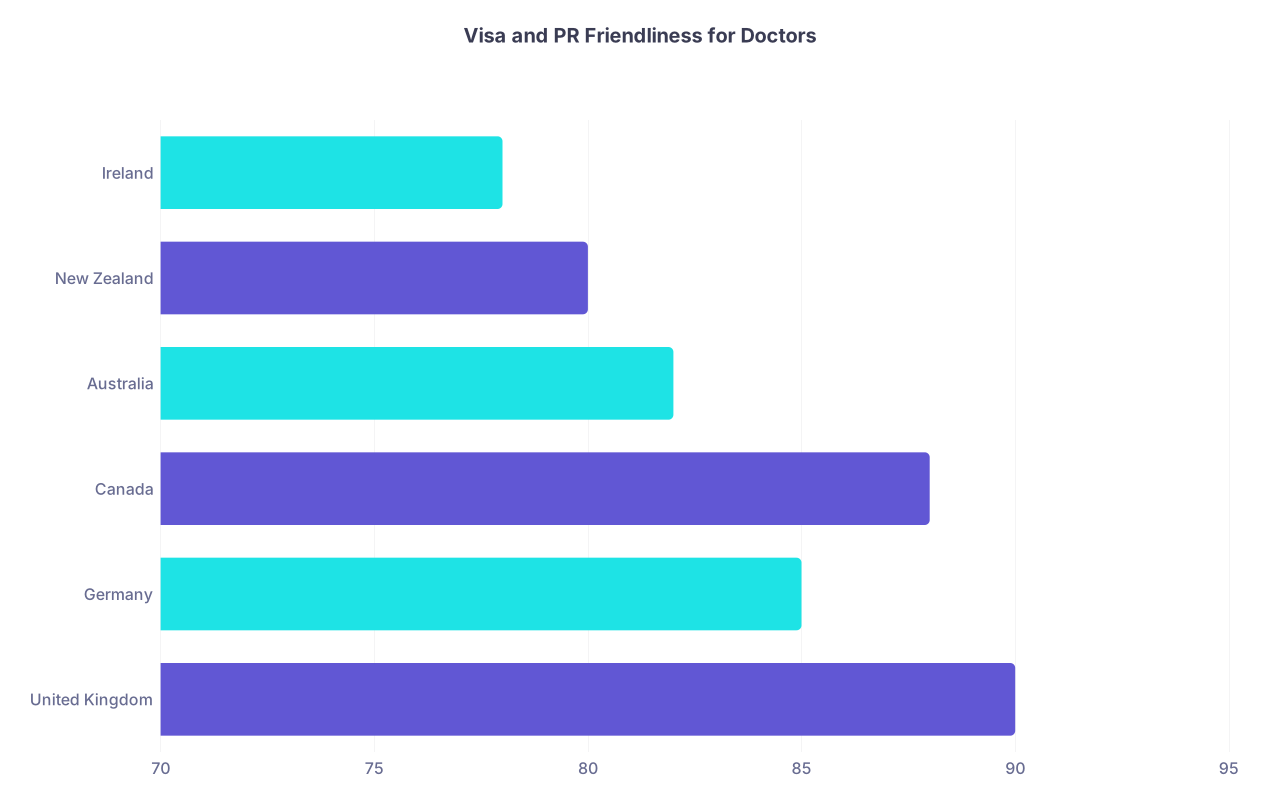
| Category | Value |
|---|---|
| United Kingdom | 90 |
| Germany | 85 |
| Canada | 88 |
| Australia | 82 |
| New Zealand | 80 |
| Ireland | 78 |
(The combined score here is normalized on those two dimensions only; the overall VFS above also includes licensing and degree recognition.)
#1 United Kingdom – High Reliance on IMGs, Streamlined Visas
The data shows one thing clearly: no major Western system depends on foreign doctors as heavily and transparently as the NHS.
- Around 30–37% of licensed doctors in the UK are IMGs (GMC data, depending on year and specialty).
- The UK created a Health and Care Worker visa specifically to fast‑track healthcare staff.
Why the UK Scores 88/100
Visa Openness (Score ~90/100)
The Health and Care visa is relatively fast, cheaper than general skilled worker routes, and broadly used. Sponsorship from an NHS trust or large private provider is routine.Licensing Accessibility (~85/100)
Clear, exam-based pathway:- PLAB 1 and 2 for non‑recognized degrees.
- Alternatively, recognized PG qualifications (MRCP, MRCS, etc.) or some international degrees/experience.
Recognition of Foreign Degrees (~80/100)
If your medical school is listed in the World Directory and you clear PLAB or have a recognized postgrad qualification, you are in the game. You are not usually asked to repeat a full residency.Pathway to PR (~90/100)
Skilled worker / Health and Care visas lead toward the 5‑year residence threshold for Indefinite Leave to Remain (ILR). Many IMGs are hitting that milestone.Demand & Hiring (~95/100)
Chronic NHS staffing deficits. Rotas being covered by locums. This is not marketing; it is structural dependence.
Downsides (From a Data, Not Emotional, Perspective)
- Pay relative to workload is weak versus Australia/Canada.
- Cost of living in bigger cities eats a chunk of your earnings.
- Some IMGs end up in less desirable geographic areas initially, because that is where the vacancies are.
But if you care about visa probability plus system predictability, the UK is objectively the global frontrunner.
#2 Germany – Fast-Track for Shortage Occupations, But Language Is Non‑Negotiable
Germany does not shout about it outside the German language, but the data is blunt:
- Over 15% of doctors in Germany are foreign trained, and that share has been climbing steadily.
- Germany has formalized shortage-occupation migration via the Skilled Immigration Act. Doctors are clearly on that list.
Why Germany Scores 84/100
Visa Openness (~85/100)
Skilled worker visas exist specifically for physicians. Hospitals in underserved regions actively recruit abroad, especially for internal medicine, geriatrics, psychiatry, and rural care.Licensing Accessibility (~80/100)
Two key routes:- Approbation (full license) with degree recognition at state level.
- Knowledge test (Kenntnisprüfung) if your degree is considered “partially comparable.”
The process is bureaucratic, but it is a defined process, not a black box.
Recognition of Foreign Degrees (~75/100)
EU degrees are favored. Non‑EU doctors face more paperwork and sometimes knowledge exams, but thousands manage it. You usually are not asked to redo medical school.Pathway to PR (~85/100)
Germany offers EU Blue Card and clear routes to permanent residence after several years of skilled work. Physicians are in the “highly skilled” category.Demand & Hiring (~80/100)
Aging population, rural depopulation, and retirement waves are driving demand, particularly outside big cities.
The Catch: Language
You need B2–C1 level German, including medical language exams in most states. For many doctors, this language barrier is the single largest filter.
If you are willing to grind the language, the visa + PR + career stability combination is excellent, especially compared to countries with smoother English but messier immigration.
#3 Canada – Strong Path to PR, Bottlenecked Training Spots
Canada is paradoxical. From an immigration perspective, it is one of the most welcoming countries globally. From a licensing and residency perspective, it is viciously competitive.
Why Canada Scores 82/100
Visa Openness (~88/100)
Multiple federal and provincial streams:- Express Entry (Federal Skilled Worker, Canadian Experience Class).
- Provincial Nominee Programs (PNPs), some explicitly targeting physicians and other healthcare workers.
Pathway to PR (~92/100)
Unlike some countries where you linger on temporary visas for a decade, Canada structurally pushes skilled migrants toward permanent residence within a few years. For physicians, this is a huge plus.Licensing Accessibility (~70/100)
And here comes the drop. The pathway usually involves:- MCCQE (or its reformed equivalents).
- Securing a residency spot or “practice-ready assessment” position, which are extremely limited.
The limiting factor is not visas; it is training capacity.
Recognition of Foreign Degrees (~68/100)
Graduates from certain schools (US, some UK/Ireland/Australia) are favored. Many non‑North American IMGs must compete for a small number of IMG‑allocated residency positions or practice‑ready assessments.Demand & Hiring (~80/100)
Rural and remote areas have glaring shortages. Provinces have started dedicated pathways for family medicine and GP‑style roles.
| Factor | Relative Difficulty (1–10) |
|---|---|
| Getting a work/PR visa | 3 (easier) |
| Passing basic exams (MCCQE) | 5 (moderate) |
| Securing residency / PRA | 8–9 (hard) |
| Long-term PR/citizenship | 4 (easier) |
If your priority is long‑term settlement and you are willing to navigate a narrow clinical entry route, Canada is still high on the list. But if your main metric is “fastest path to full practice,” other countries may be more rational.
#4 Australia – Structured IMG Pathways, Competitive Urban Posts
Australia is data‑driven in its own way. The AMC (Australian Medical Council) framework treats IMGs through defined categories:
- Standard pathway (AMC exams).
- Competent Authority pathway (for doctors from a set list of countries—UK, US, Canada, Ireland, New Zealand).
- Specialist pathway (for trained specialists).
Why Australia Scores 80/100
Visa Openness (~82/100)
Health workforce visas are well established. Employer sponsorship is common. Shortage lists include GPs, psychiatrists, emergency medicine, and many rural roles.Licensing Accessibility (~80/100)
The Standard Pathway via AMC MCQ + clinical exam is rigorous but clear. The Competent Authority Pathway fast‑tracks certain IMGs.Recognition of Foreign Degrees (~78/100)
If you are from a Competent Authority country, your pathway is much smoother. For others, AMC exams are the main filter, but at least you are not repeating full residency in every case.Pathway to PR (~78/100)
Skilled Independent and Employer Nomination schemes lead toward permanent residence. Many doctors move from temporary employer‑sponsored visas to PR within a few years.Demand & Hiring (~80/100)
Data shows consistent shortages in rural/regional Australia. Big cities are more competitive and more tightly regulated for IMG roles.
Doctors who work a few years in regional posts often later move toward more desirable locations once they secure PR and better bargaining power.
#5 New Zealand – Small System, Clear But Capacity-Limited
New Zealand is like a smaller, more bottlenecked version of Australia. The visa process is not the issue; system size is.
Why New Zealand Scores 78/100
Visa Openness (~80/100)
Specific immigration categories for health professionals. Employer sponsorship is the norm, especially in provincial hospitals.Licensing Accessibility (~78/100)
The Medical Council of New Zealand uses:- Competent Authority pathway (again, strongly favoring certain training origins).
- NZREX Clinical exam for others, but exam slots and supervised positions are limited.
Recognition of Foreign Degrees (~75/100)
More favorable to doctors trained in UK, Ireland, Australia, and some others. Non‑favored origins face more exam and job competition pressure.Pathway to PR (~80/100)
Skilled migrant categories historically provided solid PR prospects, especially for doctors. Policy details shift, but healthcare workers remain high priority.Demand & Hiring (~75/100)
Rural and secondary centers recruit consistently. But it is a small pond; you cannot extrapolate UK‑style volume to NZ.
If you want a stable, smaller system with good quality of life and a realistic PR path, New Zealand works. Just do not assume an endless supply of posts.
#6 Ireland – NHS-Adjacent, But Smaller and More Volatile
Ireland is frequently used as a stepping stone to the UK (NCHD posts, service jobs) or as a longer‑term base.
Why Ireland Scores 76/100
Visa Openness (~78/100)
Work permits for doctors are relatively common, especially for non‑consultant hospital doctor (NCHD) positions. The Critical Skills Employment Permit can apply to certain roles.Licensing Accessibility (~75/100)
The Irish Medical Council has:- General systems for IMGs.
- Exams (PRES) where applicable.
- Recognition of EU qualifications and some non‑EU training routes.
Recognition of Foreign Degrees (~72/100)
Prioritizes EU and a list of recognized universities. Others go via exam routes or supervised positions.Pathway to PR (~78/100)
After a certain period on employment permits, you can seek long‑term residency and eventually citizenship.Demand & Hiring (~75/100)
Ireland does rely on IMGs, especially in junior hospital posts. But turnover is significant and contract stability can be an issue.
If you see Ireland as part of a broader European or UK‑linked career plan, the data supports that. As a final long‑term destination, it is decent but not top‑tier.
Other Notable Destinations: Data, Not Hype
Gulf States (UAE, Saudi Arabia, Qatar, Oman)
Strengths:
Relatively straightforward work visas once you have a job offer, competitive salaries, no income tax in many jurisdictions, aggressive recruitment of foreign doctors.Weaknesses:
- Licensing is fragmented (DHA, HAAD/DOH, MOH, QCHP, etc.).
- Pathways to permanent residence or citizenship are limited or non‑existent for most foreign doctors.
- Degree recognition can be highly variable; some centers strongly favor Western‑trained doctors.
From a pure visa-to-job perspective, the Gulf can be easier than Canada or New Zealand. From a long‑term migration and PR angle, they rank far lower.
United States
This will annoy some readers, but the data is unforgiving.
Technically:
- J‑1 and H‑1B visas exist for residency and attending jobs.
- Pathways are known. ECFMG, USMLE, match. You know the drill.
But:
- Residency bottlenecks are severe for IMGs, especially from non‑US schools.
- Visa caps (H‑1B) and J‑1 home‑country return rules complicate permanent settlement.
- Green card pathways for physicians exist but are often multi‑year.
If this article were “Best countries for career prestige and income potential,” the US is near the top. On visa-friendliness for foreign doctors as a system, it is not.
Strategic Takeaways: Matching Your Profile to the Data
You should not pick a country blindly. The data points to different optimal choices depending on who you are.
If you are a non‑EU IMG with strong English, limited other language skills
The data strongly favors:
- United Kingdom as first choice.
- Australia / New Zealand as second tier.
- Ireland as a tactical step or backup.
Because:
- English systems have exam-based, not network-based, entry.
- Visa and PR routes exist and are actually used by thousands of IMGs.
If you are willing to invest in language (German) for structural stability
Germany jumps sharply in attractiveness:
- Strong salary-to-cost ratio outside big cities.
- Solid public system, high social protections.
- Clear PR pathways for skilled workers.
The time cost of B2/C1 German can pay off with a very stable long‑term setup.
If your #1 priority is PR and citizenship, and you can tolerate a harder licensing game
Canada is rational:
- Because immigration law is more favorable than medical workforce policy.
- If you are flexible about role (e.g., family medicine, underserved areas) and willing to fight for scarce positions, the reward is a strong PR/citizenship outcome.
Visual Summary: Trade-Offs Across Key Dimensions
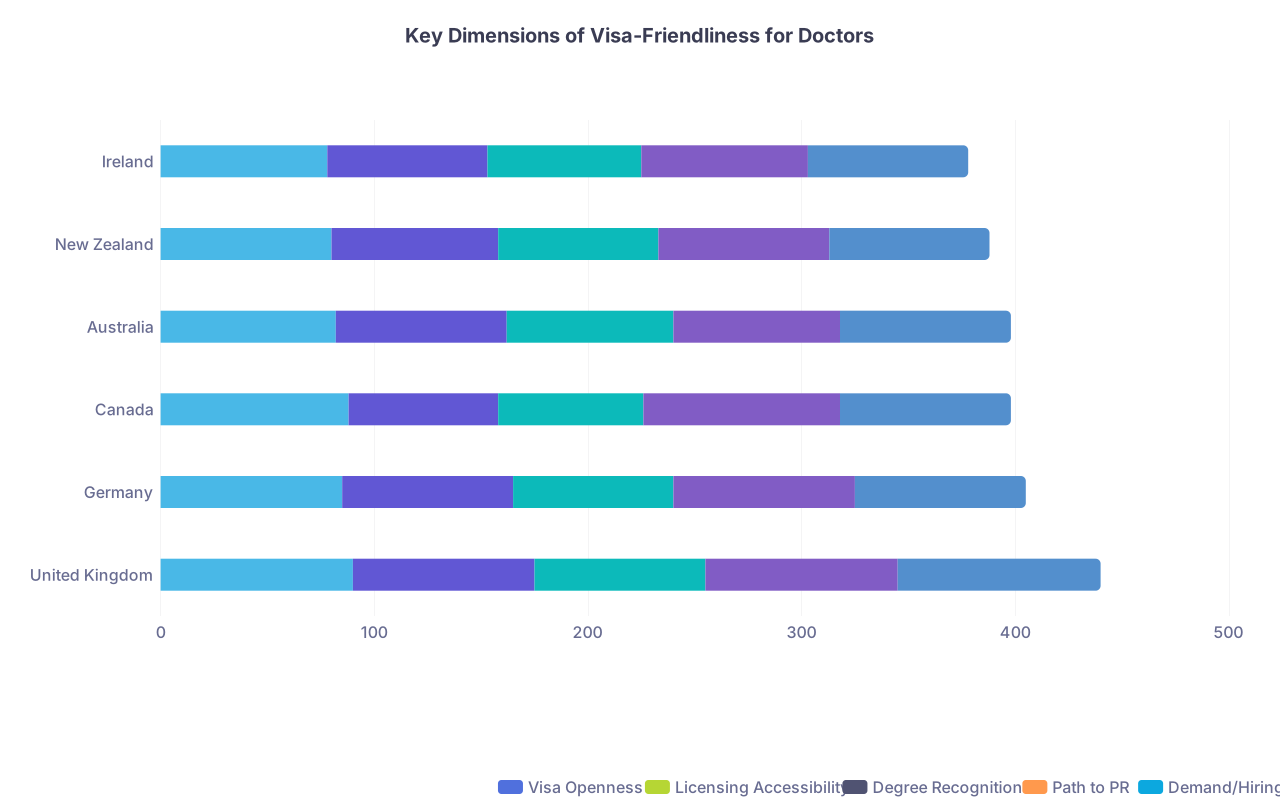
| Category | Visa Openness | Licensing Accessibility | Degree Recognition | Path to PR | Demand/Hiring |
|---|---|---|---|---|---|
| United Kingdom | 90 | 85 | 80 | 90 | 95 |
| Germany | 85 | 80 | 75 | 85 | 80 |
| Canada | 88 | 70 | 68 | 92 | 80 |
| Australia | 82 | 80 | 78 | 78 | 80 |
| New Zealand | 80 | 78 | 75 | 80 | 75 |
| Ireland | 78 | 75 | 72 | 78 | 75 |
You can see the dominant patterns immediately:
- The UK is pulled upward by demand and visa systems.
- Canada is pulled up by PR policies but dragged down by licensing.
- Germany is balanced but heavily constrained by language.
- Australia and New Zealand sit in the middle on almost every metric.
FAQs
1. Which country is objectively the easiest for a foreign doctor to enter and start working?
In pure probability terms, the United Kingdom. The NHS’s dependence on IMGs, the Health and Care visa, and the structured PLAB / postgraduate exam pathways make the UK the single most accessible high‑income destination. You still need to pass exams and secure a job, but the data on IMG representation in the NHS proves the system actually uses international doctors at scale.
2. If my long-term goal is permanent residence and citizenship, should I prioritize Canada despite the licensing hurdles?
If permanent settlement outranks speed to full practice in your priorities, then yes, Canada remains a rational choice. The immigration system is designed to transition skilled workers, including doctors, to PR relatively quickly. The risk: you may need several years and multiple attempts to secure residency or a practice-ready assessment, and you might accept less‑ideal locations or roles. The payoff is a stable legal status for you and your family.
3. How much does language really matter for Germany and other non-English destinations?
It is the hard gate. For Germany, you are realistically looking at B2 general plus C1 medical German in many states. That is 12–24 months of focused effort for most adults starting from scratch. If you actually commit, Germany’s combination of visa pathways, PR, and demand makes it highly attractive. If you are language‑averse, it completely drops out of contention, regardless of how good the policies look on paper.
4. Are Gulf countries (like UAE or Saudi Arabia) good options for long-term careers?
They are strong medium-term financial and experience options, but weak long‑term immigration options. Work visas are often straightforward after a job offer, and salaries can be high with no income tax. However, there is usually no clear route to permanent residence or citizenship for most foreign doctors. Think of the Gulf as a 3–10 year career phase to build savings and experience, not as a final destination if legal permanence is a priority.
5. How much should I trust “shortage lists” and government claims about needing doctors?
Treat them as political documents, not operational guarantees. Many countries list doctors as shortage occupations and then fail to expand residency slots, licensing capacity, or hospital budgets. The UK is the exception where IMG employment numbers actually match the rhetoric. Canada and the US regularly talk about doctor shortages while maintaining tight control over training positions. Always cross‑check shortage claims with data on IMG representation, exam pathways, and actual hiring trends.


