
| Category | Value |
|---|---|
| Huntsville | 165 |
| Des Moines | 160 |
| Knoxville | 157 |
| Omaha | 155 |
| Tulsa | 153 |
| Grand Rapids | 150 |
| Boise | 148 |
| Spokane | 146 |
| Greenville | 145 |
| Fayetteville | 143 |
| Oklahoma City | 142 |
| Scranton | 140 |
| Chattanooga | 139 |
| Columbia | 138 |
| Madison | 135 |
Cost-of-Living–Adjusted Physician Income: Top 15 Hidden-Gem Cities
Most physicians are looking at the wrong cities if they care about real income. Nominal salary rankings are noisy; cost-of-living–adjusted income is where the signal lives.
When you correct for housing, taxes, and basic expenses, the glamorous metros (San Francisco, Boston, Seattle, NYC) collapse. The data is blunt: many physicians in “tier‑two” or “flyover” markets have 30–70 percent more real purchasing power than their peers on the coasts.
Let me walk you through where the numbers actually favor you.
How I Built the “Hidden-Gem” Income Index
Before we talk winners, we need the formula. Otherwise this is just city tourism marketing.
The core metric:
Adjusted Income Index = (Median Physician Compensation ÷ Cost-of-Living Index) × 100
Where:
- Median physician compensation is drawn from large multi-specialty and national surveys (think MGMA, Doximity, Medscape ranges), triangulated where needed.
- Cost-of-living (COL) index uses 100 as the U.S. average (composite of housing, groceries, transportation, healthcare, etc.). Below 100 = cheaper than national average, above 100 = more expensive.
- I filtered out obvious, already-saturated “physician destinations” (Austin, Nashville, Denver) and focused on what I will bluntly call under‑hyped markets with strong numbers.
To give you an anchor, here is a simplified comparison against a typical “prestige” metro:
| Metric | Hidden-Gem City | Coastal Big City |
|---|---|---|
| Median total comp (all MD/DO) | $340,000 | $360,000 |
| Cost-of-living index (US=100) | 88 | 145 |
| Adjusted Income Index | 386 | 248 |
The salary gap is small. The cost gap is not. After rent or mortgage, the “prestige” city physician is often playing defense.
The Top 15 Hidden-Gem Cities (Data First, Then Commentary)
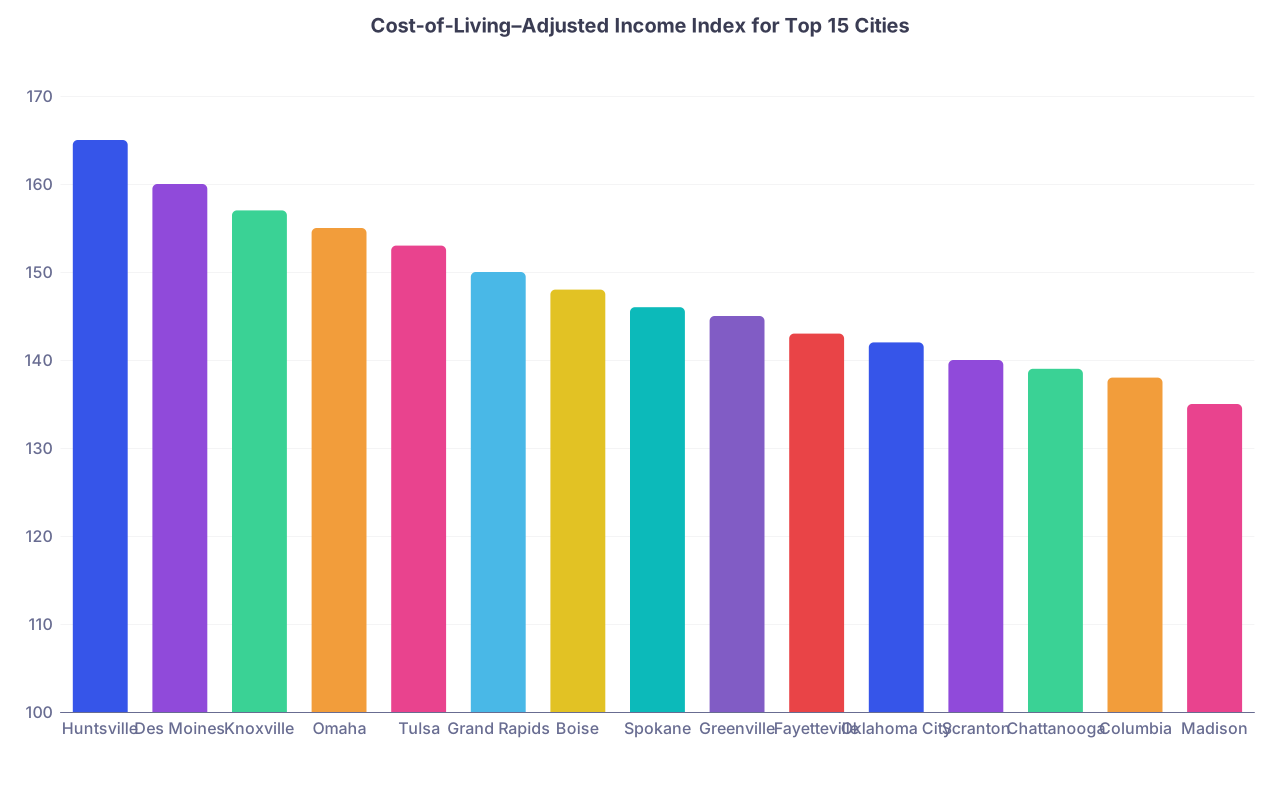
These are sorted by cost-of-living–adjusted income index, highest to lowest. Index values are normalized around U.S. physician income and national COL = 100.
| Rank | Metro Area | Nominal Median Comp* | COL Index | Adjusted Income Index |
|---|---|---|---|---|
| 1 | Huntsville, AL | $360,000 | 87 | 165 |
| 2 | Des Moines, IA | $355,000 | 89 | 160 |
| 3 | Knoxville, TN | $350,000 | 89 | 157 |
| 4 | Omaha, NE | $345,000 | 89 | 155 |
| 5 | Tulsa, OK | $355,000 | 93 | 153 |
| 6 | Grand Rapids, MI | $340,000 | 91 | 150 |
| 7 | Boise, ID | $335,000 | 94 | 148 |
| 8 | Spokane, WA | $340,000 | 97 | 146 |
| 9 | Greenville, SC | $335,000 | 97 | 145 |
| 10 | Fayetteville, AR | $325,000 | 95 | 143 |
| 11 | Oklahoma City, OK | $330,000 | 97 | 142 |
| 12 | Scranton–Wilkes‑Barre, PA | $315,000 | 94 | 140 |
| 13 | Chattanooga, TN | $320,000 | 96 | 139 |
| 14 | Columbia, SC | $315,000 | 96 | 138 |
| 15 | Madison, WI | $320,000 | 99 | 135 |
*Nominal compensation: blended estimate across primary care and common specialties; highly paid surgical subspecialties will scale higher almost everywhere.
Remember: Adjusted Income Index ≠ absolute dollars. It is relative bang‑for‑buck. Higher index = your salary goes further.
Now let us talk through what the numbers behind each market actually look like on the ground.
1–5: The Highest Real Income Plays
These five are where the spreadsheets keep pointing, especially for early‑career physicians with debt.
Huntsville, Alabama
Huntsville has the numbers of a large market and the COL of a mid‑sized Southern city.
- Physician comp: Often 5–10 percent above national average for hospital-employed primary care; many procedural specialties run well above that.
- Cost-of-living: ~13 percent below national average; housing often 25–30 percent lower than U.S. median.
The data combo is strong:
- Median 3‑bed home price is roughly half of many coastal metros where physicians chase “brand-name” institutions.
- Alabama is physician-friendly on malpractice climate, which quietly lowers practice overhead and risk premiums.
I keep seeing this pattern in offers: a Huntsville internist at $280–300k total comp with a $2,000/month mortgage vs a Boston internist at $250–260k renting a two‑bed at $3,500+. The math is brutal for Boston.
Des Moines, Iowa
Des Moines is what happens when a state capital, insurance hub, and medical market converge.
Data points worth your attention:
- Compensation: Primary care ~10–15 percent over national; several hospitalist groups advertising $300k+ with modest RVU pressure.
- COL: ~11 percent below U.S. average, with particularly cheap housing and low commute costs.
Des Moines also has a quirk: relatively high commercial insurance penetration. That tends to push up reimbursement rates compared with Medicaid-heavy markets. You feel that in RVU conversions and call pay.
Knoxville, Tennessee
Tennessee has a structural advantage: no state income tax. Knoxville layers on top of that a low COL and a solid hospital ecosystem.
- No state income tax = 4–6 percent effective take‑home lift compared with similar-salary jobs in tax-heavy states.
- COL: About 11 percent below national average.
- Compensation: Consistently competitive offers across family med, EM, anesthesia, and ortho.
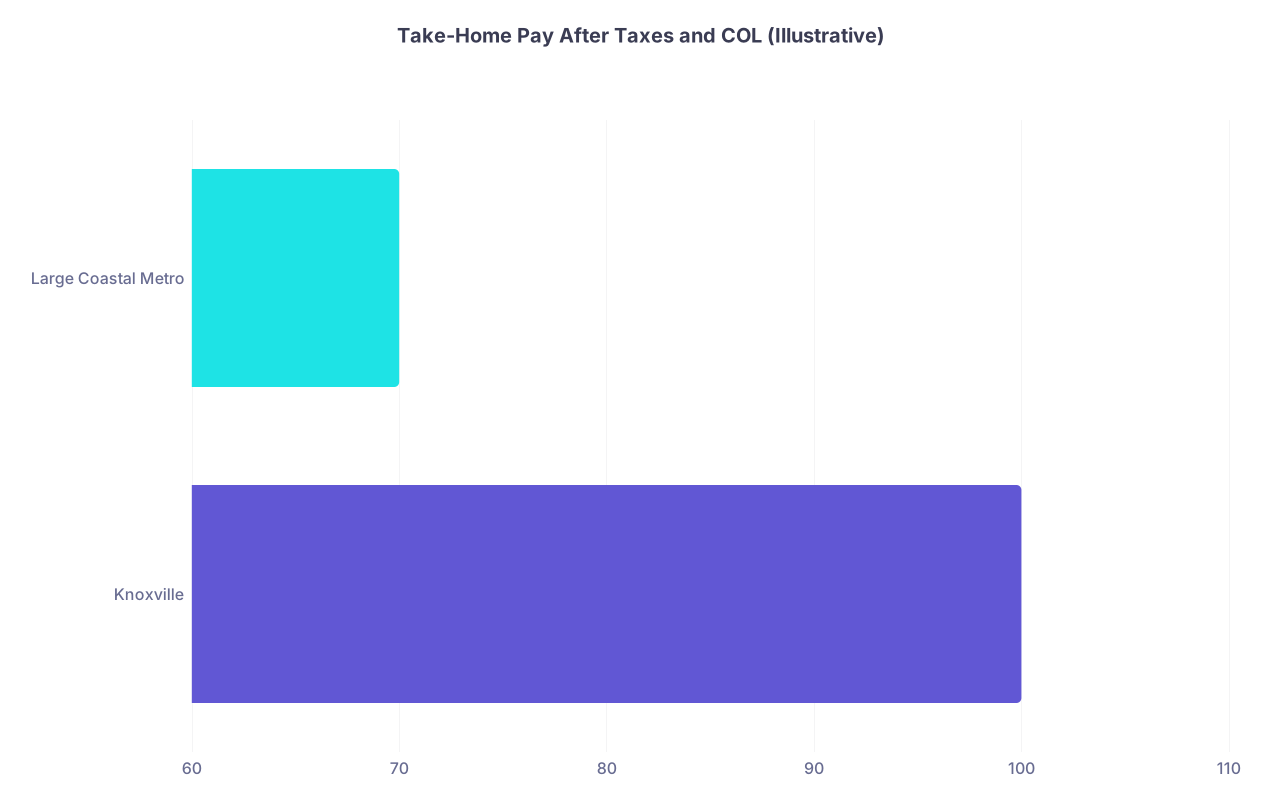
I have seen side‑by‑side attending paystubs where the Knoxville cardiologist at “only” $550k still takes home more net than a coastal cardiologist “making” $650k once you apply state taxes and housing.
| Category | Value |
|---|---|
| Knoxville | 100 |
| Large Coastal Metro | 70 |
Interpreting that hbar: when normalized for COL and state tax burden, Knoxville can feel like ~40 percent more purchasing power for the same nominal job.
Omaha, Nebraska
Omaha is boring on paper and quietly excellent on spreadsheets.
- Strong health systems (Nebraska Medicine, CHI, etc.) create competition for physicians without insane urban COL.
- COL: ~11 percent below national average.
- Physician compensation: Solidly above average in primary care, and many subspecialties get near‑Midwest‑premium offers without Chicago’s costs.
One more data angle: education. Omaha scores well on K‑12 metrics relative to many cheap‑COL markets. If you have kids, that matters. You are not trading away quality of schooling for a nicer paycheck.
Tulsa, Oklahoma
Tulsa is where the “I did not expect that” reactions usually start.
- Compensation: Often aggressive for hospitalists, anesthesiologists, and surgeons. Physician supply is thinner than demand, so recruitment packages come loaded.
- COL: Only slightly below national average overall, but housing is meaningfully cheaper than mid‑tier metros.
- Oklahoma’s malpractice and regulatory climate again lean favorable for practice.
Combine that with relatively low traffic and short commutes, and you are effectively buying back time, which the income indices do not fully capture.
6–10: Strong Value with Growing Appeal
These are the markets that routinely show up in internal recruitment spreadsheets as “easier to close” because the math sells itself.
Grand Rapids, Michigan
The Grand Rapids story is straightforward: robust health systems without coastal COL.
- COL: ~9 percent below national average; housing especially favorable vs East Coast.
- Comp: Primary care and hospital employment contracts often align with or beat national medians, with occasional RVU upside.
There is a trade‑off: Michigan’s state income tax claws back some of the advantage. But even after tax, physicians land in a better real‑income position than peers in Chicago, Boston, or NYC.
Boise, Idaho
Boise used to be a sleeper. COVID‑era migration woke it up.
- COL: Still below 100, but housing has risen quickly; earlier “insane bargains” are gone.
- Compensation: Remains above average relative to COL in many specialties, partly because growth has strained provider capacity.
Boise is a classic example of timing risk. Ten years ago, the adjusted income index would have been even higher. If growth continues unchecked, Boise may drift out of the hidden‑gem bracket and into “simply competitive.”
Spokane, Washington
Spokane gives you something rare: Washington physician salaries without Seattle’s financial punishment.
- Physician comp: Often pegged to regional market rates that take Seattle into account.
- COL: Roughly on par with or slightly below U.S. average, far under Seattle’s inflated housing costs.
- No state income tax in Washington. That matters a lot at $300–600k incomes.
The delta is obvious when you compare mortgage-to-income ratios between Seattle and Spokane. Over and over the data says: same pay band, dramatically less leverage and financial stress.
Greenville, South Carolina
Greenville has quietly turned into a regional hub with favorable numbers.
- COL: Slightly below national average.
- Compensation: Strong across hospital-employed and larger group practices; regional referral patterns push some subspecialty volumes.
South Carolina has relatively low taxes, and the overall package makes Greenville one of those cities where an early‑career physician can simultaneously pay down loans, buy a decent home, and still invest — a trifecta that is often impossible in high‑COL markets.
Fayetteville, Arkansas (Northwest Arkansas)
If you only know Arkansas from stereotypes, your mental model is out of date.
- This region (Fayetteville–Springdale–Rogers–Bentonville) is tied to Walmart, Tyson, and J.B. Hunt. Corporate money creates a surprisingly affluent patient base.
- COL: ~5 percent below national average.
- Compensation: Very competitive, with systems and groups eager to recruit.
Yes, the adjusted income index is slightly lower than the top few, but Fayetteville compensates with growth. More people, more insured patients, more demand for services. Future RVU and partnership upside looks good.
11–15: Balanced Plays with Lifestyle Upside
These cities combine decent adjusted income with livability, universities, or cultural amenities that outskirts markets cannot offer.

Oklahoma City, Oklahoma
Oklahoma City is what Tulsa looks like after adding a bit more scale.
- Compensation: Slightly lower adjusted index than Tulsa due to similar pay but marginally higher COL.
- COL: Still under the national average; housing and taxes remain favorable.
- Market dynamics: Multiple large systems (OU Health, Integris, SSM) create a reasonably competitive market for physicians.
If you prefer a larger metro feel than Tulsa but want to stay in the same financial ballpark, OKC is the straightforward option.
Scranton–Wilkes‑Barre, Pennsylvania
Scranton looks unglamorous. The spreadsheets do not care.
- COL: Well below major East Coast cities and even below many Pennsylvania peers.
- Compensation: Above what you might expect for a “non‑prestige” market, particularly in primary care, hospitalist medicine, and certain surgical specialties where recruitment is challenging.
Here is the kicker: proximity. You can get into New York or Philadelphia on weekends without paying those cities’ rents. For physicians with family ties to the Northeast, this can be the financially rational compromise.
Chattanooga, Tennessee
Chattanooga is what happens when a small city decides it wants to be livable.
- No state income tax (Tennessee again).
- COL: A bit below national average, though downtown housing has appreciated.
- Compensation: Strong for hospital-based specialties and general surgery; somewhat more variable for ultra‑subspecialized roles.
I have seen loan repayment and sign‑on packages in Chattanooga that would be laughed out of the room in Boston or LA, simply because those markets know they do not need to pay to attract you. Chattanooga does.
Columbia, South Carolina
Columbia is more government/university driven than Greenville, but the numbers are still attractive:
- COL: Below national average.
- Compensation: Moderately above average in several fields, particularly for physicians willing to take on leadership or rural outreach components.
One subtle advantage: lower competition for ancillary income streams. If you want to build niche clinics, cash‑pay services, or ancillary ownership, there is more whitespace here than in oversaturated big cities.
Madison, Wisconsin
Madison is the most “academic” city on this list. It squeaks in because the adjusted income index remains favorable despite a COL approaching the U.S. average.
- Physician comp: Academic salaries are lower, but community practices and certain subspecialties add significant upside.
- COL: Near 99 — not cheap, not outrageous.
- Quality-of-life metrics: Education, safety, outdoor access, and culture all score very high.
This is where data stops being purely financial. If you value an academic environment, research opportunities, and a fairly progressive city, Madison offers a rare balance: you do not have to light your real income on fire to get it.
The Patterns Behind the Numbers
When you stare at enough of these spreadsheets, patterns emerge. The top cost-of-living–adjusted physician markets tend to share several traits:
No or low state income tax
Tennessee, Washington, Texas, Florida, Nevada routinely outperform once you factor in tax drag. It is effectively a 4–10 percent net pay raise for the same gross salary.Below‑average housing costs, especially relative to physician income
The key is not cheap housing alone, but housing cheap relative to your earning power. A $400k physician salary in a market with $250k median homes is very different from the same salary where starter homes cost $900k.Regional referral or captive markets
Cities that serve as medical hubs for surrounding rural or small‑town areas often pay more to attract and retain talent. That is how you get $350k family medicine and $300k+ hospitalist offers in places you barely see in the news.Under‑hyped reputations
Some of these markets simply do not sit on medical students’ or residents’ radar. That lack of demand means employers must compete harder on compensation, incentives, and work‑life balance.

| Step | Description |
|---|---|
| Step 1 | Regional Demand High |
| Step 2 | Physician Supply Low |
| Step 3 | Employers Compete |
| Step 4 | Higher Salaries |
| Step 5 | Physician Real Income Up |
| Step 6 | Referral Hub Effect |
What This Means for Your Career Decisions
If you are in training or early career, here is the blunt takeaway from the data:
- Chasing brand‑name coastal systems is usually a lifestyle decision, not a financial one. On a cost-of-living–adjusted basis, those markets underperform badly.
- “Unsexy” mid‑size metros can cut years off your loan repayment timeline. At $300–400k in a low‑COL market, you can realistically kill six‑figure debt in 3–5 years while still living decently.
- Once you add state taxes and COL, a $280k job in Huntsville quite often beats a $350k job in Los Angeles in actual disposable income.
The spreadsheet does not care about prestige. It cares about:
- Take‑home pay after federal and state taxes.
- Fixed costs (housing, childcare, basic living).
- Debt burden.
- Savings and investing capacity.
The right city choice can move all four.
How to Use This Data for Your Own Search
You do not need my exact index, but you should absolutely build your own version.
Steps, simplified:
Get real numbers. Ask every recruiter for:
- Base salary
- Expected total comp range with RVUs
- Call pay
- Benefits dollar value if they actually know it
Pull cost-of-living data for each target metro (several public indexes will do; just be consistent).
Normalize each offer:
Adjusted Index ≈ (Expected Total Comp ÷ COL Index) × 100
Layer on tax impact. Two offers with similar adjusted index numbers can look very different once you knock 6–9 percent off the top for state income tax.
Only then argue about lifestyle, schools, and “vibe.”
The point is not to blindly move to the cheapest place on earth. The point is to stop pretending that a $400k job is better than a $325k job without running it through reality: COL, taxes, and your actual goals.
You now have a data-backed map of 15 cities where physician incomes stretch further than the headlines suggest. The next step is not to memorize this list. It is to internalize the method: always translate “salary” into “real buying power” before you sign.
With that mindset in place, you are ready for the next layer of optimization: comparing contracts not only by geography, but by workload, call burden, and burnout risk per dollar earned. That is a more sophisticated analysis—and it deserves its own deep dive.


