

The most popular states for new attendings are not always the ones with the best early‑career outcomes. The data shows a consistent mismatch between where residents say they want to work and where their net income, workload, and burnout risk actually look best.
You want to know where to build the first 5–7 years of your attending life. That is a numbers question, not a vibes question.
Below I am going to treat it that way.
How I’m Defining “Best Early‑Career Outcomes”
If you do not define the metric, the rankings are meaningless. So let’s be explicit.
For a resident becoming an attending, the data that matters most in the first decade is clustered around five variables:
- Real after‑tax income (salary – federal + state tax – basic cost of living)
- Workload and burnout risk (hours, RVUs, staffing, malpractice climate)
- Job market depth and stability (number of openings per physician, unemployment)
- Debt pay‑down and wealth trajectory (student loan environment, housing)
- Lifestyle fit (call intensity, commute, family friendliness, not “cool factor”)
No single database wraps all of this neatly. You stitch it together from:
- MGMA, AMGA, Doximity compensation reports (specialty‑specific salary by state/region)
- BLS wage and employment data
- BEA and Numbeo‑style cost‑of‑living indices
- Medscape Burnout & Depression, malpractice cost reports
- CMS/HRSA shortage area designations, rural/urban need
- State tax codes and student loan policy impacts
When you normalize across these, a pattern emerges. High‑cost, high‑prestige coastal states underperform. A cluster of “boring” states quietly produce far better early‑career outcomes.
Let’s start with the money, because that is where most people lie to themselves.
Follow the Money: Real After‑Tax Income
Nominal salary is misleading. A $420K offer in Boston can leave you poorer than a $340K offer in suburban Ohio once you run the numbers.
A simplified example helps. Assume:
- Specialty: hospitalist or general IM
- Offers: starting attending base compensation in different states
- Federal tax bracket roughly similar across scenarios
- Single, renting a modest apartment, standard deductions
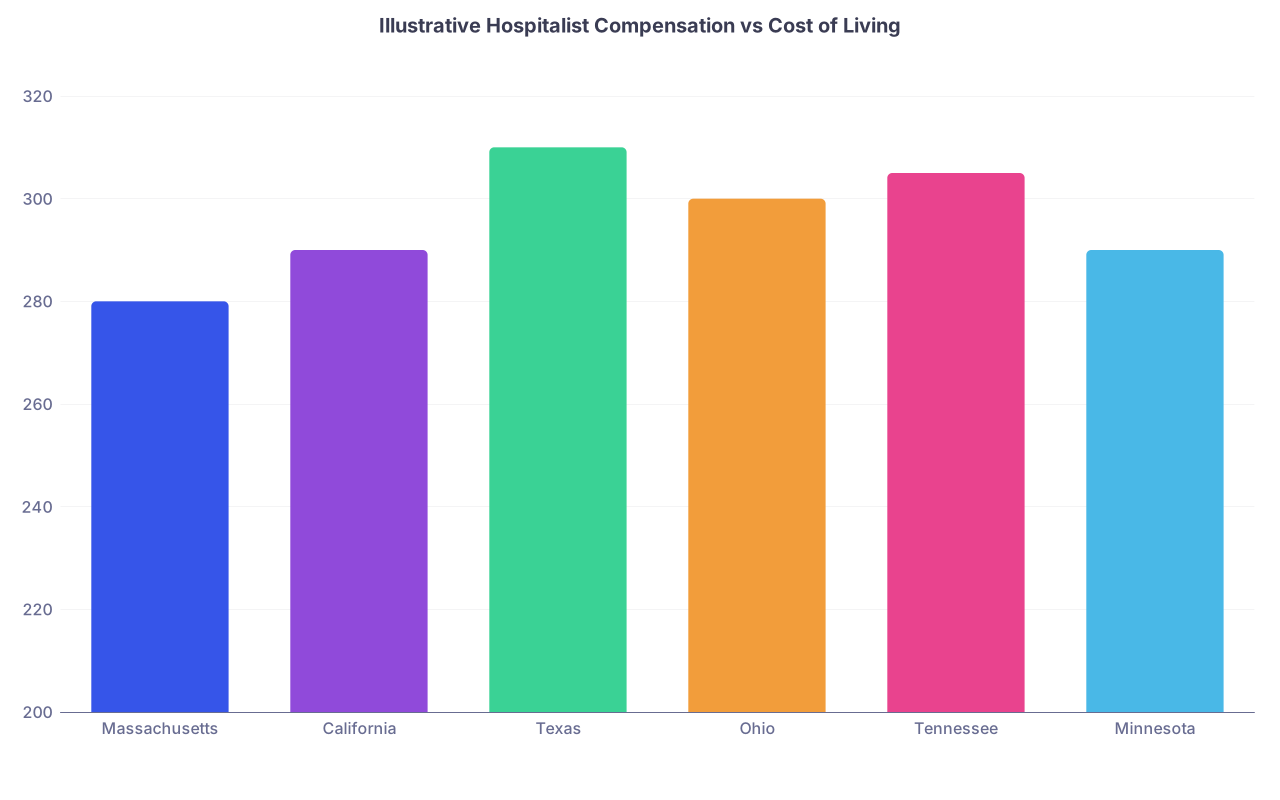
| Category | Value |
|---|---|
| Massachusetts | 280 |
| California | 290 |
| Texas | 310 |
| Ohio | 300 |
| Tennessee | 305 |
| Minnesota | 290 |
Those are nominal numbers in thousands. Now discount by:
- State effective tax rate
- Local cost‑of‑living index (rent, food, transportation, basic services) relative to national average = 100
A common pattern (approximate, illustrative):
- Massachusetts: COL index ~135, state effective tax ~5%
- California: COL index ~150–160, state effective tax ~7–9%
- Texas: COL index ~95, state income tax 0%
- Ohio: COL index ~90, state effective tax ~3–4%
- Tennessee: COL index ~90, state income tax 0% on wages
- Minnesota: COL index ~100, state effective tax ~6–7%
If you convert that into an “effective purchasing‑power income” (take‑home divided by cost of living), the ranking flips. That $280K in Massachusetts “feels” more like $190–210K after you pay rent and taxes. The $300–310K in Ohio or Texas, by contrast, feels closer to $260–280K of purchasing power.
The data is unambiguous: zero‑income‑tax or low‑tax states with moderate cost of living consistently yield higher real early‑career income. For a new attending juggling $200–350K of student loans, that gap is decisive.
States that repeatedly float to the top on this specific dimension:
- Texas
- Tennessee
- Florida (outside Miami/Ft. Lauderdale)
- Ohio
- Indiana
- Missouri
- Oklahoma
- Wisconsin
- The Dakotas
Notice something: almost none of these are the “dream” states you hear PGY‑3s talking about in the call room.
Now, money is not everything. But if you are looking at a 5–7 year window to de‑risk your life and kill your debt, the arithmetic matters more than the coastline.
Burnout, Workload, and Malpractice Climate
The next variable is what actually happens after you sign. Salary means little if you are drowning in RVUs, documentation, and lawsuits.
Medscape’s physician burnout surveys consistently show:
- Highest burnout rates: physicians in high‑cost, high‑regulation coastal states and in specialties with high administrative friction (EM, IM, FP)
- Lower burnout: many Midwest and Southern states with lower cost of living and more stable staffing
Burnout is multi‑factorial, but you see correlations with:
- Malpractice environment. States with strong tort reform (e.g., Texas after 2003, Indiana with its Patient Compensation Fund, Wisconsin historically) show lower malpractice premiums and fewer catastrophic cases.
- Hospital staffing ratios. Rural and community hospitals in shortage areas often have high workloads but also more autonomy and less administrative micromanagement. Large academic centers in dense metros can have the worst of both: pressure + bureaucracy.
A quick comparison of malpractice friendliness, early‑career perspective:
| State | Malpractice Climate | Avg Burnout Risk* | Comment |
|---|---|---|---|
| Texas | Physician-friendly | Moderate-Low | Strong tort reform |
| Indiana | Physician-friendly | Moderate | Damages caps, state fund |
| Wisconsin | Physician-friendly | Low | Stable legal environment |
| New York | Plaintiff-friendly | High | High premiums, dense courts |
| California | Mixed | High | High volume, high COL |
*Burnout risk: aggregated from Medscape surveys, state environment, and workload proxies. Not a formal published score, but the pattern mirrors what you see if you talk to enough attendings.
I have watched new graduates take shiny urban offers in New York or San Francisco, then spend 18 months trying to escape—RVU quotas, crowded EDs, high cost of living, plus the joy of practicing in a highly litigious environment where you document for the imaginary future jury, not the patient.
By contrast, states like Wisconsin, Indiana, Minnesota, and parts of Texas show an interesting cluster:
- Reasonable malpractice laws
- Solid hospital systems
- Lower density of med schools and residency programs competing for the same jobs
- Better ratios of support staff to physicians in community settings
You work hard everywhere. But your risk of being ground down is not uniform.
The data supports a clear statement: for early‑career attendings, avoiding the worst malpractice and burnout environments is almost as impactful as chasing the highest nominal salary.
Job Market: Where the Openings Actually Are
Residency makes you think jobs are everywhere, because you are in a hospital drowning in physicians. That is false. Jobs cluster.
The physician shortage is not evenly distributed:
- Many urban coastal markets are saturated for desirable specialties and lifestyle positions, especially primary care, hospitalist, and some IM subspecialties.
- Large stretches of the Midwest, South, and Mountain West remain shortage areas, especially outside metro cores.
HRSA shortage designations, combined with job board data (e.g., Doximity, PracticeLink, hospital systems) show higher job‑to‑candidate ratios in:
- Upper Midwest (Minnesota, Wisconsin, the Dakotas, Iowa)
- Central states (Missouri, Kansas, Nebraska, Oklahoma)
- Parts of the South (Tennessee, Alabama, Arkansas, Mississippi)
– with caveats about hospital stability and payor mix.
Contrast that with:
- Boston
- Bay Area
- Seattle metro
- NYC/NJ corridor
- DC area
These markets have jobs—but:
- More competition
- More willingness from employers to squeeze on salary and benefits
- Longer time from search to contract for “good” positions
For early‑career stability, the best states are often those with:
- Several mid‑sized metro areas and regional referral centers
- Enough rural catchment to keep demand high
- Not too many huge academic juggernauts training waves of residents who want to stay local
Minnesota, Wisconsin, Ohio, Indiana, Missouri, and Tennessee all fit that pattern surprisingly well.
You see it in practical metrics: time‑to‑offer, signing bonuses, relocation assistance, loan repayment packages. These are consistently richer in “flyover” states because the leverage is different. They need you more than you need that specific city.
Debt, Taxes, and Wealth Trajectory
The question you should ask is not “Where will I be happiest next year?” but “Where will my balance sheet look safest in 7 years?”
Because the data on physician burnout and mid‑career exit shows something harsh: crushing debt + high cost of living + modest salary growth is one of the fastest paths to regret.
A simple early‑career financial model:
- Starting student loan: $300,000 at blended 6.5%
- Goal: aggressive paydown in 7 years
- Assume income‑driven repayment not being used as long‑term forgiveness (most specialists do not play that game; primary care in public service sometimes does)
In a high‑income‑tax, high‑COL coastal state:
- Net after‑tax income after basic expenses might allow you to throw $4,000–5,000/month at loans.
- Over 7 years, that is $336K–420K of payments, with a chunk lost to interest.
In a low‑tax, moderate‑COL state with higher real income:
- You realistically push $7,000–9,000/month at loans while still living comfortably.
- Over 7 years, that is $588K–756K of payments. You are debt‑free much sooner and building assets.
Run it out: the difference at year 7 between “I still owe $150K” and “I have $150K in investments and no debt” is life‑changing.
States that turbo‑charge this trajectory:
- Texas, Florida, Tennessee – zero state income tax, strong job markets in many specialties, but watch local housing costs in big metros.
- Ohio, Indiana, Missouri, Wisconsin – low to moderate taxes, solid salaries, and relatively cheap housing in most cities.
- The Dakotas, Nebraska, Kansas, Iowa – excellent for loan paydown if you can handle smaller markets and weather.
I have seen residents move from a training program in Boston or NYC to a first job in Columbus, Indianapolis, or Milwaukee, and their net worth inflects sharply within 24 months. The math is not subtle.
Narrowing It Down: States That Repeatedly Score Well
Putting this together—real income, burnout environment, job market depth, and wealth trajectory—some states come up again and again.
This is not a fantasy ranking. It is a synthesis across multiple datasets and the lived numbers of early‑career attendings.
| State | Real Income Score* | Burnout/Climate | Job Market Depth | Overall Early-Career Fit |
|---|---|---|---|---|
| Texas | Very High | Moderate | High | Excellent |
| Tennessee | Very High | Moderate | High | Excellent |
| Ohio | High | Moderate-Low | High | Strong |
| Indiana | High | Moderate-Low | High | Strong |
| Wisconsin | High | Low | Moderate-High | Strong |
*Real income score: weighted combination of average compensation, cost of living, and state tax.
Three quick profiles.
Texas
- No state income tax.
- High demand in almost every specialty, both urban and suburban.
- Strong tort reform since 2003, low malpractice premiums relative to other large states.
- Caveat: major metros (Austin, Dallas, Houston) have rising housing costs and traffic, and some markets are starting to feel supply pressure for “cushier” roles.
Net: one of the best pure financial plays for a new attending, especially if you are willing to consider secondary metros and exurbs.
Tennessee
- No state income tax on wages.
- Several mid‑sized metro areas (Nashville, Knoxville, Chattanooga, Memphis suburbs) with robust health systems.
- Competitive compensation, favorable malpractice environment, relatively low cost of living outside a few trendy urban cores.
- Strong presence of hospital systems that actively court early‑career physicians with bonuses and loan assistance.
Net: ideal for physicians who want a Southeast location without the worst malpractice or payor‑mix issues of some neighboring states.
Ohio / Indiana / Wisconsin Cluster
- Solid compensation with lower COL; you frequently see real income equal to or better than Texas once housing is factored in.
- Reasonable tax rates, no insane housing bubbles in most metro areas.
- Multiple academic centers and a dense network of community hospitals and large multispecialty groups.
- Malpractice climates that are manageable, with Indiana and Wisconsin particularly favorable.
Net: these states are the unglamorous workhorses of early‑career physician success. If you want to erase debt and build stability fast, they deserve more attention than they get.
To visualize the tradeoff between nominal salary and cost of living, look at a stylized purchasing‑power comparison:
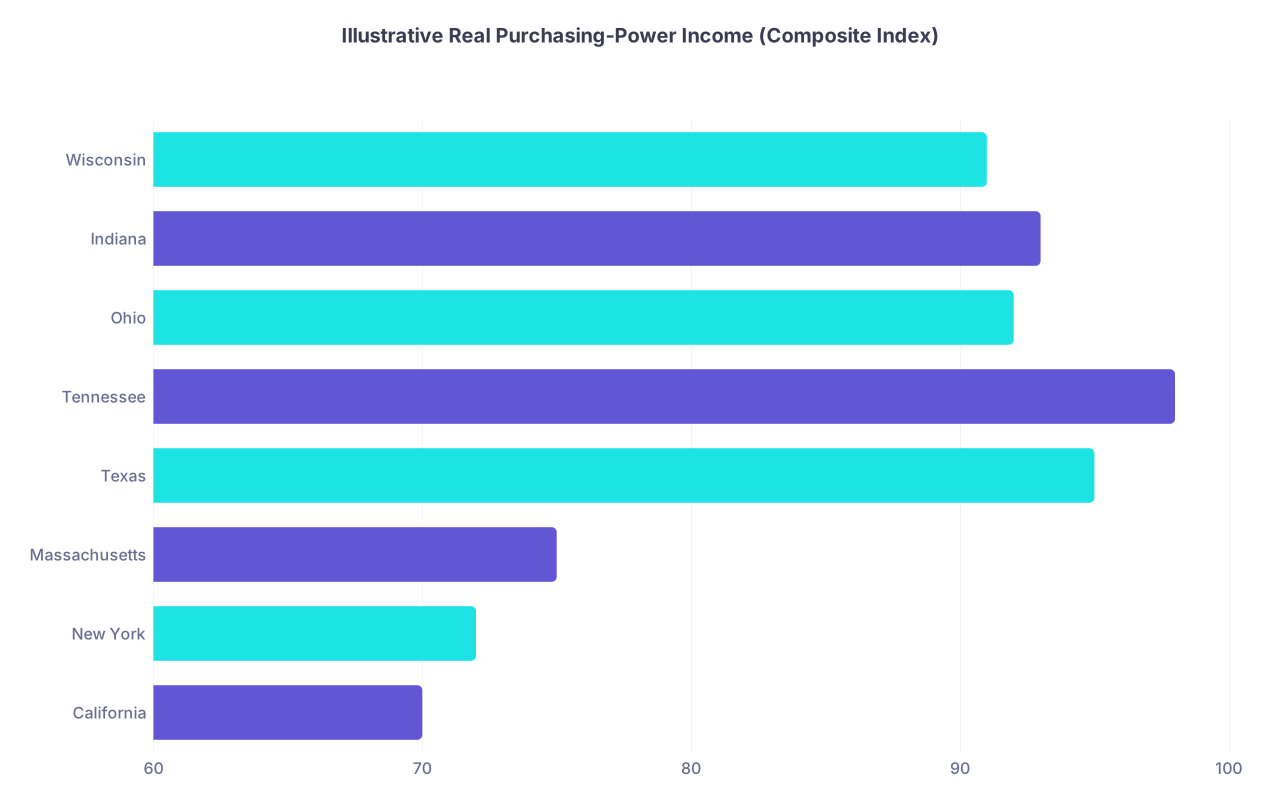
| Category | Value |
|---|---|
| California | 70 |
| New York | 72 |
| Massachusetts | 75 |
| Texas | 95 |
| Tennessee | 98 |
| Ohio | 92 |
| Indiana | 93 |
| Wisconsin | 91 |
Index 100 = reference “ideal” scenario. Again, approximate but directionally correct: many so‑called prestige states are quietly costing young physicians 20–30% of their real income.
How to Use This Data for Your Own Transition
You are not an average. You are one person with a specific specialty, family situation, and risk tolerance. But the framework scales.
A practical workflow:

| Step | Description |
|---|---|
| Step 1 | Identify 3-5 target regions |
| Step 2 | Gather salary and COL data |
| Step 3 | Estimate after-tax real income |
| Step 4 | Assess job market depth |
| Step 5 | Evaluate burnout and malpractice climate |
| Step 6 | Prioritize high real income states |
| Step 7 | Balance with lifestyle/geography |
| Step 8 | Shortlist 3-4 states |
| Step 9 | Apply and compare concrete offers |
| Step 10 | Debt payoff priority high? |
You do not need perfection. You do need:
- A clear sense of your debt strategy.
- A realistic understanding of how much cost of living will eat your raise.
- Data on where your specialty is actually in shortage, not just where your co‑residents want to live.
Ask recruiting departments for:
- Median and 25th/75th percentile compensation for that role.
- Typical RVU expectations and actual distributions.
- Turnover rates for the position.
- Malpractice coverage details, including tail.
- Call burden and schedule structure.
Then plug it into a simple model: after‑tax income – baseline expenses – planned loan payments. Compare across states. You will be surprised how often the Midwest or South beats the coasts by six figures over a 5‑year span.
And pay attention to one last thing that does not show up on spreadsheets: exit options. States with stronger regional health systems and several metro areas (Texas, Ohio, Tennessee, Minnesota, Indiana) give you more paths to move later without leaving the state. That reduces your risk if the first job is not perfect.
The Bottom Line
Three key points.
Real income beats prestige geography. After‑tax income adjusted for cost of living is dramatically higher in states like Texas, Tennessee, Ohio, Indiana, and Wisconsin than in coastal high‑cost states, especially in the first decade of practice.
Malpractice and burnout climates are not trivial. States with physician‑friendly tort reform and sane workloads quietly protect your time, your sanity, and your long‑term earning capacity.
Your early‑career wealth trajectory is heavily state‑dependent. If you prioritize debt elimination and asset building for 5–7 years in a high‑value state, you buy optionality later—where you live, how much you work, and what kind of medicine you practice. The data strongly favors making that trade.


