

What if the riskiest part of your next job is not the salary, call schedule, or EMR—but the county courthouse down the street?
Most physicians pick jobs based on money, location, and lifestyle. They glance at malpractice coverage the way they glance at the Wi‑Fi password. Quick, superficial, and then they move on.
That is how people end up trapped in plaintiff‑friendly hellholes with 2 a.m. panic attacks, predatory premiums, and hospital “support” that disappears as soon as their name hits a complaint.
Let me walk you through the malpractice climate mistakes I see over and over—things doctors wish someone had forced them to look at before they signed.
1. Treating “Malpractice Coverage” as a Box to Check
You know the line: “We provide comprehensive malpractice coverage, including tail.” Sounds fine. Also meaningless.
The mistake: assuming “covered” means “protected.”
Here is what physicians routinely fail to ask—and later regret:
- What type of policy?
- Who controls defense and settlement?
- What happens when you leave?
- What are the limits, per claim and aggregate?
You must get specific or you are gambling with your future.
| Factor | Safer Option | Common Risky Reality |
|---|---|---|
| Policy Type | Occurrence | Claims-made |
| Who Buys Tail | Employer in writing | Doctor “responsible if leaving early” |
| Consent to Settle | Strong consent-to-settle with veto | “Modified” consent / no real control |
| Limits (per claim) | ≥ $1M / $3M typical | $500k / $1M in high-risk regions |
| Defense Outside Limits | Yes | No (defense erodes your policy limits) |
The classic horror story: hospital-employed OB in a claims‑made policy, high‑risk county. She leaves after 4 years, discovers tail coverage is her problem, and the quote is $120,000+. The job she left for? Small private group that will not pay her old tail and will not hire her until she is covered.
She did not “forget” to ask. She assumed “we cover malpractice” meant what she wanted it to mean.
Do not make that assumption.
Questions you must force into the offer conversation
Ask these directly. In writing.
- Is the policy occurrence or claims-made?
- If claims-made, who pays for tail, under what conditions, and is that obligation spelled out in the contract?
- What are the limits per claim and aggregate?
- Is defense cost inside or outside limits?
- Do I have pure consent to settle, modified consent, or none?
If they dodge, minimize, or “we’ve never had an issue” you just learned something crucial: they think you are naive, and they plan to keep it that way.
2. Ignoring the State’s Tort Environment While Obsessing Over Salary
I watch this mistake constantly: doctors compare two offers like this—
- Job A: $340k, mid-sized city, “good schools”
- Job B: $300k, similar city
They pick Job A. They never ask the bigger question: Which state will destroy me faster if I am sued?
Some states are structurally safer for physicians. Others are built to feed plaintiffs’ attorneys.
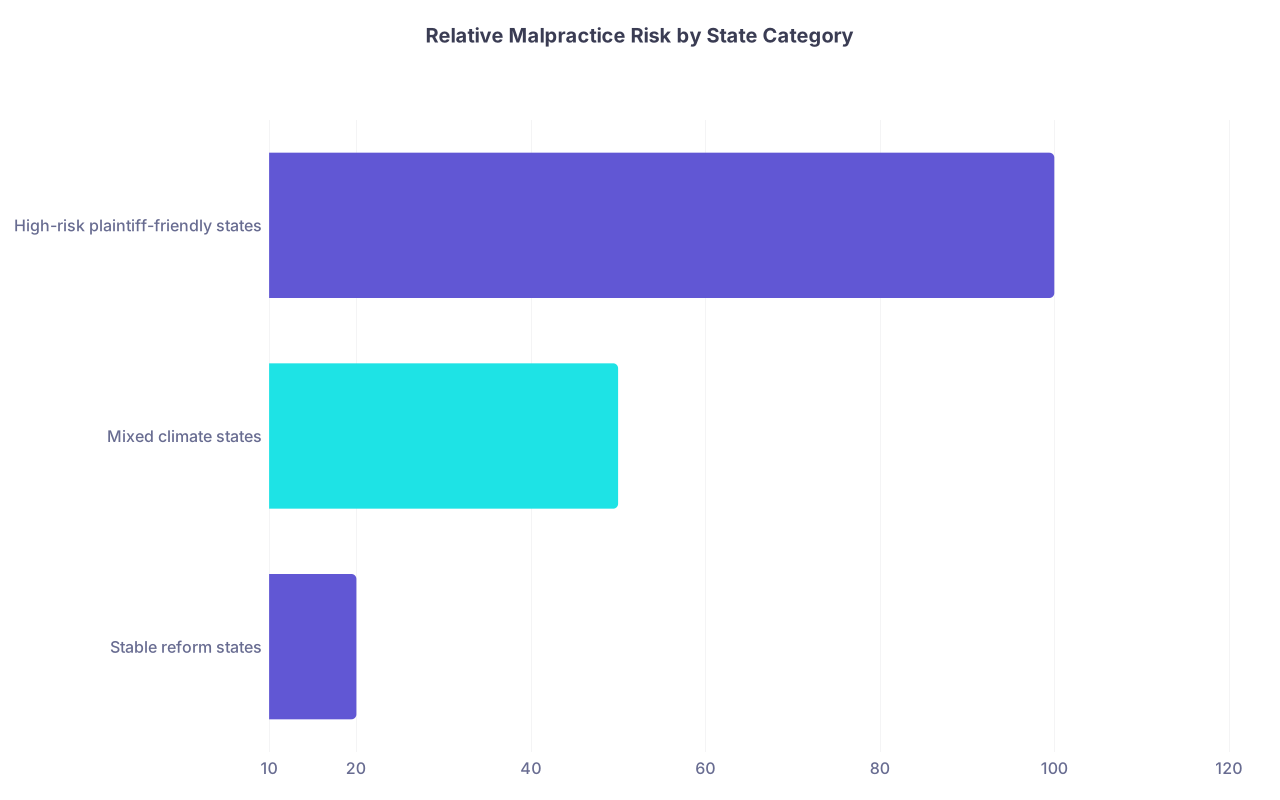
| Category | Value |
|---|---|
| Stable reform states | 20 |
| Mixed climate states | 50 |
| High-risk plaintiff-friendly states | 100 |
Those numbers are conceptual, but the pattern is real. High‑risk states combine several toxic features:
- No meaningful cap on non‑economic damages
- Plaintiff-friendly jury pools (especially in certain counties)
- Courts that routinely allow huge verdicts to stand
- Aggressive advertising plaintiff bars saturating billboards and buses
You can be an excellent clinician and still get pulled into a seven‑figure nightmare just by practicing in the wrong ZIP code.
The zip‑code trap inside “good” states
Even “safe” states have bad pockets. Certain counties are known locally as judicial minefields. I have heard surgeons literally say, “I will not operate in that county.” That is not paranoia. That is survival.
But new grads never ask this when they interview. They ask about RVUs, vacation days, and scribes. They do not ask, “What is your malpractice claim rate compared to state average?” or “Do you avoid cases in specific counties?”
You should.
Simple malpractice climate checklist
Before you rank any offer as a “top choice,” find out:
- Does the state have caps on non‑economic damages? At what level?
- What is the statute of limitations for med mal?
- Are there pre-suit screening panels or expert certificate requirements?
- Are large verdicts common in that county?
- Do local physicians routinely worry about suits—or shrug them off?
This is not academic policy talk. This is about whether your worst day becomes a learning experience or a career‑altering lawsuit.
3. Underestimating How Practice Type Changes Your Risk
Another mistake: pretending all jobs within a specialty have comparable malpractice exposure.
They do not. Not even close.
Here is how this usually goes wrong: an anesthesiologist compares two offers solely on compensation and call. One is office‑based sedation with mostly ASA I–II; the other is a tertiary trauma center with hearts, vascular, neurosurgery. Same specialty. Wildly different risk profile.
Or the hospitalist who agrees to moonlight in an understaffed, rural ED “just for extra cash” without realizing that department has a claim history that would scare a seasoned EM doc.

Common high‑risk scenarios people shrug off
- Understaffed ED with long waits and no consistent specialist backup
- OB coverage with unclear handoff rules between hospitalists, midwives, and private OBs
- Surgical programs that “stretch” indications to fill ORs
- New interventional programs with more ambition than systems support
- High-volume outpatient clinics with scary follow-up systems (or none)
Do not just ask, “What is my job?” Ask, “What is my exposure?”
Ask them:
- What is your recent malpractice history in this department or service line?
- Have any physicians in this specialty been named in major suits in the last 5–10 years?
- For high‑risk services (OB, ED, trauma, neurosurgery, interventional), what risk‑reduction protocols are in place?
If administration looks offended you asked, that is a problem. A good system is proud of its risk management, not defensive about it.
4. Trusting “We Support Our Doctors” Without Proof
Everyone says this. “We stand by our physicians.” It sounds comforting. It is often a half-truth.
Here is where people get burned:
- The hospital is named in a suit with you. Their priority is protecting the institution, not your individual reputation.
- They settle early to limit publicity or financial exposure—over your objections.
- They let you take the blame in PR or internal messaging while they quietly “restructure” a service line.
I have seen physicians stunned by how fast a “family” turns into “HR and Legal only.”
Ask for specifics, not slogans
Push past the warm language. Ask:
- Who selects my defense attorney—me, the carrier, or the system?
- Do you have internal guidelines about settling versus defending physicians?
- Can I speak with someone who has gone through a malpractice case here?
- Have you ever terminated or failed to renew a physician after a single major claim?
They may not answer that last one directly. But the hesitation tells you something.
You are not being paranoid by asking. You are being realistic. If a system cannot give you a clear picture of how they actually behave when things go wrong, assume you are on your own.
5. Ignoring How Malpractice Climate Controls Your Real “Take-Home”
Physicians obsess over pre‑tax salary differences while ignoring the hidden financial drain of a bad malpractice environment.
A high‑risk state with weak tort reform does not just mean “you might get sued.” It also reshapes:
- Your malpractice premium (if you are paying directly or via reduced comp)
- How aggressively plaintiffs’ attorneys target your specialty
- How much you practice defensive medicine—tests, consults, and wasted time
- Your long‑term insurability if you collect a few paid claims
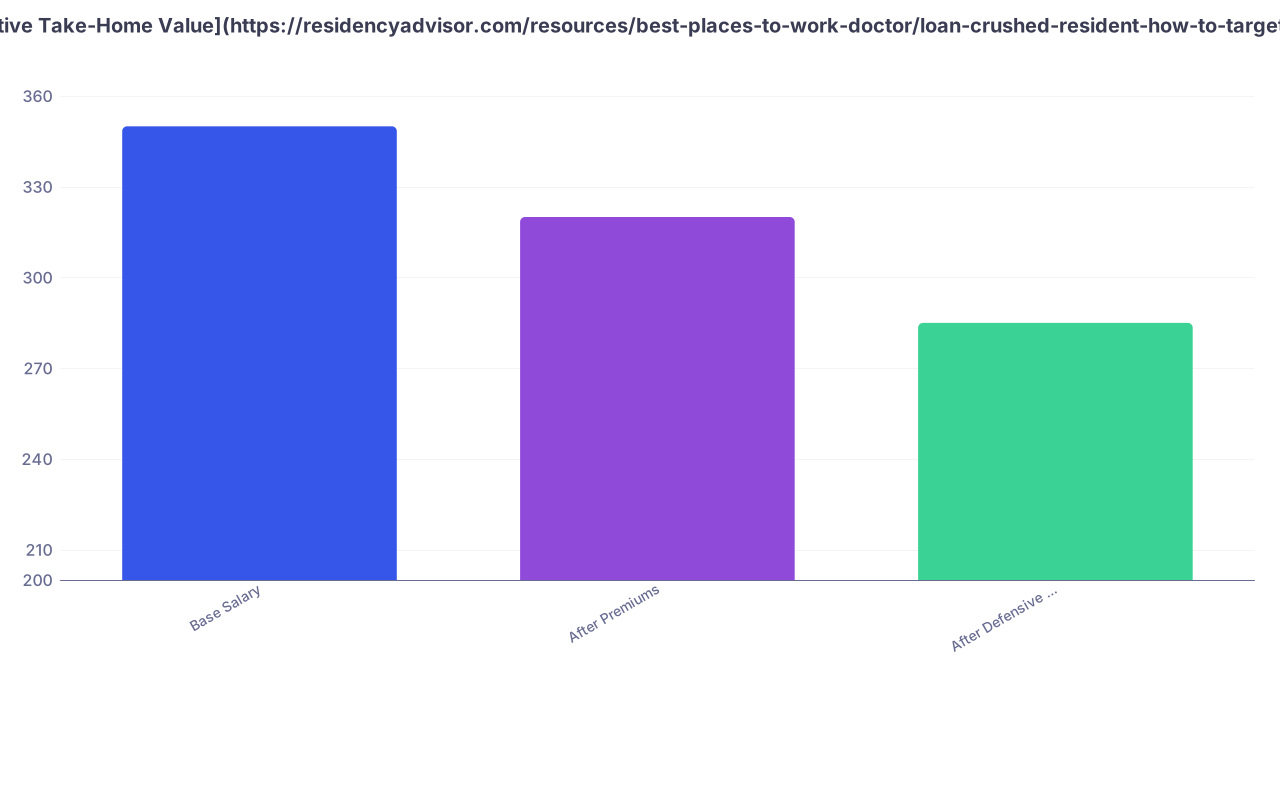
| Category | Value |
|---|---|
| Base Salary | 350 |
| After Premiums | 320 |
| After Defensive Practice Cost | 285 |
Again, conceptual numbers, but the direction is right. I have seen surgeons in plaintiff-friendly markets paying malpractice premiums that make a $50k salary difference meaningless.
If you are choosing between:
- $350k in a high‑risk, no‑cap state with a lawsuit‑happy county, vs.
- $300k in a stable, reform‑friendly state with moderate premiums,
the second job might actually leave you with more real value. Money, sleep, and career longevity.
But only if you stop pretending all dollars are equal.
6. Assuming Malpractice Risk Is Just “Part of the Job” You Cannot Influence
This is the fatalism mistake. “Everybody gets sued. There is nothing you can do.” That attitude lets hospitals and recruiters off the hook. They love physicians who think this way.
You actually have leverage, especially before you sign.
Use it while you still have options.
Things you can and should negotiate or clarify
- Tail coverage: get explicit language that the employer pays, including under early departure, non‑renewal, and termination without cause.
- Venue exposure: if the system staffs clinics or ORs in notoriously bad counties, are you required to rotate there?
- Call responsibilities: are you going to be the default scapegoat for a chaotic, understaffed service line?
- Documentation / support: scribe coverage, reasonable EMR expectations, and clear policies on handoffs and follow‑ups
Push back early. The best time to avoid a malpractice disaster is 18 months before a bad outcome, by not signing up for a dysfunctional environment to begin with.
7. Not Matching Your Risk Tolerance to the Local Culture
Two physicians can practice in the same malpractice climate and have very different experiences based on their own tolerance and the local culture.
I am not telling you to avoid any state that ever had a big verdict. I am telling you to be honest about who you are and what you can live with.
Some doctors thrive in high-volume, high‑risk settings. They know they will get sued and they accept that as part of their identity. They document aggressively, maintain tight personal risk‑management routines, and are comfortable in that environment.
Others will end up with chronic anxiety, second‑guessing every decision, unable to sleep while a case drags on for 5 years.
Both reactions are human. Only one is survivable in a high‑risk market.
How to test “fit” before you sign
During interviews, ask attending physicians and partners questions that expose the true climate:
- “Have you personally been sued? How was that handled here?”
- “How do people feel about the malpractice environment locally—anxiety or acceptance?”
- “Does this system actively teach risk management, or is it ‘learn the hard way’?”
Listen less to what they say and more to how they say it. A quick, weary look before a rehearsed answer? That tells you plenty.
8. Overlooking Long-Term Career Consequences of a Bad Malpractice Track Record
A single catastrophic claim in a bad venue can stain your record in ways that follow you:
- Future employers will see large paid claims and pass, even if the medicine was defensible.
- Insurers may mark you as higher risk, raising premiums or limiting coverage.
- Credentialing at certain hospitals becomes harder or impossible.
You might still work. But not where you want, and not on terms you like.
Think about that the next time someone tries to lure you with a short‑term bonus into a long‑term high‑risk malpractice environment.
You are not just picking your next job. You are shaping how insurable and employable you look 10 years from now.
9. Failing to Build Personal Malpractice Defense Habits from Day One
One more mistake: assuming the system will protect you simply because you are employed.
You need your own malpractice defense habits, regardless of where you work:
- Ruthless clarity in documentation for high‑risk encounters
- Consistent use of chaperones for sensitive exams and documenting that they were present
- Tight handoff notes and explicit patient instructions for red‑flag symptoms
- Early escalation of complex or deteriorating cases, with documentation of your reasoning
These are not just “good practice” ideas. They are the difference between a defensible case and a liability disaster.
Do not wait until your first claim to learn what defense attorneys wish you had documented. Ask now. Risk management departments will often set up one‑on‑one sessions. Use them.
10. Pretending Location Decisions Are Only About Lifestyle
The last big mistake is a mindset problem: treating “where to work” as a lifestyle question only.
Weather, schools, proximity to family—sure, they matter. But many physicians move in their mid‑30s or 40s for lifestyle, land in a hostile malpractice climate, and then realize they traded sunshine for legal exposure that never shuts off.
You do not have to choose between a good life and a sane malpractice environment. But you will need to be deliberate. That means:
- Mapping states (and counties) not just for COL and schools, but for tort environment
- Being willing to walk away from an otherwise “perfect” job in a judicial nightmare zone
- Recognizing that some sacrifices now (a smaller coastal city, a different region) may buy you decades of lower stress and fewer legal ambushes
Think like a 55‑year‑old version of yourself looking back. Will you be grateful you maximized a $30k salary bump in a hot plaintiff market—or that you quietly chose a calmer malpractice climate where you practiced good medicine without always looking over your shoulder?
The Short List: What You Cannot Afford to Ignore
Let me leave you with the essentials. If you remember nothing else, remember this:
- The malpractice climate is as important as salary and lifestyle. State laws, county jury behavior, and hospital culture can matter more than your technical skill.
- Never treat “malpractice coverage included” as enough. Demand details on policy type, tail coverage, limits, defense structure, and who really controls settlement.
- Your future employability depends on today’s environment. Repeated exposure to high‑risk venues and shaky systems can brand you with paid claims that follow you for decades.
Do not learn this the hard way, with your name on a docket and a hospital lawyer explaining “strategy.” Learn it now, while you still have the power to choose where—and how—you practice.


