

The glossy brochures about top academic medical centers lie to you by omission. The lifestyle they sell and the life you actually live as faculty are not the same thing.
I’ve sat in those conference rooms where department chairs debate whether to mention call burden to applicants. I’ve watched division chiefs “reframe” a 1-in-3 call schedule as “robust clinical exposure.” And I’ve seen plenty of bright residents walk into these institutions starry-eyed, then crawl out three years later exhausted, confused, and wondering how they missed all the warning signs.
Let me tell you what really happens behind those hospital branding videos and “world-class faculty” web pages.
The Prestige Tax: What You Really Trade for the Name
The first truth: you pay a prestige tax to work at big-name academic centers. You just do. And the currency is your time, your income, and your autonomy.
Here’s how it actually shows up.
You are hired “0.8 clinical / 0.2 academic,” and it sounds civilized. Two half-days a week for research or teaching, right? No. What they do not say is that the 0.2 academic time is what you do on nights, weekends, and “protected” Friday afternoons that mysteriously fill up with mandatory meetings, resident lectures, and “just one more” add-on patient.
In many major academic centers, the expectation is unspoken but ironclad: being physically present more than your contract states is a sign of commitment, of being “serious faculty.” The ones who leave at 5? I’ve heard them labeled as “nice clinically, but probably not going anywhere here” in promotions meetings.
And then there’s the money. You already suspect academic pay is lower. You don’t realize how that plays against your hours and stress until you’re in it.
| Setting | Base Pay (Relative) | Weekly Hours | Non-clinical Expectations |
|---|---|---|---|
| Elite Academic Center | Low | 55–70 | High (research/teaching) |
| Solid Community Hospital | Medium | 45–55 | Low–Medium |
| Private Practice Group | High | 45–60 | Low (business-related) |
No one in the interview will say this sentence to you: “You will work more and earn less than your community colleagues down the street, for at least 5–10 years, and possibly your entire career.” But that’s the quiet reality.
The trade-off is supposed to be prestige, complexity, and “impact.” For some people, that trade is absolutely worth it. But you should know that’s the transaction you’re making, not just vaguely feel it.
The Hidden Second (and Third) Job You’re Actually Signing Up For
At top academic centers, your job isn’t just “doctor.” It’s three jobs, minimum: clinician, educator, and scholar. The problem? Only one of those is structurally protected. The rest are squeezed into the crevices of your life.
You’ll be told you have “protected time.” That phrase is doing a lot of work.
Protected time in many departments means: we won’t officially schedule clinic then. But your pager still goes off, residents still come find you, committees still book meetings, and your division chief still drops by to ask if you can “just look at a grant idea” for someone.
I’ve personally watched junior faculty get evaluated poorly because they “didn’t produce enough scholarship” in their first 3 years, despite spending 80%+ of their real working hours stabilizing chaotic clinical services and covering constant gaps.
Let’s be explicit about the unspoken expectations at big academic names:
- You’re expected to publish early and often, even if no one gave you real infrastructure or mentorship.
- You’re expected to teach enthusiastically, even though teaching rarely counts as much as RVUs or papers for promotion.
- You’re expected to sit on committees, because “service” is part of being a “good citizen of the department.”
None of this is in your official workload grid.
And here’s the real kicker: your “achievement” bar is calibrated not against normal physicians, but against a small subset of hyper-productive, older faculty who had fewer documentation burdens, more NIH money in the system, and usually a spouse absorbing a lot of their home life. You’re being compared to a life that doesn’t exist anymore.
What Your Actual Day Looks Like (Not the Version on the Website)
Residency rotations at academic centers give you a taste, but they don’t show you what it’s like to be the one holding the service together as faculty.
Here’s the difference.
As a resident, that brutal 30-patient census is “a hard month.” As faculty, that census is your baseline reality. Except now you’re also responsible for:
- Every complaint and safety event.
- Every “VIP” patient someone flagged to your chair.
- Every trainee’s eval, feedback, and remediation.
- Every throughput call from bed control asking, “Can you just move things along?”
What no one advertises: the relentless fragmentation. The pinging messages, the EPIC inbox, the micro-disruptions that make even a “light” clinical day feel like cardiac rehab on a treadmill that randomly speeds up without telling you.
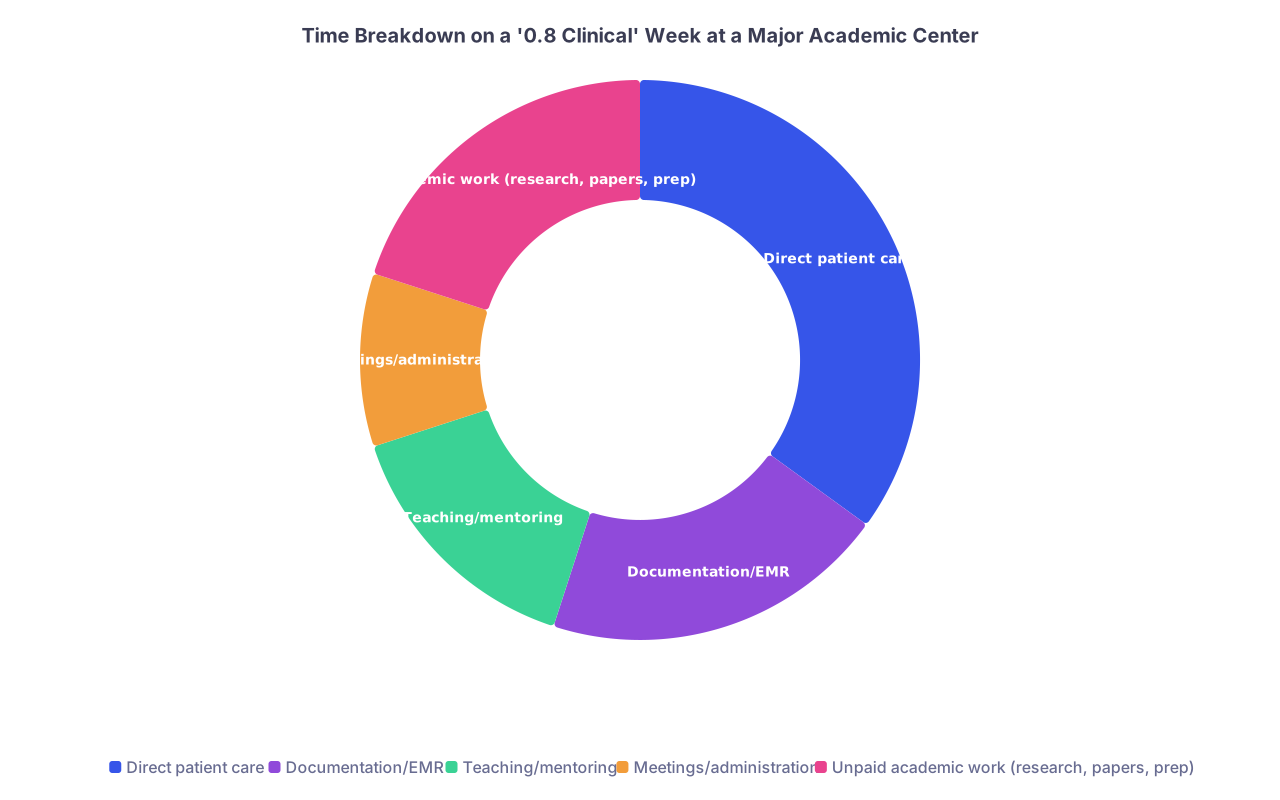
| Category | Value |
|---|---|
| Direct patient care | 35 |
| Documentation/EMR | 20 |
| Teaching/mentoring | 15 |
| Meetings/administration | 10 |
| Unpaid academic work (research, papers, prep) | 20 |
So yes, you might be technically “80% clinical,” but look where your other 20% goes. Most people do their actual thinking work—writing, analysis, deep reading—at night, on weekends, or in stolen early mornings. That is the real physician lifestyle at top-tier academic centers: constantly pushing high-cognitive-load work into personal time.
You are not crazy if you feel like your day job is swallowing your actual job.
The Call Schedule They Spin and the Reality Behind It
Listen very carefully during interviews when they talk about call. Pay attention to the verbs.
“We’ve moved to a night float system.”
“Home call most nights.”
“Weekend coverage is shared.”
Those phrases are engineered to sound humane.
I’ve seen the spreadsheets behind the words. Home call at a quaternary academic hospital with a huge catchment area is not the same as home call at a small community site. It’s often “home but tethered to your phone and EMR, and your sleep is a joke.”
For surgical subspecialties, “q4 home call” can functionally mean you’re partially on call every night anyway—fielding texts, reviewing images, answering resident questions—because the complexity of patients doesn’t respect the calendar.
And there are two more tricks:
The “volunteered” shifts. You’ll hear, “Faculty can pick up extra call if they want additional income.” Then your base salary is subtly held down, and people feel pressured to sign up for those “optional” shifts to clear basic financial goals. Suddenly “extra” is just… expected.
The culture of guilt. At some big centers, saying no to extra call is interpreted as not being a “team player.” I’ve sat in meetings where someone’s name comes up for promotion and a senior person says, “Great clinician, but never helps out when we’re short.” That’s code for: they tried to set boundaries.
Your lifestyle isn’t defined just by the written call schedule. It’s defined by how much pressure there is to take “just this once” extra coverage. At many renowned institutions, that pressure is constant and quiet.
Research Expectations: The Part They Never Explain Clearly
You’ll hear a lot about “opportunities to do meaningful research.” The word “opportunities” makes it sound optional. At top academic places, it’s not—if you want a real career there.
Here’s the dirty little secret: promotion criteria documents are technically transparent but functionally opaque. They’re written in vague language like “evidence of scholarly productivity” and “regional or national recognition.” That language gives the promotions committee room to do what it already wants to do: promote the known winners, stall the rest.
What no one spells out:
- In many departments, if you’re not on a promotion track with some publications by year 3–5, you’re silently categorized as “permanent workhorse clinician.”
- Once you’re in that mental bucket, your load shifts toward service-heavy work, because “you’re so reliable clinically.” That profile is hard to climb out of.
- The real research currency is not ideas, but infrastructure: protected time that’s actually protected, mentorship that’s actually engaged, and access to statisticians, coordinators, and funding. Without those, your “research time” becomes unpaid, nights-and-weekends hustle.
I’ve seen junior faculty with brilliant ideas simply worn down by this mismatch. Meanwhile, the chosen few—usually those who aligned early with a high-status mentor—get the grants, multi-author papers, and visibility.
This shapes lifestyle more than people expect. If you’re trying to do “real” academic work without support, you end up sacrificing evenings, vacations, and mental bandwidth. If you’re one of the anointed with real backing, your life is still full, but at least your off-clinic time is genuinely used for your own projects instead of being cannibalized by service.
(See also: Step-by-Step Plan to Find Doctor-Friendly Cities for Young Families for more.)
Teaching: The Work They Love to Celebrate but Rarely Reward
Top academic centers market themselves on teaching. Residents. Fellows. Students. CME courses. Grand rounds.
What they do not say clearly is how unevenly that teaching is valued.
Every med school and residency website has the same phrases: “Passionate educators,” “world-class teaching,” “mentorship culture.” Then you sit in actual promotion meetings and watch the scoring: the person with middling teaching evals but two R01s flies through. The superstar educator with no grant funding gets stuck at associate professor for a decade.
(Related: Burned Out in a Big City? How to Systematically Pick a Better State)
You know what that does to lifestyle? It quietly pushes faculty toward behaviors that the institution actually rewards, not what it says it values.
So you’ll see this pattern:
- Faculty pack their calendars with clinics and meetings that generate RVUs or lines on a CV.
- Teaching gets squeezed into leftover time, even for those who like it.
- Mentoring becomes transactional: brief, superficial, because everyone is drowning.
Meanwhile, the people who truly care about learners take on more and more—advising, remediation, curriculum redesign—because “you’re so great with residents.” And because those roles are poorly funded, they turn into yet another unpaid job.
The lifestyle result: if you’re a real teacher at heart, you’ll feel emotionally fulfilled but logistically crushed. Unless you fight hard for formal titles, funding, and protected time early.
Culture: The Best and Worst Part of Top Academic Centers
Let’s be fair. Academic centers are not monolithic hellscapes. Some departments have genuinely humane cultures with smart leadership that protects people. Those exist. They’re just rarer than the marketing suggests.
But there are some consistent cultural patterns at big-name places that affect lifestyle:
Hero culture. The people held up as exemplars are the ones who “do it all”: huge clinical volume, labs, national committees, textbook chapters, nonstop travel. That becomes the silent benchmark. You constantly feel like you’re behind, even if you’re functioning at 150% of what would be considered normal elsewhere.
Invisible comparison. You’re not being compared to generic physicians; you’re compared to the top 5–10% of academic physicians in the country. The ones whose names are on guidelines. That is great for ego when you win. It’s poison for contentment when you’re mid-career and realizing you won’t be “that person.”
Status by affiliation. There’s a powerful identity hit in saying “I’m faculty at [Big Name].” People get hooked on that. The institution knows this. It’s part of why they don’t feel much pressure to fix lifestyle problems; there is an endless supply of ambitious residents who will tolerate worse conditions than the last group.
Silence around exit. The happiest people I know who left big-name academic centers for community or hybrid jobs were shocked by how often their former colleagues quietly said, “I wish I could do that.” You won’t hear that in public faculty meetings. You hear it one-on-one, at conferences, over late-night texts.
Culture drives lifestyle far more than the formal job description. At some elite centers, the default is: your life revolves around the institution. Everything else is background.
The Community vs Academic Reality No One Walks You Through Honestly
During fellowship, you’re given this sanitized fork-in-the-road picture: academic vs community. One path is “prestige and teaching,” the other is “money and lifestyle.” That framing is lazy and out of date.
The real comparison, from a lifestyle standpoint, looks more like this:
| Factor | Elite Academic Center | Strong Community Hospital |
|---|---|---|
| Base salary | Lower | Higher |
| Total hours | Higher | Lower–Moderate |
| Call intensity | High complexity, often frequent | Variable, often more predictable |
| EMR/inbox burden | Very high | High, but often fewer messages |
| Autonomy | Lower (more committees, rules) | Higher in day-to-day workflow |
| Teaching opportunities | Constant | Present but more limited |
| Research | Expected for advancement | Optional; often minimal |
| Identity/prestige | High | Local/regional |
The thing academic leaders rarely say out loud: many of them would have a better day-to-day life in a strong community job. They stay because their identity is now fused with the institution, and because they’ve sunk years into building a specific academic profile.
You’re earlier in your arc. You still have flexibility. No one tells you clearly that you can get:
- Interesting clinical work
- Solid colleagues
- Better hours and pay
in a non-brand-name setting. You just lose the label. And for some people, losing that label feels unbearable. For others, it’s the best decision they ever made.
How Medicine’s Future Will Make This Better… and Worse
The future of physician lifestyles at top academic centers is not a straight line. It’s a tug-of-war between forces that help and forces that accelerate burnout.
There are some hopeful trends:
- Young faculty are openly demanding flexibility, transparency about call, and real protected time.
- Wellness and burnout aren’t taboo topics anymore. Departments are being forced to at least pretend they care.
- Remote work is creeping into academic life—telehealth sessions, remote research meetings, virtual clinics—opening the door to more hybrid schedules.
But there are counterforces:
- RVU pressures and hospital finances are tightening, not loosening. Academic centers are expensive institutions to run, and that cost eventually lands on clinical faculty shoulders.
- Complexity of patients and documentation is rising, not falling. AI may help someday, but right now, most “innovations” just add extra clicks.
- The research funding landscape is brutal. That means even more competition, more time chasing grants, fewer people making it to stable investigator status.
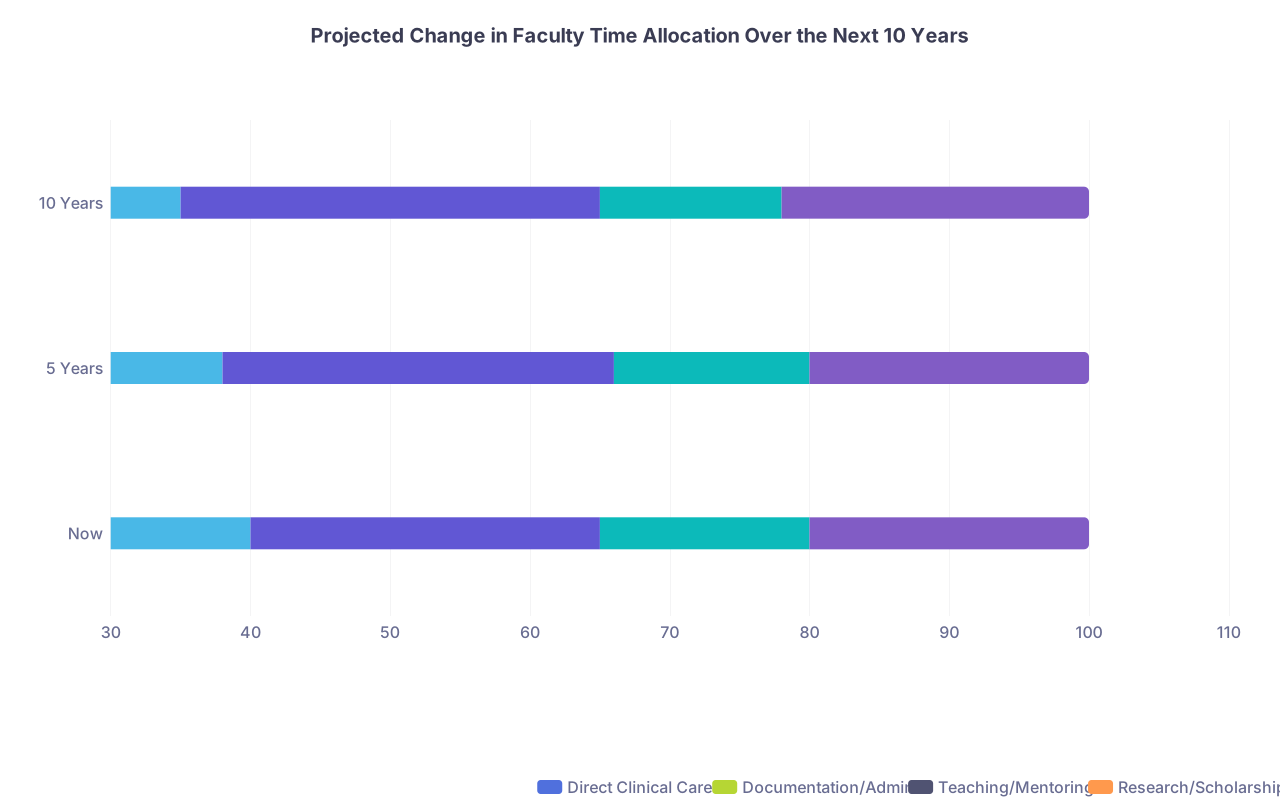
| Category | Direct Clinical Care | Documentation/Admin | Teaching/Mentoring | Research/Scholarship |
|---|---|---|---|---|
| Now | 40 | 25 | 15 | 20 |
| 5 Years | 38 | 28 | 14 | 20 |
| 10 Years | 35 | 30 | 13 | 22 |
Where this lands is pretty simple: the workload mix is going to stay heavy. Documentation and admin aren’t going away. Academic expectations are not suddenly softening. If anything, the bar will creep higher as institutions compete for rankings and prestige.
So if you’re going to dive into that world, you need to do it with eyes open and terms negotiated.
How to Read Between the Lines When You’re Choosing a Job
Let me give you a few specific, practical insider checks. These reveal more than any glossy tour or rehearsed interview answer.
Ask junior faculty—without leadership present—questions like:
- “If you could go back 3 years, would you take this same job again?”
- “When do you do your research or academic work? During the day or nights/weekends?”
- “What happens if you say no to an extra call shift?”
- “How many evenings a week are you on your laptop finishing charts or emails?”
Watch their faces more than their words. The hesitation, the sigh before answering—that’s the truth.
Ask division chiefs:
- “How many assistant professors in the last 5 years have been promoted here vs left?”
- “Can you name people who successfully stayed mostly clinical and still advanced?”
- “Where do your former faculty go when they leave? What roles?”
If they dodge or go vague, assume the real story is not pretty.
And don’t be afraid to ask for specifics on protected time. Not just “how much” but “how is it enforced?” At some places, the answer is: “Well, we try, but the service comes first.” Translation: you’ll never see that time intact.
The Bottom Line: What You Actually Need to Remember
You can absolutely have a deeply meaningful, even satisfying career at a top academic center. Many people do. But it is not because the lifestyle is inherently great. It’s because they went in fully aware of the trade-offs and built lives that worked in spite of the institutional pressures.
If you remember nothing else, remember these:
You pay a real prestige tax at elite academic centers—more hours, less pay, more hidden work. Only you can decide if the trade is worth it, but pretend it’s not there and you will be miserable.
The brochure version of the job hides the second and third jobs: research, teaching, admin. Those shape your evenings, your weekends, and your mental bandwidth far more than anything written in your contract.
Culture beats structure. A “dream” institution with a toxic department will wreck you; a less famous place with a sane, supportive culture will quietly give you a far better life.
The name on your badge is just ink and plastic. The life you live around it—that’s the part you’ll feel at 10 p.m. when you’re still charting and your kids are already asleep. Choose accordingly.


