
It’s a Tuesday afternoon, 4:45 p.m. You’re a senior resident, walking past the physician lounge on your way to sign out. Two attendings are sitting in the corner, talking low. You catch one sentence as you pass:
“…yeah, they bumped my CME pool and quietly added another week of ‘admin time’ so I’d stay. Never put it in the posting.”
You stop for half a second.
The posting you saw when you applied just said: “Competitive salary, comprehensive benefits, CME allowance.” Nothing about extra admin time. Nothing about bumped CME. Nothing about half the stuff you start hearing once you’re close to signing a real attending contract.
Let me tell you what actually happens once you’re on the inside.
Most of the best perks in physician jobs are never written in the job ad. Some never make it into formal policy. They live in side emails, handshake agreements, and “we can probably do that for you” conversations between CMOs, chairs, and the few doctors who know to ask.
The people who benefit most? The ones who understand that posted benefits are the floor, not the ceiling.
Why “Best Places to Work” Look Ordinary on Paper
Hospitals and groups almost never advertise their real flexibility or hidden perks. Not because they don’t exist, but because:
- HR wants uniformity.
- Leadership wants options.
- They do not want every doc demanding what the top 10% negotiated.
You’ll see “salary range: $300–350k,” “CME allowance,” “paid time off,” “malpractice coverage.” Safe, generic phrases. Meanwhile, behind closed doors, this is what gets discussed:
“Can we carve out 0.2 FTE for her research?”
“Give him 4 extra weeks non-clinical in year one and label it ‘onboarding’.”
“Let’s redirect some RVU bonus into a 401(k) match; he’ll like that.”
They’re not lying in the ads. They’re just leaving out everything that isn’t standardized.
The quiet truth: the attendings who look like they “landed at a great place” usually didn’t just stumble into a magical institution. They had someone tell them what to ask for, or they learned the game the hard way.
Let’s walk through the perks you rarely see on paper—but insiders use all the time.
1. Schedule and Call: The Real Currency No One Lists
This is the first domain where the written policy and the lived reality diverge.
Publicly:
“1:4 call,” “equitable weekend coverage,” “shared holiday rotation.”
Privately:
- The star recruit from fellowship gets “home call” reclassified for certain weekends.
- The senior doc “not great with nights anymore” suddenly does almost no overnights.
- The part‑time doc quietly gets a 0.6 FTE with the workload of a 0.5.
The real perk isn’t always less call. It’s controllable call, and there are several versions of this.
Hidden schedule perks you only hear about inside
Protected “soft Fridays.” Some groups unofficially allow a senior partner to block Friday afternoons for “admin” or “procedures” that end at 2 p.m. New hires don’t hear this in interviews.
Call tapering with seniority. I’ve seen contracts at large community hospitals where no one mentions this on paper, but once you hit year 5–7, your call quietly drops by 25–50% if you’re considered “core.” It’s justified as “leadership responsibilities” or “mentorship time.”
Phantom “admin days.” The ad says: “0.8 clinical / 0.2 admin.” What actually happens: some physicians convert their highest-demand half-day clinic to “admin” to get out of direct patient care while keeping their comp roughly the same. Others never hear that’s even an option.
Selective holiday exemptions. The written rule: “All physicians share holidays.” The unwritten rule: the chair hasn’t worked Christmas in 8 years, the interventionalist with three kids swaps out every major holiday, and the single hospitalist gets stuck with half of them unless they push back.
If you want to spot a truly good place to work, listen very carefully when attendings talk about how the schedule is made and who gets exceptions. Programs that quietly take care of people over time—without endless fights—are the ones worth staying in.
2. Financial Sweeteners That Never Make the Job Posting
No, I’m not talking about the posted sign‑on bonus or relocation. Everyone sees those. I’m talking about the money that moves around under different labels.
, Retirement boost, Hidden admin FTE](https://cdn.residencyadvisor.com/images/articles_svg/chart-common-unadvertised-physician-financial-perks-6954.svg "Common Unadvertised Physician Financial Perks")
| Category | Value |
|---|---|
| Extra CME | 60 |
| Off-cycle bonus | 45 |
| [Loan repayment](https://residencyadvisor.com/resources/best-places-to-work-doctor/dont-move-yet-tax-and-loan-errors-doctors-make-when-picking-a-country) | 35 |
| Retirement boost | 25 |
| Hidden admin FTE | 40 |
Quiet reallocation of compensation
I’ve watched this exact pattern in more than one system:
The posting:
“Base $280k, quality and productivity incentives up to $40k annually.”
What a savvy candidate negotiates off‑record:
- Base increased to $300–310k
- RVU threshold lowered for bonus eligibility
- “Practice development” stipend of $10–20k/year
- One‑time “transition bonus” not labeled as sign‑on, paid after year one so it doesn’t trigger the same internal rules
All of that can be approved locally by a chair or service line leader if they see you as high-value. They will never email HR saying “we’re paying her more than the others.” They’ll say “we adjusted structure for recruitment competitiveness” and move on.
Loan repayment that “doesn’t exist”
Plenty of hospitals claim: “We don’t do loan repayment.” Then magically someone gets $50k “retention” spread over five years. It’s just not billed as “loan repayment” in an official policy.
You’ll see language like:
“Physician will receive a $10,000 annual retention incentive, contingent on continued employment.”
In other words: loan repayment in everything but name.
Retirement and deferred comp tricks
This is one almost no resident understands, and it costs them. A system might have:
- Standard 403(b) match up to 4%
- A 457(b) or 401(a) option used mostly by older docs
- A “supplemental executive retirement plan” that mysteriously a few physicians get access to
Who gets funneled into that last bucket? People leadership actually wants to keep. You don’t see an internal “application.” You just get a call from the chair or CFO saying:
“We’d like to include you in a supplemental retirement program we reserve for key physicians.”
If you never ask about long-term comp mechanisms, you’ll never be offered them early.
3. Non-Clinical Time: The Closest Thing to Work-Life Sanity
Non‑clinical FTE is the most powerful unadvertised benefit in modern medicine. Because it looks like “work” on paper. But it feels like breathing room in reality.
Job ads rarely say: “We’ll protect you from seeing 25 patients a day by converting part of your job into vague leadership or QI time.” But that’s exactly what happens for the physicians who raise their hand at the right moment.
How non-clinical time really gets handed out
A new hospitalist joins. The ad said “100% clinical.” After two years of doing everything—committees, QI projects, Epic optimization—someone says:
“Why don’t we make you associate site lead for quality and give you 0.1 or 0.2 FTE for that?”
Translation: You just traded 1–2 shifts a month for meetings and PowerPoints. Most residents think they don’t want that. Then they hit 18 shifts/month with constant codes and start eyeing those meetings like they’re a spa day.
Similarly in outpatient practices:
The “busy” primary care doc tired of 24 patients per day suddenly has a “panel management” block. That’s code for one half‑day a week not booked with face‑to‑face visits, but full pay. It’s justified as “population health.” In practice, it’s a pressure release valve.
Academic vs community: who’s hidden-friendlier?
Academic centers are more open about protected time, but they still hide the real deals. What’s posted: “80% clinical, 20% academic.” What insiders know: the true stars—or the politically savvy—recalibrate that to 50–60% clinical within 3–5 years. The others stay stuck at 80–90% forever.
In community systems, they won’t even publish the idea of protected time for junior hires. But they’ll quietly give “Medical Director of X” roles at 0.1–0.3 FTE to people who:
- Ask early, and
- Are willing to do the boring stuff (policies, metrics, EMR crap)
That’s how you turn a supposedly “full clinical” job into a 0.7–0.8 clinical job without cutting pay.
4. Lifestyle Perks That Never Hit the Brochure
Now we’re getting to the subtle quality-of-life stuff residents rarely think about when they’re just trying to survive nights.

True flexibility with remote and hybrid work
Publicly: “Some telemedicine opportunities,” “hybrid possible.”
Privately:
- One senior internist now does 2–3 half-days a week fully remote video visits.
- The derm attending has shifted all follow-ups to telehealth from home Friday afternoons.
- The child psych in a “full time” job actually lives two states away and comes in one week a month.
These arrangements aren’t plastered on the careers page because the institution knows exactly what would happen: a line of doctors demanding the same. Instead, they’re handled one by one.
If you ask leadership directly, “Do any physicians currently work partially remote or off-site?” you’ll either get a quick “No, impossible here” or a long pause. That long pause is your hint something’s being done on a case-by-case basis.
Quiet spousal and family accommodation
The listing will never say: “We’ll create a position for your spouse if you come here.” But that is commonly negotiated.
I’ve watched:
- A hospital engineering a “project manager” role for a physician spouse in admin.
- A clinic facilitating a part‑time NP job for a physician’s partner at a sister practice.
- A university leveraging their HR to place a spouse in non-medical roles on campus.
These are not standardized benefits. They are favors. Favors you only get if you mention the need early and they actually want you.
The same goes for school, childcare, and commute favors. Certain chairs will quietly protect your schedule from 7 a.m. starts because your kids’ school opens at 7:30. Others will shrug and tell you to figure it out. That’s not about “policy.” That’s about culture and how far they’re willing to bend for people.
5. Career Capital: The Perks That Don’t Look Like Perks… Until 10 Years Later
The “best places to work” in medicine are not always the ones with the highest RVU payouts. They’re the ones that build you a future.
| Perk Type | What You See Early |
|---|---|
| Leadership pipeline | Committee and chief invites |
| Academic visibility | Easy access to projects |
| System mobility | Internal transfer options |
| Brand reputation | Recruiters chasing you |
| Mentorship quality | Chairs who return emails |
Leadership fast tracks
Some systems have a hidden habit: every few years they identify 3–5 “future leaders” and quietly shepherd them into chief roles, committee chairs, and then assistant CMO, service line leads, etc.
There’s no application portal. No open competition. If you are on that invisible list, things just … happen:
- You’re “asked” to co-chair a quality committee.
- You’re sent to a leadership course the group pays for.
- You’re suddenly in the loop on strategic decisions.
That’s a perk. A huge one. Not just for ego—because it comes with indirect protection when times get ugly. When layoffs hit or service lines “restructure,” the unconnected clinician seeing 25 patients a day is disposable. The physician who sits on three key committees is not.
Academic and brand leverage
An “okay-paying” job at a name-brand center can be a career multiplier. Why? Because the CV line—“Faculty, Mass General” or “Kaiser Permanente, Regional Lead”—pays dividends later.
I’ve seen mid-career moves where someone sacrifices $30–50k/year for five years at a major institution, then jumps to private or industry and more than makes it back, largely because the brand on their CV unlocked roles that never would have been offered otherwise.
This is another unadvertised benefit: some institutions are “launch pads.” Others are cul-de-sacs. The launch pads don’t pay you in cash up front; they pay you in future optionality.
6. The Future: Where the Hidden Perks Are Heading
Let me be blunt: the next decade is not going to be kinder to physicians on paper. Administrators are under pressure. Margins are thinner. Public-facing benefits will actually look smaller.
But behind the scenes? The divergence between “what HR says” and “what attendings actually get” will grow.
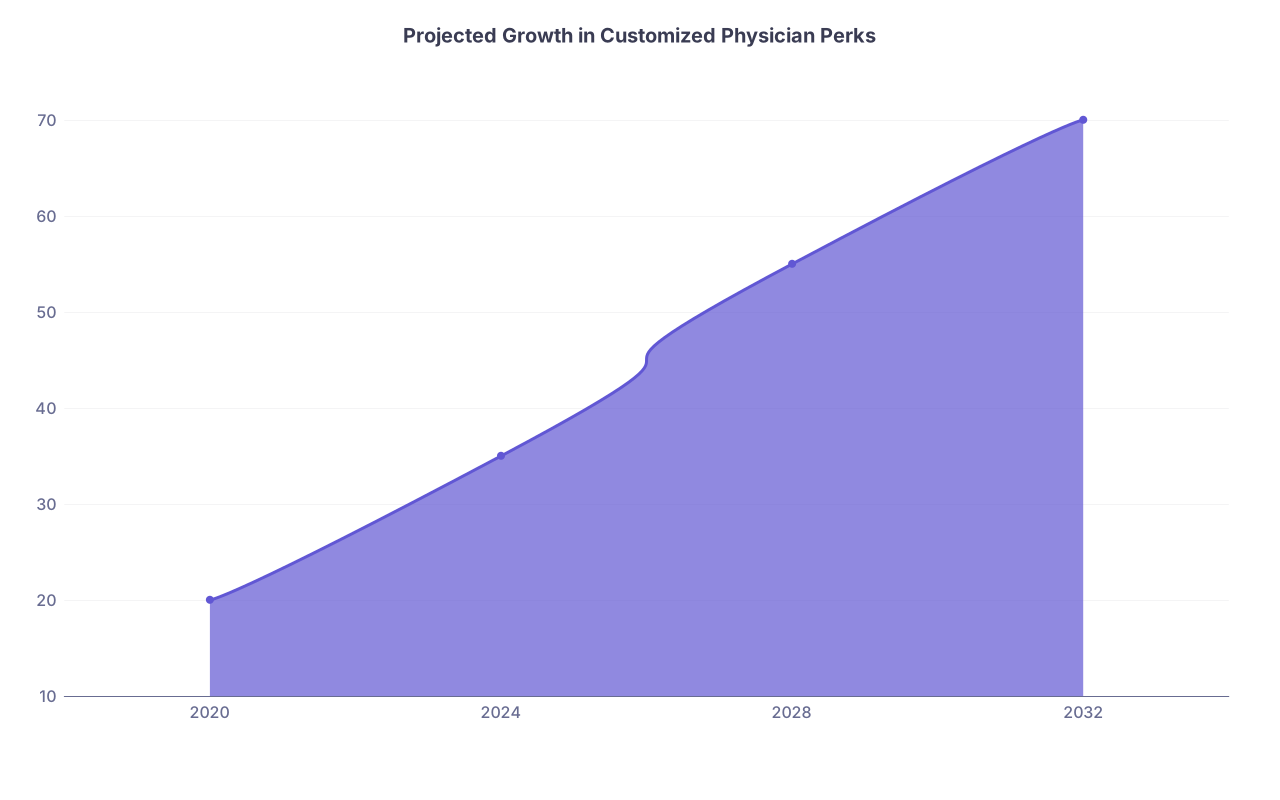
| Category | Value |
|---|---|
| 2020 | 20 |
| 2024 | 35 |
| 2028 | 55 |
| 2032 | 70 |
Here’s where insiders are already seeing movement.
Hyper-custom contracts
We’re drifting toward a world where the official template contract is useless as a description of real work. You’ll have two hospitalists under the “Hospitalist – Full Time” title whose actual jobs and perks look nothing alike:
- One with two admin days a month, reduced nights, telehealth blocks.
- One with maximum shifts, every other weekend, and no extra time.
Same title on paper. Vastly different lives.
More off-cycle and off-site arrangements
Expect more:
- Compressed schedules (7 days on in 10-hour blocks, then 7–10 off)
- “Float” roles that look bad on paper but come with high autonomy
- Hybrid clinic/admin roles packaged to keep people from leaving for industry or telehealth giants
Systems are terrified of losing mid-career physicians. They’ll flex & invent perks for individuals who look like they’re halfway out the door—long before they’ll upgrade the public benefits everyone sees.
Silent pipelines to non-clinical careers
Another hidden perk that’s starting to matter: organizations that quietly open doors for docs into non-clinical tracks—informatics, utilization management, pharma, medtech collaboration.
The “future of medicine” you’re hearing about on podcasts—doctors in AI oversight roles, product design, digital health leadership—will come in two flavors:
- People who jump straight out to startups or industry.
- People whose health systems gave them gradual on-ramps while still employed.
Those second pathways will never show up in a job ad as: “We’ll help you move into industry in 5 years.” But functionally, that’s exactly what a good system with strong informatics, quality, or innovation arms is doing.
7. How to Actually Access These Hidden Benefits
None of this matters if you don’t know how to use it.

| Step | Description |
|---|---|
| Step 1 | Job Posting |
| Step 2 | Interview Conversations |
| Step 3 | Ask Specific Questions |
| Step 4 | Informal Attending Chats |
| Step 5 | Identify Real Culture |
| Step 6 | Negotiate Custom Terms |
| Step 7 | Revisit After 1 to 2 Years |
You won’t extract every perk up front as a new grad. But you can absolutely position yourself so the doors open sooner.
Here’s the practical path:
Ask specific, not generic, questions. Don’t ask, “Is there flexibility?” Ask:
- “Does anyone here currently work hybrid or remote for part of their job?”
- “Has anyone negotiated protected time after their first year?”
- “Are there physicians here with less call based on seniority or additional roles?”
Talk to junior and mid‑career attendings alone. The chair will sell you potential. The third‑year attending will tell you what actually got delivered.
Probe internal mobility. “Have any of your physicians switched sites, changed FTE, or moved into leadership here?” If the answer is always “no,” that’s a flat organization. Flat usually means rigid. Rigid means fewer hidden perks.
On your side, you need to stop thinking like a desperate trainee and start thinking like a scarce resource. Because you are. Even now.
You don’t demand everything day one. You do make it clear—politely—what you value:
- “I’m willing to take a slightly lower base if there’s a realistic path to 0.1–0.2 protected time in year two.”
- “What I care most about is predictable call. I’d like that structure written explicitly.”
- “Is there a path to telehealth days or schedule compression for the right person?”
You’d be surprised how often that triggers the real conversation: “Well, we don’t usually advertise this, but for the right candidate we’ve sometimes…”
That sentence is where the hidden perks live.