

Academic vs community is not a personality test. It is an operational choice that will control your daily schedule, your income ceiling, your stress profile, and your future options. Treat it that way.
You do not need another vague pros/cons list. You need a decision tree and a concrete way to pressure-test where you belong. That is what we are going to build.
Step 1: Start With the Only Question That Really Matters
Forget prestige. Forget what your co-residents brag about. Start here:
Do you want your primary professional identity to be:
- A clinician who also teaches / does research?
- Or a clinician who optimizes access, efficiency, and local impact?
Answer that honestly, and you are already 60% of the way there.
Let me translate:
If you get real satisfaction from:
- Crafting lectures
- Designing protocols
- Writing papers or grants
- Being the “go-to” for a narrow slice of disease
you are naturally aligned with academic medicine.
If you get real satisfaction from:
- Running an efficient clinic or OR slate
- Building a loyal patient panel
- Seeing clear, practical results in your community
- Having more control over scheduling and income
you are naturally aligned with community practice.
This is not about what sounds noble on paper. It is about what will keep you from burning out.
Step 2: The Actual Decision Tree
Let me lay out a direct, practical decision tree. Walk through it honestly.

| Step | Description |
|---|---|
| Step 1 | Start - Finishing Training |
| Step 2 | Strong Academic Track |
| Step 3 | Academic Faculty Role |
| Step 4 | Academic or Hybrid Model |
| Step 5 | Community Private or Employed |
| Step 6 | Academic or Large Tertiary System |
| Step 7 | Do you want research, grants, or publications as core work? |
| Step 8 | Do you enjoy formal teaching and trainees daily? |
| Step 9 | Is higher income and schedule control top priority? |
| Step 10 | Do you want complex referrals and quaternary cases? |
Use it like this:
If you answer “Yes” to research/grants/publications as a core part of your work → default academic.
You can dabble in research in community, but serious research careers almost always need academic infrastructure.If you do not care about research, but love teaching daily → academic or hybrid.
Think university hospital, VA with residents, or a large teaching community hospital.If neither research nor daily teaching excites you, and your top concerns are income and schedule → community.
Either private practice or large employed medical group.If your main professional joy is managing complex cases, weird pathology, and referrals from everywhere → academic or big tertiary center.
You may have a hybrid here: academic appointment but mostly clinical.
This tree will not pick your exact job. It will narrow your universe of reasonable choices.
Step 3: Quantify What Actually Changes Between Academic and Community
Let us get concrete. Here is what typically shifts when you choose one path over the other.
| Factor | Academic Center | Community Hospital / Practice |
|---|---|---|
| Base salary (early) | Lower | Higher |
| Long-term earnings | Usually lower | Usually higher |
| Teaching intensity | High | Low–Moderate |
| Research expectation | Moderate–High | Low |
| Case complexity | Higher | Variable (often moderate) |
| Schedule control | Lower | Higher |
| Job security | Moderate (depends on grants) | Moderate–High (if productive) |
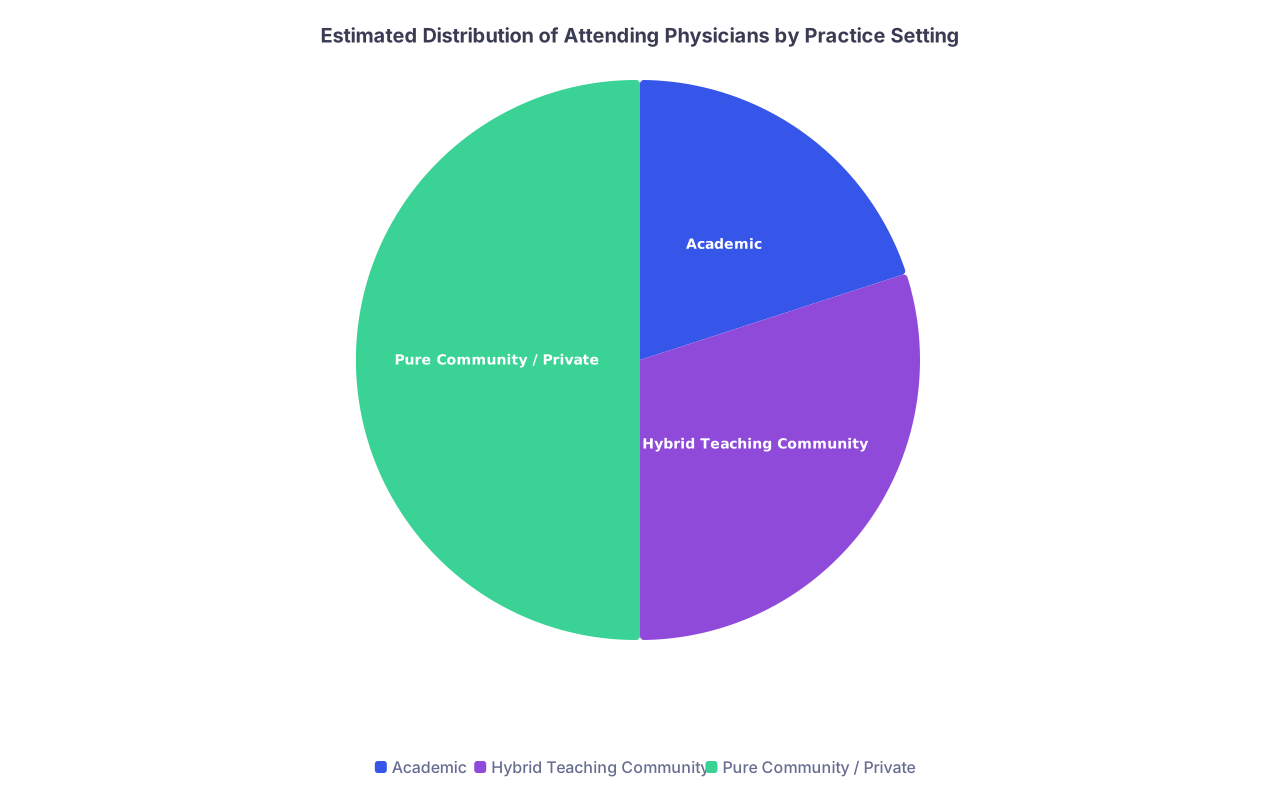
And a quick visual of how many doctors actually go where. This is not exact, but it reflects what I have repeatedly seen:
| Category | Value |
|---|---|
| Academic | 20 |
| Hybrid Teaching Community | 30 |
| Pure Community / Private | 50 |
Most physicians end up in some version of community practice. Prestige-heavy training programs often hide that reality. Keep that in mind when your academic mentors “cannot imagine” leaving the university.
Step 4: Run the “Day-in-the-Life” Simulation
The fastest way to expose a bad fit is to simulate your actual Tuesday 3 years from now in each environment.
Academic Tuesday – Typical Attending
- 6:45–7:00
Skim overnight admits; answer resident texts about a borderline patient. - 7:00–8:00
Teaching conference. Maybe you are presenting. Coffee is breakfast. - 8:00–12:00
Rounds with residents / fellows. Decision-making is slower because you are teaching and letting them think. You are fielding pages from consults and maybe a research coordinator about enrollment. - 12:00–1:00
Noon conference. You are either giving a talk or listening. - 1:00–5:00
Mix of clinic / procedures / more consults. Residents and fellows present cases. You sign notes, co-sign orders, answer emails from administration about quality metrics, curriculum, and maybe a grant deadline. - 5:00–6:30
Finish notes. Take a call with a collaborator about a paper. Maybe review abstracts for a conference. Go home with inbox still partly full.
Ask yourself: Does that sound stimulating or suffocating?
Community Tuesday – Employed Group, Busy Specialty
- 7:30–8:00
First patient on the table or in the exam room. Staff prepared everything. You approve the plan. - 8:00–12:00
High-volume clinic or OR block. Little formal teaching. Rapid decisions. You are balancing throughput with quality. - 12:00–12:30
Quick lunch. Maybe a pharma rep. Maybe catching up on a couple of results calls. - 12:30–4:30
Second clinic / OR block. Admin support helps with referrals, prior auths, etc. You handle the trickier messages personally. - 4:30–5:30
Finish charts. Review labs and imaging. Occasional call with PCPs or specialists about shared patients. Home by early evening most days.
Again: Is that satisfying? Or monotonous?
If you are honest, one of those days will feel like the “right kind of tired” and the other will feel like a grind.
Step 5: Dissect Your Motivations – The Brutal Version
Strip away the fluff. Here is what usually actually drives this decision, beneath the rhetoric.
Status and Identity
- Academic: “Professor,” publications, presenting at national meetings, being “the” expert.
- Community: Being the doc everyone in town recommends, higher income, leadership roles in the hospital.
Money and Lifestyle
- Academic: Often 10–40% lower base salary for the same specialty, especially procedural fields. Sometimes offset partly by incentives, grants, or outside work.
- Community: Higher income potential, especially in private practice or RVU-heavy models. More flexibility for side gigs once established.
Control
- Academic: Control over intellectual content and niche; less control over schedule and clinics. More committees.
- Community: More control over hours, vacation, and work style. Less freedom in doing “weird” research or non-standard protocols.
Future Options
- Academic → community is usually easier than community → academic (especially for research-heavy roles).
- If you think you “might want to be a researcher,” it is safer to start academic and later move out.
Here is the blunt advice:
- If you are primarily chasing prestige and hate writing, data, and meetings → you will be miserable in real academic medicine.
- If you are primarily chasing income but secretly crave being known for some disease niche and complex cases → pure community might frustrate you.
Step 6: Use a Simple Scoring Tool
People overcomplicate this. Do not.
Give each statement a score 1–5 (1 = strongly disagree, 5 = strongly agree):
Academic-leaning items:
- I enjoy designing or critiquing studies.
- I want to publish at least a few papers every couple of years.
- I like the idea of running a lab or being on research grants.
- Teaching residents and students would energize me, not drain me.
- I am willing to accept lower pay for more academic work.
Community-leaning items: 6. I care more about my daily schedule and vacation than my CV. 7. I want my work to be mostly direct patient care. 8. I prefer practical, efficient systems over complex academic bureaucracy. 9. I want substantial control over my income through productivity. 10. I do not want research or teaching obligations hanging over me.
Now add:
- Academic score: sum of 1–5
- Community score: sum of 6–10
Rough cut:
- Academic ≥ 18 and Academic − Community ≥ 4 → Start your search academic.
- Community ≥ 18 and Community − Academic ≥ 4 → Focus on community/employed or private practice.
- Scores close together → You are a hybrid candidate. Look at:
- Teaching community hospitals
- Large integrated health systems with “clinical scholar” tracks
- VA systems with adjunct academic appointments
This is not science. But it forces you to stop hand-waving.
Step 7: Understand Hybrid and “Stealth Academic” Options
The binary “academic vs community” frame is outdated. There are blended options that might fit you perfectly if you know to look.
1. Teaching Community Hospitals
These places have:
- Residents (often IM, FM, EM, surgery)
- Some medical students
- Little to no research pressure
You:
- Get to teach on rounds
- See good pathology (but usually not the ultra-rare quaternary stuff)
- Have productivity expectations more like community practice
Great fit if you like teaching but not grants.
2. Big Integrated Health Systems with Academic Affiliations
Think large regional systems that:
- Have university affiliations
- Let you hold an “adjunct” or “clinical” faculty title
- Support QI projects, maybe some clinical research
You:
- Are mostly a clinician
- Can publish occasionally (case series, QI, clinical trials you help enroll)
- Still earn closer to community rates in many markets
3. VA + Academic
The VA paired with a med school often gives:
- Strong benefits and pensions
- Teaching (residents, students)
- Reasonable hours compared to some academic jobs
- Less intense research pressure unless you seek it out
If you want some academic flavor without the full grind, this can be a very rational choice.
Step 8: Specialty-Specific Reality Check
Your specialty changes the calculation. The same “academic vs community” label does not look the same in derm versus neurosurgery.
| Specialty | Academic Lean Stronger When… | Community Lean Stronger When… |
|---|---|---|
| Oncology | You want trials, protocols, tumor boards | You want volume chemo clinic, better pay |
| Neurosurgery | You want complex skull base, research | You want bread-and-butter spine, income |
| Pediatrics | You want subspecialty (NICU, cards) | You want general clinic, lifestyle |
| EM | You want to teach, do admin or ED research | You want shift work, high hourly pay |
Some specialties make academic life more bearable because:
- Compensation gaps with community are smaller (psych, peds in some markets).
- Academic centers are where the fun procedures actually live (advanced oncology, transplant).
Others make the gap painful:
- Procedural fields (orthopedics, neurosurgery, GI, cards) often see big pay differences.
- If money matters, you cannot ignore this.
Step 9: Test Your Assumptions in the Real World
Before you sign a contract, do this:
1. Work Backwards From Three Names
Name:
- One attending you deeply respect in academics.
- One attending you respect in community.
- One who seems burned out or miserable.
Ask:
- What about their job and setting seems to work or fail?
- Could you see yourself in each of their lives in 10 years?
Your brain understands stories better than lists.
2. Do a Focused “Career Rotation”
If you are still in training:
Spend at least 2–4 weeks on a community rotation where you:
- See full clinic days
- Observe private or employed group dynamics
- Track how people leave at the end of the day
Spend at least 2–4 weeks with a research-active academic attending:
- See what their inbox looks like
- Watch them in lab meetings or research conferences
- Notice how often they are pulled into non-clinical tasks
No, a 2-week snapshot is not perfect. But it exposes obvious mismatches.
3. Ask Targeted Questions on Interviews
Skip the fluff. Ask:
For academic jobs:
- “What percentage of faculty are promoted to associate or full professor in 10 years?”
- “How is non-RVU academic work protected? Is it in my contract?”
- “What happened to the last 3 junior faculty who left? Why did they go?”
For community jobs:
- “How are RVUs / productivity benchmarks set and adjusted?”
- “How many physicians in this group have been here >5 years?”
- “What causes people to leave this practice?”
If people cannot answer these precisely, that is information.
Step 10: Plan for Course Corrections
Your first job is not a lifetime sentence. But you should pick a path that preserves options instead of randomly closing doors.
If You Start Academic
To keep community options open:
- Do not neglect your clinical skills or volume. You want to be able to show competence and productivity.
- Avoid ultra-narrow niches with tiny job markets unless you are sure.
- Keep some involvement in routine bread-and-butter cases.
If you leave, you are selling:
- Credibility from training and teaching
- Comfort with complexity
- Possibly subspecialty expertise
If You Start Community
To keep academic options alive:
- Maintain a CV with:
- A few case reports, QI projects, or clinical collaborations
- Lectures for local programs or CME
- Consider adjunct clinical faculty affiliations nearby.
- Stay engaged with specialty societies and national meetings.
Academic re-entry is harder but not impossible if you can show:
- Quality improvement work
- Teaching experience
- Some publications
Step 11: Sanity Check – Burnout Risk
One more filter. Which environment is less likely to burn you out?
Red flags for you in academic:
- You hate meetings and committees.
- You procrastinate anything that looks like “homework” after work (papers, grants, slide decks).
- You need clear separation between work and personal time.
Red flags for you in community:
- You quickly get bored with routine.
- You are restless when you are not “building” something intellectual.
- You actually enjoy going deep into a narrow topic for hours.
I have watched brilliant residents pick academic jobs because “that is what good residents do,” only to hate the constant low-level guilt about papers and teaching prep.
I have also seen people go community for money, then feel intellectually isolated and scramble back to academic half a decade later.
Be honest about which of those horror stories feels more like your personal nightmare.
Step 12: Put It All Together – Your Personal Decision Protocol
Use this as a concrete checklist:
Run the decision tree
- Research/teaching obsession → academic
- Schedule/money control obsession → community
- Mixed → hybrid or big systems
Score yourself
- Academic vs community scores (10 items).
- Look at the margin, not just the totals.
Simulate your Tuesday
- Write down a future “academic day” and “community day” for your specialty.
- Circle the one you would actually choose to live.
Reality rotations or shadowing
- Minimum 2–4 weeks in each environment if possible.
- Ask yourself each day: “Could I do this for 10 years?”
Interrogate offers with the right questions
- Academic: promotion rates, protected time, expectations.
- Community: RVUs, turnover, control over schedule.
Check your burnout triggers and ego traps
- Are you chasing prestige against your own temperament?
- Are you chasing money against your own intellectual needs?
If you follow that protocol, you will not magically eliminate risk. But you dramatically reduce the odds of waking up 3 years in, staring at your inbox, wondering how you got trapped in a job that never fit you.
Key Takeaways
- Academic vs community is not about “good doctor vs sellout.” It is about choosing the daily work, constraints, and rewards that match your temperament and priorities.
- Start with your core drivers: research/teaching vs schedule/income/control, then use structured tools (decision tree, scoring, Tuesday simulation) to check your instincts.
- Preserve optionality early on, but do not hide from a choice. A clear, honest match between who you are and where you work will do more for your career and sanity than any title on your badge.


